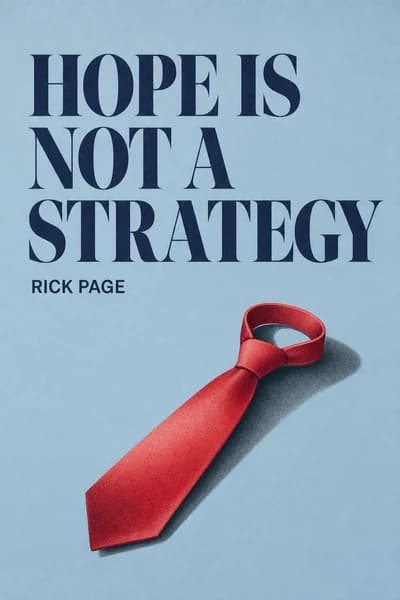
In "Hope Is Not a Strategy," Rick Page reveals the complex science behind enterprise sales. Discover why Fortune 500 sales leaders consider this their secret weapon - a tactical blueprint that transforms wishful thinking into methodical deal-closing mastery.
Rick Page, author of the #1 sales bestseller Hope Is Not a Strategy, is a globally recognized authority in complex sales methodologies and sales force effectiveness. A seasoned sales strategist with over three decades of experience, Page founded The Complex Sale, a consulting firm that has trained sales teams across 50+ countries in winning high-stakes deals.
His expertise stems from leadership roles at Dun & Bradstreet Software, where he directed global sales training programs, and his MBA from the University of North Carolina at Chapel Hill.
Hope Is Not a Strategy distills Page’s proven framework for navigating intricate sales processes, emphasizing strategic planning over wishful thinking—a philosophy refined through his work with Fortune 500 companies and startups alike. The book has become essential reading in sales training programs worldwide and established Page as a sought-after speaker at international sales conferences. His follow-up works further explore advanced tactics in competitive selling and decision-maker alignment.
Page’s methodologies continue to shape modern sales practices, with his firm’s clients attributing over $2 billion in closed deals to his strategies.
Rick Page’s Hope is Not a Strategy provides a systematic approach to managing complex B2B sales. It outlines six proven strategies: linking solutions to client pain points, prospect qualification, building competitive advantage, navigating decision-making processes, selling to key stakeholders, and maintaining strategic control. The book emphasizes solving client problems over product pitches and introduces the RADAR framework for managing sales cycles.
This book is essential for B2B sales professionals, consultants, and business development teams in competitive industries like software, professional services, or enterprise solutions. It’s particularly valuable for non-sales experts (e.g., engineers or consultants) who need to position technical solutions strategically.
Yes. Despite being published in 2002, its focus on strategic problem-solving over transactional selling remains relevant for complex sales environments. Readers praise its actionable tools like opportunity qualification checklists and competitive positioning tactics, which adapt well to modern challenges like virtual selling and multi-stakeholder deals.
RADAR is Rick Page’s methodology for managing sales cycles: Resolve client pain points, Anticipate objections, Differentiate from competitors, Accelerate or decelerate deal momentum, and Reinforce value post-sale. It helps sales teams maintain control and adapt to shifting client priorities.
The book advises building “competitive preference” early by aligning solutions with urgent client needs and reframing competitors’ strengths as weaknesses. Page stresses proactive objection handling and leveraging third-party validation to position your offering as the low-risk choice.
Unlike transactional sales guides, Page focuses on multi-step, committee-driven deals common in enterprise sales. It complements methodologies like SPIN Selling but adds tools for managing protracted cycles, political dynamics, and competitor counterattacks.
Some reviewers note its examples feel dated for digital-first sales contexts. However, its core principles—like diagnosing client pain and controlling deal velocity—translate effectively to modern remote selling when paired with CRM analytics.
Drawing on 30+ years in enterprise software sales and consulting, Page combines tactical frameworks (e.g., opportunity qualification scorecards) with real-world insights on managing stakeholder politics and post-sale relationships.
Yes. The book’s chapter on “Selling to Power” explains how to influence RFP criteria before formal bids begin. It also provides strategies for differentiating proposals and managing evaluation committees.
Later chapters advocate for “account farming” over “hunting”—focusing on expanding trusted partnerships through consistent value delivery, cross-selling aligned with client roadmaps, and co-developing success metrics.
저자의 목소리로 책을 느껴보세요
지식을 흥미롭고 예시가 풍부한 인사이트로 전환
핵심 아이디어를 빠르게 캡처하여 신속하게 학습
재미있고 매력적인 방식으로 책을 즐기세요
"They don't decide how to decide until they can't decide."
Concentration of force is strategy's first principle.
"Show up and throw up."
Mismatching talent to roles can devastate sales effectiveness.
Hope is not a strategy의 핵심 아이디어를 이해하기 쉬운 포인트로 분해하여 혁신적인 팀이 어떻게 창조하고, 협력하고, 성장하는지 이해합니다.
Hope is not a strategy을 빠른 기억 단서로 압축하여 솔직함, 팀워크, 창의적 회복력의 핵심 원칙을 강조합니다.

생생한 스토리텔링을 통해 Hope is not a strategy을 경험하고, 혁신 교훈을 기억에 남고 적용할 수 있는 순간으로 바꿉니다.
무엇이든 물어보고, 목소리를 선택하고, 진정으로 공감되는 인사이트를 함께 만들어보세요.

샌프란시스코에서 컬럼비아 대학교 동문들이 만들었습니다
"Instead of endless scrolling, I just hit play on BeFreed. It saves me so much time."
"I never knew where to start with nonfiction—BeFreed’s book lists turned into podcasts gave me a clear path."
"Perfect balance between learning and entertainment. Finished ‘Thinking, Fast and Slow’ on my commute this week."
"Crazy how much I learned while walking the dog. BeFreed = small habits → big gains."
"Reading used to feel like a chore. Now it’s just part of my lifestyle."
"Feels effortless compared to reading. I’ve finished 6 books this month already."
"BeFreed turned my guilty doomscrolling into something that feels productive and inspiring."
"BeFreed turned my commute into learning time. 20-min podcasts are perfect for finishing books I never had time for."
"BeFreed replaced my podcast queue. Imagine Spotify for books — that’s it. 🙌"
"It is great for me to learn something from the book without reading it."
"The themed book list podcasts help me connect ideas across authors—like a guided audio journey."
"Makes me feel smarter every time before going to work"
샌프란시스코에서 컬럼비아 대학교 동문들이 만들었습니다

Hope is not a strategy 요약을 무료 PDF 또는 EPUB으로 받으세요. 인쇄하거나 오프라인에서 언제든 읽을 수 있습니다.
In today's high-stakes business environment, a shocking 60% of forecasted sales never materialize. This isn't just a statistic - it's a wake-up call that traditional selling approaches no longer work in complex B2B environments. The modern enterprise sale has transformed into what might be called a treacherous canyon rather than a predictable funnel. Products become commoditized at lightning speed, customers have unprecedented access to information, and buying decisions now involve committees with conflicting agendas rather than individual decision-makers. Warning signs of a sale spiraling out of control are everywhere: unreturned calls, mysterious new stakeholders appearing mid-process, and requirements that suddenly shift to favor competitors. Perhaps most troubling is the "dead and don't know it" phenomenon - where salespeople continue investing time and resources in opportunities they've already lost because customers deliberately keep them in the dark. Why? Sometimes for documentation purposes, sometimes to maintain pricing leverage, and sometimes because no one wants to deliver bad news. The modern salesperson must function as the CEO of a virtual corporation, leading teams of specialists selling to buying committees of 20 or more. What begins as a logical evaluation inevitably transforms into what Page calls the decision-making "crucible" - where processes melt down politically and pressure builds toward potential explosion. Despite committees' hopes for happy consensus, stakeholders typically divide between different vendors or maintaining the status quo.