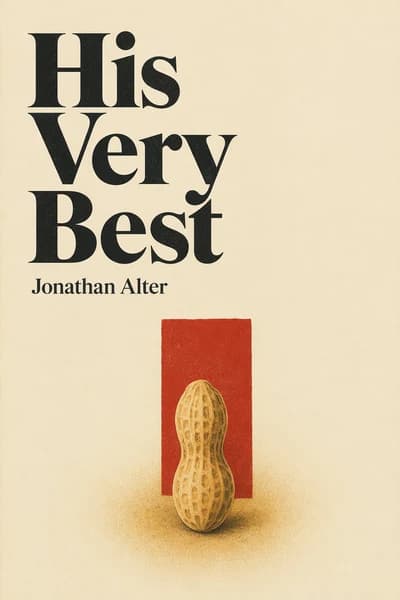
Jimmy Carter: misunderstood genius or failed president? Jonathan Alter's landmark biography reveals how the 39th president's achievements - from Middle East peace to human rights advocacy - took decades to recognize. Andrew Young calls him "the most misunderstood president since Jefferson."
Jonathan Alter, author of His Very Best: Jimmy Carter, A Life, is an award-winning political analyst, bestselling author, and Emmy-winning documentary filmmaker. A former senior editor and columnist at Newsweek with over 28 years of experience, Alter has built a reputation for incisive presidential biographies and political journalism.
His work on Carter’s legacy blends rigorous historical research with insights from decades of covering U.S. presidents, reflecting his expertise in leadership, policy, and the intersection of media and politics.
Alter’s other acclaimed works include The Center Holds: Obama and His Enemies and The Defining Moment: FDR’s Hundred Days and the Triumph of Hope, both New York Times bestsellers that established him as a leading voice in political nonfiction. A longtime NBC News and MSNBC analyst, he also helms the Substack newsletter Old Goats, Ruminating with Friends, featuring conversations with influential figures.
His Very Best was widely praised as a definitive Carter biography, named one of The New York Times’ “Notable Books” of 2020. Alter’s upcoming biography of Julius Caesar further cements his status as a preeminent chronicler of leadership across eras.
His Very Best: Jimmy Carter, a Life is a comprehensive biography examining Jimmy Carter’s presidency, personal principles, and post-White House achievements. Jonathan Alter highlights Carter’s engineering mindset, long-term policy foresight, and moral rigor, while analyzing diplomatic wins like the Camp David Accords and energy reforms. The book reassesses Carter’s legacy, framing his life through his lifelong pursuit of excellence inspired by a formative question from Admiral Hyman Rickover.
This book appeals to presidential history enthusiasts, political science students, and readers interested in leadership ethics. Alter’s balanced narrative offers insights for critics and admirers alike, particularly those curious about Carter’s underappreciated policy impact and his humanitarian work post-presidency.
Yes. Alter combines meticulous research with engaging prose, offering a nuanced portrait of Carter as both a flawed leader and a visionary. The biography challenges outdated perceptions of Carter’s presidency while celebrating his integrity and post-White House contributions to global health and diplomacy.
Key themes include Carter’s relentless pursuit of ethical governance, his analytical problem-solving style, and the tension between idealism and political pragmatism. Alter emphasizes Carter’s focus on long-term outcomes, such as environmental conservation and Middle East peace, which gained recognition decades later.
Alter acknowledges Carter’s mixed record: he praises diplomatic successes (Panama Canal treaties, Egypt-Israel peace) and energy policy innovations but critiques his managerial detachment and struggles with Congress. The book argues Carter’s presidency laid groundwork for future progress despite短期 setbacks.
The biography notes Carter’s tendency to micromanage details while failing to unify his team, leading to bureaucratic inefficiencies. Alter also highlights his inability to leverage political relationships, which hampered domestic agenda items like healthcare reform.
Carter’s legacy centers on elevating human rights in foreign policy, pioneering renewable energy advocacy, and post-presidency humanitarian work through Habitat for Humanity and disease eradication. Alter positions him as a model of principled leadership beyond electoral politics.
Carter emerges as intellectually rigorous yet socially rigid—a “peanut farmer with a calculator mind.” Alter depicts his deep moral conviction, self-discipline, and occasional stubbornness, illustrating how these traits shaped both his achievements and political limitations.
Yes. Nearly a third of the book details Carter’s global activism post-1980, including election monitoring, housing initiatives, and Nobel Peace Prize-winning conflict mediation. Alter argues this period cemented Carter’s reputation as “America’s elder statesman of conscience”.
Alter’s account stands out for its unprecedented access to Carter’s diaries and interviews, offering fresh perspectives on his private doubts and public decisions. Unlike partisan portrayals, it balances admiration for his ethics with clear-eyed analysis of governance missteps.
Alter frames Carter’s Southern Baptist faith as central to his humanitarian drive but notes it sometimes led to moral inflexibility. The book explores how his spirituality shaped policies like affordable housing advocacy and conflict resolution efforts.
Alter drew from Carter’s personal journals, White House documents, 200+ interviews, and correspondence with Carter himself. This primary material provides intimate details, like Carter’s post-presidency reflection that “losing the election freed me to do my best work”.
저자의 목소리로 책을 느껴보세요
지식을 흥미롭고 예시가 풍부한 인사이트로 전환
핵심 아이디어를 빠르게 캡처하여 신속하게 학습
재미있고 매력적인 방식으로 책을 즐기세요
His father Earl was both hero and harsh judge.
"You're the cause of me being what I am."
Adjusting to changing times while holding to unchanging principles.
Rickover demanded, "Why not?"
Rosalynn could "wear a white dress all day and keep it clean"
His Very Best의 핵심 아이디어를 이해하기 쉬운 포인트로 분해하여 혁신적인 팀이 어떻게 창조하고, 협력하고, 성장하는지 이해합니다.
His Very Best을 빠른 기억 단서로 압축하여 솔직함, 팀워크, 창의적 회복력의 핵심 원칙을 강조합니다.

생생한 스토리텔링을 통해 His Very Best을 경험하고, 혁신 교훈을 기억에 남고 적용할 수 있는 순간으로 바꿉니다.
무엇이든 물어보고, 목소리를 선택하고, 진정으로 공감되는 인사이트를 함께 만들어보세요.

샌프란시스코에서 컬럼비아 대학교 동문들이 만들었습니다
"Instead of endless scrolling, I just hit play on BeFreed. It saves me so much time."
"I never knew where to start with nonfiction—BeFreed’s book lists turned into podcasts gave me a clear path."
"Perfect balance between learning and entertainment. Finished ‘Thinking, Fast and Slow’ on my commute this week."
"Crazy how much I learned while walking the dog. BeFreed = small habits → big gains."
"Reading used to feel like a chore. Now it’s just part of my lifestyle."
"Feels effortless compared to reading. I’ve finished 6 books this month already."
"BeFreed turned my guilty doomscrolling into something that feels productive and inspiring."
"BeFreed turned my commute into learning time. 20-min podcasts are perfect for finishing books I never had time for."
"BeFreed replaced my podcast queue. Imagine Spotify for books — that’s it. 🙌"
"It is great for me to learn something from the book without reading it."
"The themed book list podcasts help me connect ideas across authors—like a guided audio journey."
"Makes me feel smarter every time before going to work"
샌프란시스코에서 컬럼비아 대학교 동문들이 만들었습니다

His Very Best 요약을 무료 PDF 또는 EPUB으로 받으세요. 인쇄하거나 오프라인에서 언제든 읽을 수 있습니다.
Jimmy Carter's life reads like an American fable - a barefoot farm boy from tiny Archery, Georgia who rose to become president and later a Nobel Peace Prize winner. Once dismissed as a failed president, historical reassessment has revealed a leader whose policies on human rights, energy, and the environment were decades ahead of their time. But perhaps most remarkable is what came after the White House: a 40+ year post-presidency that transformed global health and conflict resolution. Growing up during the Depression in rural Georgia, young "Hot" Carter lived in a house without electricity or running water until age eleven. Though his family enjoyed relative prosperity compared to neighbors, Carter's upbringing instilled both humility and fierce determination. This complex childhood - privileged yet modest, religious yet questioning - created the foundation for his lifelong commitment to human dignity while also forging the inner steel that would carry him through both triumph and adversity.