1장
The Happiness Paradox: Why Contentment Is Simpler Than You Think
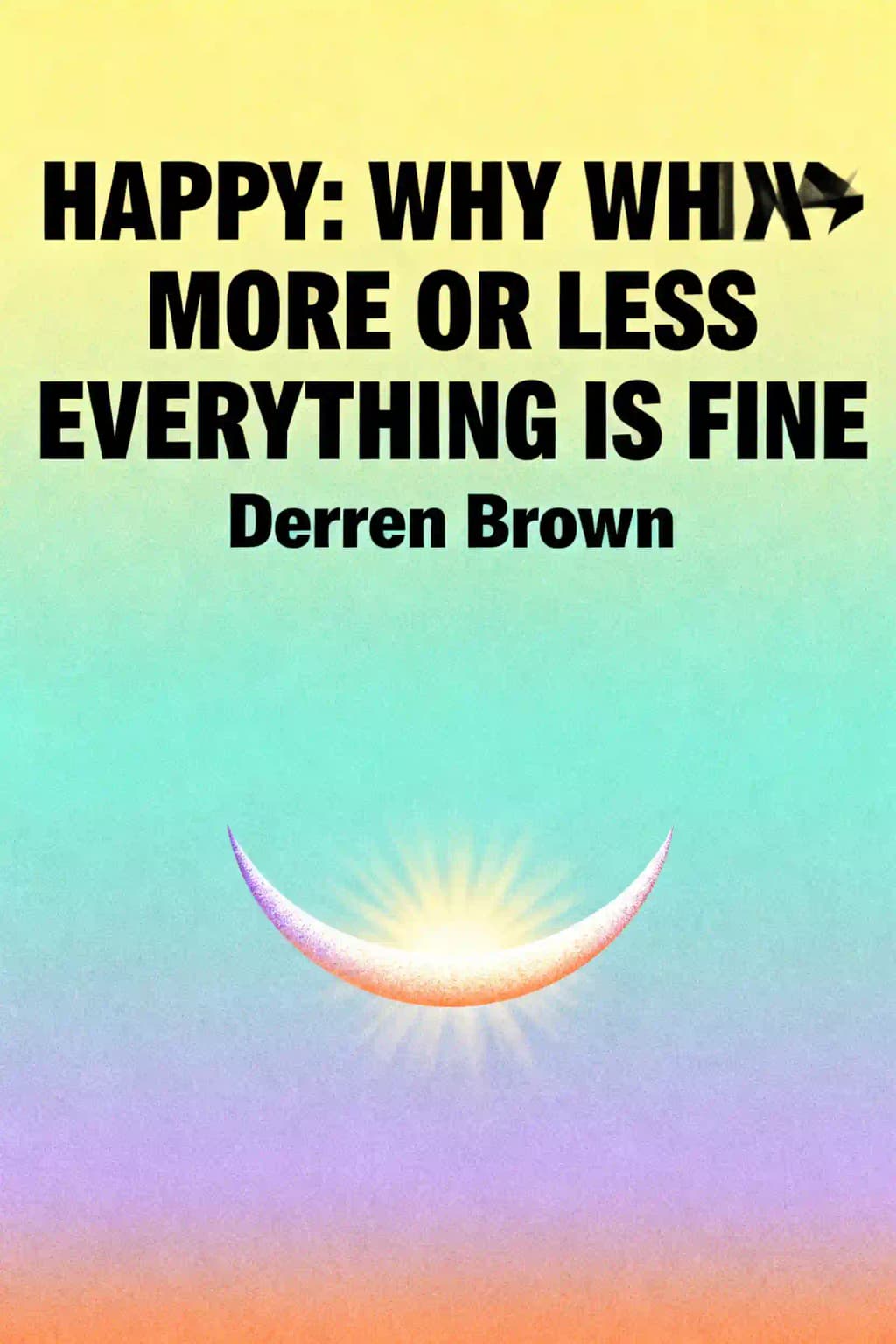
In a world obsessed with positivity and self-improvement, Derren Brown's "Happy" offers a refreshingly contrarian perspective. The book has developed something of a cult following among celebrities like Tim Ferriss and Stephen Fry, who praise its blend of ancient wisdom and modern psychology. Brown, best known for his mind-bending television shows, brings his analytical prowess to the most fundamental human question: how can we be happy? His answer might surprise you-it's not about positive thinking or achieving goals, but about changing the stories we tell ourselves. Drawing from Stoic philosophy, cognitive psychology, and his own experiences in the spotlight, Brown argues that happiness isn't found in chasing rainbows but in accepting reality as it is. In an age of Instagram-perfect lives and relentless self-optimization, this book offers a radical alternative: what if more or less everything is already fine?
2장
The Storytelling Animal: How Our Narratives Shape Our Reality
We are, at our core, storytellers. Our brains constantly craft narratives about ourselves and the world around us, defining who we are and how we experience life. Without these stories, we'd be overwhelmed by life's chaotic details. The problem is that many of our most powerful stories aren't ones we've consciously chosen-they're scripts handed down by parents, religion, peers, or media.
These inherited narratives often make happiness elusive. Perhaps you carry the story that "you must achieve impressive things to be loved" or "you must sacrifice your happiness for others." As Carl Jung observed, "The greatest burden a child must bear is the unlived life of the parents."
The Stoic philosopher Epictetus recognized this fundamental truth 2,000 years ago: "What upsets people is not things themselves but their judgements about these things." Shakespeare echoed this wisdom through Hamlet: "There is nothing either good or bad, but thinking makes it so." This insight forms the foundation of modern therapeutic approaches like Cognitive Behavioral Therapy and Neuro-Linguistic Programming.
Emotional maturity begins with recognizing the gulf between external events and our internal responses. We're constantly editing our perceptions, like a brain filling in visual blind spots. We're skeptical when others tell one-sided stories about arguments, yet rarely apply this skepticism to our own self-narrative.
Our stories can trap us in learned helplessness, as demonstrated by psychologist Richard Nixon's famous anagram experiment. When people believe they can't succeed, they stop trying. But we can change our stories. In Brown's "Fear and Faith" TV experiment, participants given placebo "wonder drugs" overcame anxieties, phobias, and addictions simply because they gave themselves permission to act differently. One participant's dermatitis even cleared up unexpectedly-showing the remarkable power of changing our internal narratives.
Many popular routes to happiness-positive thinking, self-belief, goal-setting-can actually be disastrous to follow. Drawing on two millennia of philosophical wisdom and modern psychology, we'll explore more effective approaches to flourishing that have stood the test of time. As we'll see, fame and money do very little to affect happiness beyond a basic comfortable amount. Our personal narratives matter far more.
3장
The Toxic Positivity Trap: When Optimism Becomes Dangerous
The self-help industry has promoted a dangerous myth: that positive thinking alone can transform your reality. Books like "The Secret" by Rhonda Byrne claim your thoughts are "the most powerful magnet in the universe," attracting similar energies, and that the universe "rearranges itself" to deliver what you desire-like ordering from a cosmic catalog.
This isn't ancient wisdom as Byrne claims. It originated with Phineas Parkhurst Quimby's New Thought Movement in the 19th century, which emerged as a reaction against harsh American Calvinism. New Thought portrayed God as an all-powerful Mind/Spirit that humans could harness to control illness and physical reality. Ironically, this movement preserved Calvinism's judgmental aspects while promoting positive thinking.
The problem with this approach is that it creates a destructive cycle of self-blame. When the promised results don't materialize, followers are told they simply didn't believe strongly enough or visualize correctly. This mirrors the blame-shifting seen in faith healing, where victims are told their conditions persist due to insufficient faith or financial giving.
I've witnessed the devastating consequences of this thinking firsthand. While investigating fraudulent faith healers in Dallas, I heard tragic stories: a pastor with cerebral palsy whose mother bankrupted the family seeking healing; another pastor who let his daughter die rather than give her medicine; and a 14-year-old MS patient who self-immolated after being told her condition persisted due to "secret sin" despite her thousand-dollar donation.
While positive thinking and clear goals can be helpful, blind faith more commonly leads to disaster. For every success story, countless others invest without caution and fail. The Secret's appeal lies in tapping our primal desire to control fate, but in reality, determination interacts with random fortune, not a caring universe.
What actually drives success is focus, opportunity-seeking, and substantial luck-not cosmic ordering. Understanding this reality preserves self-respect and grounds happiness in something deeper than material acquisition. True happiness might involve accepting the universe's indifference and finding contentment even when desired outcomes don't materialize.
4장
The Goal Illusion: Why Chasing Success Makes Us Miserable
Our culture has become obsessed with goal-setting as the path to achievement and progress. From early schooling through career planning, we're taught to set specific targets while actual living happens "ad interim" (in the meantime), largely unattended.
The self-help industry promotes S.M.A.R.T. goals (Specific, Measurable, Achievable, Realistic, Time-Targeted), but this approach is fundamentally flawed. We misunderstand what makes us happy, choose wrong goals, and invest too specifically-often sacrificing other aspects of life. Even when achieved, goals rarely deliver lasting satisfaction because we quickly adapt to new circumstances and remain ourselves, with whatever tendencies toward dissatisfaction we already possess.
Failure brings double anxiety: humiliation plus confusion about what to do next. By removing "naysayers" as instructed by self-help gurus, we fuel self-deception and ignore valuable feedback. The entrepreneurial success stories we admire are largely fictions that ignore the overwhelming role of chance.
Schopenhauer offers a more accurate understanding of life through his image of the diagonal: our aims pull us in one direction, while events pull in another, with our actual life path drawn along the middle. Like chess, we start with a plan, but must constantly modify it in response to circumstances beyond our control.
The self-help notion that we can control our destiny through positive thinking ignores reality-most of life is entirely out of our control. While we're sold an image of the good life as a straight upward trajectory toward our goals, Schopenhauer's diagonal better reflects how life actually works. By obsessively focusing on future goals and "believing in ourselves at all costs," we miss the present moment and guarantee frustration when reality refuses to conform to our plans.
At the root of our disappointment lies our fundamental relationship with desire itself. We chase carrots dangling before us, following career ladders without questioning if they'll truly make us happy. The places and things that loudly promise happiness rarely deliver it. Joy, as Schopenhauer notes, prefers to arrive quietly elsewhere, unannounced.
Travel exemplifies this disappointment-we fantasize about idyllic destinations as escapes from stress, but inevitably bring ourselves along. As Socrates wisely observed: "I have never been anywhere that I haven't been." The backdrop changes, but our capacity for dissatisfaction remains. Seneca understood this perfectly: "You need a change of soul, not a change of climate."
5장
The Considered Life: Becoming the Author of Your Story
The journey to happiness begins with a crucial first step: realizing we need a plan. Not the typical ambitious goal-setting of accumulation, but a blueprint for who we want to be. Without consciously authoring our life stories, others will write them for us, leaving us fundamentally bored, anxious, and prone to internal complaints.
Daniel Kahneman's psychological framework helps us understand this challenge by distinguishing between our "experiencing self" and our "remembering self"-a distinction that parallels the separation between pleasure and happiness. The experiencing self feels immediate pleasure or pain, while the remembering self makes judgments about our overall happiness, typically retrospectively.
This explains why we might choose less pleasurable experiences that provide better stories for our remembering self-like visiting a sick relative instead of enjoying a theme park. Kahneman's cold water experiment demonstrates this powerfully: participants preferred longer discomfort (90 seconds) with a slightly improved ending over shorter discomfort (60 seconds) without relief. We make decisions based not on experiences themselves but on the stories we tell about them, favoring good endings over overall comfort.
To engage deeply with our stories, we need expert advice before building our life's architecture. No amount of wallpaper will fix severely cracked walls. We can cherry-pick from different philosophical approaches as long as they complement each other in our final structure. Some may prefer religion's framework that removes the need for existential questioning by providing ready-made answers.
Classical philosophers once populated Athenian marketplaces teaching how to live well-philosophy was a thing of the streets. Today, philosophy has become highly academic, focused on language and metaphysics rather than personal flourishing. Meanwhile, psychology traditionally addressed pathology rather than optimal living, though positive psychology has recently begun empirical research into happiness.
These disciplines offer complementary approaches: psychology provides a "horizontal" view with data from large populations, while resonant philosophy offers a "vertical" journey of deep personal understanding. Unlike modern self-help's focus on fads, ancient philosophy creates lasting change through deep structure-a blueprint for life.
Jules Evans identifies four steps in the Socratic tradition of self-inquiry: (1) humans can know themselves through examining unconscious beliefs; (2) we can change ourselves by changing beliefs, which changes emotions; (3) we can create new habits of thinking and acting; and (4) following philosophy as a way of life leads to flourishing.
This considered life acknowledges Milan Kundera's insight that there's no dress rehearsal-each moment passes never to return. Nietzsche's concept of "eternal recurrence" offers a powerful thought experiment: would you happily live your life over and over for eternity? This question helps us determine whether our center of gravity lies within us or remains subject to external circumstances.
6장
Ancient Wisdom for Modern Minds: The Stoic Path to Happiness
The Stoic approach to happiness stands in stark contrast to modern "venting" theories. While Freud's steam-engine metaphors suggested built-up emotions needed release to prevent neurosis, research by Brad Bushman at Iowa State University shows that activities like pillow-punching actually increase aggression rather than providing catharsis.
The Stoics would never legitimize negative emotions through "release" but instead advocate taking responsibility for our judgments that create suffering. This isn't about shallow positive thinking or "looking on the bright side" but a profound shift in our relationship with events and emotions. Even physical pain and illness can be approached as "externals" we can choose how to respond to.
As Epictetus-once a slave whose master deliberately broke his leg-wrote: "Man is disturbed not by things, but by the views he takes of them." This isn't victim-blaming but a source of strength and freedom, echoed millennia later by Holocaust survivor Viktor Frankl: "Everything can be taken from a man but one thing: the last human freedom-to choose one's attitude in any given set of circumstances."
When we attempt to control what lies outside our domain, we inevitably face frustration and anxiety. This pattern emerges most clearly in romantic relationships, where we unconsciously project childhood needs onto our partners. Initially, we see them not as complete humans but as projections of our desires-the magical "other" who will satisfy us.
These unconscious needs become powerful control mechanisms. A partner fearing abandonment might anxiously question commitment, while one fearing being overwhelmed might create distance. Neither approach works; both are doomed attempts to make the other conform to deeply ingrained demands. The healthier path involves recognizing these patterns as our own internal scripts rather than blaming our partners.
When facing situations where we have only partial control, we must distinguish between what we can and cannot influence. Epictetus's guideline is clear: focus only on our thoughts and actions; ignore everything else. For career advancement, we control our work quality and visibility, but not whether our boss offers promotion. For actors auditioning, as Bryan Cranston advises, the job is creating a compelling character and presenting it well-everything else is beyond control.
The Stoics called external things "indifferents"-items outside our control that we should not become overly attached to. By relinquishing our presumption of control over these things, we gain two benefits: we value them more by appreciating their transience, and we prepare ourselves for eventual loss.
Seneca took this principle seriously, recommending we mentally rehearse losing everything to appreciate it more. He even suggested occasionally living as a pauper for a day to soften the blow of potential destitution. This principle was demonstrated in Brown's TV program "Apocalypse," where a young man who took life for granted experienced an artificial apocalypse scenario to learn appreciation.
Ironically, by undoing our attachment to external things, we value them more. We should accept that whether things come or go is not under our control, allowing us to enjoy them more deeply knowing they are temporary. As Epictetus advised, we should quietly remind ourselves of the mortality of what we love. This awareness makes relationships more precious precisely because they are finite.
7장
Mastering Anger: The Path to Emotional Freedom
Anger is perhaps the most destructive and pervasive of all passions. Seneca vividly describes its ugliness-the contorted face, the restless or fixated eyes, the swollen veins-while Plutarch laments how it transforms us into unrecognizable, harsh versions of ourselves.
Aristotle defined anger as "a longing, accompanied by pain, for revenge for an undeserved slight." This definition highlights two crucial aspects: anger always contains a desire to harm another, and it stems from perceived slights. This desire for retribution, whether direct or indirect, distinguishes true anger from other emotions.
There are compelling reasons to avoid anger. First, anger undermines our ability to communicate effectively. When we become angry, we undermine our own arguments. The physical manifestation of anger-wide eyes, lost decorum, unpleasant demeanor-completely distracts from whatever point we're trying to make. Instead of leading others to empathize with our position or reconsider their stance, our fury becomes a spectacle that only confirms to observers that they've "hit a nerve."
Second, anger destroys relationships and cuts through love of any sort. When we lash out in anger, the brief pleasure is vastly exceeded by the remorse we feel afterwards. We often obsess over our angry remarks more than the recipient was bothered by them. Seneca describes the angry person as "the executioner of those persons he holds most dear and destroyer of the things whose loss will soon make him weep."
Third, when we're angry, our intelligence is banished and we make foolish decisions. Plutarch compares anger to being trapped in a house fire-surrounded by smoke and chaos, unable to see or hear anything beneficial. Louis C.K. illustrates this with his road rage example, where normal, decent people transform into vengeful monsters behind the wheel, wishing death upon strangers for minor driving infractions.
In the 1950s, American psychoanalyst Albert Ellis broke from Freudian tradition and turned to Stoicism to create "rational therapy," later known as REBT. This approach, combined with Aaron Beck's cognitive therapy, formed cognitive behavioral therapy (CBT). The parallels between CBT and Stoicism are striking-both insist our judgments cause problems rather than events themselves, both encourage appropriate alternative judgments, and both have us question what's in our control.
The most widely recommended technique for preventing anger is simply waiting. Like a leaky bucket that gradually empties, anger naturally dissipates with time. The modern advice to count to ten before responding has Stoic origins. Seneca emphasizes that we delay not to ignore the issue but to make better judgments: "The best corrective of anger lies in delay."
Another powerful approach is to resist curiosity-particularly about what others might be saying about us. Seneca advises: "Do you want to avoid losing your temper? Resist the impulse to be curious." This ancient wisdom applies perfectly to our modern social media landscape, where many compulsively check feeds and comments, maintaining artificially high levels of anxiety and irritation.
When we're angry, assuming a different perspective can dramatically shift our emotional state. When helping others through distress, we naturally adopt a calmer, more rational perspective. We easily see their catastrophizing as unnecessary and offer balanced viewpoints.
Our inflated sense of entitlement fuels much of our anger. Brown challenges the ubiquitous self-help message that we should increase our self-esteem and self-confidence, suggesting that for many, this approach exacerbates rather than solves our problems. Our center of gravity must be internal, not dependent on others' validation.
When others irritate us, adopting the belief "we're not so different" can transform our response. Seneca wisely noted that "all of us are inconsiderate and imprudent, all unreliable, dissatisfied, ambitious... all of us are corrupt." Marcus Aurelius similarly advised self-reflection about our own similar failings whenever we encounter someone's wrong behavior.
8장
The Fame Mirage: Why Recognition Doesn't Bring Happiness
Celebrity culture transformed in the early 20th century when actors' private lives became matters of public interest. Today, over half of teenagers prefer fame to regular careers, with 54% in a 2010 survey stating they want to "become a celebrity"-though 70% had no idea how to achieve this. While easy to mock these ambitions, the desire for fame is understandable: visibility has become more accessible, with British television alone featuring nearly a quarter-million "ordinary people" annually by 2003.
Famous people face a catch-22: they must express nothing but gratitude for their success or risk public backlash. When celebrities hint that fame has downsides, the indignant public responds with two accusations: "It's your fans that got you where you are" and "If you don't like it, why be famous?" These reactions stem from our emotional investment in celebrities-we project onto them, creating images that have nothing to do with who they really are, then feel personally wounded when these projections crumble.
The overwhelming truth is that fame does not make you happy. While some aspects are agreeable, the fantasy of fame fails to account for a crucial reality: once inside the bubble of celebrity, it's still just you looking out. If you were dissatisfied before fame, you'll remain dissatisfied after achieving it.
Fame typically arrives gradually, making it impossible to feel that moment of "arrival." Those driven by recognition often find themselves trapped on a hedonic treadmill, constantly comparing themselves to even more successful people. The drive for recognition can never truly be fulfilled because we quickly adapt to each new level of success, always seeking more intensity rather than finding satisfaction.
While fame may not make you happier, many assume money will. However, becoming richer only increases happiness to the point of being financially comfortable. Beyond that threshold, additional wealth doesn't continue to increase happiness. This reinforces a central theme: happiness comes from removing stressors (like money troubles) rather than acquiring more.
Being loved by strangers is best treated as a side effect of doing what you enjoy. When a public persona attracts adoration, a dissonance occurs-it's as if the star has a twin receiving all the attention. Wealth and fame cannot fill the gap left by an unnoticed true self, which might have atrophied if fame arrived early. The fans who "love" a celebrity aren't responding to their authentic self but to a mediated, orchestrated version.
For those seeking success, there exists a simple but powerful formula: TALENT + ENERGY. For true stardom, another formula applies: STYLE + ATTITUDE. Style refers to immediately identifiable performance qualities, while attitude describes that powerful "something" that defines standout performers-the conviction, clarity and singular voice that transcends the work.
For performers, success requires managing expectations. Don't just complain your agent isn't doing enough; control what you can by remaining visible, expressing appreciation, and being pleasant to work with. Focus not on desired fame but on developing talent and energy now, keeping you rooted in the present and open to opportunities.
9장
Facing Mortality: How Death Gives Life Meaning
Debra Westwick, a terminally ill woman, found her shortened life had become deeper and richer after her cancer diagnosis. After initial uncertainty, the final prognosis provided a strange relief, allowing her to acknowledge and prepare for her inevitable end. Rather than asking "Why me?" about her cancer, she asked "Why not me?"
Debra and her son speak openly about her approaching death without euphemisms or false hope. Remarkably, they wouldn't trade this profound time together for anything. Like political consultant Philip Gould who documented his final months in "When I Die: Lessons from the Death Zone," Debra views terminal illness as "a weird kind of privilege"-the opportunity to prepare oneself and loved ones for what's coming.
The author examines whether it makes sense to fear death, noting that this fear manifests in various ways throughout life-from dreading birthdays to anxiety about one's mortality. He introduces two philosophical arguments against fearing death that have endured for thousands of years.
Epicurus argued that death shouldn't be feared because we won't exist to experience it. Lucretius built on this by arguing that we've already experienced the state of non-existence before birth, and since we don't feel distressed about that period, we shouldn't fear returning to non-existence after death.
The author explores the deprivation account of death's harm, challenging both Lucretius and Epicurus. While Lucretius might counter that our feelings of future deprivation are precisely what his symmetry argument aims to dispel, the author maintains that death harms us by thwarting our desires to continue our projects.
We don't truly desire immortality either; rather, we want to postpone death until "later"-a time that never arrives. As Simone de Beauvoir wrote: "There is no such thing as a natural death... for every man his death is an accident and, even if he knows it and consents to it, an unjustifiable violation."
The quandary remains: death provides meaning to life by creating boundaries, yet we instinctively fight against it. The therapeutic answer lies in embracing transience rather than fighting it-following Epictetus's advice to remember our loved ones' mortality, which heightens our appreciation of them in the present.
Freud, walking with friends in 1915, observed that transience enhances beauty rather than diminishing it. "Transience value is scarcity value in time," he wrote, noting that "a flower that blossoms only for a single night does not seem to us on that account less lovely." The Stoic approach suggests thinking, when things are lost, "I gave them back." What we valued was never truly ours; we enjoyed it temporarily before it returned to eternity.
10장
Living Fully: Embracing the Present Moment
When facing death, one is often pressured into a "brave battle" narrative designed to comfort the living rather than serve the dying. This imposed story can alienate the dying person from the deep richness that acceptance might bring. For a meaningful end, the dying person must be allowed to author their own death rather than being reduced to a cameo in others' narratives.
Palliative nurse Bronnie Ware documented the five most common regrets of the dying: not living authentically, working too hard, not expressing feelings, losing touch with friends, and not allowing themselves to be happier. These regrets emerge not because we're living wrongly now, but because our needs change when our future shortens.
To avoid future regret, Brown suggests: come out about secrets that disconnect you from others; fall in love repeatedly despite risks; choose meaningful work over money when possible; don't be a "dick" but treat others with compassion; and regularly evaluate how you spend your time. As Heidegger noted, we can shift from the everyday mode of living to the ontological mode where we contemplate our existence more deeply.
We tend to feel defined by our past, but our past is actually a story we create daily in the present through the narratives we accept about who we are and why. The modern refrain "I'm like this because this happened to me" is both a constructed narrative and a truth, as our personalities contain defensive response patterns triggered whenever present situations resemble past traumas. These unconscious patterns can be overcome by consciously owning them, gaining perspective, and creating new neural pathways through mindful awareness.
Our fear of aging equates it with becoming decrepit, lonely and invisible, fueled by an "anti-aging" industry that targets even teenagers. This gerontophobia contains a bizarre paradox: we fear what we will inevitably become if we're fortunate enough to live. Yet aging is simply living-a continuous process we've experienced positively throughout life. Research suggests we actually become happier as we age, with priorities shifting toward present-moment considerations like relationships.
Drawing on psychoanalyst Donald Winnicott's concept of the "good-enough mother," Debra applies this principle to death. Just as Winnicott freed parents from impossible standards of perfection, recognizing that gradual, well-timed withdrawal teaches children independence, Debra embraces a "good-enough death" free from perfectionist pressures.
When confronted by a grieving father asking about an afterlife for his deceased daughter, Brown finds a more meaningful answer: our consciousness exists as patterns of thinking that can be experienced by others. When someone knows us well-our story, preferences, ways of thinking-they can approximate our "self" in their own mind. When we think of our departed loved ones, their consciousness pattern is recreated within us momentarily.
Stoicism offers a path to happiness through avoiding disturbance, but happiness itself is not a static thing but an activity-a fluctuating relationship with life, others, fortune and ourselves. Mindfulness-simply paying deliberate attention in the present-keeps us engaged and brings the riches of noticing. It challenges the harmful narratives we live by, confronting them with counter-evidence we observe around us.
While Stoicism effectively ensures tranquility, our ultimate aim may not be happiness but living fully. Anxiety can be a signal we're moving in the right direction-out of comfort zones. Rather than expunging all sadness, we might pay attention to what it offers. The final call is not merely to seek tranquility but, from its strong shores, to welcome its opposite. Like a strong society that engages its enemies, we must seek conversation with our own discomforts before repressed forces rage against us.