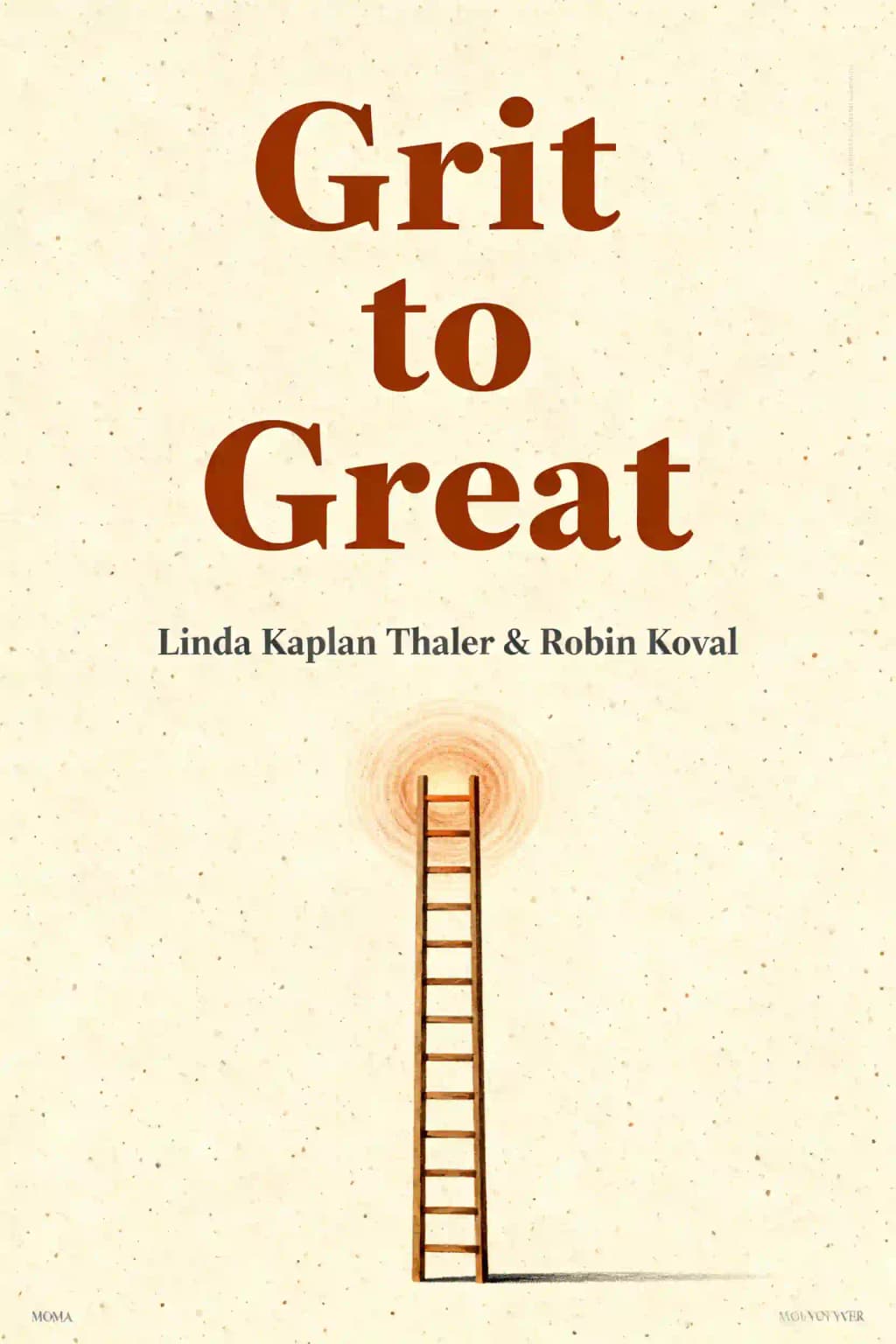
In "Grit to Great," advertising legends Thaler and Koval reveal why perseverance trumps talent. Endorsed by James Patterson, who declares: "You don't need brilliance to succeed - you need this book." Discover why grit, not genius, creates extraordinary success stories.
Linda Kaplan Thaler and Robin Koval, bestselling authors of Grit to Great: How Perseverance, Passion, and Pluck Take You from Ordinary to Extraordinary, are award-winning advertising executives and motivational speakers whose work reshaped modern marketing.
Kaplan Thaler, a 2016 Clio Lifetime Achievement Award recipient and Advertising Hall of Fame inductee, co-founded the billion-dollar agency behind iconic campaigns like the Aflac Duck and Clairol’s “Yes, Yes, Yes” ads. Koval, former CEO of the American Legacy Foundation, brings decades of leadership in public health advocacy.
Together, they’ve authored four national bestsellers blending business strategy and behavioral psychology, including The Power of Nice—a Goodreads Choice Awards nominee praised for reframing workplace collaboration—and Bang! Getting Your Message Heard in a Noisy World.
Frequent media commentators, they’ve appeared on Good Morning America, The Today Show, and The Apprentice. Grit to Great was named one of 2015’s top business books by Forbes, distilling their research on resilience into actionable insights for professionals. Their books have been translated into 12 languages and cited in over 1,200 academic works.
Grit to Great argues that perseverance, passion, and hard work—collectively termed "grit"—outperform innate talent in achieving long-term success. Authors Linda Kaplan Thaler and Robin Koval debunk the talent myth, emphasizing courage, resilience, initiative, and tenacity as core components of grit. The book combines research, real-world examples (e.g., Steve Jobs), and actionable strategies to help readers cultivate grit in personal and professional challenges.
Aspiring professionals, entrepreneurs, students, and anyone facing setbacks will benefit from this book. It’s tailored for individuals seeking practical advice on overcoming obstacles, building resilience, and sustaining effort toward long-term goals. Leaders aiming to foster grit in teams will also find value in its insights on creating a culture of perseverance.
Yes, particularly for readers seeking evidence-backed strategies to develop resilience. The book’s blend of motivational stories (e.g., Colin Powell’s career), psychological research, and clear frameworks makes it actionable. Critics praise its focus on effort over talent, though some note it may oversimplify systemic barriers to success.
Linda Kaplan Thaler is a Hall of Fame advertising executive (creator of the Aflac duck campaigns) and co-founder of the Kaplan Thaler Group. Her experience building a billion-dollar agency grounds the book’s principles in real-world success. She’s also co-authored bestsellers like The Power of Small and Bang!, establishing her authority on perseverance and creativity.
These traits, amplified by deliberate practice and a growth mindset, enable ordinary individuals to achieve extraordinary results.
Success stems from relentless effort and patience, not innate talent. The authors cite studies showing grit as a stronger success predictor than IQ, using examples like Angela Duckworth’s research. They argue that embracing discomfort and persisting through setbacks—not quick wins—leads to lasting achievement.
Some critics argue the book underplays systemic barriers (e.g., socioeconomic status) and overemphasizes individual responsibility. Others note its anecdotes may not apply universally. However, its focus on actionable steps for personal grit development remains widely praised.
This line encapsulates the book’s thesis: success comes from sustained effort (sweat), not innate confidence or talent (swagger). It reinforces the idea that humility, hard work, and consistency trump natural ability or charisma.
The book advises embracing challenges (e.g., career pivots) and cultivating habits like daily practice to strengthen resilience.
Both highlight perseverance as critical to success, but Thaler’s work leans more on corporate anecdotes and practical strategies (e.g., fostering team grit). Duckworth’s research dives deeper into psychological studies, while Grit to Great emphasizes relatable, actionable advice for professionals.
In an era of rapid technological change and economic uncertainty, the book’s lessons on adaptability and resilience remain vital. Its principles align with trends like remote work and AI disruption, where grit helps individuals navigate constant evolution.
These books complement Grit to Great by exploring overlapping themes of effort, resilience, and long-term achievement.
저자의 목소리로 책을 느껴보세요
지식을 흥미롭고 예시가 풍부한 인사이트로 전환
핵심 아이디어를 빠르게 캡처하여 신속하게 학습
재미있고 매력적인 방식으로 책을 즐기세요
Success isn't about having special gifts-it's about stamina and resilience.
Character, unlike talent, can be developed regardless of circumstances.
Failure is essential to developing grit.
You're not special.
Research shows that perseverance often matters more than innate ability in achieving long-term success.
Grit to great의 핵심 아이디어를 이해하기 쉬운 포인트로 분해하여 혁신적인 팀이 어떻게 창조하고, 협력하고, 성장하는지 이해합니다.
생생한 스토리텔링을 통해 Grit to great을 경험하고, 혁신 교훈을 기억에 남고 적용할 수 있는 순간으로 바꿉니다.
무엇이든 묻고, 학습 스타일을 선택하고, 나에게 맞는 인사이트를 함께 만들어보세요.

샌프란시스코에서 컬럼비아 대학교 동문들이 만들었습니다
"Instead of endless scrolling, I just hit play on BeFreed. It saves me so much time."
"I never knew where to start with nonfiction—BeFreed’s book lists turned into podcasts gave me a clear path."
"Perfect balance between learning and entertainment. Finished ‘Thinking, Fast and Slow’ on my commute this week."
"Crazy how much I learned while walking the dog. BeFreed = small habits → big gains."
"Reading used to feel like a chore. Now it’s just part of my lifestyle."
"Feels effortless compared to reading. I’ve finished 6 books this month already."
"BeFreed turned my guilty doomscrolling into something that feels productive and inspiring."
"BeFreed turned my commute into learning time. 20-min podcasts are perfect for finishing books I never had time for."
"BeFreed replaced my podcast queue. Imagine Spotify for books — that’s it. 🙌"
"It is great for me to learn something from the book without reading it."
"The themed book list podcasts help me connect ideas across authors—like a guided audio journey."
"Makes me feel smarter every time before going to work"
샌프란시스코에서 컬럼비아 대학교 동문들이 만들었습니다

Grit to great 요약을 무료 PDF 또는 EPUB으로 받으세요. 인쇄하거나 오프라인에서 언제든 읽을 수 있습니다.
Ever wonder why some people achieve the impossible while others with seemingly more talent fall short? Steve Jobs had a mediocre GPA. Michael Jordan was cut from his high school basketball team. Colin Powell was an average student with little self-confidence. What transformed these ordinary beginnings into extraordinary success stories wasn't natural talent-it was grit. Those iconic Aflac Duck commercials that seemed so effortless? They required a full year of production with thirty team members working through endless rejections and setbacks. Success isn't about having special gifts-it's about stamina and resilience. Without consistent application and hard work, talent remains merely potential-"a masterpiece unpainted." When psychologist Angela Duckworth developed a simple twelve-point scale to measure grit, she discovered something surprising: sometimes there was a negative correlation between high IQ and grit. Those with higher intelligence often gave up more quickly when faced with difficult tasks, while those with comparatively lower IQs had developed grittier problem-solving approaches through necessity. Even Google stopped asking for transcripts and GPAs, finding they "don't predict anything." Instead, what matters is "results intelligence"-the ability to deliver under pressure and bounce back from difficulties.
Since the 1960s, the self-esteem movement has dominated parenting and education with poor results. Children receive participation trophies, grades inflate, and young professionals expect quick promotions. American students rank low in skills but highest in confidence. Teacher David McCullough Jr. captured this backlash when warning graduates that Americans "have come to love accolades more than genuine achievement." Research shows high self-esteem doesn't improve grades or behavior. Telling kids they're smart often backfires - many avoid effort or fixate on mistakes. Educators like Meghan Dunn now teach grit by pushing students beyond comfort zones, encouraging problem-solving, and insisting on completion. Sometimes good parenting means allowing children to fail. When Linda's daughter struggled with bike riding, a stranger's advice to put her hands in her pockets worked. Though Emily fell twice, on her third attempt, she succeeded.
Failure isn't just inevitable - it's essential to developing grit, which has four key components working together to create lasting success: **Guts**: The courage to tackle tough challenges without faltering. Sara Blakely faced years of rejection before creating Spanx, while Howard Schultz approached 242 investors before funding Starbucks. Guts means volunteering for difficult tasks and stepping outside your comfort zone. **Resilience**: The ability to bounce back from setbacks and use failures as learning opportunities. Jerry Seinfeld performed the night after being booed offstage, while Thomas Edison viewed his 1,000 failed light bulb attempts as discovering ways that didn't work. **Initiative**: Being a self-starter who finds creative solutions independently. Thirteen-year-old Richard Turere invented "lions light" - a system of flashing LEDs protecting his family's cattle - using spare parts and self-taught electronics. **Tenacity**: Maintaining relentless focus despite obstacles. James Dyson created 5,126 failed prototypes over 15 years before perfecting his bagless vacuum, while Colonel Sanders faced 1,009 rejections before a restaurant accepted his chicken recipe.
While dreamers sleep, doers take victory laps because they wake up and get to work. The Yiddish proverb says it best: "If you want your dreams to become reality, wake up already." Setting attainable goals, creating plans, and steadily working forward produces results that dreaming alone never will. Linda's colleague Jim at J. Walter Thompson exemplified this principle. Despite his demanding executive job, he woke before dawn daily to write for four hours. His flight epiphany about writing bestsellers led to "Along Came a Spider," the first of James Patterson's 110 New York Times bestsellers. Research shows visualization can hinder achievement when focused solely on outcomes rather than process. NYU professor Gabriele Oettingen found that graduates who frequently fantasized about ideal jobs applied for fewer positions, received fewer offers, and earned lower salaries. Effective positive thinking should focus on overcoming obstacles, not just imagining success.
Fear can be overcome through preparation and mindfulness. When properly trained, we can perform extraordinarily under pressure. Flight attendant Lee Yoon-Hye demonstrated this during the Asiana Flight 214 crash, carrying passengers to safety despite her fractured tailbone. "We followed our training," she said. "My body just started carrying out the steps needed for an evacuation." Rejection can become a catalyst for growth. When entrepreneur Jia Jiang faced devastating rejection from an investor, he challenged himself to be rejected once daily for 100 days. He began getting surprising yeses - including a Krispy Kreme employee who created Olympic-ring doughnuts for him at no charge, making his video go viral. Through this experiment, Jiang discovered rejection isn't "this monster bag of hurt" but merely someone's opinion, becoming "a better communicator, a better negotiator." In Silicon Valley, Google manager Sabrina Farmer battled "impostor syndrome" - dismissing her abilities as luck while anticipating failure. After claiming she "could never" run a triathlon, she questioned this limitation, trained, and completed not just a triathlon but a marathon. Though she didn't enjoy running, she gained crucial insight: her habit of self-doubt served as emotional protection but ultimately held her back.
Achievement requires delayed gratification. Between effort and accomplishment lies a waiting period filled with practice and repetition. While humans prefer instant rewards, we can manage our impulses. History shows perseverance's power - Susan B. Anthony advocated for women's voting rights for fifty years without seeing success, Van Gogh sold just one painting during his lifetime, and the Washington Monument remained unfinished for decades. Resilience and flexibility are essential components of grit, like bamboo that bends rather than breaks in strong winds. Arthur, an electrician who lost three fingers in a lawn mower accident, exemplifies this quality. His doctor's perspective helped Arthur recover, return to work, and become a respected foreman known for his positive attitude. Optimism fuels resilience, but failure often drives us to work harder. In Silicon Valley, failure has become a badge of honor among entrepreneurs. As James Dyson notes, "You never learn from success, but you do learn from failure," showing how setbacks can reshape ideas into innovations.
Human grit knows no age limit. James Henry exemplifies this-at 96, after hiding his illiteracy his entire life, he learned to read and wrote a bestselling memoir. Diana Nyad's remarkable Cuba-to-Florida swim at 64 proves determination can sometimes outweigh youth. Her mantra: "Don't ever give up. You can chase your dreams at any age." Our brains are hardwired for altruism, with helping others triggering our pleasure and reward regions. Navyn Salem, a stay-at-home mom with a communications degree, established Edesia, a nonprofit factory that has treated malnutrition for over 2.5 million children across 44 countries. The "happiness paradox" suggests true happiness comes not from pursuing it directly but as a side effect of dedicating oneself to something greater. Grit is the great equalizer-anyone, regardless of background or resources, can lay claim to it. The question isn't whether you have what it takes to achieve greatness-it's whether you have the grit to continue when everything tells you to stop.