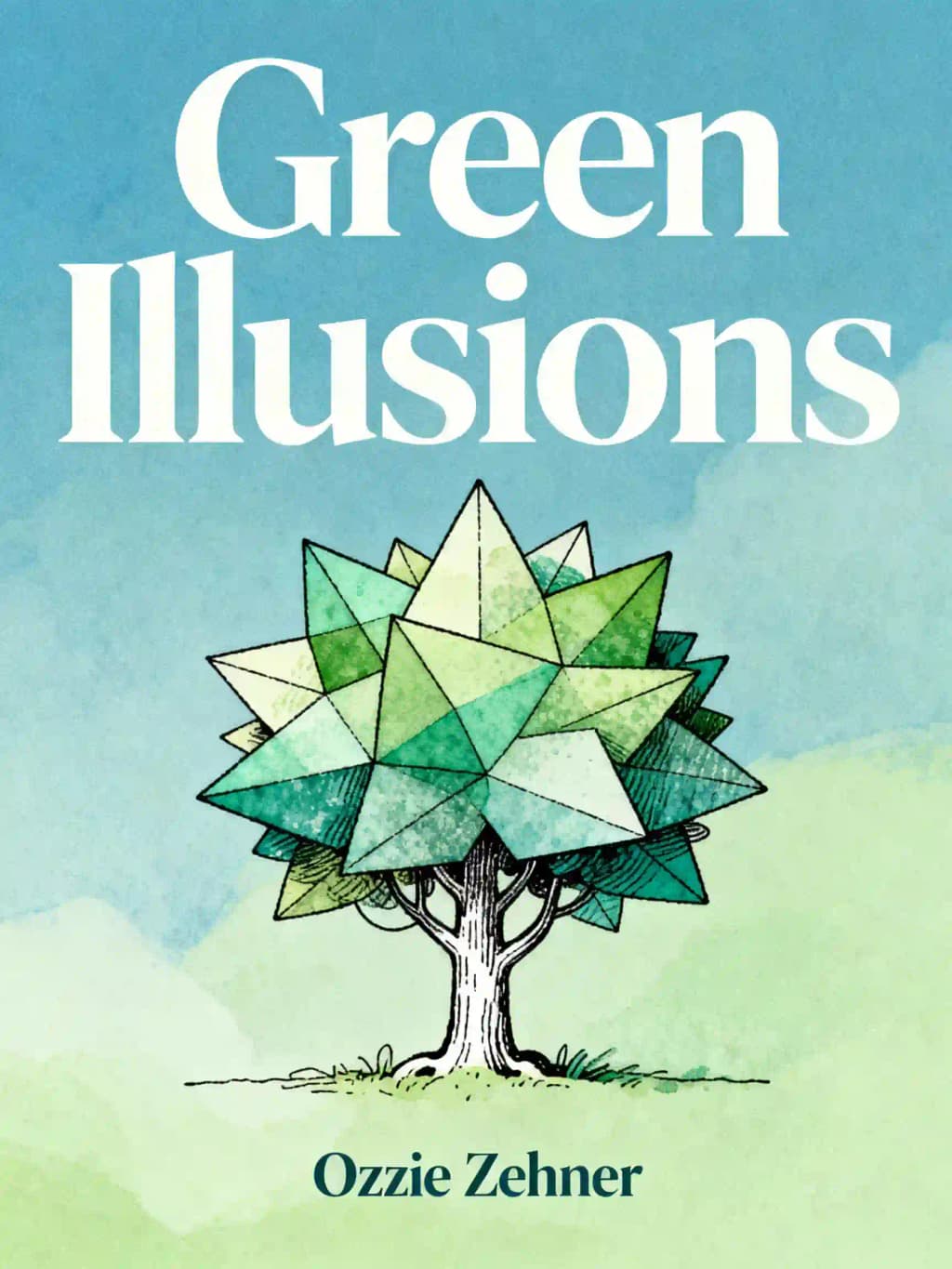
"Green Illusions" shatters our clean energy myths, winning the Northern California Book Award while sparking death threats. Ozzie Zehner's provocative analysis reveals why solar panels won't save us - it's our consumption crisis, not energy crisis, that demands attention. What environmental truths are we refusing to face?
Ozzie Zehner, author of Green Illusions: The Dirty Secrets of Clean Energy and the Future of Environmentalism, is a visiting scholar at the University of California, Berkeley, and a prominent critic of renewable energy’s unintended consequences.
With a background in engineering (BS, Kettering University) and science and technology studies (MS, University of Amsterdam), Zehner merges technical expertise with cultural analysis to challenge mainstream environmental narratives. His work, featured in The Christian Science Monitor, IEEE Spectrum, and Bulletin of the Atomic Scientists, advocates for systemic social and political reforms over technological fixes.
Zehner’s critiques extend to his role as co-producer of the controversial documentary Planet of the Humans, which scrutinizes green energy’s limitations. A frequent commentator on CNN, PBS, and MSNBC, he emphasizes themes like consumerism, urban policy, and energy efficiency.
His ideas have influenced debates on sustainability, with endorsements from figures like John Perkins and James Howard Kunstler. Green Illusions remains a pivotal text in environmental discourse, urging readers to reconsider “green” solutions through a lens of cultural and economic accountability.
Green Illusions critiques the environmental movement’s reliance on alternative energy, exposing hidden drawbacks of solar, wind, and biofuels. Ozzie Zehner argues that focusing solely on technology ignores systemic issues like overconsumption and inequality. He advocates for solutions centered on social policies, women’s empowerment, and urban design to reduce energy demand. The book challenges readers to rethink “green” marketing and prioritize human well-being over technological fixes.
Environmental policymakers, energy analysts, and sustainability advocates will find this book provocative. It’s also valuable for readers skeptical of mainstream environmental narratives or interested in critiques of renewable energy. Students studying environmental policy, urban planning, or energy economics gain insights into unintended consequences of “clean” technologies.
Yes—it’s a rigorously researched critique that reshapes debates about sustainability. Praised as “provocative and essential” by John Perkins (author of Confessions of an Economic Hit Man), the book offers actionable solutions like tax reforms and community redesigns. Its focus on consumption over technology makes it a standout in environmental literature.
Zehner reveals:
The book disputes claims that renewables alone can solve climate change, highlighting their dependence on subsidies, geopolitical mining, and inconsistent output. Zehner compares ethanol’s inefficiency to gasoline and notes solar’s limited impact compared to simple policy stickers promoting energy conservation.
Zehner links energy consumption to population growth, advocating for contraception access and gender equality as sustainable strategies. Empowering women reduces birth rates and resource strain more effectively than technological fixes, aligning with global health and equity goals.
He promotes walkable neighborhoods, biking infrastructure, and dense cities to cut transportation energy use. Urban areas, despite pollution, inherently lower per-capita consumption through shared resources—a concept he calls “unexpectedly green”.
Zehner accuses mainstream environmental groups of prioritizing corporate-friendly tech (e.g., electric cars) over systemic change. He argues this distracts from root causes like consumerism and flawed governance, calling for a shift to “critical environmentalism”.
Key strategies include:
Unlike works promoting tech-driven solutions, it frames energy crises as symptoms of deeper social issues. The book’s focus on governance, gender equity, and consumption patterns offers a pragmatic counterpoint to optimistic renewable energy narratives.
Zehner sidesteps debates over climate science, instead critiquing how both deniers and activists use energy policy to advance ideological goals. He urges centering discussions on measurable well-being improvements, like cleaner air and equitable cities.
Yes—its warnings about renewable energy limitations remain pertinent as solar/wind dominate policy talks. The 2025 focus on urban resilience and social equity aligns with Zehner’s call for systemic solutions beyond technology.
While Kolbert and Klein focus on climate impacts and capitalism, Zehner targets the environmental movement itself. His critique of “green” tech complements their works but offers more actionable policy alternatives, making it a critical companion read.
저자의 목소리로 책을 느껴보세요
지식을 흥미롭고 예시가 풍부한 인사이트로 전환
핵심 아이디어를 빠르게 캡처하여 신속하게 학습
재미있고 매력적인 방식으로 책을 즐기세요
Our green dreams are actually illusions?
Solar cells function as lucrative forms of misdirection.
Wind turbine syndrome.
Biofuels' most serious consequence.
Mere leaps of faith.
Green Illusions의 핵심 아이디어를 이해하기 쉬운 포인트로 분해하여 혁신적인 팀이 어떻게 창조하고, 협력하고, 성장하는지 이해합니다.
Green Illusions을 빠른 기억 단서로 압축하여 솔직함, 팀워크, 창의적 회복력의 핵심 원칙을 강조합니다.

생생한 스토리텔링을 통해 Green Illusions을 경험하고, 혁신 교훈을 기억에 남고 적용할 수 있는 순간으로 바꿉니다.
무엇이든 물어보고, 목소리를 선택하고, 진정으로 공감되는 인사이트를 함께 만들어보세요.

샌프란시스코에서 컬럼비아 대학교 동문들이 만들었습니다
"Instead of endless scrolling, I just hit play on BeFreed. It saves me so much time."
"I never knew where to start with nonfiction—BeFreed’s book lists turned into podcasts gave me a clear path."
"Perfect balance between learning and entertainment. Finished ‘Thinking, Fast and Slow’ on my commute this week."
"Crazy how much I learned while walking the dog. BeFreed = small habits → big gains."
"Reading used to feel like a chore. Now it’s just part of my lifestyle."
"Feels effortless compared to reading. I’ve finished 6 books this month already."
"BeFreed turned my guilty doomscrolling into something that feels productive and inspiring."
"BeFreed turned my commute into learning time. 20-min podcasts are perfect for finishing books I never had time for."
"BeFreed replaced my podcast queue. Imagine Spotify for books — that’s it. 🙌"
"It is great for me to learn something from the book without reading it."
"The themed book list podcasts help me connect ideas across authors—like a guided audio journey."
"Makes me feel smarter every time before going to work"
샌프란시스코에서 컬럼비아 대학교 동문들이 만들었습니다

Green Illusions 요약을 무료 PDF 또는 EPUB으로 받으세요. 인쇄하거나 오프라인에서 언제든 읽을 수 있습니다.
Picture a world where solar panels glisten on every rooftop, wind turbines spin gracefully across hillsides, and electric cars glide silently through our streets. This is the future we've been sold-a technological salvation that promises to rescue us from climate catastrophe without requiring us to change much at all. It's a seductive vision, one that appears in glossy advertisements, political speeches, and even children's textbooks. But what if this entire narrative is a carefully constructed illusion? What if our obsession with alternative energy is actually preventing us from addressing the real problem? When researchers ask people to visualize the future of energy, they invariably create collages of wind turbines and solar arrays-never images of smaller homes, walkable neighborhoods, or people simply consuming less. This reveals something profound about our collective imagination: we've been trained to see salvation in production rather than transformation in consumption.




