1장
When the Khmer Rouge Came to Phnom Penh
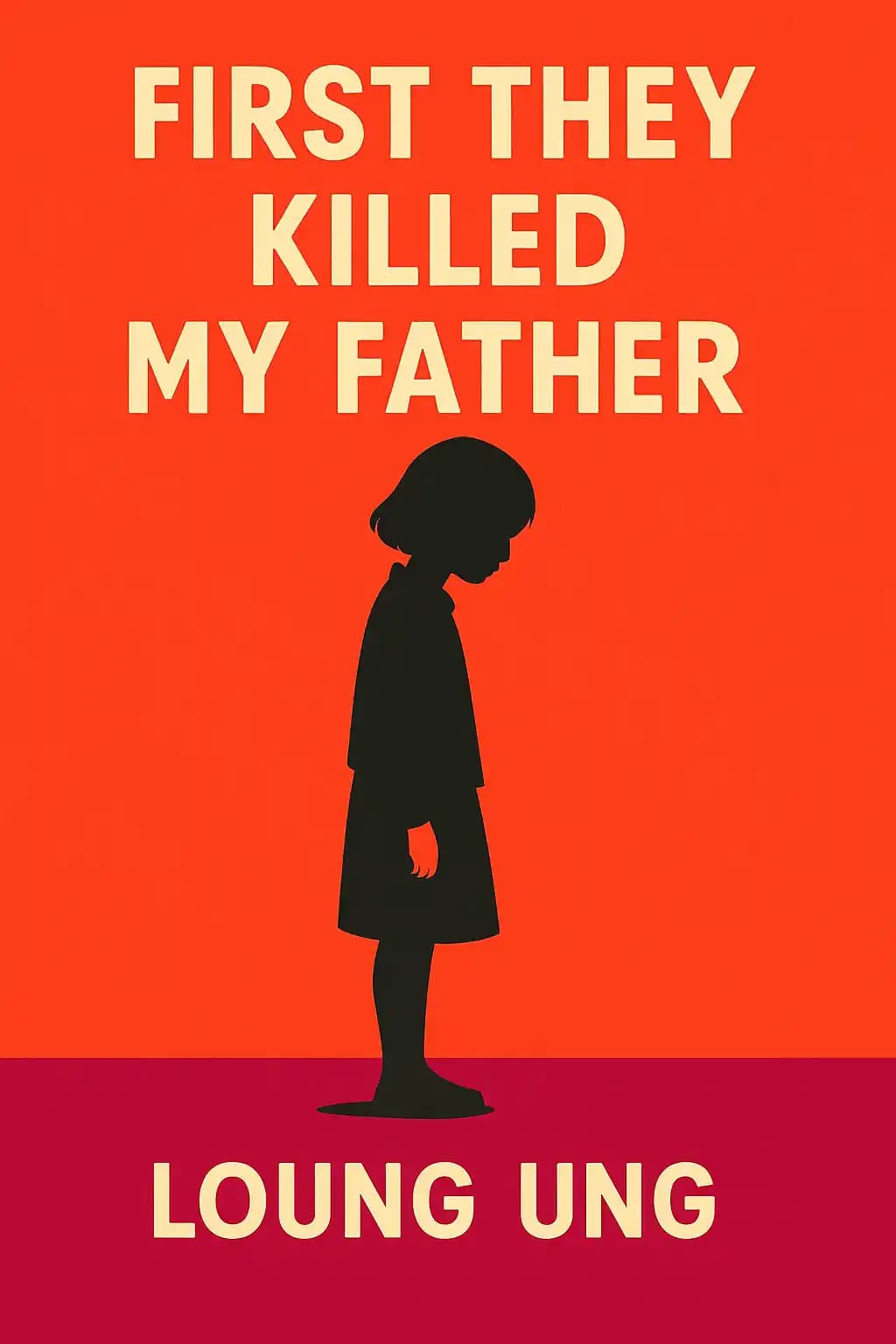
Phnom Penh was once a vibrant city that awoke early to escape the sweltering heat. By 6 AM, the streets bustled with life-waiters opening shops, vendors setting up food carts, and children playing soccer in the boulevards. This was the Cambodia that five-year-old Loung Ung knew before April 17, 1975-the day that changed everything. On that fateful Thursday afternoon, as she played hopscotch outside her family's apartment, trucks rumbled into the city carrying men in black clothes with red scarves, firing shots into the air. These Khmer Rouge soldiers ordered everyone to evacuate immediately, claiming the U.S. would bomb the city. Within days, two million residents were forced from their homes, beginning one of history's most brutal genocides. Loung Ung's memoir has become a literary landmark, translated into eleven languages and adapted into a critically acclaimed film directed by Angelina Jolie. Through the unfiltered perspective of a child, Ung creates a devastating account that captures both the innocence lost and the resilience found during Cambodia's darkest chapter.
2장
A Family Torn from Privilege
The Ung family represented Cambodia's growing middle class-nine members living in a spacious apartment with modern amenities in Phnom Penh. Loung's father worked as a military policeman after leaving his life as a Buddhist monk to join the Royal Secret Service. Her mother, originally from China, maintained their comfortable home where Loung lived with her six siblings: eighteen-year-old Meng, the valedictorian; sixteen-year-old Khouy, more interested in girls than books; fourteen-year-old Keav, whose beauty Pa fiercely protected; ten-year-old Kim, nicknamed "little monkey"; eight-year-old Chou, quiet and obedient; and three-year-old Geak, meaning "jade," adored by everyone. Loung, the troublemaker Pa called "a diamond in the rough," enjoyed privileges many Cambodians didn't have-attending three language schools, swimming at exclusive clubs, and living with luxuries like telephones and a glass cabinet filled with candies for guests.
When the Khmer Rouge forced them to evacuate, they initially traveled by truck until fuel ran out, then continued on foot carrying only clothes and food. At military checkpoints, Loung's father quickly instructed the family to claim they were peasants, knowing his government connections would mean certain death. "Remember, we are a family of peasants. Let me do all the talking," he warned as soldiers searched for former officials. This abrupt transition from privilege to desperate survival marked the beginning of their nightmare-one shared by millions of Cambodians. The family's middle-class status and Chinese heritage made them doubly targeted under the new regime, forcing them to hide not just possessions but their very identities as they embarked on a seven-day trek into an uncertain future.
3장
The Brutal New Reality
After eight days of fleeing Phnom Penh, the Ung family arrived at Krang Truop-a small, dusty village surrounded by endless rice fields crisscrossed with red-dirt roads. They stayed with relatives, seventeen people crammed under one thatched roof with dirt floors and no bedrooms or bathrooms. Pa bluntly told his children they could never return to Phnom Penh, that the Khmer Rouge had lied. "You must forget the city," he instructed Loung, "and never speak of our previous life."
Life under the Khmer Rouge regime meant complete transformation. The family learned to survive without basic necessities-using hay instead of toothbrushes, bathing without soap, and adapting to rural hardships. Though initially they had enough to eat, Loung lived in constant fear, sensing they were being watched. After two months, her father decided they must leave under cover of darkness, concerned that new arrivals from Phnom Penh might recognize him.
The family's journey continued through a series of villages, each move driven by the need to conceal their past. In Anlungthmor, they occupied a small hut on stilts with bamboo leaf and straw walls. Soon after arriving, Loung fell terribly ill with fever and hallucinations. Without doctors or medicine, many villagers succumbed to illness and starvation. When relentless rain flooded the village, the family caught frogs, grasshoppers, and June bugs to survive. The floodwaters rose to Pa's waist, but he managed to catch rabbits and fish floating by, which they ate raw with lime juice.
By November 1975, seven months after their forced evacuation, they arrived in Ro Leap village. Here, the brutal social hierarchy became clear: first-class citizens (the chief and Khmer Rouge soldiers), base people (original villagers), and new people (city evacuees like the Ungs). The village chief announced strict rules: they must wear only black clothes, address everyone as "Met," abandon family titles, and accept that everything belonged to the Angkar-the mysterious organization controlling their lives. Their colorful clothes were confiscated and burned in a pile, including Loung's precious red dress her mother had made for New Year's.
"Children won't attend school but will work instead," the chief declared, establishing the pattern of forced labor that would define life under the Khmer Rouge. As Chinese-Cambodians, Loung's father warned they would need to work harder than others to avoid suspicion. The family's very survival depended on erasing their identity and conforming to the regime's vision of an agrarian communist society built on the broken backs of its citizens.
4장
Separation and Starvation
The Khmer Rouge systematically tore families apart, believing that loyalty should be to the Angkar alone, not to family members. To protect Khouy from army conscription, the family arranged his quick marriage to a woman named Laine before both were sent to a labor camp. Though clearly a marriage of convenience rather than love, it served its purpose. Despite his physical weakness, Meng was also forced to the camp as he was deemed too old to live at home. The brothers loaded rice and unloaded weapons, receiving better food rations which they dried and smuggled to the family during increasingly restricted visits.
Fourteen-year-old Keav was taken to a teen work camp called Kong Cha Lat. Once the beautiful daughter who fussed over her appearance, she now looked small and defeated in her oversized black clothes as she was led away. Loung's father explained these separations served a purpose-if the Khmer Rouge discovered his government background, they couldn't eliminate the entire family at once.
As food grew increasingly scarce, hunger became Loung's constant companion. The village's rations dwindled to a twelve-ounce can of rice for every ten people. She cherished each spoonful of watery soup, counting the precious few grains at the bottom of her bowl, savoring them one by one while tears mixed with the food in her mouth. Her once-plump body transformed-ribs visible, stomach bloated, feet swollen. When she pressed her thumb into her swollen flesh, the dent refilled slowly, like a balloon. Walking became difficult as her joints ached and her eyes nearly swelled shut from malnutrition.
The village population shrank daily as people died from starvation, poisoning, or execution. Villagers ate anything edible-rotten leaves, roots, rats, turtles, snakes, insects. Death pervaded the village, with bodies often lying in the sun until the stench forced burial. Loung witnessed so many deaths that she became emotionally numb. Her neighbor Chong lost her baby son to starvation, then her daughters to poisonous mushrooms they ate in desperation. In her madness, Chong brought Loung's mother a bowl of earthworms, excited about this "perfect food" that might have saved her children.
Six months after Keav left their village, a messenger arrived with urgent news-she was gravely ill with severe diarrhea at the hospital. After being repeatedly dismissed by her supervisor as "a lazy, worthless city girl," Keav was finally allowed to visit the infirmary after soiling herself. At the makeshift hospital, she was placed on a cot with hollow promises of medicine that didn't exist, as all real doctors had been killed by the Angkar. When Loung's mother returned from visiting Keav, she brought devastating news-Keav was dying from dysentery. Despite her parents' hurried attempt to fulfill Keav's wish to see her father one last time, they arrived too late. They couldn't even find her remains among the dozen girls who died that day from food poisoning.
5장
The Disappearance of Pa
Four months after Keav's death, the family continued to suffer as food rations shrank further. They lived in constant terror of being discovered as former government supporters. One evening, while Kim and Loung sat outside watching the beautiful sunset, two armed soldiers approached asking for their father. When he emerged, they claimed they needed his help with an ox wagon stuck in mud.
After a private moment with his wife, who began sobbing, Pa came out standing tall and proud for the first time since the Khmer Rouge takeover. In a rare display of affection, he picked up Loung, held her tight and kissed her hair, calling her his "beautiful girl." When she asked when he would return, a soldier answered that he'd be back tomorrow morning. Loung begged to accompany him, but Pa refused, telling his children to take care of themselves. He cradled Geak, embraced Chou, and instructed Kim to look after the family.
As Pa walked away between the two soldiers, Loung waved desperately, hoping he'd turn back, but he never did. His figure disappeared into the red-gold horizon. Inside their hut, Ma sat crying in the corner. Though Loung had seen Pa leave many times in Phnom Penh, Ma's unusual distress confirmed what her heart knew but her mind could not accept.
The next morning, Pa didn't return. The family sat on the steps all day, waiting and inventing excuses for his lateness. By the third day, they accepted the terrible truth-Pa was gone, just like Keav. Loung's grief transformed into rage as she vowed to kill Pol Pot someday. At night, Pa visited her in dreams, wearing his military uniform, his face round like before the war. She begged him not to leave, but he always faded away.
In the weeks that followed, soldiers continued taking fathers from other families. Rumors circulated that Pa had escaped execution and was forming his own resistance army in the mountains. Ma clung desperately to these stories, sitting on the steps each night, waiting for his return. Eventually, she resumed her life without him, focusing on keeping her remaining children alive. Despite villagers looking down on her white skin and poor field work skills, she became surprisingly resourceful, finding ways to feed her children despite the constant threat of punishment for breaking the Angkar's rules.
6장
A Child Soldier is Born
A month after Kim was caught stealing corn and severely beaten by a soldier, Ma made a devastating announcement: to protect her children from execution, they must separate. "If we stay together, we will die together," she explained, instructing Kim, Chou and Loung to go in different directions and claim to be orphans. Despite Loung's protests, the next morning Ma forced them to leave, coldly pushing her away when she reached for her. Geak, only four, remained behind with Ma.
Ignoring their mother's instructions to separate, Chou and Loung traveled together until reaching a girls' work camp. They lied to the supervisor, claiming their parents died during the Civil War. At the camp, they worked from sunrise to sunset planting crops for the army, sleeping packed with fifty other girls. Every night, they endured propaganda sessions where children chanted "Angkar! Angkar! Angkar!" The other children bullied Loung for her light skin, spitting on her and throwing mud.
After three months at the camp, Loung was transferred to a child soldier training camp because she was deemed strong and worked hard. Though not yet eight years old, she was selected for her strength and placed among girls aged ten to fifteen. At the camp, they gathered for propaganda sessions where the instructors preached hatred against the Youns (Vietnamese) and glorified the Angkar. When not training or dancing in performances for soldiers, Loung worked in leech-infested rice fields.
The hatred she'd cultivated against the Khmer Rouge grew stronger each day. When bullied by the other children for her light skin, she finally snapped and attacked a girl named Rarnie, nearly choking her to death before being pulled away. Though punished without food, she refused to show weakness. Her rage fueled her, replacing sad memories with angry ones that made her want to survive just to take revenge.
Met Bong, her instructor, intensified their indoctrination, telling them Pol Pot was sending soldiers to villages to take children eight and older for training. She claimed she'd been "training Loung's mind" all these months, trying to make her believe Pol Pot's propaganda and hate the Vietnamese. Despite these efforts, Loung silently vowed she would never kill her mother for them, maintaining her inner resistance even as she outwardly complied with the regime's demands.
7장
The Walls Come Crumbling Down
Six months after their family reunion at the infirmary, Loung's strength returned with increased food rations. Instead of field work, the children now trained for combat as rumors spread of Vietnamese invasions. Met Bong's propaganda lessons grew longer, with Pol Pot now replacing the Angkar as the source of power. The children heard violent details of soldiers' supernatural abilities to kill the Vietnamese, learning how they cut off enemies' heads to prevent proper burial and condemn their souls to wander eternally.
During weapon training, Met Bong taught them how ordinary tools-sickles, hoes, machetes-could become deadly weapons. When she handed Loung a rifle to demonstrate, Loung recognized it as the type that had injured her brother Kim, filling her with hatred. At night, she suffered from nightmares where she was hunted by monsters or Khmer Rouge soldiers until she turned the tables and became the killer herself.
Walking back to Ro Leap after visiting, Loung discovered the devastating truth-her mother and little sister Geak had been executed. Consumed by grief, she lost herself in darkness for three days, with no memory of where she went or what she did. When she returned to camp, Met Bong slapped her awake, demanding to know where she'd been. Loung could only answer honestly that she didn't know.
The next day at training, she attacked the practice dummies with uncontrollable rage, stabbing her wooden stake into the chest repeatedly. With each thrust, she envisioned not a Vietnamese soldier but Pol Pot himself. The pretense was over-she was truly an orphan now, consumed by hatred for the regime that murdered her family.
In January 1979, nearly four years after the Khmer Rouge takeover, the Vietnamese army invaded Cambodia. The Khmer Rouge soldiers fled, their propaganda about their fighting prowess proving false. Instead of the devils Met Bong had described, the Vietnamese soldiers greeted refugees with smiles and directed them to camps. After days of walking, Loung and her siblings reached a refugee camp in Pursat City, a sprawling collection of tents and makeshift shelters with Vietnamese soldiers patrolling.
8장
Survival and Reunification
At the refugee camp, Loung and her siblings struggled to find food as Kim fished in the increasingly polluted river. After a week of cold nights and empty stomachs, they asked a nearby family to take them in. Though they couldn't help directly, the man searched for someone who would take all three siblings together. To Loung's astonishment, it was the palm tree boy and his father-the same people who collected palm sap at her soldier training camp.
Though initially joyful at this seeming stroke of fate, Loung soon discovered the arrangement was purely for labor-she and Chou would help with childcare, cooking, and chores while Kim would hunt and fish with the father. Despite their hard work, the foster mother constantly belittled them, wondering aloud if they were worth keeping. Loung also had to avoid the fourteen-year-old son Paof, whose inappropriate advances made her uncomfortable.
During their stay with this family, they witnessed the continued violence of the civil war. One day, a grandmother was shot during crossfire. The hospital where Loung was sent to bring her food was a nightmare-hot, foul-smelling, and filled with moans and cries. Unlike Khmer Rouge hospitals where people died silently, here patients screamed because they were fighting to live.
Eventually, they moved to a kinder foster family-a mother, father, and three young children who treated them well, sharing special treats and never hitting them. Still, life remained dangerous. During one firewood expedition, Loung discovered a decomposing corpse with maggots crawling from its mouth and eyes. While fetching water from the river another day, she helped a girl dislodge a bloated corpse caught on the riverbank.
In February 1979, a Khmer Rouge attack shattered their temporary peace. Rockets rained down on the village as they fled with thousands of desperate people to an abandoned warehouse with concrete walls. When a rocket struck their shelter, Loung's friend Pithy was killed instantly, her skull caved in by the blast. Outside, people scattered in panic as bullets whizzed past. The foster father returned from the village with horrific stories-people killed in bomb shelters by grenades, decapitated heads hanging by hair, babies speared with bayonets.
In April 1979, their situation finally brightened. Kim had been visiting the Vietnamese camp nightly, asking new arrivals if they'd seen their brothers. One day, Kim returned with Meng, and soon after, Khouy arrived too. The brothers had escaped from Khmer Rouge soldiers who had forced them to work as porters. With their brothers' return, Loung felt safe again. They discussed plans to return to Bat Deng, their mother's hometown, to search for surviving relatives.
9장
The Journey to America
After eighteen days of travel, the siblings reached Bat Deng where their uncles lived. Uncle Leang arrived on bicycle with sweet rice cakes, though he didn't recognize Loung at first, thinking she was a beggar. At Bat Deng, Aunt Keang gave them new clothes-Loung's was blue as the sky, transforming her from the black rags of the Khmer Rouge.
Their uncles' village had been liberated by the Vietnamese weeks before Pursat. Here, the Khmer Rouge had been more moderate-work hours shorter, food rations larger, and fewer killings. When Uncle Leang said Ma would have survived had she held on just two more months, Loung fled to the market, angry and resentful that her mother couldn't last just sixty more days.
Weeks later, Meng married Eang, a Chinese woman separated from her family during the evacuation. When Eang's sister arrived from Vietnam with news their parents were alive, Meng and Eang visited Vietnam, returning with plans to escape Cambodia. With money from selling Ma's jewelry, only two could afford passage-Meng chose Loung to accompany him, promising to send for the others in five years.
Returning to Phnom Penh on the back of Meng's bicycle, Loung barely recognized the city. Buildings stood charred and bullet-riddled, streets were littered with cavernous potholes, and the once-beautiful boulevards had lost their lush trees. From there, they traveled by boat down the Mekong River, hiding under plastic sheets covered with fish to cross into Vietnam.
After two months in Saigon, they embarked on a dangerous sea journey to Thailand, enduring a pirate attack where Loung lost Pa's jade Buddha pendant. After three days at sea, they finally reached the Lam Sing Refugee Camp, where they registered with officials and lived in a bamboo hut purchased from a departing refugee.
Life in the camp revolved around standing in lines for rations of rice, fish, salt, and water. They were among the poorest refugees, often borrowing money for food. Meng got baptized as a Christian to improve their chances of finding sponsors, explaining that "Christians like to help other Christians."
After months of waiting, on June 5, 1980, Meng announced they'd found a sponsor and were going to America. The night before their departure, Loung dreamed of Pa reassuring her: "Wherever you go, I will find you." The next day, they boarded a plane at Bangkok International Airport, bound for Vermont.
10장
A Life Rebuilt from Ashes
In Vermont, Loung began the long process of healing and adaptation. She learned English, attended school, and eventually earned a political science degree. Meanwhile, Meng and his wife Eang worked long hours at IBM to support their family members in both America and Cambodia. Back in Bat Deng, a community of almost a hundred Ungs grew from the ashes of the genocide.
After fifteen years sheltered from Cambodia's continuing war, Loung became spokesperson for the Campaign for a Landmine-Free World, traveling extensively to share her story. When she finally returned to Cambodia, her fantasies of instant connection were crushed when her family reacted awkwardly to her-her practical black pants and Teva sandals resembling Khmer Rouge attire. But when Chou and she locked eyes, her sister burst into tears and took her hand. Their fingers clasped naturally as if the chain was never broken.
The publication of her memoir elicited powerful responses from fellow Cambodians around the world. One writer, a Cambodian-Chinese refugee like herself, lamented how Cambodian suffering received less attention than Vietnamese refugees despite enduring greater horrors. Another incarcerated reader found solace in her story while facing possible deportation. A Cambodian born during the Khmer Rouge period thanked her for helping him understand what his mother endured.
Loung chose to write her story in a child's voice to authentically capture her experiences and to dispel the myth that children suffer less than adults from trauma. Growing up in Vermont, she was frustrated when people told her brother, "Isn't it lucky she was so young when she went through the war? Maybe she won't remember." She wanted to scream "I remembered! I saw! I hurt!" but lacked the words or courage.
Through her memoir, Loung Ung not only documented her personal journey through one of history's darkest chapters but also gave voice to the experiences many survivors couldn't articulate. Her story created connections across the diaspora of Cambodians still processing their collective trauma, while educating the world about a genocide that too often remains in the shadows of history. From a five-year-old girl playing hopscotch in Phnom Penh to an internationally recognized human rights activist, her journey embodies both the devastating human cost of war and the remarkable resilience of the human spirit.