1장
A Journey Through Hell and Back: One Man's Remarkable Resilience
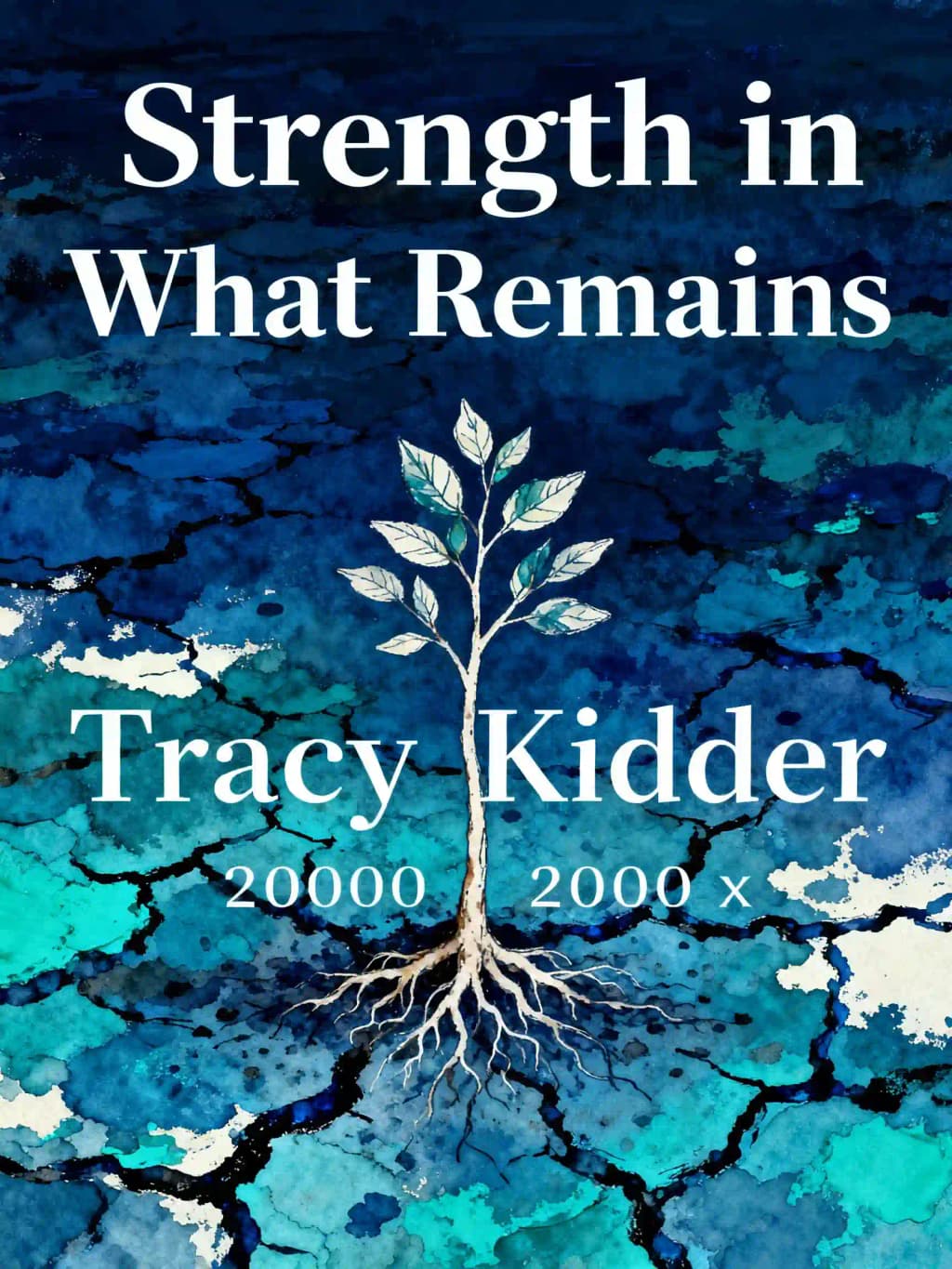
In a world where refugee stories often become statistics, Tracy Kidder's "Strength in What Remains" stands as a testament to the extraordinary resilience of the human spirit. This New York Times bestseller follows Deogratias "Deo" Niyizonkiza's harrowing journey from the genocidal horrors of Burundi to the bewildering streets of New York City. Oprah Winfrey called it "a testament to the power of will and friendship," while Barack Obama included it on his summer reading list, praising its portrayal of "how one person can make a difference." The book's unflinching examination of both human cruelty and compassion has made it required reading in universities worldwide, offering readers a profound meditation on trauma, healing, and the possibility of rebuilding a life shattered by unimaginable violence.
2장
From Medical Student to Hunted Refugee
Deo's life changed forever on October 22, 1993. As a third-year medical student interning at Mutaho Hospital in northern Burundi, he emerged from his room that morning to find the hospital eerily empty. The usual bustle of nurses, patients, and staff had vanished, replaced by an ominous silence. A patient's brother soon delivered the devastating news: President Melchior Ndadaye, Burundi's first democratically elected Hutu president, had been assassinated, allegedly by Tutsi army members, and Hutus were now killing Tutsis across the country in retaliation.
The hospital, once a place of healing, quickly descended into chaos. Deo, a Tutsi, hid under his bed as militiamen armed with machetes and clubs smashed through doors, their voices echoing through the corridors as they chanted about warming up "cockroaches" - their dehumanizing term for Tutsis - and cutting "at the level of the ear." Two militiamen briefly appeared in his doorway, their shadows falling across the floor as they searched the room, but concluded, "The cockroach is gone." The acrid smell of gasoline and burning flesh filled the air as they set fire to parts of the hospital. After hours of terrified hiding, Deo escaped at nightfall, forced to pick his way through bodies of patients and staff strewn across the courtyard.
His desperate flight took him south through brush and thickets, avoiding main roads where he could see bonfires and hear the threatening chants of murderous crowds. By morning, he discovered a village transformed into a scene of horror - smoldering houses containing murdered families. In one particularly haunting scene, he found a hut where a woman lay dead with male genitalia stuffed in her mouth, a grotesque display of the sexual violence that characterized the genocide. Exhausted and traumatized, he returned to the Mubarazi River, which now ran red with blood and carried floating corpses downstream.
For six months, Deo navigated a landscape of unspeakable horror, moving from hiding place to hiding place. He witnessed countless atrocities while constantly evading death - sleeping in caves, foraging for food, and relying on his medical knowledge to treat his own injuries. One memory haunted him persistently - a baby at its dead mother's breast in a banana grove, staring at him with innocent eyes as he walked away, knowing the infant would die. Despite trying to rationalize that he couldn't have helped without risking his own life, this memory remained a wound that would never fully heal, representing all the impossible choices he was forced to make.
Eventually, Deo made his way to Rwanda, only to find himself caught in another genocide as that country erupted into similar ethnic violence. Through a remarkable combination of luck, courage, and the compassion of strangers - including a Hutu woman who risked everything by hiding him in her home for several weeks despite the mortal danger to her own family - he eventually secured passage to America. He arrived at JFK airport with just $200 in his pocket, no English skills, and the psychological scars of witnessing two genocides, determined to rebuild his life in a new land.
3장
Lost in the New World
Deo's arrival in America in May 1994 marked the beginning of a profound cultural displacement. His journey started with a confusing layover in Ireland, where the sight of English signs and Western architecture led him to believe he'd reached New York. When he finally landed at JFK Airport, disoriented and exhausted, his first encounter with American soil was marked by suspicion. At immigration, officials meticulously questioned his dubious cover story about being a coffee salesman, eyeing skeptically at his worn clothes and the mere $200 in his pocket - all he had managed to gather for his new life.
Fortune brought him to Muhammad, a French-speaking Senegalese immigrant who offered crucial assistance during these first bewildering hours. Muhammad's offer of shelter led Deo to a dilapidated tenement building in Harlem, its walls prominently tagged with "PEN" graffiti. The building was a stark introduction to urban poverty: no electricity, windows patched with cardboard, floors strewn with garbage, and a bathroom rendered unusable by neglect. Each night, Deo would lay his few possessions on the bare floor, using his jacket as a pillow.
The cultural shock extended far beyond living conditions. Harlem presented Deo with a series of paradoxes that challenged everything he knew from Burundi. He was particularly struck by the inverse relationship between wealth and body weight - in America, the poor were often overweight, a concept that seemed impossible to reconcile with his African experience where only the wealthy could afford excess food. The streets offered their own peculiar education: he observed the ritual of brown-paper-bag drinking, the distinctive fashion of backwards baseball caps, and pants worn deliberately low - all customs that seemed to defy practical logic.
His first attempt at employment became an odyssey through New York's labyrinthine subway system. Armed with Muhammad's vague directions to a grocery store, Deo spent an entire day lost underground, trapped in a maze of incomprehensible maps and signs, watching trains pass while struggling to decipher the complex route system. This experience became a powerful metaphor for his larger displacement - surrounded by movement but unable to find his direction.
When he finally secured work as a delivery boy at a grocery store, the job paid a pitiful $15 per day. His employer, known as "Goss," embodied the casual cruelty of his new reality. Beyond the physical strain of pushing heavily loaded carts through Manhattan's unforgiving streets, Deo endured regular humiliation. Goss's pointed question about African heat while watching Deo struggle under the summer sun particularly stung - a reminder of how his identity had been reduced to crude stereotypes.
Despite careful rationing, his meager earnings barely covered essential expenses. Each day required careful calculations: subway tokens for work, medication for his fungal-infected feet (a painful reminder of his flight through Burundi's forests), antacids for his stress-induced stomach problems, and his most treasured possessions - dictionaries. These books represented his hope for advancement, his bridge to understanding this new world.
Bookstores became his sanctuary, offering both shelter and opportunity for self-improvement. After exhausting days of deliveries, he would seek out these havens, methodically working through a painstaking process of language acquisition. With English and French dictionaries spread before him, he would cross-reference words, practicing pronunciation in whispers until closing time or until fatigue overtook him in the comfortable chairs, leading to gentle but firm requests to leave.
4장
Unexpected Angels in New York
Deo's life changed direction through a series of chance encounters with extraordinary strangers. During a delivery to a church rectory, he met Sharon McKenna, who spoke French with him. Feeling sick and forgetting his usual caution, he revealed more than he normally would-that he had escaped violence in Burundi and Rwanda.
Sharon arranged for her doctor to examine Deo for free, bought him a bilingual copy of Le Petit Prince to help with his English, and even purchased an $81 physiology textbook when she learned of his dream to return to medical school. Most importantly, she introduced him to Nancy and Charlie Wolf, a couple who would become his surrogate family.
Deo visited the Wolfs' book-filled SoHo apartment with Sharon, where he met Nancy-a nervous, blonde artist who spoke too quickly-and Charlie, whose calm demeanor reminded Deo of his brother Lonjino. When Charlie insisted America was "a country of second chances" and that Deo could return to school, Deo felt a glimmer of hope, remembering the classroom as "the greatest pleasure he had known."
The Wolfs invited Deo to move into their SoHo apartment, sleeping in a windowless middle room they called "the Black Hole"-Charlie's former office with walls covered in books. Though comfortable, Deo was haunted by vivid images of machetes and flesh, often taking cold showers at night to stay awake.
The Wolfs encouraged him to quit his grocery job and helped him enroll in English as a Second Language classes at Hunter College, where he excelled. Deo treasured his Saturday walks with Charlie to Union Square, enjoying their conversations about the city's history and their evening discussions about English expressions.
After five months, Charlie suggested Deo move to Chapel Hill, North Carolina, where his friend could help Deo enroll at the university. Though sensing the Wolfs didn't want him to leave, Deo chose the university opportunity. At the train station, Nancy cried and Charlie pulled out his handkerchief as Deo departed, secretly hoping until the last moment they would ask him to stay.
5장
From Delivery Boy to Columbia Student
When the opportunity in North Carolina didn't materialize as hoped, Nancy and Charlie arranged college tours for Deo, who fell in love with Columbia University. They paid his $6,000 tuition for Columbia's American Language Program, where he studied through spring and summer 1995.
Applying to Columbia's School of General Studies proved challenging-his Burundian transcripts showed him marked as "dead" with a black cross over his photo. Despite this trauma, Deo excelled on Columbia's placement exams, finishing the calculus test early and impressing an administrator who had initially doubted him.
By fall 1995, Deo had improbably become a freshman at Columbia University. When a classmate asked if he was the son of an African king, Deo simply replied, "I don't know why I'm here, but I'm here!" He didn't reveal that just a year earlier he'd been delivering groceries and sleeping in Central Park, or that his education was funded through loans, scholarships, and Nancy and Charlie's generosity.
Starting college again felt like a demotion after completing three years of medical school in Burundi. His transition was challenging-language barriers caused him to misname chemicals on tests and misunderstand exam questions about "carousels." Despite the dean warning him about academic probation, Deo refused to slow down. By spring term, he had made the dean's list.
Columbia transformed him intellectually and emotionally. He searched for meaning in philosophy, particularly drawn to Plato, looking for structure in a world made untrustworthy by genocide. In Butler Library's late-night study rooms, he sought to bridge the gap between his experiences and his ability to articulate them-an antidote to both cosmic and personal loneliness.
In his moral philosophy class, Deo challenged his instructor's assertion that "animals are not rational, only human beings are rational." Drawing from his experience with Burundian cows who recognized their names and calves, he'd argued that animals might be more rational than humans who committed genocide. "Rwanda is not a special case," he'd insisted, following his professor to the subway to continue the debate.
Reading Hannah Arendt's work on the Holocaust left him questioning, "What if the German people had said no to Hitler?"-the same question he'd asked about his own people. His Columbia education helped him avoid self-poisoning hatred, enabling him to see beyond simplistic ethnic divisions to recognize misery as the primary cause of violence-poverty, disease, and oppression creating conditions where people "were not themselves."
6장
Finding Purpose Through Partners In Health
After graduating from Columbia without permanent residency, Deo faced significant obstacles in pursuing his medical school dream. Despite working multiple jobs to support himself, he remained determined, taking additional pre-medical courses at night and working full-time at a Manhattan hospice unit where he gained invaluable healthcare experience. In 2001, his persistence led him to the Harvard School of Public Health, where a pivotal moment occurred when he discovered Paul Farmer's groundbreaking work "Infections and Inequalities." The book articulated precisely what Deo had witnessed firsthand in Burundi - the devastating cycle of how poverty creates conditions for disease, and disease, in turn, deepens poverty.
Their first meeting proved serendipitous. After attending one of Farmer's lectures, Deo approached him, and they discovered a shared fluency in French. Their conversation, which began about healthcare inequities, extended through the night, touching on their shared experiences in impoverished communities and their vision for global health equity. Recognizing Deo's unique perspective and dedication, Farmer created a position for him at Partners In Health (PIH), where Deo worked directly with Haitian patients, bridging cultural gaps and supporting vital research initiatives.
Working alongside Farmer profoundly impacted Deo's healing process. Small moments revealed their deepening bond - like when Farmer, exhausted from his tireless work, fell asleep on Deo's shoulder during a car ride to the airport. This simple act of trust moved Deo deeply, awakening his protective instincts. While working as Joia Mukherjee's research assistant, Deo's trauma manifested in late-night emails documenting Burundian atrocities and compelling needs to share his experiences, revealing both his dedication and his ongoing struggle with PTSD.
PIH became more than a workplace for Deo - it became his sanctuary and extended family. The organization's warm, collaborative environment provided the supportive community he had lost. He immersed himself in every aspect of the work, from collecting medical specimens to preparing comprehensive documents for international conferences. The mission aligned perfectly with his personal values and experiences, leading him to realize, "Finally, finally, this is who I am. This kind of work is not just work. It's part of me, my life, me."
A breakthrough moment came when Deo shared his complete story with the PIH staff during what was supposed to be a brief lunchtime talk. The scheduled hour stretched into several as colleagues listened intently, creating a safe space for him to break years of silence about his experiences. This moment of vulnerability and acceptance, combined with the practical support of immigration lawyer James O'Malley securing his permanent residency and Paul Farmer's continued mentorship, paved the way for Deo to achieve his long-held dream of attending medical school at Dartmouth, where he could finally begin his formal medical training while maintaining his connection to PIH's global health mission.
7장
Confronting the Past: Return to Burundi
In June 2006, twelve years after his harrowing escape, Deo made an emotionally charged return to Burundi accompanied by the author. As they navigated through the winding roads of southwestern Burundi, the imposing mountain called Ganza loomed persistently in their view, becoming an unavoidable presence that seemed to follow their journey. Deo repeatedly halted their progress to photograph the mountain, his actions resembling those of an ordinary tourist though he was, in fact, a son of this soil returning to confront his past. The mountain held deep personal significance, triggering vivid childhood memories of when he and his brother would traverse its treacherous paths carrying heavy loads of food and supplies, often encountering troops of mischievous monkeys who would attempt to steal their precious cassava.
As their vehicle wound through increasingly narrow dirt roads toward his hometown, Deo's normally talkative demeanor gave way to a heavy silence. He spoke of gusimbura, a deeply ingrained cultural taboo that forbids speaking the names of those who have died - a stark contrast to Western approaches to remembrance. "In the Western world, people try to remember," he explained with a mixture of sadness and cultural understanding. "Here in Burundi, they try to forget." This cultural practice reflected the collective trauma of a nation trying to cope with its violent history.
Their tour of Bujumbura revealed a capital city profoundly transformed by years of civil conflict. The once-open cityscape had become a maze of defensive architecture, with corrugated metal sheets forming makeshift walls tall enough to shield against gunfire. The grand avenue that Deo remembered, once graced with majestic trees providing shade and beauty, now stood bare except for commercial billboards. Perhaps most symbolically jarring was the replacement of a statue honoring Prince Rwagasore, a national independence hero, with a towering plastic Heineken bottle in the main public square - a stark representation of how commercial interests had supplanted national pride.
Throughout their journey, Deo's commentary became increasingly bitter, reflecting his deep distress at witnessing the devastating effects of structural violence on his homeland. This violence manifested not just in the physical scars of war, but in the systemic poverty, social exclusion, and endemic corruption that had taken root. When passing a humble mud hut adorned with a bright Coca-Cola sign, Deo made a poignant observation that cut to the heart of global inequality: "Coca-Cola can reach here, but not medicines."
The most emotionally challenging part of their journey was the visit to Mutaho Hospital, the site where Deo's desperate flight had begun thirteen years earlier. Standing in the courtyard that had once been a makeshift morgue, Deo's trauma surfaced as he precisely retraced his steps: "This is where I was. This courtyard was full of bodies. I came out here, and I went this way." Despite gentle suggestions from his companions that they should leave, Deo remained determined to document everything with his camera, even as the current hospital staff watched him with mixture of curiosity and discomfort.
Their journey concluded at the memorial in Kibimba, where the words "PLUS JAMAIS CA!" ("Never again!") were prominently displayed. Deo's response was laden with the weight of his experiences: "I have learned never to say, 'Never again.'" His cynicism reflected not just personal trauma, but a deep understanding of humanity's recurring cycles of violence and the complex challenges facing his homeland's path to genuine peace and reconciliation.
8장
Building Hope: Village Health Works
The most transformative part of Deo's journey came when he decided to build a clinic in Kayanza, the village near his birthplace. Eventually withdrawing from Dartmouth Medical School to focus on this mission, Deo faced countless obstacles-securing land titles and permits, importing equipment, overcoming officials' suspicions, managing construction, and raising funds. At night, he slept in a tent, sometimes waking to check that the partially constructed buildings hadn't collapsed or been stolen.
Despite his complaints about slow progress, the clinic developed rapidly. Government officials became allies, providing security after rebel threats. Partners In Health offered counsel and training. Deo established women's and men's committees to give villagers a voice, with women ultimately taking leadership. When a Belgian company quoted $50,000 to make the access road passable, 166 villagers volunteered with basic tools to complete the six-kilometer road themselves.
By November 2007, the clinic opened with three buildings, a pharmacy, and clean water supply. Dr. Dziwe Ntaba left his New Jersey practice to work without pay. Through donations, they secured a generator, solar power system, imaging equipment, computers, and satellite communications. By summer 2008, Village Health Works was treating an average of 47 patients daily (20,000 in its first year), administering AIDS medications, and running vaccination and nutrition programs with six Burundian nurses and a doctor.
Patients came from everywhere-some on foot in groups, others carried in makeshift stretchers, even from Tanzania and Congo. A former Hutu militiaman who initially questioned why a Tutsi would build in a 99% Hutu area eventually volunteered to help. An elderly man who admitted fighting Tutsis since 1965 told Deo he wished he'd spent his life doing something like this instead.
Most remarkably, the clinic became a "neutral ground" where Hutus and Tutsis could mingle without fear-a place of reconciliation for everyone, including Deo himself. Through building this clinic, Deo had found a way to transform his trauma into healing, not just for himself but for an entire community. His journey had come full circle-from a medical student fleeing genocide to a healer bringing hope to the very place where his nightmare began.
9장
The Weight of Memory and the Path to Healing
Throughout Deo's journey, memory served as both burden and bridge. In America, he was haunted by vivid flashbacks-the baby at its mother's breast, the river running red with blood, the sounds of machetes and screams. These memories intruded on his present, causing him to take cold showers at night to avoid sleep and its accompanying nightmares.
Yet Deo found himself caught between two approaches to trauma-the Western impulse to remember and process versus the Burundian concept of gusimbura, the cultural taboo against speaking the dead's names. "In the Western world, people try to remember," he explained. "Here in Burundi, they try to forget."
His healing came not through forgetting but through transforming his relationship with memory. At Columbia, philosophy provided intellectual tools to understand human cruelty without succumbing to hatred. "Really, I trained my mind to be flexible," Deo explained. "Be willing to know that even when you think you know for sure, always leave room for uncertainty."
At Partners In Health, sharing his story with colleagues who truly listened created space for his trauma to be witnessed and held. And through Village Health Works, he channeled his pain into purpose, creating a place where the very divisions that had torn his country apart could begin to heal.
When an elderly Hutu man who had fought Tutsis since 1965 told Deo he wished he'd spent his life building something like the clinic instead, it represented the possibility of reconciliation-not through forgetting the past, but through creating a different future together. The clinic became a place where Hutus and Tutsis could meet as neighbors rather than enemies, where children could grow up seeing cooperation rather than division, and where Deo himself could reclaim his identity not as a victim or survivor, but as a healer.
In this way, Deo's journey offers a profound meditation on human resilience-not as the absence of suffering, but as the capacity to transform it into something meaningful. From the depths of genocide to the heights of service, his story reminds us that even in our darkest moments, strength remains in what remains behind.