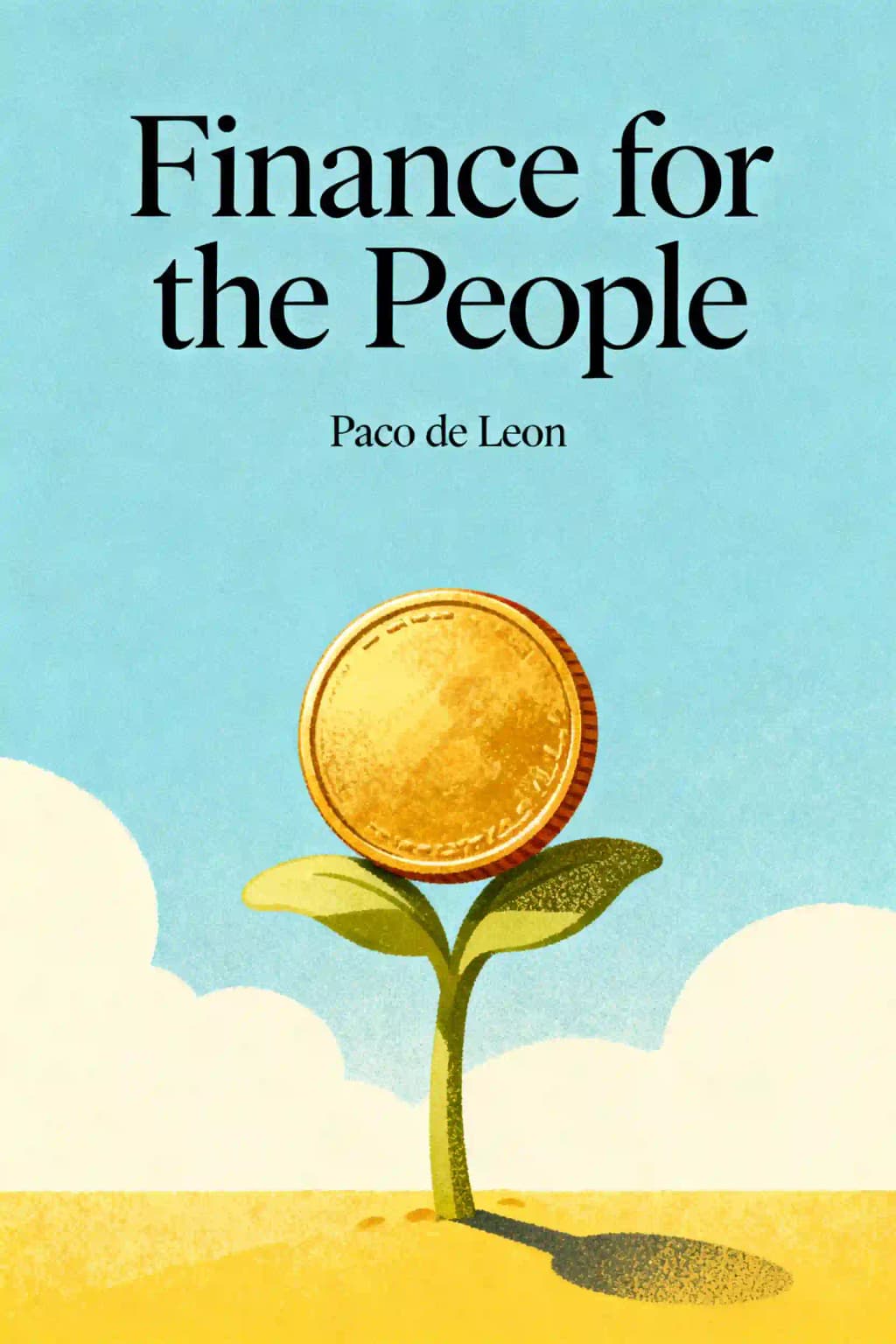
Paco de Leon's "Finance for the People" revolutionizes personal finance with illustrations and empathy, not austerity. Named one of Fortune's Most Anticipated Books of 2022, it explains inflation through whiskey and student debt through plants. What financial beliefs are secretly controlling your life?
Paco de Leon is the author of Finance for the People and a financial expert renowned for demystifying personal finance for creatives and entrepreneurs. A certified financial planner and founder of The Hell Yeah Group, a Los Angeles-based financial firm, she blends her background in wealth management, small business consulting, and artistic pursuits to address systemic financial barriers.
The book combines practical money management with mindfulness, reflecting her mission to empower readers through approachable frameworks and hand-drawn illustrations.
De Leon’s insights have been featured in The New York Times, NPR, Bloomberg, and VICE, and she authored Refinery29’s finance column Taking Stock. A TED speaker, she hosts the podcast Weird Finance, exploring money’s societal impact, and publishes the Nerdletter, a weekly guide to financial literacy.
Finance for the People has been hailed as a “transformative, no-fluff classic” by Refinery29, resonating with readers seeking inclusive, actionable strategies to build wealth and reclaim financial agency.
Finance for the People is a practical, illustrated guide to improving financial health by addressing both practical steps and psychological barriers. Paco de Leon blends mindfulness exercises with actionable strategies for managing debt, saving, and investing, while acknowledging systemic inequalities. The book features over 50 diagrams to simplify complex concepts, making it accessible for readers at any financial level.
This book suits anyone overwhelmed by finances, especially creatives and those excluded from traditional financial systems. It’s ideal for readers seeking to balance emotional money struggles with tactical advice, such as building emergency funds or navigating credit card debt. De Leon’s empathetic approach resonates with millennials and underrepresented groups.
Yes, reviewers praise its unique blend of empathy and practicality, calling it “one of the most approachable financial books” (Refinery29). Unlike conventional guides, it tackles systemic challenges and personal beliefs, offering tools like the “Pyramid of Financial Awesomeness” framework. The illustrations and relatable tone make complex topics engaging.
De Leon acknowledges rigged systems but emphasizes actionable control, like negotiating debts or automating savings. She provides strategies to “play the game” within flawed structures, such as improving credit scores or investing retirement funds wisely. The book avoids blaming individuals, focusing instead on resilience.
This framework prioritizes financial milestones like emergency savings, debt repayment, and retirement investing. De Leon encourages non-linear progress, allowing readers to tackle achievable goals first. The pyramid serves as a visual roadmap for building stability and wealth.
These emphasize accountability and systematic effort over quick fixes.
She advises listing all debts, negotiating lower interest rates, and using the “avalanche method” (prioritizing high-interest debts first). De Leon also stresses addressing emotional spending habits through mindfulness exercises.
Yes, it demystifies stocks, retirement accounts (e.g., 401(k)s), and compound growth. De Leon advocates low-cost index funds and diversifying investments. The book contrasts with traditional guides by linking investing to systemic barriers and personal empowerment.
Unlike austerity-focused guides, Finance for the People emphasizes increasing income over cutting small expenses. De Leon critiques scarcity mindsets, blending structural analysis with tools like budget tracking and debt payoff calculators.
Some note it’s basic for finance-savvy readers, focusing more on foundational steps than advanced strategies. Others highlight its U.S.-centric examples, though global readers can adapt core principles.
As founder of The Hell Yeah Group (serving creatives), her experience in banking, wealth management, and small business consulting informs the book’s practical tone. Her TED talks and podcast (Weird Finance) further shape its accessible style.
Yes, de Leon ties financial health to self-awareness, using exercises to uncover hidden money beliefs. Readers journal responses to prompts like “What did your family teach you about debt?” to align actions with values.
With rising inflation and student debt, its focus on systemic resilience and mental shifts remains critical. The book’s hybrid approach—mixing tactical steps with emotional wellness—aligns with post-pandemic financial realities.
저자의 목소리로 책을 느껴보세요
지식을 흥미롭고 예시가 풍부한 인사이트로 전환
핵심 아이디어를 빠르게 캡처하여 신속하게 학습
재미있고 매력적인 방식으로 책을 즐기세요
Money isn't just currency-it's power.
We're all weird about money in our unique ways.
Credit numbs the spending pain.
The antidote to scarcity is gratitude.
Experiences plant themselves like seeds in your subconscious.
Finance for the People의 핵심 아이디어를 이해하기 쉬운 포인트로 분해하여 혁신적인 팀이 어떻게 창조하고, 협력하고, 성장하는지 이해합니다.
Finance for the People을 빠른 기억 단서로 압축하여 솔직함, 팀워크, 창의적 회복력의 핵심 원칙을 강조합니다.

생생한 스토리텔링을 통해 Finance for the People을 경험하고, 혁신 교훈을 기억에 남고 적용할 수 있는 순간으로 바꿉니다.
무엇이든 물어보고, 목소리를 선택하고, 진정으로 공감되는 인사이트를 함께 만들어보세요.

샌프란시스코에서 컬럼비아 대학교 동문들이 만들었습니다
"Instead of endless scrolling, I just hit play on BeFreed. It saves me so much time."
"I never knew where to start with nonfiction—BeFreed’s book lists turned into podcasts gave me a clear path."
"Perfect balance between learning and entertainment. Finished ‘Thinking, Fast and Slow’ on my commute this week."
"Crazy how much I learned while walking the dog. BeFreed = small habits → big gains."
"Reading used to feel like a chore. Now it’s just part of my lifestyle."
"Feels effortless compared to reading. I’ve finished 6 books this month already."
"BeFreed turned my guilty doomscrolling into something that feels productive and inspiring."
"BeFreed turned my commute into learning time. 20-min podcasts are perfect for finishing books I never had time for."
"BeFreed replaced my podcast queue. Imagine Spotify for books — that’s it. 🙌"
"It is great for me to learn something from the book without reading it."
"The themed book list podcasts help me connect ideas across authors—like a guided audio journey."
"Makes me feel smarter every time before going to work"
샌프란시스코에서 컬럼비아 대학교 동문들이 만들었습니다

Finance for the People 요약을 무료 PDF 또는 EPUB으로 받으세요. 인쇄하거나 오프라인에서 언제든 읽을 수 있습니다.
What if the real reason you're struggling financially has nothing to do with budgeting apps or spending too much on coffee? Picture someone inheriting a trust fund but spending every dollar as soon as it arrives, living paycheck to paycheck despite being wealthy. Or consider someone raised in affluence who can't open their own mail, racking up late fees despite having plenty of money. These aren't stories about financial illiteracy-they're about something deeper. Money carries emotional weight that no spreadsheet can capture. We're all weird about money in our own ways, shaped by childhood experiences, family dynamics, and cultural messages about wealth and worth. That woman with the trust fund? She opposed economic inequality so fiercely that her brain sabotaged her own financial stability to resolve the cognitive dissonance. The one who couldn't open mail had never learned basic financial tasks because everything was handled for her. Our money problems aren't just mathematical-they're psychological, emotional, and deeply personal. Every financial decision you make is influenced by stories planted in your mind years ago. Maybe you watched your father grow resentful when your mother outearned him, teaching you that discussing money breeds conflict. Perhaps you grew up in poverty and now identify so strongly with that struggle that behaviors leading to stability feel like betraying who you are. These aren't conscious choices-they're subconscious programs running in the background. Society reinforces this weirdness through aggressive silence. We've normalized talking about sex and politics on first dates, yet salary discussions remain taboo even among close friends. Many workplaces explicitly forbid employees from discussing compensation, keeping everyone in the dark about their market value. When we suppress money conversations, they don't disappear-they emerge later as anxiety, shame, or explosive arguments. Meanwhile, your brain is working against you in other ways. That ancient survival mechanism that once helped your ancestors detect resource scarcity now makes you feel perpetually lacking, even when you have enough. The comparison instinct that kept early humans safe in their tribes now fuels endless scrolling through social media, where you're bombarded with curated highlight reels that make your life feel inadequate-followed immediately by ads selling solutions to that manufactured inadequacy.