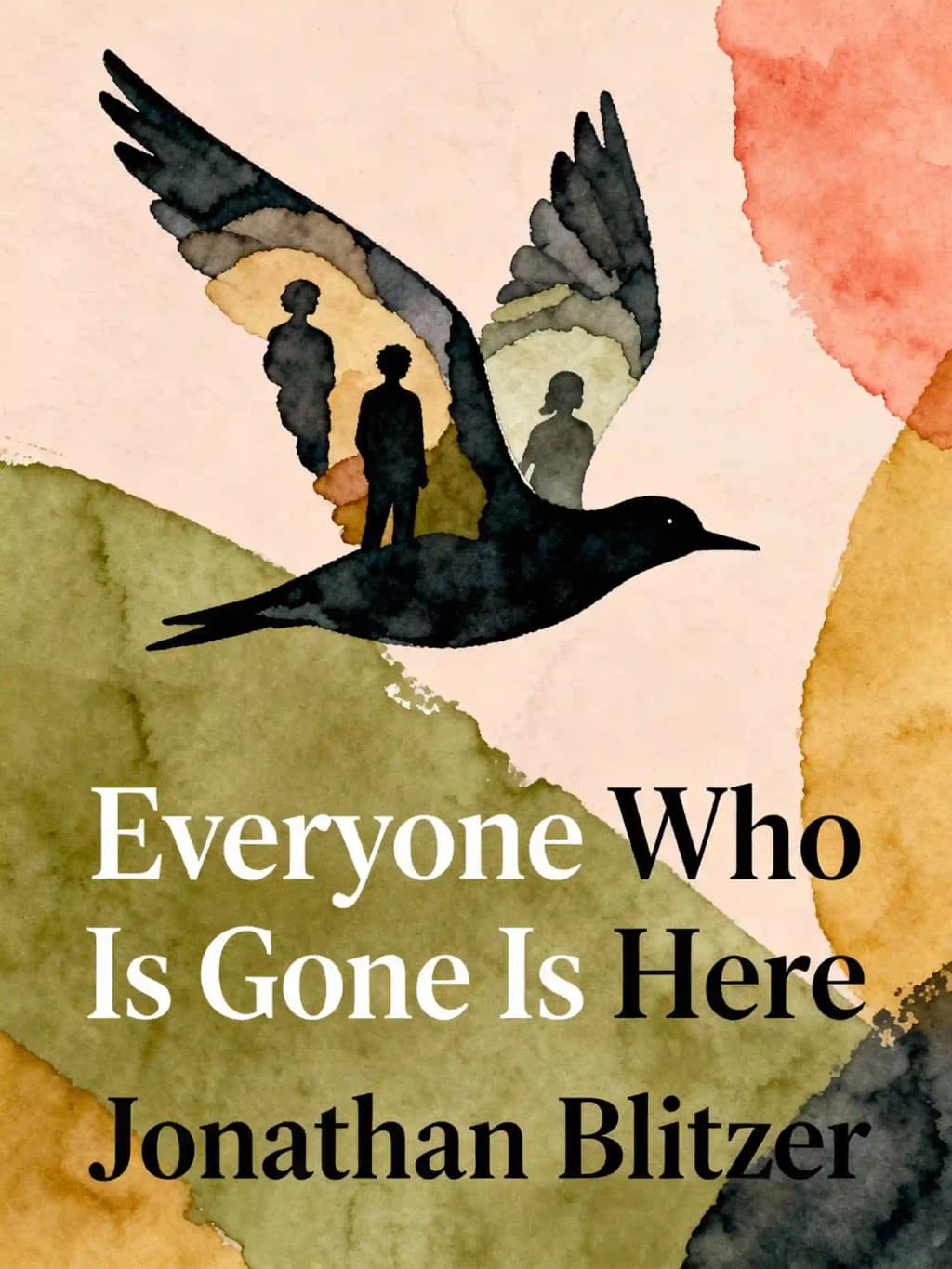
Blitzer's masterful chronicle unveils how U.S. policies shaped Central America's migration crisis through unforgettable human stories. Praised by Jill Lepore for its "devastatingly sharp relief," it reveals what one migrant called "una cucharita de justicia" - a little spoonful of justice long overdue.
Jonathan Blitzer, acclaimed author of Everyone Who Is Gone Is Here: The United States, Central America, and the Making of a Crisis, is a staff writer at The New Yorker and a leading voice on immigration policy and humanitarian crises.
Blitzer’s narrative non-fiction work traces the roots of Central American migration to the U.S., blending political history with firsthand reporting from El Salvador, Guatemala, and Honduras. His expertise stems from over a decade of investigative journalism, including award-winning coverage of deportation policies, gang violence, and climate-driven displacement.
A 2021 Emerson Fellow at New America, Blitzer has received the Edward R. Murrow Award, the Immigration Journalism Prize, and a National Award for Education Reporting. His writing has appeared in The Atlantic, The New York Times, and The Nation, with notable stories profiling figures like Stephen Miller and analyzing migration’s intersection with climate change.
Everyone Who Is Gone Is Here has been widely praised for its searing insights into America’s border crisis and was named a finalist for the 2024 Helen Bernstein Book Award for Excellence in Journalism.
Everyone Who Is Gone Is Here by Jonathan Blitzer examines the U.S.-Central America immigration crisis through personal stories of migrants and policymakers. It traces decades of political conflict, corruption, and misguided U.S. policies that fueled displacement, while highlighting the human cost of border struggles. Blitzer connects historical events like 1980s civil wars to modern-day crises, offering a comprehensive look at systemic failures.
Jonathan Blitzer is a New Yorker staff writer and award-winning journalist specializing in immigration. He received the 2018 Immigration Journalism Prize and a National Award for Education Reporting. His work blends investigative rigor with narrative storytelling, drawing from years of reporting on Central American migration and U.S. policy impacts.
This book is essential for policymakers, historians, and readers seeking to understand immigration’s root causes. It appeals to those interested in Central American history, human rights advocacy, or U.S. foreign policy. Blitzer’s blend of personal narratives and political analysis makes it accessible for both academic and general audiences.
Yes—it’s lauded as an “urgent, extraordinary” account (Patrick Radden Keefe) and named a New York Times Best Book of 2024. Barack Obama included it in his 2024 reading list. The book’s depth and empathy make it critical for understanding ongoing border debates and humanitarian challenges.
Blitzer details the 1980s Salvadoran/Guatemalan civil wars, U.S. Cold War interventions, 1990s mass deportation policies, and Honduras’ 2000s anti-crime crackdowns. These events destabilized Central America, creating conditions for gang proliferation and mass migration—a direct link to today’s border crises.
It identifies U.S.-backed military regimes, economic inequality, and corruption as key drivers. For example, Salvadorans fleeing U.S.-funded death squads in the 1980s faced deportation, while later policies turned street gangs into transnational cartels—forcing new waves of displacement.
Blitzer argues U.S. interventions—from Reagan-era support for authoritarian regimes to Obama/Trump-era deportations—directly destabilized Central America. Policies like mass incarceration and family separations exacerbated trauma, creating cycles of violence and migration.
Yes, including Juan Romagoza, a Salvadoran doctor tortured by U.S.-backed forces, and John Fife, an Arizona minister aiding refugees. These accounts humanize statistics, showing migrants’ resilience amid bureaucratic indifference.
He condemns detention centers as inhumane and counters that deporting gang members without context strengthened cartels. The book highlights how enforcement-first approaches ignore systemic causes, perpetuating crises.
Blitzer advocates for addressing root causes: reducing corruption, investing in Central American economies, and reforming U.S. asylum processes. He emphasizes cross-border cooperation over militarized enforcement.
It contextualizes Trump-era policies within a 40-year history of bipartisan failures. Blitzer shows how immigration became a populist tool, with rhetoric overshadowing humanitarian realities—a pattern persisting in 2025 debates.
The book was longlisted for the Baillie Gifford Prize, named a New York Times Best Book of 2024, and endorsed by Jon Stewart and Sally Hayden. It’s praised for its “masterful” synthesis of policy and human experience.
저자의 목소리로 책을 느껴보세요
지식을 흥미롭고 예시가 풍부한 인사이트로 전환
핵심 아이디어를 빠르게 캡처하여 신속하게 학습
재미있고 매력적인 방식으로 책을 즐기세요
the conditions driving migration remain more terrifying than any punishment at the border.
Romero enlisted Juan and other medical students as his 'eyes and ears'
This is so that you will never practice medicine again.
dismissing the reports as 'guerrilla propaganda' despite overwhelming evidence.
operating as 'pro bono coyotes'
Everyone Who Is Gone Is Here의 핵심 아이디어를 이해하기 쉬운 포인트로 분해하여 혁신적인 팀이 어떻게 창조하고, 협력하고, 성장하는지 이해합니다.
Everyone Who Is Gone Is Here을 빠른 기억 단서로 압축하여 솔직함, 팀워크, 창의적 회복력의 핵심 원칙을 강조합니다.

생생한 스토리텔링을 통해 Everyone Who Is Gone Is Here을 경험하고, 혁신 교훈을 기억에 남고 적용할 수 있는 순간으로 바꿉니다.
무엇이든 물어보고, 목소리를 선택하고, 진정으로 공감되는 인사이트를 함께 만들어보세요.

샌프란시스코에서 컬럼비아 대학교 동문들이 만들었습니다
"Instead of endless scrolling, I just hit play on BeFreed. It saves me so much time."
"I never knew where to start with nonfiction—BeFreed’s book lists turned into podcasts gave me a clear path."
"Perfect balance between learning and entertainment. Finished ‘Thinking, Fast and Slow’ on my commute this week."
"Crazy how much I learned while walking the dog. BeFreed = small habits → big gains."
"Reading used to feel like a chore. Now it’s just part of my lifestyle."
"Feels effortless compared to reading. I’ve finished 6 books this month already."
"BeFreed turned my guilty doomscrolling into something that feels productive and inspiring."
"BeFreed turned my commute into learning time. 20-min podcasts are perfect for finishing books I never had time for."
"BeFreed replaced my podcast queue. Imagine Spotify for books — that’s it. 🙌"
"It is great for me to learn something from the book without reading it."
"The themed book list podcasts help me connect ideas across authors—like a guided audio journey."
"Makes me feel smarter every time before going to work"
샌프란시스코에서 컬럼비아 대학교 동문들이 만들었습니다

Everyone Who Is Gone Is Here 요약을 무료 PDF 또는 EPUB으로 받으세요. 인쇄하거나 오프라인에서 언제든 읽을 수 있습니다.
Ten Honduran migrants bow their heads in prayer at a Mexican housing complex called Solidarity 2000. It's August 2019, and they're thousands of miles from home but still hundreds from their destination. They share stories, swap memories of American detention centers, and pass around keepsakes-scraps of paper with phone numbers, faded photographs, rosaries blessed by priests they'll never see again. This scene captures something essential about modern migration: it's no longer about single men crossing borders for work. It's about families fleeing conditions so desperate that no wall, no policy, no threat of separation can stop them. Despite a century of enforcement efforts and billions spent on deterrence, people keep coming because what they're running from is worse than anything they'll face at the border. Juan Romagoza wanted to heal people, not become a revolutionary. Growing up in rural El Salvador, he watched his grandfather die waiting for medical care-an image that drove him toward medicine. But medical school in the late 1970s coincided with political awakening. El Salvador's grotesque inequality, where twenty-five families controlled ninety percent of the nation's wealth, was cracking open. When Juan saw soldiers execute a wounded student protester in his hospital in February 1980, everything changed. He found himself drawn to Archbishop Oscar Romero, the "voice of the voiceless" whose radio sermons condemned government violence. Romero enlisted Juan and other medical students as his eyes and ears, gathering evidence of torture that he cited in broadcasts heard across the nation. When Romero was assassinated while celebrating mass in March 1980, any hope for peaceful resolution died with him. Juan continued treating torture victims, learning to recognize the signature patterns of electric shocks and cigarette burns. Then his name appeared on a death squad list. Captured in December 1980, Juan endured twenty-four days of systematic torture-electric shocks, sexual assault, suspension by his fingers. His torturers shot through his left forearm, telling him he'd never practice medicine again. They were wrong, but Juan's personal nightmare reflected a larger tragedy: the Reagan administration was pouring hundreds of millions into supporting the very forces committing these atrocities, all in the name of fighting communism.