1장
A Timeless Tale of Good and Evil in America's Eden
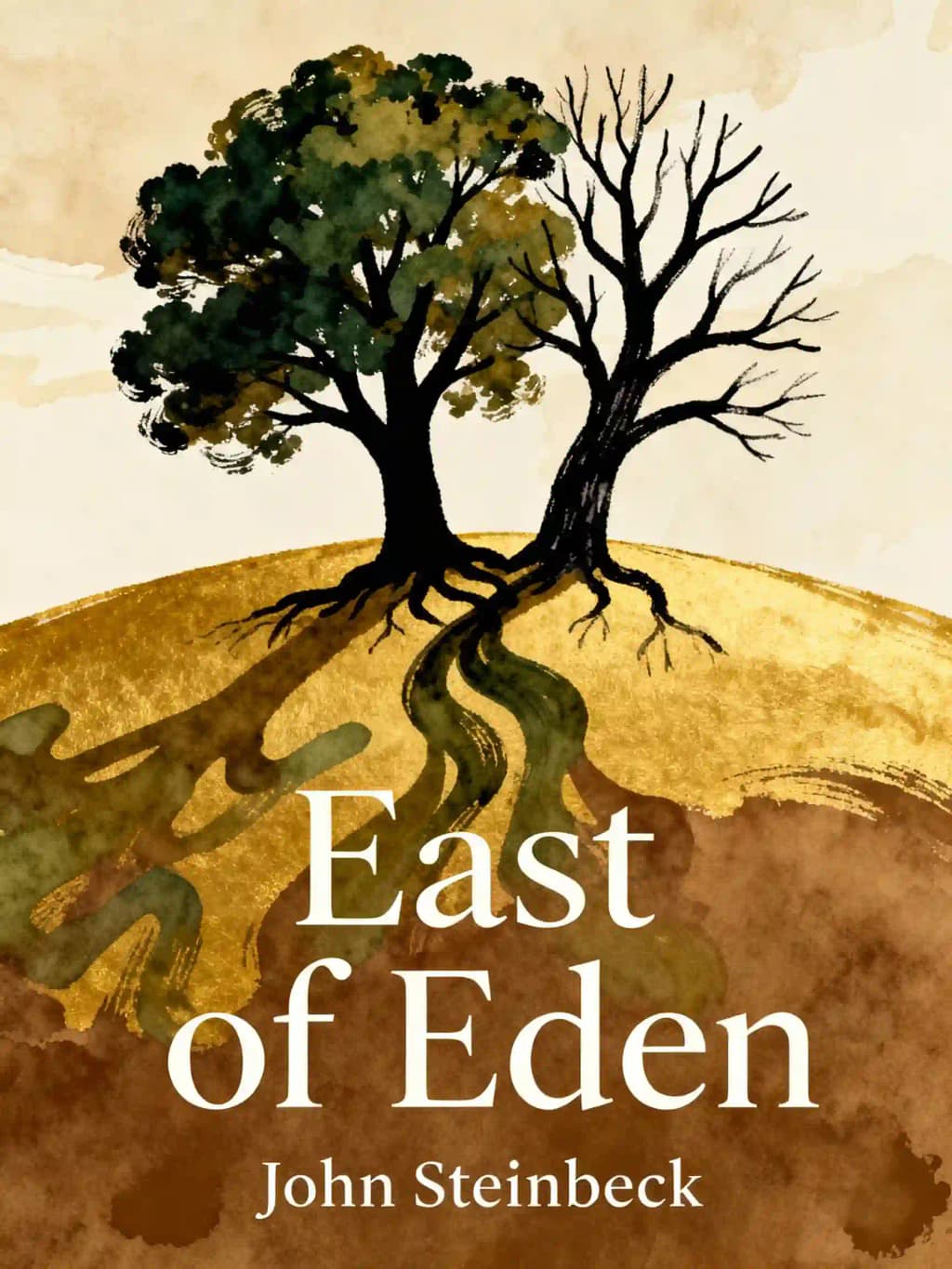
Have you ever wondered why East of Eden remains one of America's most beloved novels nearly 70 years after its publication? When Oprah Winfrey selected it for her book club in 2003, she called it "the perfect novel" that changed her life. The book has sold over 50 million copies worldwide and continues to captivate readers with its exploration of human nature. John Steinbeck himself considered it his magnum opus, telling his publisher, "I think everything else I have written has been, in a sense, practice for this." This sprawling epic, drawing from biblical themes and Steinbeck's own family history, offers a profound meditation on the eternal struggle between good and evil that resonates across generations.
2장
The Salinas Valley: A Land of Contrasts and Cycles
The Salinas Valley stretches between two mountain ranges in Northern California-the inviting, sun-filled Gabilans to the east and the dark, brooding Santa Lucias to the west. This geographical setting isn't merely backdrop but a living character in Steinbeck's narrative. The valley follows California's thirty-year water cycle: five or six lush years when wildflowers erupt in explosions of color, followed by decent years, then devastating dry periods when the land cracks open and springs disappear. Yet people consistently forget the dry years during wet ones, and forget the wet during drought-a pattern that mirrors the human tendency to ignore history's lessons.
Before European settlement, indigenous peoples lived simply off the land. They were followed by "hard, dry Spaniards" seeking gold or God, who claimed vast tracts and established feudal settlements. When Americans arrived, they developed an insatiable land-greed, taking more than they needed or could use. Families who might have prospered on ten acres in Europe remained poor on two thousand in California. These early settlers survived through either "divine stupidity or great faith," trusting themselves as valuable individuals and giving their courage and dignity to God, receiving it back-a quality Steinbeck suggests might be lost in modern times.
Into this valley came two remarkable families whose intertwined destinies form the novel's backbone: the Hamiltons and the Trasks. Samuel Hamilton, an Irishman with wandering blue eyes and clever hands, homesteaded seventeen hundred acres of harsh, dry land east of King City with his Presbyterian wife Liza. Though skilled at blacksmithing, carpentry, and invention, Samuel had no talent for making money. He built wells for luckier men, invented machines, and repaired tools while men gathered to hear his poetic talk. Despite his skills, Samuel remained poor while raising nine children, becoming known throughout the region for his gentle hands and wisdom.
The contrast between the valley's fertile soil and the Hamiltons' barren land establishes one of the novel's central tensions-the arbitrary nature of fortune and the human capacity to create meaning despite circumstances. Samuel's inventive spirit and Liza's rigid discipline create a family that thrives despite material poverty, suggesting that true wealth lies in character rather than possessions.
3장
The Curse of Cain: Adam and Charles Trask
The Trask family story begins in Connecticut with Cyrus Trask, a Civil War veteran who lost his leg after just thirty minutes of combat but reinvented himself as a military expert through elaborate lies. Running his household like an army camp, Cyrus subjects his sons-Adam and Charles-to harsh military training. Adam is naturally obedient, shrinking from conflict by retreating into a veiled inner life. His half-brother Charles, just a year younger, possesses natural athleticism and competitive spirit.
The relationship between the brothers echoes the biblical story of Cain and Abel. When Adam accidentally outperforms Charles in a game, Charles attacks him savagely, revealing a jealousy that will define their relationship. Later, when Adam gives their father a stray puppy for his birthday while Charles gives an expensive knife, Cyrus treasures Adam's gift and ignores Charles's. This perceived rejection triggers Charles's murderous rage, and he nearly kills Adam in a calculated assault.
This pattern of jealousy and violence establishes the novel's exploration of sibling rivalry and inherited sin. As Charles later writes to Adam: "I think of my life and it seems like an accident... sometimes I think I missed something." This sense of misdirection and missed purpose haunts both brothers throughout their lives.
After Cyrus arranges for Adam to join the cavalry, Adam develops a profound aversion to violence during his five years of service. Though skilled as a marksman, he deliberately misses when shooting at enemies and risks his life to save wounded men. Meanwhile, Charles maintains the farm alone, writing revealing letters about his loneliness and inner struggles.
When Adam returns, the brothers establish an uneasy coexistence until Adam leaves again, wandering for three years as a bindlestiff-a traveling laborer. During these years, he encounters "philosophers, criminals, fallen priests, and professors" around campfires, learning the techniques of survival and the wisdom of poverty. After being twice sentenced to Florida road gangs and enduring brutal conditions, Adam escapes and finally returns home to Charles.
Their relationship represents one of the novel's most compelling explorations of how temperament and circumstance shape human destiny. Despite their shared upbringing, the brothers respond differently to life's challenges-Adam with passive resistance, Charles with smoldering violence-suggesting that human nature contains both impulses in varying measures.
4장
The Monster Among Us: Cathy Ames
Into the brothers' lives comes Cathy Ames, perhaps American literature's most chilling villain. Steinbeck describes her as born with "a malformation of the soul," lacking normal human empathy or conscience. Despite her angelic appearance-golden hair, heart-shaped face, tiny rosebud mouth-something in her gaze disturbs people, a quality that makes them look twice.
Unlike most children who desperately seek conformity, Cathy never conformed. Her genius lay in calculated lying that served specific purposes of escape or profit. Most disturbing was her early understanding of human sexuality as a weapon-she recognized its power to manipulate others while remaining immune to its influence herself.
Cathy's life unfolds as a series of calculated deceptions. At sixteen, she murders her parents by burning down their house after her father punishes her for running away. She reinvents herself as Catherine Amesbury and becomes the mistress of Mr. Edwards, a Boston brothel operator. When Edwards discovers her true nature and past, he beats her savagely and leaves her for dead.
The injured Cathy crawls to the Trask farm, where Adam falls hopelessly in love with her. Despite Charles's suspicions-"There's something that bothers me-that I ought to know"-Adam marries Cathy. On their wedding night, she drugs Adam and sleeps with Charles, creating a paternity mystery that will echo through generations.
Cathy represents pure evil in the novel's moral universe-not the result of circumstance or trauma but something innate and inexplicable. Her character challenges comfortable notions that human nature is fundamentally good or that evil always has understandable causes. As Steinbeck writes, "I believe there are monsters born in the world to human parents... The face and body may be perfect, but if a twisted gene or a malformed egg can produce physical monsters, may not the same process produce a malformed soul?"
5장
Eden in California: Adam's Dream and Downfall
After selling his farm share to Charles for a considerable sum, Adam takes his reluctant bride across the continent to California's Salinas Valley. The journey west represents more than mere relocation - it embodies the quintessential American journey of reinvention. Lured by promotional materials describing the valley as paradise, with rich soil and perfect climate, Adam meticulously surveys available properties before selecting a fertile stretch of land near the Hamilton family's homestead. When Cathy becomes pregnant, Adam's joy knows no bounds, his happiness blinding him to her desperate attempt to terminate the pregnancy with a knitting needle - an act that foreshadows the darkness lurking beneath his idealistic vision.
Adam's vision for his land is biblical in scope, reflecting the grandiose dreams of countless settlers before him. He plans with extraordinary attention to detail, using copper nails instead of iron to prevent rust, selecting hardwood that will resist rot for generations. Every element is chosen for permanence, from the foundation stones to the roof beams. He envisions vast alfalfa fields stretching to the horizon, visible from every window of his grand house. The rows of eucalyptus trees he plans will serve as windbreaks while creating natural corridors of shade. His experimental farm concept includes exotic fruits and vegetables from around the world, and he dreams of innovative irrigation systems with windmills dotting the landscape. These plans represent not just a farm but a manifest destiny - the quintessential American desire to create a new Eden, to start fresh and build a legacy that will outlast generations.
Samuel Hamilton, the wise Irish immigrant and neighbor, becomes integral to Adam's planning process. Using his legendary divining rod, Samuel helps locate multiple water sources on the property, though he privately harbors concerns about the enterprise's future. Despite his intuitive misgivings about Cathy, whose cold demeanor and empty eyes trouble him deeply, Samuel is moved by Adam's pure-hearted enthusiasm and earnest belief in possibility. He commits himself to helping realize this vision of paradise, perhaps seeing in Adam's dream echoes of his own younger hopes.
The dream violently implodes when Cathy gives birth to twin boys - Caleb and Aron. Just days after their birth, in a scene of shocking brutality, she shoots Adam in the shoulder and abandons the family without a backward glance. She makes her way to Salinas, where she calculates her next move and eventually becomes a prostitute at Faye's brothel, assuming the name Kate. This new identity allows her to pursue her darker impulses while maintaining a facade of respectability. Meanwhile, Adam falls into a devastating depression that lasts over a decade. He proves unable to even name his sons for nearly a year, and the basic care of the infants falls to Lee, his philosophical Chinese servant, who becomes their de facto parent.
This catastrophic abandonment represents more than personal tragedy - it symbolizes the fundamental fall from Eden, the moment when innocence shatters against reality's harsh edges. Adam's psychological paralysis mirrors the biblical Adam's expulsion from the Garden, suggesting that all human dreams of perfection ultimately collide with the darker aspects of human nature. The carefully planned paradise becomes a monument to shattered illusions, with the copper nails and hardwood serving as painful reminders of misplaced faith in permanence.
6장
Timshel: The Freedom to Choose
The novel's philosophical heart emerges through Lee, the Chinese servant who raises Adam's twin sons. Initially speaking pidgin English to meet Americans' expectations of Asian immigrants, Lee reveals his true educated self to Samuel Hamilton, demonstrating how societal prejudices force him to wear a mask. Their subsequent friendship produces the novel's most profound discussions about human nature and moral choice, with Lee serving as both philosopher and moral compass.
Years after Cathy's devastating departure, Lee confronts Samuel and Adam about the unnamed twins, who are growing up in an emotional vacuum without proper parental attention. The boys, already showing distinct personalities, remain nameless - a symbolic representation of Adam's withdrawal from fatherhood. In a pivotal scene, Samuel physically attacks Adam, shaking him from his years-long stupor and demanding he name his sons and fulfill his parental duties. After careful deliberation, they choose Caleb and Aaron (Cal and Aron), deliberately echoing the biblical Cain and Abel, though this parallel weighs heavily on their future.
During this emotionally charged naming ceremony, Lee reveals his scholarly investigation into the Cain and Abel story, particularly focusing on the Hebrew word "timshel" that appears when God speaks to Cain. Working with Chinese scholars at Berkeley and consulting numerous rabbis, Lee discovered that earlier translations had fundamentally misinterpreted this crucial word. The King James Bible translated it as "thou shalt," while the American Standard version used "do thou," both suggesting a predetermined fate. However, the correct translation-"thou mayest"-reveals that humans have choice rather than predetermined destiny.
"The American Standard translation orders men to triumph over sin," Lee explains with passionate conviction. "The King James translation makes a promise in 'thou shalt.' But the Hebrew word timshel-'thou mayest'-that gives a choice. It might be the most important word in the world. That says the way is open... For if 'thou mayest'-it is also true that 'thou mayest not.'" This linguistic discovery becomes a philosophical breakthrough, suggesting that moral choice lies at the heart of human existence.
This revelation becomes the novel's moral compass and central theme, weaving through every major character's journey. Humans are neither condemned to repeat their ancestors' sins nor guaranteed salvation through divine grace-they must actively choose their path. As Lee eloquently states, "We are descended from this. This is our ancestry... we have the choice of winning." This philosophy offers hope without denying the reality of evil or the power of inherited tendencies, suggesting that while we may carry the weight of our heritage, we retain the freedom to choose our own destiny. The concept of timshel becomes particularly significant for Cal, who struggles with his perceived inheritance of his mother's darkness, ultimately learning that he can choose his own moral path despite his genetic legacy.
7장
The Next Generation: Cal and Aron
The twins Cal and Aron grow up as distinct personalities despite their identical appearance. Aron is golden-haired with blue eyes, naturally drawing affection. Cal grows dark-skinned and dark-haired, quick-minded and secretive. Adults find him precociously mature but slightly frightening, and while no one truly likes him, his classmates respect him out of fear.
From early childhood, Cal craves the warmth and affection that comes naturally to Aron. His attempts to imitate his brother's winning ways appear suspicious on his dark, slit-eyed face. Repeated rejection teaches Cal to expect it everywhere, building walls of self-sufficiency around himself.
The brothers' contrasting natures play out against the backdrop of Salinas, where the Trasks move for better schools. Aron falls in love with Abra Bacon, a strong-willed girl who becomes his idealized vision of purity. Meanwhile, Cal discovers the truth about their mother through night wanderings and eavesdropping. When he confronts Lee with this knowledge, Lee confirms that Kate runs a brothel in Salinas but begs Cal to protect Aron from this devastating truth.
Cal's struggle with his perceived inheritance of evil drives the novel's final act. After Adam loses his fortune in a failed refrigeration venture, Cal determines to earn money to repay his father. Partnering with Will Hamilton, Cal contracts with farmers to grow beans at five cents a pound, then sells them to the British Purchasing Agency for twelve cents as World War I creates demand. He earns fifteen thousand dollars honestly but struggles with his motives-"My father is good. I want to make it up to him because I am not good."
When Cal presents this gift on Thanksgiving, Adam rejects it, saying he doesn't want profits from war and wishes Cal had given him "what your brother has-pride in the thing he's doing." This devastating rejection triggers Cal's darkest impulse-he takes Aron to see their mother at her brothel. The shock sends Aron into a tailspin; he enlists in the army underage and is killed in combat.
The parallel to Cain and Abel is explicit, yet Steinbeck complicates this biblical narrative. Cal's sin isn't simple jealousy but a complex mixture of love, rejection, and self-loathing. His struggle represents the universal human battle between destructive impulses and the desire for goodness.
8장
The Power of Blessing
The novel reaches its emotional apex with Adam's devastating stroke, triggered by the news of Aron's death in World War I. As Adam lies paralyzed, barely able to move or speak, Lee becomes the moral compass of the scene, understanding that this final moment between father and son carries the weight of generations. Lee's desperate plea for Adam to bless Cal emerges from his deep understanding that without this spiritual and emotional release, Cal might repeat the destructive patterns that have haunted the Trask family for generations.
Lee's intervention is particularly poignant because he has witnessed the entire tragic arc of the family's story. His words to Adam - "Give him your blessing. Don't leave him alone with his guilt" - echo with the wisdom of someone who has seen how unresolved guilt can poison a soul. He understands that Cal, like his father before him, stands at a crucial crossroads where a parent's blessing or rejection could determine the course of his entire life.
The concept of "timshel" - thou mayest - reaches its full significance in this climactic moment. When Adam, with monumental effort, utters "Timshel!" as his final word, it transcends simple forgiveness. This single word carries multiple layers of meaning: it's simultaneously a blessing, a recognition of free will, and a profound acknowledgment that Cal's future remains unwritten. The word liberates Cal from both the deterministic burden of his mother's perceived evil and the crushing weight of his own guilt over Aron's death.
This scene masterfully weaves together the novel's central themes about human nature and moral choice. Through Adam's final blessing, Steinbeck illustrates that our inheritance - whether genetic or spiritual - need not determine our destiny. The moment emphasizes that while we may carry the weight of our ancestors' choices and our own past actions, we retain the fundamental human dignity of moral choice.
The power of this blessing extends beyond the immediate father-son relationship. It represents a breaking of cycles - of rejection, of predetermined fate, of inherited sin. Lee's earlier conversations with Cal about choice take on new meaning in light of this moment: "We are descended from this... we are the children of our father. And now you can have the choice." These words resonate throughout the novel's conclusion, suggesting that each generation has the opportunity to choose anew.
The enduring impact of East of Eden lies in this nuanced exploration of human agency. Steinbeck's message isn't one of simple optimism, but rather a complex hope that acknowledges both human frailty and potential. The novel suggests that while we cannot escape our nature or our past, we possess the profound ability to choose our response to them. This message continues to speak to readers across generations, offering a framework for understanding both personal struggle and the larger human story of moral choice and redemption.
9장
The Eternal Story of Humanity
Steinbeck ultimately suggests there is only one story that has ever existed-humans caught in "a net of good and evil." This singular narrative transcends all changes in landscape, economy, and social customs, remaining the essential fabric of human consciousness. From ancient myths to modern literature, from the streets of Salinas Valley to the towers of Manhattan, this fundamental conflict plays out in endless variations. After all our struggles and achievements, we're left with only the simplest moral questions: "Was it good or was it evil? Have I done well-or ill?"
East of Eden brilliantly explores this eternal story through multiple generations, showing how patterns repeat yet can be broken through conscious choice. The Trask and Hamilton families serve as microcosms of humanity, their struggles echoing biblical narratives while remaining deeply personal and immediate. The novel's genius lies in its refusal to offer simple answers while still affirming the possibility of redemption. Evil exists as a real force in the world-embodied most chillingly in Cathy/Kate, whose malevolence seems almost supernatural-yet so does the capacity for growth, forgiveness, and moral choice, as demonstrated through characters like Adam, Cal, and Lee.
The final whispered "Timshel" represents not just Adam's blessing to Cal but Steinbeck's message to readers. This Hebrew word, meaning "thou mayest," becomes the philosophical cornerstone of the novel. We may be shaped by our inheritance and circumstances, but we are not determined by them. The freedom to choose-to overcome our worst impulses and nurture our best-remains our most profound human gift and responsibility. This concept is particularly embodied in Cal's journey, as he struggles against what he perceives as inherited evil from his mother while discovering his capacity for choice.
In our contemporary world of moral relativism and deterministic explanations for behavior, East of Eden's insistence on moral choice feels both challenging and refreshing. Modern society often seeks to explain away human actions through psychology, sociology, or genetics, but Steinbeck's novel stands firm in its assertion of individual moral agency. The novel acknowledges the weight of inheritance and circumstance while refusing to absolve individuals of responsibility. This balance-between understanding the forces that shape us and affirming our power to transcend them-gives the novel its enduring relevance and power.
As we close the final pages, we're left with the sense that while the struggle between good and evil continues eternally, each generation has the opportunity to choose anew. The novel suggests that this choice isn't made once but must be renewed daily in both small and large decisions. The path is never easy, but it remains open-thou mayest. This message resonates particularly strongly in times of moral uncertainty, reminding us that while we cannot escape the presence of both good and evil in our nature, we retain the precious freedom to choose between them.