1장
The Digital Paradox: How Minimalism Reclaims Our Humanity
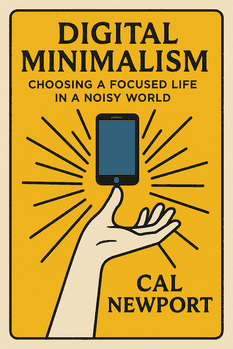
In an age where our devices buzz incessantly with notifications, where the average American checks their phone 52 times daily, and where screen time has become our default pastime, Cal Newport's "Digital Minimalism" arrives as both a warning and a roadmap. This book has struck a chord with millions seeking balance in their digital lives, becoming a Wall Street Journal bestseller and earning praise from tech industry leaders and psychologists alike. Newport, a Georgetown computer science professor who famously doesn't use social media himself, offers a counterintuitive perspective in our hyper-connected world. What makes this book particularly compelling is how it transforms philosophical concepts dating back to Aristotle and Thoreau into practical strategies for modern life. As tech addiction increasingly dominates public health discussions, Newport's approach provides not just critique but concrete solutions. Imagine waking tomorrow with a profound sense of control over your relationship with technology-this is the promise that has made "Digital Minimalism" required reading in Silicon Valley boardrooms and college dorms alike.
2장
The Attention Economy's Invisible Trap
We didn't sign up for this. When Steve Jobs unveiled the first iPhone in 2007, he presented it primarily as a "revolutionary mobile phone" and an "iPod with touch controls." The device launched without an App Store, without social media notifications, without the addictive features that now dominate our digital experience. Jobs himself was initially reluctant to allow third-party apps, concerned about potential instability. What happened in the years that followed represents one of the most profound shifts in human behavior in modern history.
The transformation was subtle yet comprehensive. Technologies that began as minor conveniences gradually entrenched themselves at the core of our daily existence. Facebook evolved from a simple way to keep up with friends to an all-encompassing social ecosystem demanding constant engagement. Smartphones shifted from communication tools to attention-capturing devices we check compulsively throughout our waking hours.
This shift wasn't accidental. As former Google design ethicist Tristan Harris revealed, Silicon Valley companies deliberately engineer their products to maximize user engagement through psychological manipulation. "Your mind is being programmed," Harris warns, comparing tech executives to "tobacco farmers in t-shirts" selling addictive products to an unsuspecting public. The comparison is apt: these companies employ teams of engineers and psychologists whose sole purpose is to make their products as habit-forming as possible.
The mechanisms of this addiction are remarkably sophisticated. Social media platforms leverage intermittent positive reinforcement-the same psychological principle that makes slot machines so addictive. Just as pigeons in B.F. Skinner's experiments pecked compulsively at buttons that delivered unpredictable rewards, we check our phones repeatedly for the variable reward of likes, comments, and notifications. Each notification triggers a dopamine hit, reinforcing the behavior in a powerful neurological loop.
Even more insidious is how these platforms exploit our fundamental need for social approval. The human brain evolved in tribal environments where social standing was crucial for survival. Social media hijacks this primitive instinct, equating digital reactions with tribal acceptance. This creates a powerful psychological hook where missing potential notifications causes genuine distress, compelling continual engagement.
What's truly concerning is how this attention economy has outpaced our ability to adapt. Our brains, evolved for a world of face-to-face interaction and natural rhythms, now confront engineered digital environments specifically designed to exploit our psychological vulnerabilities. The result is a profound asymmetry: billion-dollar companies deploying sophisticated techniques to capture our attention versus individuals armed only with willpower and good intentions.
3장
The Philosophy of Digital Minimalism
Digital minimalism offers a philosophical counterbalance to the attention economy's manipulations. Rather than suggesting minor adjustments or "digital detox" periods that ultimately lead back to the same patterns, Newport proposes a comprehensive philosophy: "A technology use philosophy that starts with your deeply held values and then determines the best role for technology in serving those values."
This approach inverts the standard relationship with technology. Instead of accepting new tools by default and trying to find ways to manage their downsides, digital minimalists begin with their core values and carefully select only those technologies that provide substantial benefits. The philosophy rests on three fundamental principles:
First, clutter is costly. Each additional technology in our lives imposes costs in terms of attention, time, and mental space that often outweigh its small benefits. Henry David Thoreau's experiences at Walden Pond provide a valuable historical perspective here. Thoreau viewed life itself as the true currency, urging us to weigh the minutes expended against any technological benefits. "The cost of a thing," he wrote, "is the amount of what I will call life which is required to be exchanged for it." This economic theory illustrates that excess leads to burdens-more is often less in the digital realm.
Second, optimization matters. Simply identifying that a technology offers some value isn't enough; we must carefully consider how we use each tool to maximize its benefits while minimizing its costs. This reflects the economic principle of diminishing returns-beyond a certain point, additional engagement with technology yields decreasing benefits while continuing to extract costs.
Third, intentionality brings satisfaction. Digital minimalists find genuine fulfillment in mastering their technology habits, creating a sense of autonomy that transcends the specific technologies they choose to use or avoid. This principle finds surprising support in the practices of the Amish, who, contrary to popular belief, aren't anti-technology but rather highly selective about which technologies they adopt. They evaluate each new tool based on whether it strengthens or weakens their community values-a radical intentionality that brings profound satisfaction.
Real-world digital minimalists demonstrate the power of these principles. Adam traded his smartphone for a basic flip phone to set a better example for his children. Michal abandoned social media entirely, focusing instead on meaningful face-to-face interactions. Charles implemented strict rules about when and how he engages with digital content. Each found that these deliberate choices, rather than minor adjustments, truly restored control and enhanced personal fulfillment.
4장
The Digital Declutter: Breaking the Cycle
Gradual changes rarely succeed against the engineered seductions of digital platforms. Newport proposes a more decisive approach: the digital declutter, a thirty-day period of technological reset that breaks existing habits and creates space for intentional rebuilding.
The process begins by defining clear technology rules. Identify which technologies are truly "optional"-those used primarily for entertainment, information, or connection rather than essential professional or personal functions. Gaming and television usage should also be scrutinized. The key is to maintain critical technology uses while eliminating those that are merely convenient or habitual.
During the thirty-day break, it's crucial not only to follow these technology rules but also to actively rediscover meaningful activities beyond screens. This isn't merely about abstaining from technology but about rebuilding a life rich with alternative sources of value and satisfaction. Participants often rediscover forgotten hobbies, deepen relationships through face-to-face interactions, and reconnect with books and physical activities.
The final step-reintroducing technology-is perhaps the most critical. Begin with a blank slate, allowing back only those technologies that directly support your deeply held values. For each technology you consider reintroducing, ask three questions: Does this technology directly support something I deeply value? Is it the best way to support this value? How can I use this technology to maximize its benefits and minimize its harms?
This process transforms technology from a default presence to a carefully selected tool that enhances life's genuinely valuable dimensions. One participant described the experience: "I realized I don't need to be on Instagram. I don't need to know what my friends are doing all the time. And I don't need to document everything I'm doing either."
The digital declutter works because it addresses both the behavioral and psychological dimensions of digital dependence. Behaviorally, it disrupts established habits and creates space for new ones. Psychologically, it demonstrates that life without constant digital connection isn't just survivable but often preferable, undermining the fear of missing out that drives much of our compulsive technology use.
5장
The Power of Solitude in a Connected World
Abraham Lincoln's presidency during the Civil War provides an unexpected lesson in the value of solitude. During the most challenging periods of the war, Lincoln would retreat to the Soldiers' Home, a cottage on elevated ground three miles from the White House. There, amid the serene landscape and away from the constant demands of his office, Lincoln found the mental space to process the weighty decisions before him, including drafting the Emancipation Proclamation.
This historical example illustrates a crucial insight: solitude-defined not as physical isolation but as freedom from input from other minds-is essential for clarity of thought and emotional regulation. Raymond Kethledge and Michael Erwin, in their book "Lead Yourself First," define solitude as "a subjective state in which your mind is free from input from other minds." This state allows for deep reflection, problem-solving, and emotional processing that simply isn't possible amid constant digital stimulation.
Yet modern society has engineered away opportunities for solitude. The continuous connectivity facilitated by smartphones means many people now go entire days without a single moment free from the influence of other minds. This "solitude deprivation" represents a novel threat to human well-being, as our minds require periods of uninterrupted thought to function properly.
The consequences are significant. Without solitude, we struggle to process complex emotions, develop coherent views on important issues, or engage in the deep thinking necessary for creative work. Martin Luther King Jr., for example, regularly sought solitude to confront both personal and societal challenges, finding in these quiet moments the clarity to articulate his vision for social change.
Reclaiming solitude doesn't require dramatic lifestyle changes. Simple practices can create pockets of mental freedom throughout your day:
Leave your phone at home when running errands or taking short trips. This minor change can combat solitude deprivation by creating natural spaces for uninterrupted thought.
Take long walks without digital devices. Nietzsche credited his philosophical insights to walking, writing that "all truly great thoughts are conceived while walking." Walking provides physical distance from digital distractions and creates a mental environment conducive to reflection.
Write letters to yourself-not for publication but as a means of organizing thoughts and clarifying values. This practice helps transform vague impressions into concrete ideas and provides a record of your evolving perspective over time.
These practices aren't about rejecting connection but about balancing it with necessary periods of mental autonomy. Like Thoreau at Walden Pond, who regularly walked into town for conversation and dinner with friends, the goal is to move rhythmically between solitude and connection, allowing each to enhance the other.
6장
Reclaiming Conversation in a Digital Age
In 2007, ESPN broadcast the national championship of the USA Rock Paper Scissors League-an unexpectedly revealing sporting event. The competition between two "RPS phenoms" demonstrated that even this seemingly simple game requires sophisticated social cognition, as players attempt to predict and manipulate their opponents' choices through psychological insight.
This event highlights a fundamental truth: humans possess an innate, profound capacity for social interaction supported by advanced neural networks. Our brains are literally hardwired for sociality, with dedicated systems for interpreting facial expressions, voice tones, and body language. When not engaged in specific tasks, our minds default to thinking about social relationships and interactions-what neuroscientists call the "default network."
Yet digital communication tools often fail to engage these sophisticated social capacities. Text messages, social media interactions, and emails lack the rich nonverbal cues that our brains evolved to process. The result is what sociologist Sherry Turkle calls "communication that isn't conversation"-exchanges that may convey information but fail to satisfy our deeper social needs.
This creates what might be called the social media paradox: while these platforms promise connection, research shows that increased social media use often correlates with increased loneliness and decreased well-being. The explanation lies in displacement-digital interactions tend to replace rather than supplement richer face-to-face connections.
The solution is what Newport calls "conversation-centric communication"-a philosophy that prioritizes rich, real-time interactions while relegating text-based communication to a supporting role. This approach recognizes that conversation-whether in person or through voice/video calls-is the only form of interaction that fully engages our social cognition systems and satisfies our need for connection.
Implementing this philosophy requires several practical shifts:
Don't click "like." The ubiquitous "like" button revolutionized social media by providing a fast means of engagement, but at the cost of meaningful interaction. These minimal-effort interactions barely register as communication, diluting social relationships to digital reflexes rather than genuine contact.
Consolidate texting. Rather than allowing text messages to interrupt your day continuously, treat them more like email-checking and responding during specific time windows. This preserves your attention while encouraging more meaningful exchanges when you do engage.
Hold "conversation office hours"-specific times when you're reliably available for phone calls or in-person meetings. This practice transforms low-quality interactions into richer conversations by offering predictability and reducing the need for scheduling.
These practices aren't about rejecting digital communication entirely but about reclaiming its proper role as a supplement to, rather than replacement for, conversation. As Turkle writes, "Face-to-face conversation is the most human-and humanizing-thing we do."
7장
The Art of High-Quality Leisure
Aristotle argued in the Nicomachean Ethics that the happiest life is one filled with activities valued for their own sake rather than as means to other ends. This ancient wisdom challenges the modern notion that leisure time should be filled with passive consumption or digital distraction.
High-quality leisure activities share three key characteristics that distinguish them from the low-quality leisure that dominates much of modern life:
First, they demand active participation rather than passive consumption. Arnold Bennett, a British writer from the early 20th century, advocated for a "strenuous life" of engaged leisure that energizes rather than depletes. This principle is evident in the satisfaction that comes from activities like trail maintenance, gardening, or learning a musical instrument-pursuits that require effort but yield deeper rewards than scrolling through social media feeds.
Second, high-quality leisure often involves craft-the application of skill to create something of value. Activities like woodworking, knitting, or cooking engage human capacities neglected by screen-based interactions and provide tangible evidence of accomplishment. As woodworker Gary Rogowski explains, craft connects us to our primal abilities and leverages our natural tendency to manipulate the physical world. Philosopher Matthew Crawford adds that craft provides "real and lasting satisfaction" by connecting us to concrete reality in ways that digital interactions cannot.
Third, the most fulfilling leisure activities often involve structured social interaction. Board game cafes like Toronto's Snakes & Lattes have thrived because they facilitate face-to-face social engagement around shared activities. Similarly, group fitness programs like F3 and CrossFit succeed not primarily because of their exercise regimens but because they create communities with shared experiences, rituals, and support systems.
Rebuilding a leisure life around these principles requires intentional practices:
Fix or build something every week. Regular engagement with physical projects, whether repairing household items or creating new ones, cultivates practical skills and reconnects you with the satisfaction of tangible accomplishment.
Schedule low-quality leisure. Rather than eliminating digital entertainment entirely, confine it to specific time periods to protect space for more substantial activities. This strategy terrifies social media companies because it reveals how little value their platforms actually provide.
Join something. Following Benjamin Franklin's example of founding and participating in numerous clubs and societies, seek out structured social activities that bring people together around shared interests or goals.
Follow leisure plans. Approach free time with the same intentionality successful professionals bring to their work life by developing seasonal and weekly leisure plans with specific objectives and activities.
These practices transform leisure from a passive default state to an active pursuit of meaningful engagement. As digital distractions recede, the resulting space allows for rediscovery of activities that engage our full human capacities and provide deeper satisfaction than any notification or social media feed.
8장
Joining the Attention Resistance
In 2017, Facebook launched a series titled "Hard Questions," addressing controversial issues in technology. One article posed the question: "Is spending time on social media bad for us?" This self-examination marked a significant shift in Facebook's narrative and suggested growing vulnerability in the attention economy's business model.
The attention economy-the business model that converts human attention into revenue through advertising-depends on maximizing the time users spend engaged with digital platforms. Yet as awareness grows about the costs of this engagement, resistance has begun to emerge. Digital minimalism represents a philosophical framework for this resistance, offering principles and practices for reclaiming attention from the companies designed to capture it.
Effective resistance requires practical strategies that reduce the power of digital platforms to manipulate behavior:
Delete social media from your phone. Social media companies earn the majority of their revenue from mobile advertising because smartphones capture attention more effectively than computers. By removing these apps from your phone while potentially maintaining access on a computer, you dramatically reduce mindless usage while preserving intentional engagement.
Turn devices into single-purpose computers. Tools like Freedom or Cold Turkey allow you to block distracting websites and apps during specific periods, transforming multi-purpose devices into focused tools for specific tasks. This approach aligns technology use with human attention systems, which function best when focused on one thing at a time.
Use social media like a professional. Social media professor Jennifer Grygiel approaches platforms like Twitter with the disciplined mindset of a professional tool rather than an entertainment source. She schedules specific times for engagement, focuses on quality over quantity, and maintains clear boundaries between personal and professional use.
Embrace slow media. Inspired by the Slow Food movement, Slow Media advocates for thoughtful consumption of news and information. This means focusing on high-quality sources, valuing in-depth reporting over breaking news, and creating specific rituals for media consumption-like reading a physical newspaper over breakfast or dedicating one evening a week to long-form journalism.
Consider "dumbing down" your smartphone. Some digital minimalists have traded smartphones for simpler devices or used tools like the Light Phone that provide essential functions without addictive features. While radical, this approach can dramatically increase focus and presence in daily life.
These resistance strategies aren't about rejecting technology entirely but about shifting from a passive consumer to an active user who engages with digital tools on personal terms. As Newport writes, "The key is to transform technology from a source of distraction into a tool for supporting a life well lived."
9장
The Minimalist Path Forward
Samuel Morse's invention of the telegraph in the 1830s marked the beginning of electronic communication, fundamentally altering how humans interact across distances. The demonstration of transmitting information across miles represented a profound shift in human experience-one that we're still grappling with nearly two centuries later.
What makes electronic communication so disruptive is that it operates outside our evolutionary intuition. For most of human history, communication required physical presence or tangible objects like written letters. The ability to transmit information instantaneously across vast distances remains, at some level, mysterious to our evolved psychology, making it difficult to develop intuitive boundaries around these technologies.
The rapid acceleration of communication technology-from telegraph to telephone to internet to smartphones-has outpaced our collective ability to develop cultural norms and personal practices that harness benefits while minimizing harms. Digital minimalism emerges as a calculated response to this challenge, embracing the genuine advantages of communication technologies while safeguarding space for a meaningful and fulfilling life.
The philosophy recognizes that we cannot simply revert to a pre-digital existence-nor should we want to. The Mouse Book Club illustrates how traditional and digital elements can intertwine to promote high-quality leisure. By offering pocket-sized classics, they encourage deep reading over digital distraction. Yet their success relies on recent technological innovations like online crowdfunding and community building, suggesting that digital tools can enable a leisure renaissance when used intentionally.
Digital minimalism ultimately offers a middle path between uncritical embrace of technology and reactionary rejection. It acknowledges the genuine benefits of digital tools while recognizing their potential to undermine the very values they purport to serve. By starting with deep values rather than shiny features, by optimizing use rather than maximizing it, and by finding satisfaction in intentional choices rather than default settings, digital minimalists craft a relationship with technology that enhances rather than diminishes human experience.
As we navigate an increasingly connected world, the principles of digital minimalism provide not just practical guidance but a philosophical framework for maintaining humanity in a digital age. The goal isn't to use less technology but to use it better-to ensure that our tools serve our deepest values rather than the other way around. In this pursuit, we reclaim not just our attention but our autonomy as human beings capable of choosing a life worth living.
10장
The Minimalist's Toolkit: Practical Steps for Digital Freedom
Implementing digital minimalism doesn't require technological expertise-just clarity about your values and commitment to aligning your digital life with them. Begin with a thirty-day digital declutter to reset habits and create space for intentional rebuilding. During this period, eliminate optional technologies while actively exploring meaningful offline activities.
When reintroducing technology, apply the three principles: clutter is costly (be highly selective), optimization matters (consider how you use each tool), and intentionality brings satisfaction (create clear rules and boundaries). Specific practices like leaving your phone at home, taking long walks, and writing letters to yourself can help reclaim solitude in a connected world.
For healthier social connections, embrace conversation-centric communication by prioritizing rich interactions over low-quality digital exchanges. Don't click "like," consolidate texting to specific periods, and establish conversation "office hours" when you're reliably available for meaningful interaction.
Rebuild your leisure life around activities that demand active engagement, involve craft, or feature structured social interaction. Fix something weekly, schedule low-quality leisure rather than defaulting to it, join community organizations, and develop seasonal leisure plans to guide intentional use of free time.
Finally, join the attention resistance through practical steps like removing social media apps from your phone, using website blockers to create focused work environments, approaching social media with professional discipline, embracing slow media consumption, and considering simpler digital tools.
These practices aren't about rejecting modern life but about engaging with it deliberately. By making these changes, you reclaim not just time and attention but the autonomy to shape a digital existence that enhances rather than diminishes your humanity. The result is a life where technology serves as a powerful tool for connection, creativity, and meaning-rather than a source of distraction and discontent.