1장
The American Dream's Broken Promise
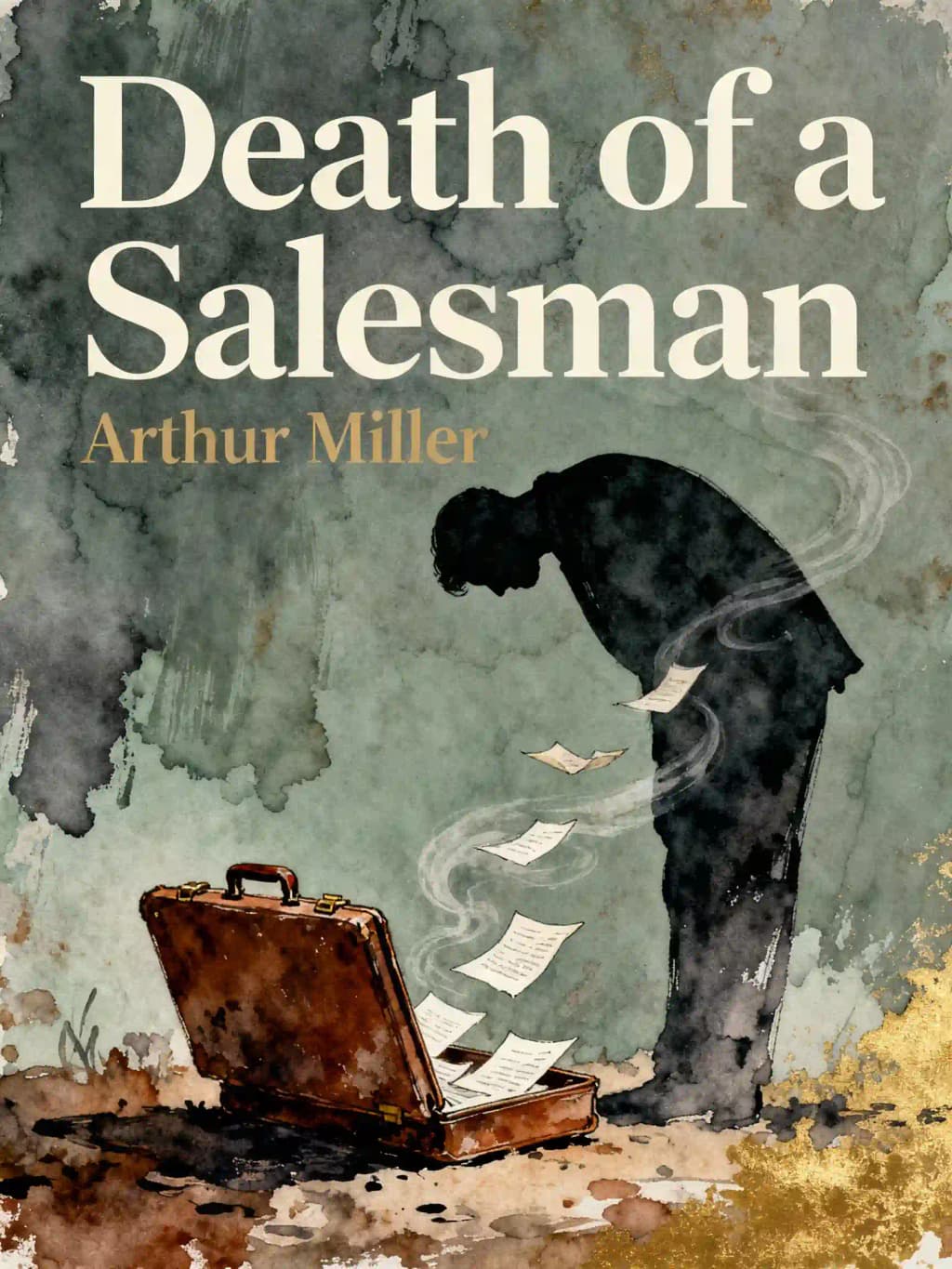
What happens when a man stakes his entire identity on a dream that was never truly his? Arthur Miller's "Death of a Salesman" isn't just a play-it's a mirror held up to American society that continues to reflect our struggles nearly 75 years after its premiere. When Elia Kazan directed its first Broadway production in 1949, audiences sat in stunned silence before erupting into applause that lasted over 10 minutes. The play would go on to win the Pulitzer Prize and transform American theater forever. Its protagonist, Willy Loman, has become synonymous with the tragic pursuit of success at all costs. Barack Obama once cited it as his favorite play, while David Mamet called it "perfect." Even today, in our era of hustle culture and social media success stories, the play's examination of failure and self-deception feels unnervingly current. As Charley says in the play's most quoted line, "a salesman is got to dream"-and in America, that dream can be both salvation and poison.
2장
The Fractured Mind of Willy Loman
Willy Loman exists in a perpetual state of contradiction. At 63, he's a traveling salesman who can no longer sell, a father who can't connect with his sons, a husband who betrays his loyal wife, and a dreamer whose dreams have failed him. His mind is like a broken kaleidoscope-constantly shifting between past and present, reality and fantasy, hope and despair.
"I'm tired to the death," Willy confesses early in the play, but his exhaustion runs deeper than physical fatigue. He's worn out from decades of chasing success through personality and likability rather than substance. "Be liked and you will never want," he instructs his sons, revealing the hollow philosophy that has guided his life. Yet this philosophy has led him nowhere-he's been demoted to working on commission, his sales are declining, and he can barely afford to keep his household running.
What makes Willy compelling isn't just his failure but his desperate refusal to acknowledge it. When faced with unpleasant truths, he reconstructs reality. His car is simultaneously "the finest car ever built" and a piece of junk. His son Biff is both "lazy" and "never lazy." His refrigerator is both reliable and breaking down. These aren't mere inconsistencies-they're survival mechanisms. Each contradiction serves an immediate psychological need, allowing Willy to maintain his fragile sense of dignity.
Willy's memories aren't accurate flashbacks but carefully curated constructions. When he recalls his sons' high school days, he does so not to remember what actually happened but to insist on their potential for success. His brother Ben-who walked into the jungle at seventeen and came out rich at twenty-one-represents the ruthless drive and achievement Willy lacks but believes he should want. Under increasing strain, the boundary between real and imagined erodes until Willy can no longer distinguish between them.
Yet there's something noble in Willy's refusal to surrender. As Miller himself noted, "Something in him knows that if he stands still he will be overwhelmed. These lies and evasions of his are his little swords with which he wards off the devils around him." His determination to leave his mark, to invest his name with substance, represents a struggle to create meaning in an unrewarding life. In a culture where personal worth equals professional success, Willy's failure threatens not just his livelihood but his very identity.
3장
Linda Loman: The Strength Behind the Fragility
"Attention, attention must finally be paid to such a person!" Linda Loman's passionate defense of her husband stands as one of theater's most powerful declarations of loyalty. Far from being a passive victim, Linda emerges as the play's moral center-a woman of remarkable strength and determination who has sustained her family when fantasy replaced truth.
Linda lives with terrible knowledge. She's discovered Willy's hidden rubber hose connected to the gas heater. She's found him in the cellar trying to kill himself. She's heard him talking to people who aren't there. Yet she persists, not out of blind devotion but from a fierce determination to protect what remains of her husband's dignity. "I don't say he's a great man," she tells her sons. "But he's a human being, and a terrible thing is happening to him."
Though Willy often bullies her, cuts off her sentences, and reconstructs her in memory to serve his purposes, Linda maintains a clear-eyed view of reality. She sees through her sons' bluster, demands their support, and manages the family's precarious finances. When Biff and Happy abandon their father at the restaurant, Linda's fury is magnificent: "Get out of here, both of you, and don't come back!"
Linda defines herself through Willy partly because her world offers little else. In post-war America, her options were limited to a supporting role. Yet her commitment isn't mere submission-it's a conscious choice to stand by someone she genuinely loves despite his flaws. Her tragedy lies in her inability to save him. Despite her practical common sense, she shares Willy's belief that life truly begins when debts are paid. Her final words at his grave-"We're free and clear"-carry devastating irony. They've finally paid off the mortgage, but now "there'll be nobody home."
Linda's strength-her love and determination-ultimately can't hold Willy back from self-destruction. She becomes both a victim of his desperate egotism and of a society that validates his restless pursuit while dismissing her devotion as irrelevant to the national enterprise. In her quiet dignity, she represents the unsung heroes who sustain the dreamers without receiving credit for their sacrifices.
4장
The Father-Son Tragedy
"Death of a Salesman," Arthur Miller once remarked, "is really a love story between a man and his son, and in a crazy way between both of them and America." At its emotional core, the play examines the complex, often painful relationship between fathers and sons-the inheritance of values, the weight of expectations, and the struggle for individual identity.
Biff Loman returns home after years of drifting, working ranch jobs in the West. At 34, he's still searching for purpose, haunted by the moment when his idealized vision of his father shattered. As a high school football star, Biff embodied Willy's dreams of greatness. But when he discovered his father's infidelity in a Boston hotel room, something broke inside him. "You fake! You phony little fake!" the teenage Biff screamed at Willy-words that would echo through both their lives.
This Boston hotel scene functions as the play's emotional epicenter. Until that moment, Biff had fully embraced his father's values-popularity, athletic prowess, cutting corners. After witnessing Willy's betrayal of Linda, Biff begins to question everything his father taught him. His subsequent failure in math, which prevents his college scholarship, becomes almost deliberate-a rejection of the path Willy had laid out for him.
Years later, the adult Biff struggles to reconcile his love for his father with his need to break free from Willy's delusions. "I'm a dime a dozen, and so are you!" he tells Willy in their final confrontation. This isn't cruelty but an attempt at honesty-to strip away the fantasy and find some authentic connection before it's too late. When Biff breaks down sobbing, declaring "Pop, I'm nothing! I'm nothing, Pop," it's both an admission of failure and a plea for acceptance without the burden of greatness.
Willy, tragically, misinterprets this emotional breakthrough. "That boy is going to be magnificent!" he exults, seeing Biff's tears not as a rejection of false values but as proof that "Biff likes me!" This fundamental misunderstanding drives Willy to his final, desperate act-sacrificing himself for a twenty-thousand-dollar insurance policy that he believes will launch Biff's success.
Happy, the younger son, presents a different tragedy. While Biff rebels against his father's values, Happy has internalized them completely. He chases women, exaggerates his position at work, and lives in a state of perpetual dissatisfaction-a junior version of Willy without the self-awareness that occasionally breaks through his father's delusions. At the funeral, while Biff has finally gained insight ("He had the wrong dreams"), Happy vows to stay in the city and "show everybody else that Willy Loman did not die in vain." The cycle continues.
5장
The American Dream as Nightmare
"Death of a Salesman" isn't just about one man's failure-it's an indictment of an American value system that equates human worth with material success. Though not explicitly set during the Depression, the play carries its psychological scars. In a nation that promises opportunity to all, what happens to those who don't succeed? What does it mean when a man who has "worked hard all his life" ends up "worth more dead than alive"?
Willy Loman believes fervently in the American Dream-the idea that personality, attractiveness, and being "well-liked" will inevitably lead to success. He tells his sons that a person who makes an appearance in the business world, who creates personal interest, is the man who gets ahead. "Be liked and you will never want," he instructs them. This philosophy stands in stark contrast to the reality of American capitalism, which rewards not likability but ruthless competition.
The play presents several competing versions of success. There's Ben's jungle capitalism-"when I walked into the jungle, I was seventeen. When I walked out I was twenty-one. And, by God, I was rich!" There's Charley's steady, unflashy business acumen that has allowed him to support his family and help Willy without fanfare. There's Bernard's academic achievement leading to arguing cases before the Supreme Court. And there's Willy's version-based on personality, connections, and being remembered.
What makes the play so devastating is that Willy has internalized society's values so completely that he judges himself by standards rooted in social myths rather than human necessities. He cannot recognize the love offered by Linda, Charley, and especially Biff because it doesn't fit his definition of success. When Charley offers him a job-a genuine solution to his financial problems-Willy refuses, seeing it as charity rather than opportunity. "I can't work for you, that's all, don't ask me why," he tells Charley, unable to admit that accepting help would mean acknowledging failure.
The physical setting reinforces this theme. Willy's house was once surrounded by open space and trees that provided shade and beauty. Now it's hemmed in by apartment buildings that block the sunlight. This encroachment symbolizes how the promise of America-open space, opportunity, growth-has been replaced by confinement, competition, and diminishing returns. As Linda observes, "The street is lined with cars. There's not a breath of fresh air in the neighborhood."
By the play's end, Willy's suicide represents the ultimate perversion of the American Dream-believing that his death (through the insurance money) will provide his son with the financial means to succeed where he failed. "Can you imagine that magnificence with twenty thousand dollars in his pocket?" Willy asks the spectral Ben, transforming his self-destruction into a final business transaction.
6장
Memory and Time: The Play's Revolutionary Structure
When "Death of a Salesman" premiered in 1949, its structure was revolutionary. Rather than following a linear timeline, the play moves fluidly between present and past, reality and memory, often without clear transitions. Miller likened this structure to geological strata, revealing different times simultaneously. Though the events occur over 24 hours, they incorporate what Miller called "social time" and "psychic time" as memories crash into Willy's present.
This structure brilliantly reflects Willy's anxious search for the moment his life went wrong. Like many of us facing disappointment, he constantly revisits the past, looking for the wrong turn, the missed opportunity, the crucial mistake that led to his current situation. "I still feel-kind of temporary about myself," Willy confesses, revealing how his identity has never fully solidified.
The play opens with the sound of a flute-a musical motif that recurs throughout, connecting Willy to his father who made and sold flutes while traveling. This memory represents both heritage and betrayal-his father deserted the family, just as Willy's brother Ben later abandoned him. The flute becomes a symbol of the temporary life, forever traveling but never arriving.
Stage designer Jo Mielziner's innovative set design was crucial to realizing Miller's vision. Rather than using traditional scene changes, Mielziner created a unified space where past and present could coexist. The Loman house featured transparent walls, allowing scenes to flow with the speed of Willy's mind. This design eliminated the need for blackouts between scenes, creating a dreamlike quality that blurred the line between memory and reality.
The most powerful example of this fluid structure comes in the Boston hotel scene. As Willy sits in a restaurant with his sons in the present, his mind slips back to the moment when teenage Biff discovered him with another woman. The scene shifts seamlessly between the restaurant and the hotel room, with adult Biff's accusations in the present triggering Willy's memory of his son's devastating discovery years earlier. This collision of past and present reveals how a single moment can reverberate through decades, shaping relationships and destinies.
By rejecting linear storytelling, Miller creates a more truthful representation of how we experience life-not as a neat sequence of events but as a complex web of memories, hopes, regrets, and present realities. This structure allows us to see not just what happens to Willy but how his mind processes these events, making the play both more intimate and more universal.
7장
The Tragedy of Self-Deception
"The man who makes an appearance in the business world, the man who creates personal interest, is the man who gets ahead," Willy insists. "Be liked and you will never want." These aren't just lines from a play-they're beliefs many Americans still hold today. What makes "Death of a Salesman" so powerful is how it exposes the danger of these seductive half-truths.
Willy's tragedy stems not from external forces but from his own self-deception. He has built his identity on myths-that personality equals success, that being well-liked is enough, that his sons are destined for greatness based on their physical attributes and popularity. When reality contradicts these beliefs, he doesn't adjust his thinking but doubles down, retreating further into fantasy.
This self-deception extends to his entire family. Linda enables Willy's delusions out of love, telling him "you're the handsomest man in the world" when he worries about his appearance. Happy has inherited his father's tendency to exaggerate, claiming he's "the assistant buyer" when he's really "one of the two assistants to the assistant." Even Biff, who struggles toward honesty, has spent years "trying to find himself" rather than accepting his limitations.
The play's most heartbreaking moments come when reality briefly breaks through these layers of self-deception. When Willy is fired by Howard, his boss's son, he's forced to confront his diminished value to the company he served for decades. "You can't eat the orange and throw the peel away-a man is not a piece of fruit!" Willy protests, suddenly articulating the dehumanizing nature of capitalism that he's otherwise accepted.
Another moment of clarity comes when Charley explains why Willy has never been a good salesman: "The only thing you got in this world is what you can sell. And the funny thing is that you're a salesman, and you don't know that." This insight-that Willy has been selling without understanding the fundamental nature of selling-cuts to the heart of his failure.
Perhaps the most painful moment of self-recognition comes when Biff confronts his father with the rubber hose Willy has hidden for suicide. "What is this supposed to do, make a hero out of you? This supposed to make me sorry for you?" Biff demands. For a brief moment, Willy's defenses crumble, and he faces the reality of what he's become-a man so desperate to be important that he's willing to die for it.
The tragedy deepens because these moments of clarity don't lead to transformation. After each confrontation with reality, Willy retreats back into his comforting illusions. Even his final act-suicide for insurance money-represents a doubling down on his delusion that material success will solve everything. He dies as he lived, unable to distinguish between genuine human connection and the appearance of success.
8장
The Dignity of the Common Man
"I don't say he's a great man," Linda says of Willy. "But he's a human being, and a terrible thing is happening to him." This simple declaration forms the moral center of "Death of a Salesman." Through Willy Loman, Miller insists that attention must be paid to the struggles of ordinary people-that their lives, dreams, and disappointments matter.
In classical tragedy, protagonists were kings, generals, or nobles whose falls affected entire kingdoms. Miller revolutionized theater by applying tragic dimensions to a common salesman. As he wrote in his essay "Tragedy and the Common Man," Miller believed that "the common man is as apt a subject for tragedy in its highest sense as kings were." What makes Willy Loman tragic isn't his social position but his unwavering belief in his own significance despite mounting evidence to the contrary.
Charley's eulogy captures this dignity: "Nobody dast blame this man. A salesman is got to dream, boy. It comes with the territory." These lines acknowledge both the necessity of Willy's dreams and their ultimate futility. There's something noble in his refusal to accept mediocrity, even as this refusal destroys him.
Willy's true talent, as Biff recognizes too late, was working with his hands. "There was more of him in that front stoop than in all the sales he ever made," Biff observes at the funeral. The tragedy deepens because Willy abandoned what he loved and did well-carpentry, gardening, building-to pursue a profession that never suited him. When he works in his yard, planting seeds at night, we glimpse the man he might have been if he hadn't been seduced by his brother's material success or Dave Singleman's popularity.
Even in his delusions, Willy maintains a certain dignity. When Howard shows off his wire recorder-a symbol of technological progress that's making men like Willy obsolete-Willy tries to engage with it, to demonstrate he's not behind the times. When he begs for a non-traveling position, he does so while trying to maintain his pride: "I'm not asking for a gift, Howard, I've earned it." His desperation is palpable, but so is his determination to be treated with respect.
Miller doesn't present Willy as a perfect victim. He's flawed-unfaithful to his wife, harsh with his sons, unable to accept help from Charley. But the play insists that these flaws don't diminish his humanity or his right to dignity. By focusing on an ordinary man's struggles, Miller challenges us to recognize the complexity and worth of lives that might otherwise be dismissed as unremarkable.
9장
The Legacy of "Death of a Salesman"
When the curtain fell on the first performance of "Death of a Salesman" in February 1949, the audience sat in stunned silence before erupting into applause. The play would go on to win the Pulitzer Prize, run for 742 performances in its original Broadway production, and become a cornerstone of American literature. More than seven decades later, it continues to resonate with audiences worldwide, speaking to universal concerns about success, failure, family, and identity.
What explains the play's enduring power? Part of its strength lies in its ambiguity. Miller doesn't offer easy answers or simple morals. Is Willy a victim of a capitalist system that uses people and discards them, or is he responsible for his own destruction through his stubborn adherence to false values? The play allows for both interpretations, making it relevant across different political perspectives and historical moments.
The play's influence extends far beyond theater. Its language has entered our cultural vocabulary-phrases like "attention must be paid" and "riding on a smile and a shoeshine" capture enduring truths about American life. Its structure, blending past and present, reality and memory, influenced generations of playwrights and filmmakers. Its central character has become an archetype-the name "Willy Loman" evokes an entire complex of ideas about failure, delusion, and the dark side of the American Dream.
"Death of a Salesman" has proven remarkably adaptable across cultures. When Miller directed a production in Beijing in 1983, he was struck by how deeply Chinese audiences connected with the play despite vast cultural differences. Japanese, African, and European productions have similarly found resonance in Willy's struggles. This universality suggests that while the play is distinctly American in its setting and concerns, it touches on human experiences that transcend national boundaries.
In our current era of economic uncertainty, social media performance, and "hustle culture," the play feels unnervingly current. Many workers today, like Willy, find themselves made obsolete by technological change and corporate restructuring. Many parents still project their unfulfilled ambitions onto their children. Many people still measure their worth by their professional success rather than their human connections.
Perhaps most importantly, "Death of a Salesman" continues to move us because it combines unflinching social criticism with profound compassion. Miller doesn't excuse Willy's flaws or simplify his character, but he insists that we see him fully-his dreams and delusions, his cruelties and kindnesses, his failures and his fragile dignity. In doing so, the play challenges us to extend the same complex understanding to others and to ourselves-to recognize that attention must be paid to the Willy Lomans of the world, not because they are great men, but because they are human beings.