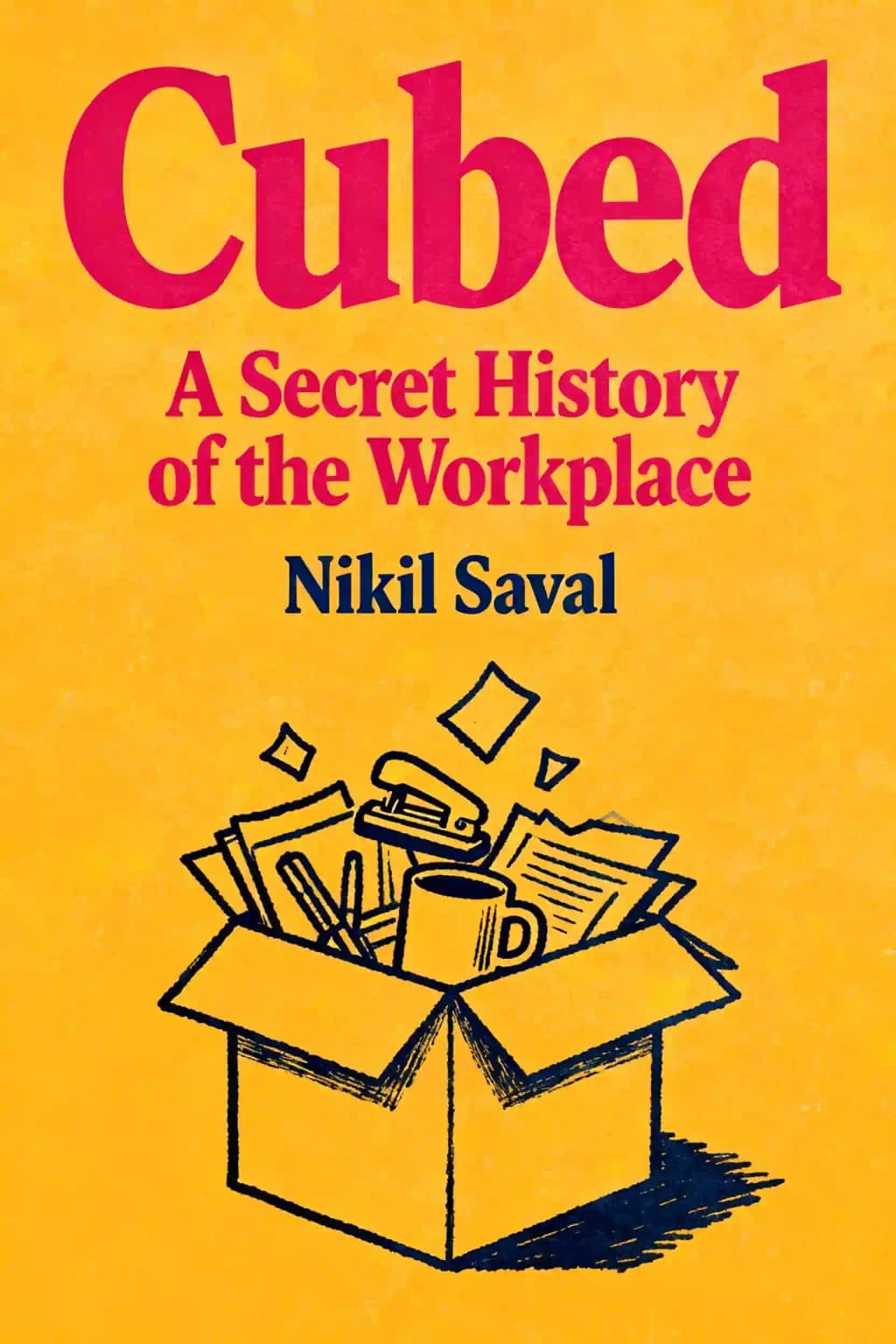
"Cubed" unveils the secret history of office spaces, transforming how we view cubicles and conference rooms. Praised by The New York Times, this cultural touchstone asks: Why do we work in boxes? Discover how architecture shapes productivity - and why your workspace matters more than you think.
Nikil Saval, author of Cubed: A Secret History of the Workplace, is a writer, organizer, and authority on the intersection of design, labor, and urban history. A frequent contributor to The New Yorker and The New York Times, Saval combines his academic background—a Ph.D. in English from Stanford University—with decades of activism.
His activism includes co-founding the progressive organization Reclaim Philadelphia and organizing with labor unions like UNITE HERE. His book, a blend of cultural criticism and historical analysis, traces the evolution of office spaces from 19th-century counting houses to modern cubicles, revealing how workplace design reflects broader societal power dynamics.
Saval’s insights are informed by his role as co-editor of the literary journal n+1 and his current work as a Pennsylvania State Senator advocating for housing justice and workers’ rights. His upcoming book, Everything is Architecture, explores modernist design through figures like Buckminster Fuller.
Cubed has been widely cited in discussions about labor reform and urban policy, cementing Saval’s reputation as a visionary thinker bridging academia and grassroots activism.
Cubed traces the evolution of office spaces from 19th-century counting houses to modern cubicles and open-plan designs, examining how workplace architecture reflects societal shifts in labor, gender roles, and corporate culture. Nikil Saval connects design trends to broader economic changes, highlighting their impact on worker productivity, communication, and identity. The book blends historical analysis with cultural commentary, referencing literature like Bartleby the Scrivener and pop culture icons like The Office.
This book suits professionals in HR, architecture, or workplace design, as well as readers interested in labor history, organizational culture, or social anthropology. Its accessible style appeals to fans of narrative nonfiction seeking insights into how office environments shape daily work life and societal norms.
Yes. Critics praise its engaging blend of historical research and cultural critique, calling it a “readable version of Foucault’s genealogical work” for office workers. Saval’s analysis of design trends and labor dynamics offers fresh perspectives on mundane spaces, making it a standout in workplace literature.
The cubicle emerged from the 1960s “Action Office” concept, which aimed to balance privacy and collaboration. However, cost-cutting led to its dilution into cramped, uniform partitions. Saval critiques this shift as symbolic of corporate efficiency over worker well-being, arguing it stifled creativity and reinforced hierarchical structures.
Saval documents how clerical roles became dominated by women in the early 20th century, often relegating them to low-paid, undervalued positions. He ties this to gendered stereotypes of clerical work as “unskilled” and explores how office design reinforced power imbalances, such as placing male executives in secluded, privileged spaces.
Open-plan offices, initially touted for fostering collaboration, often created noise and distractions, undermining their purpose. Saval argues that design choices—from mid-century executive suites to modern co-working spaces—reflect shifting corporate priorities, balancing efficiency, surveillance, and employee satisfaction.
The book spans the 19th-century industrial era’s clerical boom, mid-20th-century corporate modernism, and postmodern open-plan trends. It concludes with early 2010s innovations, such as activity-based workspaces, while contextualizing each shift within economic and technological changes.
Saval, a labor organizer, frames office design as a battleground for worker autonomy. He critiques layouts that prioritize managerial control over employee needs and advocates for designs that empower workers, reflecting his broader activism for equitable workplaces.
Saval envisions offices that prioritize flexibility, worker input, and well-being over rigid hierarchies. He highlights emerging trends like hybrid layouts and sustainable design but cautions against solutions that ignore systemic labor inequalities.
The book uses The Office, Bartleby the Scrivener, and Dilbert cartoons to illustrate societal attitudes toward clerical work. These references underscore how media both reflects and shapes perceptions of office drudgery, bureaucracy, and worker alienation.
Unlike technical manuals, Cubed offers a sociocultural lens, aligning it with works like David Graeber’s Bullshit Jobs. Its narrative-driven approach makes it more accessible than academic texts, while its focus on labor rights distinguishes it from purely architectural analyses.
Saval’s critique of rigid office structures resonates with modern debates over hybrid work. The book provides historical context for current shifts, urging readers to reimagine workspaces as tools for equity—not just productivity—in a post-pandemic world.
저자의 목소리로 책을 느껴보세요
지식을 흥미롭고 예시가 풍부한 인사이트로 전환
핵심 아이디어를 빠르게 캡처하여 신속하게 학습
재미있고 매력적인 방식으로 책을 즐기세요
America has truly become "a nation of clerks."
Clerks saw themselves as bosses-in-training.
Blessed Be Drudgery.
Paradoxically, these "laborsaving" devices created more work rather than less.
Clerks occupied an ambiguous position in American capitalism-neither working class nor elite.
Cubed의 핵심 아이디어를 이해하기 쉬운 포인트로 분해하여 혁신적인 팀이 어떻게 창조하고, 협력하고, 성장하는지 이해합니다.
Cubed을 빠른 기억 단서로 압축하여 솔직함, 팀워크, 창의적 회복력의 핵심 원칙을 강조합니다.

생생한 스토리텔링을 통해 Cubed을 경험하고, 혁신 교훈을 기억에 남고 적용할 수 있는 순간으로 바꿉니다.
무엇이든 물어보고, 목소리를 선택하고, 진정으로 공감되는 인사이트를 함께 만들어보세요.

샌프란시스코에서 컬럼비아 대학교 동문들이 만들었습니다
"Instead of endless scrolling, I just hit play on BeFreed. It saves me so much time."
"I never knew where to start with nonfiction—BeFreed’s book lists turned into podcasts gave me a clear path."
"Perfect balance between learning and entertainment. Finished ‘Thinking, Fast and Slow’ on my commute this week."
"Crazy how much I learned while walking the dog. BeFreed = small habits → big gains."
"Reading used to feel like a chore. Now it’s just part of my lifestyle."
"Feels effortless compared to reading. I’ve finished 6 books this month already."
"BeFreed turned my guilty doomscrolling into something that feels productive and inspiring."
"BeFreed turned my commute into learning time. 20-min podcasts are perfect for finishing books I never had time for."
"BeFreed replaced my podcast queue. Imagine Spotify for books — that’s it. 🙌"
"It is great for me to learn something from the book without reading it."
"The themed book list podcasts help me connect ideas across authors—like a guided audio journey."
"Makes me feel smarter every time before going to work"
샌프란시스코에서 컬럼비아 대학교 동문들이 만들었습니다

Cubed 요약을 무료 PDF 또는 EPUB으로 받으세요. 인쇄하거나 오프라인에서 언제든 읽을 수 있습니다.
The viral "cubicle rage" video of 2007 captured what millions secretly fantasize about-smashing the walls of their office prison. This moment of rebellion speaks to a profound truth: the office has become the signature environment of modern society, transforming America into "a nation of clerks." The humble white-collar worker has proven as significant to American economic development as the factory hand. What began as small countinghouses has expanded into vast corporate landscapes that shape not just how we work, but how we think about work itself. The evolution of office spaces reflects broader shifts in American society, economics, and power dynamics. As remote work reshapes our relationship with physical workplaces, understanding this history becomes essential to imagining what comes next.