1장
The Discovery Revolution: Transforming Product Development Through Customer Insights
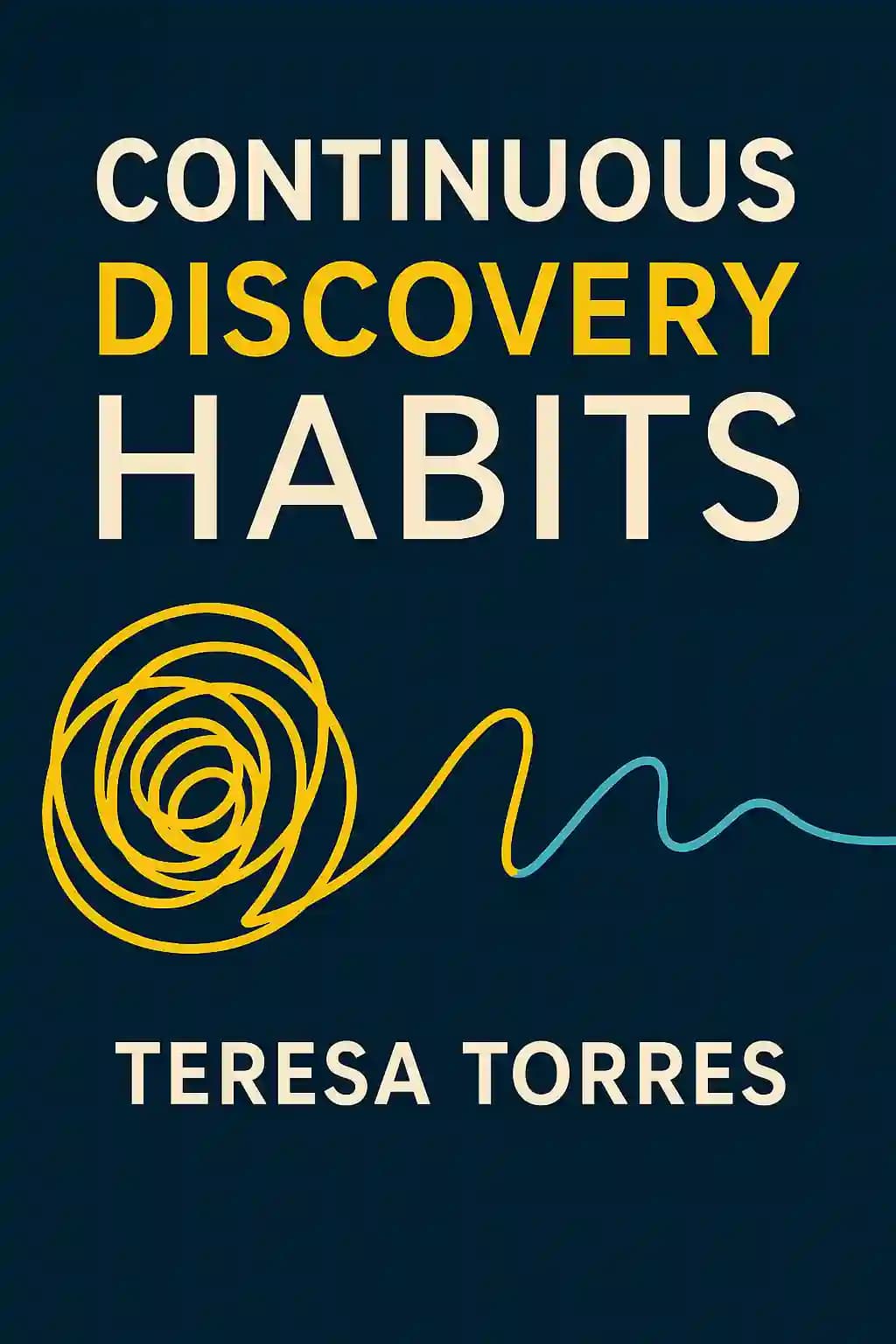
Have you ever wondered why so many products fail despite millions in funding and brilliant teams behind them? Teresa Torres' "Continuous Discovery Habits" reveals the missing link: a systematic approach to understanding what customers actually need before building solutions. This isn't just another product management methodology-it's a paradigm shift that has transformed how companies like Netflix, Airbnb, and Amazon develop products. The book has become required reading at top tech companies and MBA programs, with Tim Brown (IDEO CEO) calling it "the most important product development book of the decade." What makes Torres' approach revolutionary is how it bridges the gap between customer empathy and business outcomes, creating a framework that's both human-centered and commercially viable. In a world where 70% of products fail to meet customer expectations, Torres offers a proven path to building what people actually want.
2장
The Fundamental Shift: From Delivery to Discovery
For decades, product development has been dominated by a delivery mindset-focusing on shipping features on time and on budget. But as digital products have evolved, a critical realization has emerged: building the right things matters more than building things right. Companies like Nokia and Blackberry learned this lesson the hard way, delivering well-built products that ultimately failed to meet evolving customer needs.
Discovery is the work you do to decide what to build, while delivery is the work to build and ship it. Most companies overemphasize delivery while underinvesting in discovery, leading to products nobody wants. The traditional approach where business leaders owned discovery through annual budgeting processes and assigned fixed timelines to engineering teams has proven wasteful-resulting in late projects, budget overruns, and products customers don't use. For example, studies show that 45% of features in typical software products are never used, representing massive waste in development resources.
Digital products are never truly "done"-they must continuously evolve as markets change, customer needs shift, and new technologies emerge. Companies like Netflix demonstrate this principle well, having evolved from DVD-by-mail to streaming to content creation, constantly discovering new customer needs. This reality demands a continuous discovery framework that helps teams identify unmet customer needs and develop solutions that address them effectively. The framework must be lightweight enough to execute weekly while providing sufficient rigor to ensure teams are making evidence-based decisions.
The book targets product trios-typically a product manager, designer, and software engineer working together-though teams may need to adapt this core group to their specific context. This trio structure has proven effective because it brings together business, user experience, and technical perspectives while remaining small enough for rapid decision-making. While including more perspectives brings diversity of thought, it also slows decision-making, so teams must balance inclusiveness with efficiency. Some organizations successfully expand to include data analysts or subject matter experts while maintaining agility.
Success with continuous discovery requires six fundamental mindsets: being outcome-oriented (defining success by value created, not features shipped), customer-centric (recognizing business exists to serve customers), collaborative (working across functions rather than in silos), visual (mapping and externalizing thinking), experimental (identifying assumptions and gathering evidence), and continuous (infusing customer input throughout development rather than just at project beginnings). These mindsets represent a significant shift from traditional product development approaches that often prioritize internal stakeholder requests over customer needs.
True continuous discovery means weekly customer touchpoints conducted by the team building the product, where they perform small research activities in pursuit of a desired outcome. These activities might include customer interviews, usability tests, prototype feedback sessions, or analysis of usage data. This ensures daily product decisions are infused with customer input, rather than making weeks or months of decisions without customer perspective. Teams practicing continuous discovery typically spend 4-6 hours per week on these activities, making it sustainable alongside delivery work.
3장
Opportunity Solution Trees: The Map for Product Success
The tension between business outcomes and customer needs appears across industries-from ad-cluttered news sites to restricted sports broadcasts to hidden hotel fees. The Wells Fargo scandal of 2016 illustrates what happens when business outcomes are prioritized at the expense of customer needs: under pressure to increase accounts per customer, bankers opened fraudulent accounts without permission, resulting in massive fines and settlements.
But as Peter Drucker argued, businesses should "convert society's needs into opportunities for profitable business" rather than seeing business and customer needs as opposing forces. Modern product discovery is shifting from an output mindset (features) to an outcome mindset (impact).
Discovery has an underlying structure that guides product work: define a clear outcome that sets discovery scope, map the opportunity space to structure the ill-structured problem, and discover solutions that address those opportunities. Opportunity solution trees (OSTs) visualize this structure, showing paths to reach desired outcomes. The tree's root is the business outcome, followed by the opportunity space (customer needs/pains/desires), then the solution space, and finally assumption tests to evaluate solutions.
OSTs help teams balance business and customer needs by starting with business outcomes (creating business value ensures the team can serve customers long-term) and then exploring customer needs that could drive that outcome. By mapping the opportunity space, teams adopt a customer-centric framing for reaching their outcome.
These visual maps also help build shared understanding across the trio, preventing the natural instinct to immediately solve problems without questioning problem framing or considering alternatives. When teams visualize options through opportunity solution trees, they enable true cross-functional collaboration over time.
OSTs help product trios adopt a continuous mindset by breaking large, project-sized opportunities into smaller ones that teams can address incrementally. By solving these smaller opportunities continuously, teams eventually address larger opportunities, learning to tackle project-sized challenges through continuous delivery.
As product trios gain experience with opportunity solution trees, the shape of their tree guides their discovery work. A shallow opportunity space suggests more customer interviews are needed, while a sprawling one indicates focus is required. Too few solutions for a target opportunity calls for ideation, and insufficient assumption tests means ramping up testing.
4장
Setting Meaningful Outcomes Over Outputs
Shifting to an outcome mindset represents a fundamental transformation in how product teams operate, yet many organizations struggle with this transition. Teams often grapple with three core challenges: accurately measuring outcomes, effectively influencing them, and ensuring they're pursuing the right ones. The experience of Sonja Martin's team at tails.com perfectly illustrates these complexities. Initially tasked with improving 90-day customer retention, they found this lagging indicator too delayed to effectively measure the impact of their experiments. Through extensive customer interviews and data analysis, they identified more actionable product outcomes: increasing the perceived value of tailor-made dog food and improving palatability scores - metrics that provided faster feedback loops and clearer direction for product improvements.
Setting outcomes should be a collaborative two-way negotiation process. Product leaders bring critical business context, strategic priorities, and market insights, while product trios (typically comprising product manager, designer, and engineer) contribute deep customer knowledge, technical feasibility understanding, and realistic impact estimates. Research from organizational psychology shows that teams perform up to 16% better when actively involved in setting their own outcomes, though the optimal approach varies based on task complexity and team maturity. For instance, experienced teams might handle more autonomous goal-setting, while newer teams benefit from more structured guidance.
While S.M.A.R.T. goals (Specific, Measurable, Achievable, Relevant, Time-bound) have become conventional wisdom, recent research reveals important nuances for complex product work. For new challenges or unexplored territory, teams should prioritize learning goals (such as "identify three key user pain points") before transitioning to performance goals (like "increase conversion by 20%"). This sequencing allows teams to build understanding before optimizing metrics. Teams should also maintain focus on one primary outcome for multiple quarters rather than frequently switching priorities, which can lead to context switching and reduced impact. Additionally, outcomes should be set at the team level rather than individual level to promote collaboration and avoid siloed thinking.
Product teams typically exhibit four distinct patterns in outcome-setting: The most common pattern is delivering outputs without clear outcomes, essentially building features without understanding their impact. Some teams operate under strictly dictated outcomes from leadership, limiting their ability to leverage ground-level insights. Others set outcomes in isolation without leadership input, risking misalignment with company strategy. The ideal pattern involves collaborative negotiation of outcomes, incorporating both strategic direction and team expertise. Even teams successfully negotiating outcomes should regularly evaluate their approach, ensuring they're pursuing true product outcomes (like user value delivery) rather than just business outcomes (like revenue) or traction metrics (like page views). For new metrics or challenges, teams should begin with learning goals to build understanding before setting specific performance targets. When working with familiar metrics, goals should be appropriately challenging - research suggests targets that feel about 70% achievable tend to optimize both motivation and achievement.
5장
The Art of Continuous Customer Interviewing
While Steve Jobs famously dismissed market research, saying "People don't know what they want until you show it to them," this doesn't mean product teams should avoid talking to customers. Continuous interviewing isn't about asking customers what to build, but discovering opportunities-customer needs, pain points, and desires that represent ways to positively intervene in customers' lives.
People are notoriously bad at accurately reporting their own behavior. A workshop participant claimed fit was her top priority when buying jeans, but when asked about her last purchase, she bought them on Amazon based on brand and price without knowing if they'd fit. Decades of research shows we struggle with direct questions, falling prey to cognitive biases-we overestimate positive behaviors, create coherent but false explanations for our actions, and answer based on our ideal selves rather than reality.
Effective interviewing requires separating what you want to learn (research questions) from what you actually ask (interview questions). Rather than creating lengthy discussion guides for occasional customer conversations, teams should interview weekly and focus on immediate learning needs. Instead of asking "What criteria do you use when purchasing jeans?" ask "Tell me about the last time you purchased jeans."
Getting good stories requires breaking normal conversational patterns where people expect a 50/50 back-and-forth exchange. Use temporal prompts like "What happened first?" and "What happened next?" to guide participants through their experience. Ask them to set the scene and guide them through the beginning, middle, and end. Stories have specific locations, challenges, and supporting characters-ask about these elements to tease out forgotten details.
Continuous interviewing requires ongoing synthesis rather than waiting for a clear stopping point. The interview snapshot-a visual one-pager-helps transform notes into actionable insights and builds a reference system for customer knowledge. Include a participant photo (with permission), a memorable quote, quick facts about the customer, documented opportunities using the customer's own words, and interesting insights that might become valuable later.
Weekly interviewing forms the foundation of strong discovery practice. The opportunity space constantly evolves as customer needs change, new products disrupt markets, and competitors shift the landscape. To make continuous interviewing sustainable, automate the recruiting process so you wake up Monday morning with an interview already scheduled. This automation becomes especially valuable during hectic weeks when releases go awry or team members fall ill.
6장
Mapping and Prioritizing Opportunities
As you collect customer stories through continuous interviews, you'll uncover countless needs, pain points, and desires-each representing a potential opportunity. Without structure, this can quickly become overwhelming. Mapping the opportunity space is critical because finding the best path to your desired outcome is an ill-structured problem that requires framing before solving.
While some teams capture opportunities in prioritized backlogs, flat lists make comparison difficult because opportunities come in different shapes and sizes-some are interrelated while others are subsets of broader needs. For example, comparing "I can't find anything to watch" with "I'm out of episodes of my favorite shows" is challenging because the latter is actually one reason for the former.
Instead of managing a flat opportunity backlog, use an opportunity solution tree to visualize the complexity of the space. Trees show two key relationships: parent-child (representing subsets) and sibling relationships. This structure helps break down large, intractable problems into smaller, more solvable ones, allowing teams to deliver value iteratively over time rather than waiting until they can solve the entire problem at once.
To structure your opportunity space effectively, identify distinct moments in your customers' experience that don't overlap. For a streaming service, these might include "Deciding to watch something," "Choosing something to watch," "Watching something," and "The end of the watching experience." These distinct moments become the top-level branches of your opportunity solution tree.
When adding opportunities to your tree, ask three questions: Is it framed as a customer need (not a solution)? Have we seen it in multiple interviews? Will addressing it drive our desired outcome? Work with one branch at a time, grouping similar opportunities together. Similar opportunities might be siblings with a parent opportunity. Continue grouping siblings and identifying parents until you've built a coherent structure for each branch.
Working vertically down the opportunity solution tree allows teams to adopt an Agile mindset by addressing one opportunity at a time rather than spreading resources across many. The tree structure optimizes prioritization by comparing top-level opportunities against each other rather than evaluating them in isolation. Once the highest priority parent opportunity is identified, teams can focus assessment efforts on just that branch, ignoring others.
Torres recommends evaluating opportunities using four criteria: opportunity sizing (how many customers are affected and how often), market factors (how addressing opportunities affects market position), company factors (alignment with vision and strategic objectives), and customer factors (importance to customers and satisfaction with existing solutions).
7장
From Ideas to Evidence: The Solution Discovery Process
Brainstorming is polarizing-some see it as creative magic, others as a waste of time. Research shows our first ideas are rarely our best; generating more ideas leads to more diverse and novel solutions, with the most original ideas typically emerging later in ideation. While product teams have plenty of ideas, they're often first ideas for various opportunities rather than diverse solutions for targeted needs.
Traditional group brainstorming is actually less effective than individual ideation. Research consistently shows individuals generate more ideas, more diverse ideas, and more original ideas than groups. Groups suffer from social loafing, conformity, production blocking (losing ideas while others speak), and downward norm setting.
To implement effective ideation, first review your target opportunity thoroughly with your team to ensure shared understanding. Next, have everyone generate ideas individually before sharing them with the team. When sharing, take time to describe each idea, allowing questions and building upon others' concepts. Repeat this individual-collective cycle until you've generated 15-20 ideas.
After generating ideas, first verify each one actually addresses your target opportunity, eliminating those that don't. Then use dot-voting to identify the top three ideas. Don't narrow to just one yet-the goal is setting up a good compare-and-contrast decision for later testing.
Most product teams eventually face the harsh reality of building the wrong product. This happens because of cognitive biases-confirmation bias leads us to seek evidence supporting our ideas while ignoring contradictory information, and escalation of commitment makes us increasingly attached to ideas we've invested in. To avoid these traps, we must prepare to be wrong by testing assumptions rather than complete ideas.
Product trios need to identify five key categories of assumptions: Desirability (will customers want our solution?), Viability (will it create business value?), Feasibility (can we build it?), Usability (can customers use it effectively?), and Ethical assumptions (what potential harm might result?).
Before testing assumptions, teams must align on what their vague solution ideas actually mean through story mapping. This technique forces specificity about how an idea will work and what users will do, revealing underlying assumptions. Once your team has a clear concept, use it to uncover hidden assumptions by analyzing each step of your story map.
After generating assumptions, prioritize which ones require testing using assumption mapping. Evaluate each assumption on two dimensions: how much evidence you already have and how important the assumption is to your idea's success. The most important assumptions with the weakest evidence are your riskiest and should be tested first.
8장
Testing Assumptions and Measuring Impact
Testing assumptions across multiple ideas simultaneously helps combat cognitive biases that can derail product development. When we test only one idea at a time, confirmation bias makes us notice confirming evidence while missing disconfirming evidence. This selective attention becomes particularly problematic in product development, where early decisions can have long-lasting consequences. Similarly, the more time invested in a single idea, the more likely we'll commit to it despite flaws - a phenomenon known as the sunk cost fallacy.
Strong assumption tests create realistic scenarios that allow participants to behave naturally, rather than just asking what they think. For example, instead of asking "Would you use this fitness app?", create a simple prototype and observe how potential users interact with it. Define specific evaluation criteria upfront (e.g., "At least 3 out of 10 people complete a workout routine," or "Users spend more than 5 minutes exploring features") to align the team on what success looks like and guard against confirmation bias. Start with small tests before investing in large-scale experiments - even feedback from just five carefully selected customers can provide valuable early signals about product-market fit.
Small tests inevitably produce false positives and false negatives, but there are effective strategies to manage these risks. Mitigate potential errors by selecting participants with variation in demographics, behaviors, and use cases. For instance, test with both fitness enthusiasts and beginners, or users from different age groups and technical backgrounds. False negatives (when tests fail but the assumption is actually true) aren't very costly when tests are small - you lose only a day or two of effort. False positives (when tests succeed but the assumption is actually false) typically get caught in successive rounds of testing as you scale up experiments.
To achieve Marty Cagan's benchmark of 15-20 discovery iterations weekly, leverage efficient testing methods like unmoderated user testing platforms (such as UserTesting.com), one-question surveys, and A/B tests. Most assumptions can be tested through prototype tests, surveys, or data mining of existing user behavior. When defining evaluation criteria, use specific numbers rather than percentages (e.g., "40 users complete signup" instead of "80% conversion rate"), and always ensure you're testing with the right audience segment.
When instrumenting your product to measure impact, resist the temptation to track everything from the start. This can lead to data overload and unclear priorities. Instead, start small and experiment your way to the best instrumentation. Begin by measuring what you need to evaluate your current assumption tests, then gradually expand to measure progress toward your desired outcome. For example, start by tracking basic engagement metrics, then add more sophisticated measurements as you learn what matters most. Don't shy away from measuring hard-to-track metrics - if something creates genuine value for your customers and business, invest in finding creative ways to track it, whether through proxy metrics, custom events, or specialized analytics tools.
9장
Implementing Continuous Discovery in Any Organization
Regardless of your company's current approach to product development, you can find ways to implement continuous discovery habits. The key is having a strong sense of agency-focusing on how you can change your own work rather than trying to change the entire company. Instead of asking for permission or waiting for someone to show you how, start small and iterate from there.
Don't work alone-the habits in this book are designed for a cross-functional trio. Even if your team isn't fully resourced or your company culture doesn't support the trio model, you can start building these relationships yourself. Your guiding principle should be including all three disciplines in as many discovery decisions as possible, making each week better than the last.
Continuous interviewing is the keystone habit for continuous discovery-a habit that drives the adoption of other habits. When teams engage with customers weekly, they naturally start rapid prototyping and experimenting more often. Even in challenging situations where customer access seems impossible, teams have found ways to chip away at this barrier.
Even if you work in a feature-team model where stakeholders dictate what to build, you can still apply discovery principles. When given a specific solution to implement, work backward by asking: "If our customers had this solution, what would it do for them?" Try to uncover the implied opportunity. Use story mapping to identify hidden assumptions, and work with stakeholders to evolve ideas when assumptions prove faulty.
Meet regularly as a trio to reflect on your discovery process. If you already do Scrum retrospectives, add reflective questions about discovery. Ask "What did we learn during this sprint that surprised us?" and "How could we have learned that sooner?" Remember that surprises are inevitable no matter how good your discovery process becomes-they help you improve, so take time to learn from them.
The most important thing is to start. Don't let perfect be the enemy of good. Even small improvements in how you understand customer needs can dramatically improve your product outcomes. Continuous discovery isn't a destination-it's a journey of constantly improving how you create value for both customers and business.