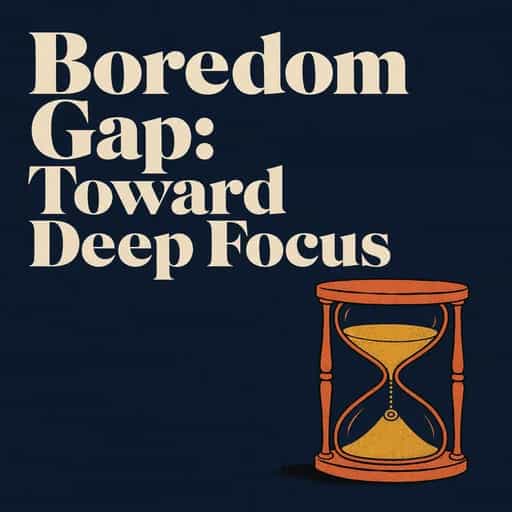
In "Bored and Brilliant," podcast host Manoush Zomorodi reveals how our smartphone addiction kills creativity. Born from her wildly successful WNYC experiment, this counterintuitive guide shows why spacing out isn't wasting time - it's your brain's most productive state.
Manoush Zomorodi, the author of Bored and Brilliant: How Spacing Out Can Unlock Your Most Creative Self, is an award-winning journalist and podcast host who specializes in the impact of technology on human behavior.
A former reporter for BBC News and Thomson Reuters, Zomorodi's exploration of the "Attention Economy" has manifested in various forms, including bestselling books, a widely viewed TED Talk with over six million views, and her contributions to NPR’s TED Radio Hour, which won the Ambie Award in 2023.
As the founder of Stable Genius Productions, she has created acclaimed podcasts such as Note to Self, recognized as the Best Tech Podcast in 2017, and ZigZag, which delves into digital mindfulness through engaging, interactive experiments. Zomorodi was named one of Fast Company’s 100 Most Creative People in Business in 2018.
Zomorodi effectively blends her extensive global reporting experience with her own personal insights into fostering creativity in the age of smartphones. Her TED Talk, which addresses strategies for surviving information overload, has been translated into 24 languages and adapted into corporate training programs across the globe.
Bored and Brilliant explores how embracing boredom can enhance creativity and productivity in the digital age. The book argues that constant smartphone use drains attention spans, and offers science-backed strategies to reclaim mental space through "boredom challenges," such as reducing screen time and engaging in mundane tasks to spark innovation.
This book is ideal for individuals feeling overwhelmed by technology, parents navigating digital parenting, and professionals seeking to boost creativity. It’s also valuable for anyone interested in neuroscience, mindfulness, or breaking free from the "attention economy."
Yes—the book combines research, real-world experiments from Zomorodi’s Note to Self podcast, and actionable advice. With 6+ million TED Talk views and accolades like the 2023 Ambie Award, it’s a trusted guide to balancing tech use.
Manoush Zomorodi is an award-winning journalist, host of NPR’s TED Radio Hour, and founder of Stable Genius Productions. Her work focuses on technology’s impact on humanity, and she’s been named one of Fast Company’s 100 Most Creative People in Business.
Key concepts include:
The book offers a 7-day program with steps like tracking screen time, deleting addictive apps, and practicing “analog” activities (e.g., writing by hand). One challenge involves staring at boiling water to trigger reflective thinking.
This exercise encourages intentional boredom:
Yes—Zomorodi addresses concerns like gaming addiction and social media’s impact on children. The book advises setting tech-free zones and modeling mindful device use to foster family creativity.
The book cites studies showing boredom activates the brain’s default mode network, which aids introspection and idea generation. Zomorodi explains how constant stimulation suppresses this critical mental state.
“Want to be creative? Get bored!” encapsulates the thesis. Another key line: “Your smartphone is training you to crave novelty… at the expense of deeper thinking”—highlighting the need for intentional tech use.
Yes. By scheduling distraction-free periods and embracing mundane tasks (e.g., walking without podcasts), employees can unlock “Eureka moments” and tackle complex problems with renewed focus.
Unlike generic advice, Zomorodi’s approach blends neuroscience, personal experiments, and humor. It’s particularly unique for linking boredom to creativity rather than framing tech detoxes as pure discipline.
저자의 목소리로 책을 느껴보세요
지식을 흥미롭고 예시가 풍부한 인사이트로 전환
핵심 아이디어를 빠르게 캡처하여 신속하게 학습
재미있고 매력적인 방식으로 책을 즐기세요
Boredom functions as both warning and motivational push toward more rewarding experiences.
Phones have become 'a best friend who has all the best and worst qualities.'
Having nothing to do can be wonderful, too.
Our relationship with our devices has become intensely physical and emotional.
The digital economy thrives on app designers who excel at creating products we can't stop using.
Bored and Brilliant의 핵심 아이디어를 이해하기 쉬운 포인트로 분해하여 혁신적인 팀이 어떻게 창조하고, 협력하고, 성장하는지 이해합니다.
Bored and Brilliant을 빠른 기억 단서로 압축하여 솔직함, 팀워크, 창의적 회복력의 핵심 원칙을 강조합니다.

생생한 스토리텔링을 통해 Bored and Brilliant을 경험하고, 혁신 교훈을 기억에 남고 적용할 수 있는 순간으로 바꿉니다.
무엇이든 물어보고, 목소리를 선택하고, 진정으로 공감되는 인사이트를 함께 만들어보세요.

샌프란시스코에서 컬럼비아 대학교 동문들이 만들었습니다
"Instead of endless scrolling, I just hit play on BeFreed. It saves me so much time."
"I never knew where to start with nonfiction—BeFreed’s book lists turned into podcasts gave me a clear path."
"Perfect balance between learning and entertainment. Finished ‘Thinking, Fast and Slow’ on my commute this week."
"Crazy how much I learned while walking the dog. BeFreed = small habits → big gains."
"Reading used to feel like a chore. Now it’s just part of my lifestyle."
"Feels effortless compared to reading. I’ve finished 6 books this month already."
"BeFreed turned my guilty doomscrolling into something that feels productive and inspiring."
"BeFreed turned my commute into learning time. 20-min podcasts are perfect for finishing books I never had time for."
"BeFreed replaced my podcast queue. Imagine Spotify for books — that’s it. 🙌"
"It is great for me to learn something from the book without reading it."
"The themed book list podcasts help me connect ideas across authors—like a guided audio journey."
"Makes me feel smarter every time before going to work"
샌프란시스코에서 컬럼비아 대학교 동문들이 만들었습니다

Bored and Brilliant 요약을 무료 PDF 또는 EPUB으로 받으세요. 인쇄하거나 오프라인에서 언제든 읽을 수 있습니다.
A successful radio host sits at her desk, staring at a blank screen. She has everything she needs-time, resources, a platform-yet nothing comes. Her creative well has run completely dry. The culprit isn't burnout or lack of talent. It's the device in her pocket, the one she checks 100 times a day, filling every crack in her schedule with scrolling, swiping, refreshing. When Manoush Zomorodi recognized this pattern in 2015, she launched an experiment that would attract over 20,000 participants worldwide, all desperate to reclaim something they'd lost without realizing it: their ability to be bored. What emerged wasn't just a week-long digital detox-it was a wake-up call about what we're sacrificing in our race toward constant connectivity. We've developed an oddly intimate relationship with our devices. We dress them in expensive cases, keep them against our bodies, feel phantom vibrations when they're not even there. One person described their phone as "a best friend who has all the best and worst qualities." Another compared his device to "a baby's binky"-a security object that soothes anxiety but creates troubling dependency. In Manhattan, one-third of pedestrians use phones while walking. At busy intersections, nearly half ignore red lights because they're distracted by screens. Our smartphones have colonized nearly every moment-waiting in line, riding elevators, even walking down the street-transforming potential thinking time into consumption time.