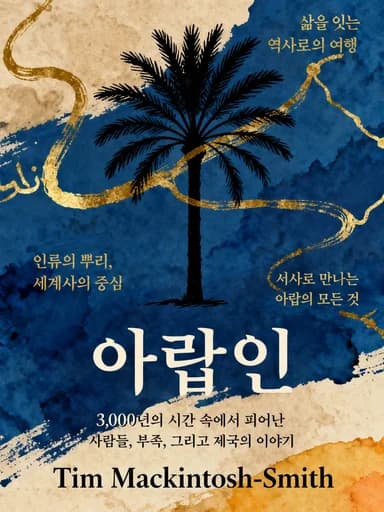
Discover the 3,000-year Arab saga that Harvard's Steven Caton called "superb." Tim Mackintosh-Smith's masterwork reveals how language, not religion, shaped Arab identity. Written amid Yemen's civil war, it sparks vital questions: why has Arab unity remained so elusive?
Tim Mackintosh-Smith, author of Arabs: A 3,000-Year History of Peoples, Tribes and Empires, is an eminent Arabist, historian, and award-winning travel writer renowned for his expertise in Arabic language and cultural history. Born in England and educated at Oxford, he has lived in Yemen since the 1980s, deeply immersing himself in the region’s heritage—a perspective that informs his exploration of Arab identity through linguistic and migratory lenses in this sweeping historical work.
His debut book, Yemen: Travels in Dictionary Land, won the Thomas Cook-Daily Telegraph Award, while his acclaimed trilogy retracing Ibn Battutah’s medieval journeys (Travels with a Tangerine, The Hall of a Thousand Columns, Landfalls) established him as a master of blending scholarship with vivid storytelling.
Mackintosh-Smith’s authority extends beyond print: he presented the BBC documentary series Travels with a Tangerine and contributed to the Library of Arabic Literature as a Senior Research Fellow. Written during Yemen’s civil war, Arabs has been hailed as “a book of vast scope and stunning insight,” synthesizing three millennia of history while challenging homogenized views of Arab identity. His works, including Yemen: The Unknown Arabia and the historical thriller Bloodstone, reflect a career dedicated to illuminating the Arab world’s complexities.
Arabs offers a sweeping exploration of Arab identity through 3,000 years, tracing how language, migration, and cultural exchange shaped diverse communities from ancient Sabaeans to modern nation-states. Tim Mackintosh-Smith challenges Eurocentric views by framing Arabic as the unifying thread, weaving poetry, etymology, and lesser-known historical episodes to reveal continuity amid upheaval.
This book suits history enthusiasts, scholars of Middle Eastern studies, and readers seeking nuanced perspectives on Arab identity beyond stereotypes. Its blend of academic rigor and narrative flair appeals to fans of Ibn Khaldun’s Muqaddimah or Albert Hourani’s A History of the Arab Peoples.
Yes—critics praise its “stunning insight” and readability despite dense subject matter. Mackintosh-Smith avoids dry chronology, instead using linguistic analysis and vivid anecdotes (e.g., pre-Islamic trade routes) to make complex themes accessible. However, some note its focus on language may oversimplify political narratives.
As a Yemen-based Arabist and translator, Mackintosh-Smith draws on 40+ years’ immersion in Arabic texts and cultures. His travel writing experience (e.g., Travels with a Tangerine) enriches the narrative with geographic and ethnographic depth, while wartime confinement in Sana’a sharpened his focus on historical resilience.
Arabic emerges as the “DNA of Arabness,” linking disparate groups across millennia. The book highlights how linguistic innovations—from pre-Islamic poetry to modern media—preserved cultural cohesion despite shifting political empires, arguing that Arab identity transcends genetics or borders.
It counters Eurocentric periodization by emphasizing continuity over rupture, showing how pre-Islamic Arab kingdoms influenced Islamic civilization. Mackintosh-Smith also critiques the “Golden Age” cliché, examining marginalized voices and internal diversity often omitted in standard histories.
While Hourani focused on post-7th-century Islamic history, Mackintosh-Smith delves deeper into pre-Islamic eras and emphasizes linguistic over political unity. Critics note Arabs is more “passionate” and anecdotal, blending scholarship with literary flair.
Some scholars argue its linguistic lens downplays sectarian divides (e.g., Sunni-Shi'a tensions) and modern nationalism. Others note sparse coverage of North Africa’s Berber-influenced Arab communities, creating a Middle East-centric narrative.
It contrasts nomadic Bedouin traditions with urban centers like Baghdad and Damascus, examines African-Arab syncretism in Sudan, and explores hybrid identities in Al-Andalus. Case studies reveal how local customs adapted Arabic frameworks.
The book contextualizes 21st-century issues like migration crises and identity politics through ancient patterns. Its analysis of linguistic revival (e.g., Modern Standard Arabic) offers insights into contemporary cultural preservation efforts.
Mackintosh-Smith’s decades in Sana’a infuse the text with lived understanding of tribal governance, oral traditions, and resilience during conflict. His proximity to ancient Sabaean ruins illustrates how layers of history coexist in Arab landscapes.
저자의 목소리로 책을 느껴보세요
지식을 흥미롭고 예시가 풍부한 인사이트로 전환
핵심 아이디어를 빠르게 캡처하여 신속하게 학습
재미있고 매력적인 방식으로 책을 즐기세요
The Arabs are not a race but a cultural compound.
The Qur'an is a linguistic nationality that unites disparate lineages to the Arabic language.
The Qur'an explicitly declares itself 'an Arabic Qur'an'.
Poetry competitions at markets like Ukaz brought tribes together in peaceful competition.
Arabs의 핵심 아이디어를 이해하기 쉬운 포인트로 분해하여 혁신적인 팀이 어떻게 창조하고, 협력하고, 성장하는지 이해합니다.
Arabs을 빠른 기억 단서로 압축하여 솔직함, 팀워크, 창의적 회복력의 핵심 원칙을 강조합니다.

생생한 스토리텔링을 통해 Arabs을 경험하고, 혁신 교훈을 기억에 남고 적용할 수 있는 순간으로 바꿉니다.
무엇이든 물어보고, 목소리를 선택하고, 진정으로 공감되는 인사이트를 함께 만들어보세요.

샌프란시스코에서 컬럼비아 대학교 동문들이 만들었습니다
"Instead of endless scrolling, I just hit play on BeFreed. It saves me so much time."
"I never knew where to start with nonfiction—BeFreed’s book lists turned into podcasts gave me a clear path."
"Perfect balance between learning and entertainment. Finished ‘Thinking, Fast and Slow’ on my commute this week."
"Crazy how much I learned while walking the dog. BeFreed = small habits → big gains."
"Reading used to feel like a chore. Now it’s just part of my lifestyle."
"Feels effortless compared to reading. I’ve finished 6 books this month already."
"BeFreed turned my guilty doomscrolling into something that feels productive and inspiring."
"BeFreed turned my commute into learning time. 20-min podcasts are perfect for finishing books I never had time for."
"BeFreed replaced my podcast queue. Imagine Spotify for books — that’s it. 🙌"
"It is great for me to learn something from the book without reading it."
"The themed book list podcasts help me connect ideas across authors—like a guided audio journey."
"Makes me feel smarter every time before going to work"
샌프란시스코에서 컬럼비아 대학교 동문들이 만들었습니다

Arabs 요약을 무료 PDF 또는 EPUB으로 받으세요. 인쇄하거나 오프라인에서 언제든 읽을 수 있습니다.
Three thousand years ago, in the vast deserts of Arabia, a remarkable experiment began-not in conquest or empire-building, but in language. While other civilizations defined themselves by borders, bloodlines, or gods, one people chose words as their foundation. This wasn't a conscious decision made in some ancient council chamber. Rather, it emerged organically from scattered tribes who discovered that shared eloquence could create bonds stronger than any fortress wall. The Arabic language became a living homeland, a territory that couldn't be conquered by invading armies because it existed in memory, breath, and verse. Today, a Moroccan and an Iraqi may struggle to understand each other's street conversations, yet both can read seventh-century poetry with surprising ease. This linguistic continuity across thirteen centuries and thousands of miles represents something unprecedented in human history-a civilization that lives not in a place, but in a language.