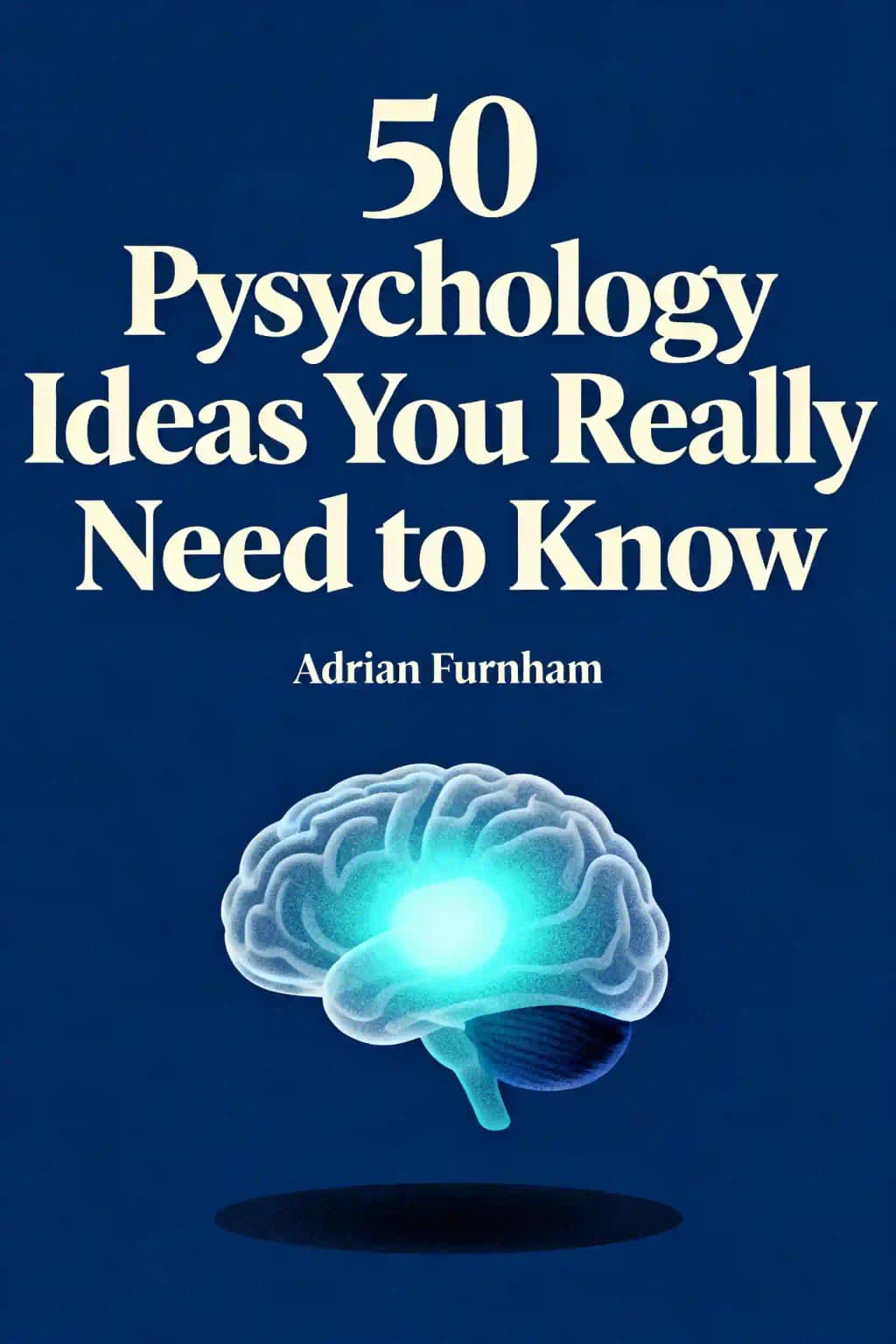
Unlock the mind's hidden mechanisms with Adrian Furnham's acclaimed guide - distilling complex psychology into 50 essential concepts. From cognitive dissonance to emotional intelligence, this renowned British psychologist (author of 700+ scientific papers) transforms academic insights into practical wisdom for understanding human behavior.
Adrian Furnham, author of 50 Psychology Ideas You Really Need to Know, is a renowned British psychologist and organizational behavior expert.
A professor at University College London since 1992, Furnham has written extensively on workplace psychology, leadership, and behavioral economics, with over 50 books including The Psychology of Behaviour at Work and The Elephant in the Boardroom: The Psychology of Leadership Derailment.
His accessible explanations of complex concepts stem from decades of academic research and consulting for global corporations. Named one of HR Magazine’s 20 Most Influential People in HR, Furnham’s insights shape management practices worldwide. His works, translated into multiple languages, bridge academic rigor with real-world application.
With over 1,200 peer-reviewed articles, Furnham remains a leading voice in understanding human behavior across professional and cultural contexts.
50 Psychology Ideas You Really Need to Know by Adrian Furnham explores foundational and modern psychological concepts through 50 concise essays. It covers topics like the placebo effect, Freudian theory, cognitive development, and emotional behavior, offering insights into how these ideas shape human thought and action. Structured for casual readers, it avoids academic jargon while summarizing key theories, debates, and real-world applications.
This book suits curious beginners seeking a lightweight introduction to psychology, not academic rigor. It’s ideal for readers interested in understanding basic concepts like cognitive biases, personality theories, or stress management without diving into textbooks. However, those seeking depth in social or biological psychology may find gaps in coverage.
Yes for casual learners; less so for specialists. The book’s accessible format and standalone chapters make it easy to digest, but critics note uneven topic prioritization (e.g., placing niche concepts before fundamentals) and limited coverage of social/developmental psychology. Its strength lies in brevity, not comprehensiveness.
Key ideas include:
The book organizes 50 self-contained essays into themes like clinical psychology, cognition, and personality. Each chapter introduces an idea, summarizes research, and discusses its implications. Readers can skip between topics without losing context, though critics argue this loose structure weakens foundational learning.
Critics highlight:
Adrian Furnham is a renowned psychologist and former professor at University College London. With over 48 books, including The Psychology of Money and The New Psychology, he specializes in applied psychology, workplace behavior, and cultural differences. His expertise lends credibility but leans toward accessible summaries over original research.
Unlike textbooks (e.g., Psychology 101), Furnham’s work prioritizes brevity over depth, making it a “sampler” rather than a comprehensive guide. It complements his later book The New Psychology, which addresses modern issues like AI and social media. For structured learning, pair it with academic resources.
Yes. Practical applications include:
While not quote-heavy, it highlights pivotal ideas like:
Partially. Core concepts (e.g., cognitive biases, emotional behavior) remain timeless, but newer editions (2023) add contemporary relevance. For cutting-edge topics like AI’s psychological impacts, Furnham’s The New Psychology offers better coverage.
For expanded learning, consider:
저자의 목소리로 책을 느껴보세요
지식을 흥미롭고 예시가 풍부한 인사이트로 전환
핵심 아이디어를 빠르게 캡처하여 신속하게 학습
재미있고 매력적인 방식으로 책을 즐기세요
Psychology has quietly infiltrated nearly every aspect of modern life.
The placebo effect demonstrates the mind's remarkable influence over the body.
Red pills tend to stimulate while blue pills calm.
Healing involves more than just biochemical interventions.
Experts frequently disagree on categorizations.
50 Psychology Ideas You Really Need To Know의 핵심 아이디어를 이해하기 쉬운 포인트로 분해하여 혁신적인 팀이 어떻게 창조하고, 협력하고, 성장하는지 이해합니다.
50 Psychology Ideas You Really Need To Know을 빠른 기억 단서로 압축하여 솔직함, 팀워크, 창의적 회복력의 핵심 원칙을 강조합니다.

생생한 스토리텔링을 통해 50 Psychology Ideas You Really Need To Know을 경험하고, 혁신 교훈을 기억에 남고 적용할 수 있는 순간으로 바꿉니다.
무엇이든 물어보고, 목소리를 선택하고, 진정으로 공감되는 인사이트를 함께 만들어보세요.

샌프란시스코에서 컬럼비아 대학교 동문들이 만들었습니다
"Instead of endless scrolling, I just hit play on BeFreed. It saves me so much time."
"I never knew where to start with nonfiction—BeFreed’s book lists turned into podcasts gave me a clear path."
"Perfect balance between learning and entertainment. Finished ‘Thinking, Fast and Slow’ on my commute this week."
"Crazy how much I learned while walking the dog. BeFreed = small habits → big gains."
"Reading used to feel like a chore. Now it’s just part of my lifestyle."
"Feels effortless compared to reading. I’ve finished 6 books this month already."
"BeFreed turned my guilty doomscrolling into something that feels productive and inspiring."
"BeFreed turned my commute into learning time. 20-min podcasts are perfect for finishing books I never had time for."
"BeFreed replaced my podcast queue. Imagine Spotify for books — that’s it. 🙌"
"It is great for me to learn something from the book without reading it."
"The themed book list podcasts help me connect ideas across authors—like a guided audio journey."
"Makes me feel smarter every time before going to work"
샌프란시스코에서 컬럼비아 대학교 동문들이 만들었습니다

50 Psychology Ideas You Really Need To Know 요약을 무료 PDF 또는 EPUB으로 받으세요. 인쇄하거나 오프라인에서 언제든 읽을 수 있습니다.
Psychology sits at a unique crossroads-revered by some as the "queen of social sciences" while dismissed by others as merely stating the obvious. Born in the 1870s alongside thinkers like Freud, this discipline has quietly infiltrated nearly every aspect of modern life. From the crime shows we binge-watch to the cars we drive, psychological principles shape our world in profound ways. What makes this field so captivating is its remarkable breadth-exploring everything from dreams to delusions, memory to social mobility. It offers insights that sometimes challenge our deepest intuitions while occasionally confirming what we've always suspected about ourselves and others. Have you ever wondered why certain people feel better after taking sugar pills, or why we sometimes see patterns that aren't really there? These mysteries of the mind form the foundation of psychological inquiry.