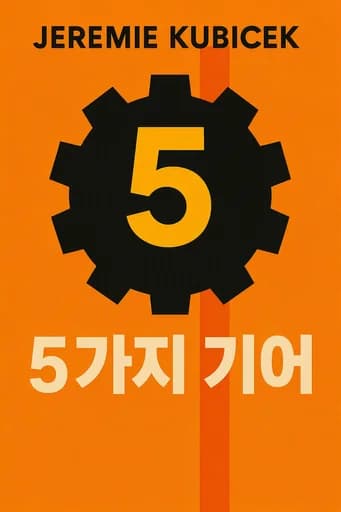
5 Gears
How to Be Present and Productive When There Is Never Enough Time
5 Gears 개요
Stuck in perpetual busyness? "5 Gears" offers a revolutionary framework for shifting between work, rest, and relationships. Endorsed by Patrick Lencioni, this productivity system helps you master the art of being fully present - something 89% of professionals struggle with daily.
5 Gears의 핵심 주제
- intentional presence
- social gear shifting
- relational intelligence
- deep work focus
- emotional connectivity
5 Gears의 명언
You're not really with us.
running people over
What gear are we in?
shift to 3rd gear
Pain signals areas needing attention
5 Gears의 등장인물
- Jeremie KubicekAuthor and CEO who developed the 5 Gears framework
- Steve CockramCo-author of the book and framework developer
- Ryan UnderwoodCase study who used the gears to save his marriage
- L.V. HansonCase study who uses gear language with colleagues
- AndrewFord Motor Company employee using the framework
저자 소개
5 Gears의 저자 소개
Jeremie Kubicek, co-author of 5 Gears: How to Be Present and Productive When There’s Never Enough Time, is a bestselling leadership strategist and organizational culture expert. A serial entrepreneur and co-founder of GiANT Worldwide, Kubicek has built over 25 companies across four continents, including leadership platforms certifying coaches for Fortune 500 firms. His work blends neuroscience and visual learning tools to help leaders master communication, self-awareness, and team dynamics—themes central to 5 Gears, which tackles modern productivity challenges through relational intentionality.
Kubicek’s leadership insights are distilled in other acclaimed works like The 100X Leader and the national bestseller Making Your Leadership Come Alive, both emphasizing trust-based leadership frameworks. As a keynote speaker, he has addressed global audiences through Catalyst Conferences and partnerships with thought leaders like Dr. Henry Cloud. His practical models, used by organizations from startups to multinational corporations, reflect his Oklahoma roots and hands-on experience navigating ventures in Moscow, London, and beyond.
5 Gears is part of Kubicek’s neurolinguistic leadership series, which has equipped over 500,000 professionals to transform workplace communication. His tools are implemented in executive programs at top business schools and featured in media outlets like NPR and Forbes.
5 Gears 요약 다운로드
5 Gears 요약을 무료 PDF 또는 EPUB으로 받으세요. 인쇄하거나 오프라인에서 언제든 읽을 수 있습니다.
이 책에 대한 FAQ
5 Gears provides a framework to improve presence and productivity by aligning communication and focus with situational demands. It uses a car gear metaphor—1st (self-reflection), 2nd (family/social), 3rd (collaboration), 4th (task execution), and 5th (hyper-focus)—to help readers avoid burnout, strengthen relationships, and enhance leadership. Jeremie Kubicek emphasizes self-awareness to shift gears intentionally.
Professionals, parents, and leaders struggling to balance work-life demands will benefit most. The book offers tools for office workers needing post-work decompression, remote teams improving collaboration, and individuals seeking deeper connections. It’s particularly relevant for those in high-stress roles or transitioning careers.
Yes, for its actionable strategies to manage attention and relationships. Critics praise the gear model’s simplicity but note the terminology (“I’m in 5th gear”) can feel forced in daily conversations. Overall, it’s valued for improving emotional intelligence and reducing workplace miscommunication.
- 1st gear: Solo reflection/recharge (e.g., morning routines).
- 2nd gear: Deep relational focus (family dinners, 1:1 conversations).
- 3rd gear: Collaborative socializing (team meetings, networking).
- 4th gear: Multitasking productivity (emails, administrative tasks).
- 5th gear: High-intensity focus (deadline-driven projects).
The model creates a shared language to signal availability (e.g., “I’m in 4th gear—let’s circle back later”). This reduces conflicts caused by mismatched priorities and helps teams align workflows. Kubicek argues that mastering gear shifts prevents “running over” others emotionally.
- “Pain can be a good thing… run toward it because it might be the area that needs focus”
- “Context determines which gear you need to be in”
- “Your greatest strength in one gear becomes your weakness in another”
Some readers find the gear terminology unnatural in casual dialogue. Others desire more examples for non-corporate settings (e.g., healthcare or creative fields). However, most agree the framework’s benefits outweigh these quirks.
Leaders learn to model gear-shifting to build trust. For example: Prioritizing 2nd gear in team check-ins fosters psychological safety, while 5th gear rallies focus during crises. Kubicek’s CORE Process (Call, Own, Respond, Execute) helps leaders address mismatches proactively.
Unlike Atomic Habits (habit-building) or Deep Work (focus tactics), 5 Gears uniquely blends relational intelligence with task management. It complements Kubicek’s The Communication Code (2023), which tackles interpersonal dynamics.
Remote work and AI-driven distractions make intentional presence critical. The gears help navigate hybrid environments—e.g., using 1st gear to transition after virtual meetings or 3rd gear to rebuild office camaraderie post-pandemic.
- Audit your default gear using Kubicek’s self-assessment.
- Practice gear transitions (e.g., 10-minute walks to shift from 5th to 2nd gear).
- Teach the model to colleagues/family to align expectations.
A serial entrepreneur and CEO of GiANT, Kubicek has launched 25+ companies globally. His work in Russia (1990s) and leadership training with John Maxwell informs 5 Gears’ cross-cultural applicability.