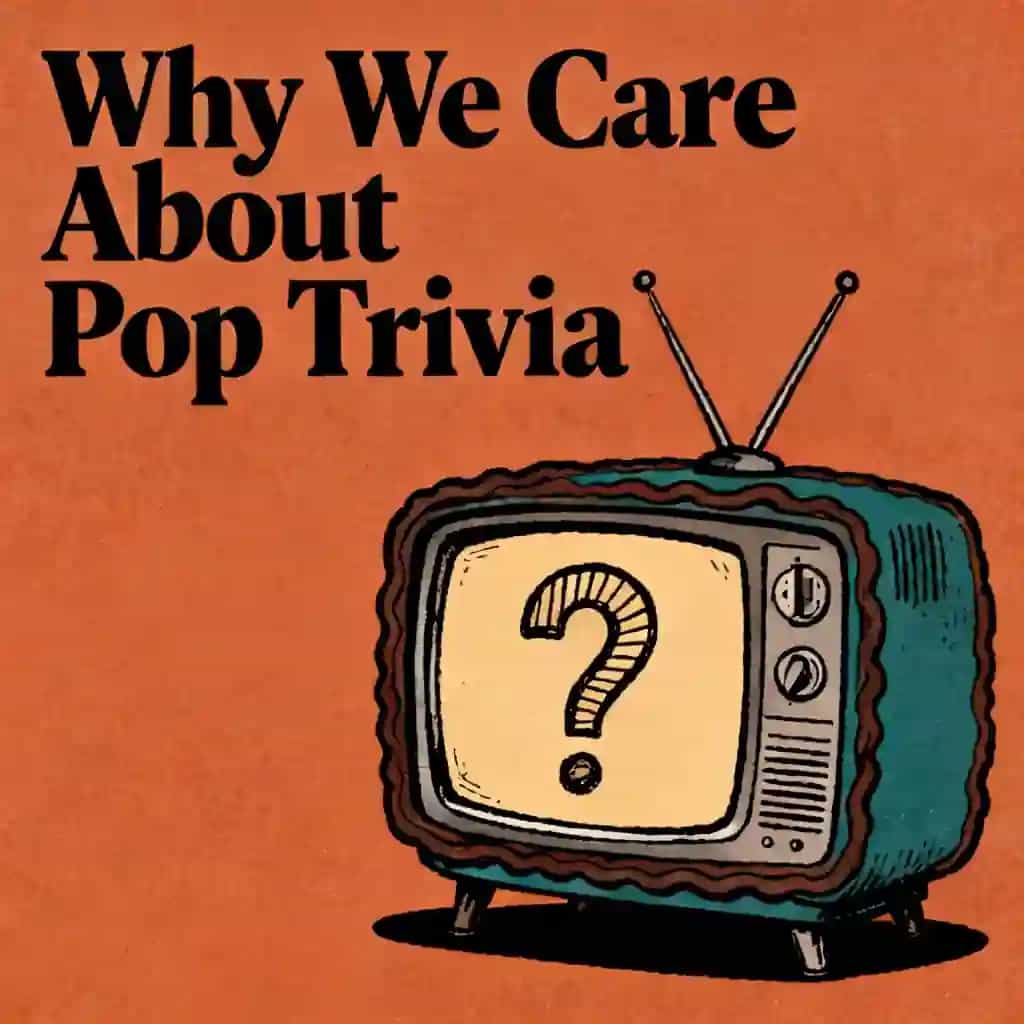
Lena: Miles, have you ever noticed how the most frustrating trivia questions are the ones where you almost know the answer? Like, it’s on the tip of your tongue, and you can visualize the person or the movie poster, but the name just won't come?
Miles: Oh, it’s a specific kind of mental torture. Psychologists actually have a term for it—the "tip-of-the-tongue" phenomenon. But in trivia, I think it’s often because we store information in "clusters." You might know everything about the movie Titanic, but if I ask you what James Cameron was doing on September 11, 2001, your brain has to jump to a completely different shelf.
Lena: Well, what was he doing?
Miles: He was actually underwater, filming the Titanic wreckage for a documentary called Ghosts of the Abyss. He surfaced twelve hours after the attacks happened. He was basically the last person in the Western Hemisphere to find out.
Lena: That is a haunting coincidence. It’s like he was literally submerged in the past while the future was changing. And speaking of 9/11 coincidences, I heard a story about Mark Wahlberg and Seth MacFarlane.
Miles: Yeah, they were both supposed to be on the planes that crashed. Wahlberg decided at the last minute to go to a film festival in Canada instead, and MacFarlane—this is very "on brand" for him—was hungover and missed his flight by ten minutes.
Lena: Ten minutes. That is the thinnest possible line between being a household name and being a tragedy. It makes you realize how much of what we consider "general knowledge" is just a series of unlikely survivals. Like Steve Buscemi.
Miles: Right! People forget he was a firefighter before he was an actor. After the attacks, he went back to his old engine company and spent five days working twelve-hour shifts digging through the rubble. He didn't do any interviews; he just put the gear on and worked.
Lena: That really changes how you look at him in The Big Lebowski or Boardwalk Empire. But that’s the thing about "celebrity facts"—they often humanize people we’ve turned into icons. Like, did you know that Jackie Chan is a classically trained opera singer?
Miles: Wait, the guy who does all the stunts and gets beat up for a living?
Lena: He’s released over twenty albums! He was a pop star in Hong Kong before he ever made it big in movies. He even voiced the Beast in the Mandarin version of Beauty and the Beast. He sang the songs!
Miles: I need to hear that immediately. It’s like finding out that the "M" in M&M’s doesn't just stand for Mars.
Lena: Oh? What’s the other "M"?
Miles: It stands for Mars and Murrie. Forrest Mars Sr. teamed up with Bruce Murrie, who was the son of the president of Hershey’s. They needed a partnership to ensure a steady supply of chocolate during World War II when it was being rationed. So the world’s most famous candy is actually a product of wartime cooperation.
Lena: That makes so much sense. It also explains why they’re candy-coated—so they "melt in your mouth, not in your hands," right? Because they were intended for soldiers in the heat.
Miles: Exactly. Trivia is often just the "secret history" of the things we use every day. Like Ketchup. In the 1830s, it wasn't a condiment; it was sold as a medicine.
Lena: Medicine? For what?
Miles: Indigestion and diarrhea. A doctor in Ohio named John Cook Bennett turned it into a pill form. Imagine taking "Heinz" for a stomach bug.
Lena: I think I’ll stick to the fries. But it’s that "repurposing" of knowledge that’s so cool. Like the "Quick Brown Fox" sentence. Every kid learns it for typing, but do they know why?
Miles: Because it’s a pangram. It uses every single letter in the English alphabet. It’s the most efficient way to test a keyboard or a font.
Lena: It’s these "utilitarian" facts that stay with us. They’re like the "aglet"—that little plastic tube on the end of a shoelace. We use them every day, we never think about the name, but once you know it, you see it everywhere.
Miles: And that’s the goal, isn't it? To start seeing the world as a collection of stories instead of just a collection of objects.