第1章
Beyond Borders: The Journey of Displaced Souls
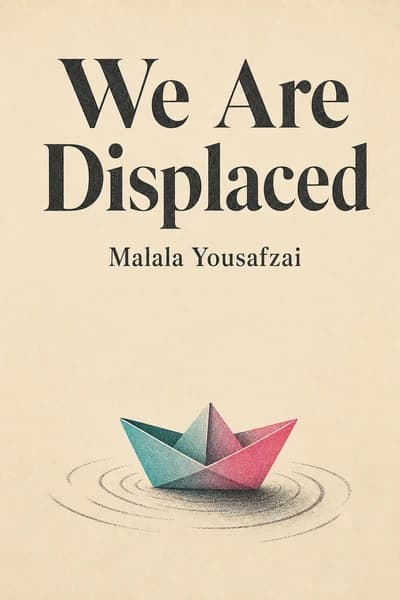
In a world where peace is often taken for granted, Malala Yousafzai's "We Are Displaced" stands as a powerful testament to those for whom safety is a luxury. The book has become a cultural touchstone since its 2019 publication, praised by human rights advocates and celebrities alike, including Angelina Jolie who called it "a stirring and timely book that strips the label 'refugee' of its faceless anonymity." Through Malala's own story and those of nine other displaced young women, the book humanizes the global refugee crisis affecting over 68 million people worldwide. As the youngest-ever Nobel Peace Prize laureate, Malala transforms statistics into stories that resonate deeply, inviting us to consider: What would you do if you were forced to leave everything behind? What if the choice was between death and the unknown? These questions haunt every page of this remarkable work that has been translated into over 30 languages and incorporated into humanitarian studies curricula worldwide.
第2章
Paradise Lost: The Fall of Swat Valley
When I close my eyes, I can see Swat Valley through Malala's memories-pine forests stretching toward snowcapped mountains, rushing rivers cutting through lush landscapes, a paradise on earth. Her childhood unfolds in vivid detail: running through Mingora's streets with friends, playing cricket on rooftops, visiting family in Shangla, and listening to her parents discuss politics and education late into the night.
The Taliban existed only in distant Afghanistan-nothing for young Malala and her brothers to worry about. But by 2004, when she was just six years old, subtle changes began creeping into their lives. By 2007, the paradise she knew was transforming into something unrecognizable.
The changes came gradually, almost imperceptibly at first. Co-educational classes became impossible. After a devastating earthquake in 2005, extremists providing aid began preaching increasingly strict interpretations of Islam through local radio broadcasts-women must cover completely, music and dancing were declared sinful, girls shouldn't attend school.
"This wasn't our Islam," Malala reflects. Men with long beards and black turbans began patrolling streets that once felt safe and familiar. During a family trip to Shangla, Taliban fighters stopped their car searching for music cassettes. One ordered young Malala to cover her face despite being a child. The fear that had been growing now felt inescapable.
Then the violence began. At eleven years old, Malala witnessed the Taliban bombing girls' schools throughout Swat Valley. Though the nighttime attacks spared lives, arriving at school to find only rubble felt beyond cruel. They cut electricity, targeted politicians, banned children's games, and bombed police stations. Those who spoke against them would be found dead in what was once called Green Square-now renamed Bloody Square-with notes explaining their "sins."
Imagine waking each morning wondering if your school still exists. Imagine checking door locks nightly, varying routes home, living with the constant whir of military helicopters overhead. For Malala and countless others, this became normal life-bomb blasts making the ground tremble, gunfire punctuating the night. A day without explosions meant "today was a good day."
第3章
When Home Becomes Dangerous: The Flight from Swat
By late 2008, the Taliban issued a decree: all girls' schools would close by January 15, 2009, or face violent attacks. Even Malala's father-a staunch education advocate who ran two schools including one for girls-would follow this order to protect his students and daughter. When schools closed, Malala began writing for BBC Urdu about their plight, describing how walks to school became fear-filled sprints and nights were spent huddled away from windows as bombs exploded nearby.
In May 2009, the government ordered everyone to evacuate Swat as they planned military operations against the Taliban. Though her father initially resisted, news of a cousin's death in crossfire convinced the family to flee. "I cried, fearing I'd never see my home again," Malala recalls. She packed schoolbooks that her mother later made her leave behind-a heartbreaking symbol of priorities during displacement.
They joined thousands fleeing in overcrowded vehicles or on foot, taking longer routes to avoid Taliban blockades. The family stayed first with her father's friend in Mardan before continuing to Shangla while her father remained in Peshawar advocating for peace. The journey took three exhausting days, ending with a fifteen-mile walk carrying all their belongings.
Even at relatives' homes, they learned the Taliban had recently visited-nowhere felt truly safe. In Shangla, they alternated between extended family homes to avoid burdening any one household too long. Despite fleeing because of restrictions on girls' education, Malala continued her studies with her cousin Sumbul-a small act of defiance and normalcy she desperately needed.
For six weeks, they lived this routine-school with Sumbul, homework, and anxiously awaiting news from her father. Her mother would climb atop boulders in fields to get cell reception on her Nokia phone. Finally, her father called them to join him in Peshawar, where they reunited in a joyful group hug. They spent weeks moving between friends' and relatives' homes, carrying IDP (Internally Displaced Person) cards for food rations like millions of others. Malala turned twelve during this displacement, her birthday passing largely forgotten as she wished only for peace and a return to normal life.
第4章
The Impossible Return: Finding Home in Exile
When permission finally came to return home, Malala felt almost numb with disbelief. The journey back through the Swat Valley revealed bullet-riddled houses and rubble-stark evidence of warfare that tempered her excitement. Every turn in the road brought new devastation: schools reduced to shells, markets abandoned, gardens withered to dust. Her father wept openly at the sight of the Swat River, its waters still flowing despite the destruction around it, and Malala felt a tug of hope, though it dimmed quickly upon arrival. The city they returned to was not the one they had left behind. Streets once bustling with vendors and schoolchildren were eerily silent, buildings damaged by bullets or reduced to rubble, their walls telling stories of violence through countless bullet holes.
Their home remained physically untouched, a miracle amid the destruction, but the psychological damage was profound. Her brothers discovered their beloved chickens had starved to death-tiny skeletons in the coop that felt symbolic of the larger devastation visited upon their community. Though her precious books were safe, preserved like time capsules from a happier era, an overwhelming sadness filled her. The school where she had once studied and dreamed had been transformed into a military base, with desks overturned, walls blasted open, and children's artwork trampled underfoot. The playground where she had once laughed with friends was now silent, littered with shell casings and military debris.
Gradually, life attempted to return to a new normal, though the Taliban's presence lingered like a shadow. They were no longer visible on street corners, but their influence remained in whispered threats and anonymous notes. Malala continued speaking for girls' education, addressing local gatherings and international media, until that fateful day on October 9, 2012, when Taliban gunmen stopped her school bus and shot her in the head. After emergency treatment in Pakistan, she was flown to Birmingham, England while in a medically induced coma, her survival hanging by a thread. Despite the severity of her injuries, her spirit remained unbroken.
Walking out of Queen Elizabeth Hospital into Birmingham's cold winter nearly three months later, Malala felt like a stranger in a foreign land. The family had arrived with only the clothes they wore, forced to start from absolute scratch in this unfamiliar world of double-decker buses and English rain. Her mother, particularly, struggled with the transition, fearful of living in a high-rise apartment that reminded her of their internal displacement in Pakistan but now surrounded by foreign faces, unfamiliar food, and an incomprehensible language. The simple tasks of daily life became monumental challenges: shopping for groceries, navigating public transportation, understanding school systems.
Initially believing their stay would be temporary, Malala gradually realized this might be permanent when she enrolled in Edgbaston High School for Girls in April. The cultural shock was intense - from the uniform to the teaching methods to the social dynamics. She struggled to connect with classmates who lived in a world so different from her own, desperately missing her friends from Mingora who understood her experiences without explanation. The thousands of supportive letters she received from around the world became her lifeline, helping her decide to continue her activism for girls' education with even greater determination. "The Taliban had failed," she reflects. "Instead of silencing me, they had amplified my voice beyond Pakistan's borders. Each letter reminded me that I was no longer just speaking for the girls of Swat Valley, but for millions of girls denied education worldwide."
第5章
The Complex Emotions of Displacement
Though not technically a refugee, Malala deeply understands displacement-leaving home because it's too dangerous to stay. When she thinks of refugees, she thinks of resilience and courage, having witnessed firsthand how people rebuild their lives from nothing. Most people expect refugees to feel only gratitude and relief, not understanding the complex emotions of leaving everything behind, including extended family, cultural identity, and a sense of belonging that may never fully be recovered.
"While grateful to the UK for welcoming us, I miss Pakistan daily," she confesses-the taste of properly boiled tea with milk, the authentic flavor of rice and chicken, the sounds of Pashto in the streets, and the smell of earth after rain in her grandparents' mountain village. She describes the particular ache of missing cultural celebrations, like Eid, where the absence of familiar traditions and community gatherings becomes painfully apparent. Simple things, like the call to prayer echoing through the valley or the weekly bazaar's bustle, become precious memories that both comfort and haunt.
What she doesn't miss is the fear-checking locked doors at night, waiting anxiously for her father's safe return, or the sounds of helicopters and bombs. The trauma of those experiences lingers, creating a complicated relationship with her homeland. She recalls nights spent listening to Taliban radio announcements, wondering if her school would be next on their list of targets, and the constant vigilance that became second nature to her family.
This mixture of gratitude and grief, relief and longing, characterizes the refugee experience. It's a complexity often lost in political discourse that reduces displaced people to statistics or political talking points. Through her own story and those she's collected, Malala illuminates this emotional landscape with remarkable clarity and compassion. She shares stories of Syrian doctors now working as grocery store clerks, Afghan professors driving taxis, and Iraqi musicians who haven't touched their instruments since fleeing - all carrying both the weight of what they've lost and the determination to build something new.
Have you ever had to leave a place you loved? Even voluntary moves bring emotional turmoil-now imagine leaving under threat of violence, knowing you might never return. This perspective shift is what Malala invites through these collected narratives. She describes the psychological toll of starting over: learning a new language, navigating unfamiliar social norms, and struggling to maintain cultural identity while adapting to a new society. The courage required isn't just in the moment of fleeing, but in the daily choice to keep moving forward, to build a new life while carrying the memory of the old one.
第6章
Sisters Separated: Zaynab and Sabreen's Journey
Among the most poignant stories is that of Zaynab, whom Malala met during her film tour for "He Named Me Malala." Despite missing two years of school while fleeing wars, Zaynab graduated as valedictorian with a perfect 4.0 GPA. Her sister Sabreen, equally bright and determined, faced a different fate when only Zaynab received a visa to resettle in America.
"I still don't know why I got a visa while my younger sister didn't," Zaynab reflects. Saying goodbye to sixteen-year-old Sabreen at the Cairo airport was agonizing-they'd already lost so much after fleeing dangerous Yemen two years earlier. That December 2014 parting left a hole so vast it sometimes threatened to consume her, making her refugee experience more bitter than sweet.
Arriving in Minneapolis speaking no English, Zaynab faced the shocking Minnesota cold-she'd never experienced anything like it, wrapping her scarf until only her eyes showed. Inside her new school, she was relieved to see many Muslim students, a "vibrant rainbow of hijabs streaming through hallways." A helpful student named Habib (meaning "loved one" in Arabic) guided her to class, where another student, Asma, spoke to her in Arabic, becoming her guide, translator, and best friend.
Meanwhile, after Zaynab's departure, Sabreen took matters into her own hands, joining other Yemeni girls on a harrowing boat journey across the Mediterranean to Europe. For over a month, Zaynab heard nothing from her sister, leaving their mother desperate with worry. Finally, a Facebook message arrived: "I made it to Italy. I'm safe." Eventually, Sabreen was sent to a refugee camp in Holland with Wi-Fi, allowing regular communication. Later, she surprised Zaynab by announcing she wanted to marry a Yemeni man she'd met at the camp-seeking companionship in a world where she had been repeatedly uprooted.
Their story illustrates how refugee policies can arbitrarily separate families, creating new traumas even as they resolve others. It also shows the remarkable resilience of young people who create new lives and connections despite these challenges.
第7章
Education as Resistance: Muzoon's Advocacy
In the sprawling Zaatari refugee camp, Malala met Muzoon Almellehan, a Syrian girl whose passionate advocacy for education mirrored Malala's own journey. Despite speaking different languages - Malala in Urdu and Muzoon in Arabic - they formed an immediate bond through their shared conviction that education could transform lives. This connection led to Muzoon being dubbed "the Malala of Syria," though Malala preferred to call her "the Muzoon of Syria," recognizing her unique identity and contribution.
When war erupted in Syria in 2011, Muzoon's life in Daraa was upended. Her family endured two years of relentless bombings, street fighting, and the constant fear of death before finally fleeing to Jordan's Zaatari refugee camp. Though the camp provided basic shelter and safety, Muzoon's primary concern wasn't food or housing - it was the continuation of her education. She was dismayed to discover that only 20% of the camp's children attended the makeshift schools, with many families preferring to arrange early marriages for their daughters as a misguided form of protection.
Determined to change this pattern, Muzoon launched a tent-by-tent campaign, becoming a fierce advocate against child marriage and for education. She would spend hours talking to families, explaining, "No one knows when we'll go back to Syria! We could be in the camp for years. Without education, what future will our children have?" Her advocacy was particularly powerful because she understood the cultural and economic pressures facing these families, yet could articulate why education offered a better long-term solution.
One of her most significant victories came when she helped prevent a seventeen-year-old girl from marrying a forty-year-old man. Through persistent dialogue with both the girl and her family, Muzoon helped them see education as an investment in the future. "You and me, we can be the ripple effect," she told the girl. "If we go to school, others will follow. Every girl who stays in school becomes an example for others."
Muzoon's story illustrates how education becomes a powerful form of resistance against the erasure and hopelessness that displacement often brings. In refugee camps, where people risk losing their sense of identity and purpose, education provides structure, dignity, and hope. By continuing to learn and encouraging others to do the same, refugees maintain their agency and build futures beyond their current circumstances. This perspective transforms education from a luxury into a necessity - a vital lifeline to normalcy, opportunity, and self-determination.
Her work eventually gained international recognition, leading to her appointment as UNICEF's youngest Goodwill Ambassador, proving that one person's dedication to education can create lasting change even in the most challenging circumstances. Muzoon's advocacy demonstrates that education is not just about acquiring knowledge - it's about preserving dignity, maintaining hope, and building resilience in the face of adversity.
第8章
From Survival to Purpose: Transformative Journeys
The book's most powerful theme emerges through stories of transformation-how displaced young women move from mere survival to finding purpose through their experiences. These journeys reveal how resilience, opportunity, and support can transform trauma into triumph.
Marie Claire's journey exemplifies this evolution, illustrating both the devastating impact of forced displacement and the remarkable human capacity for renewal. After fleeing the Democratic Republic of Congo following her mother's brutal murder, Marie Claire and her family resettled in Zambia. Her father, who survived despite being stabbed multiple times in the head, required constant care. The attack left deep physical and emotional scars on the entire family. Though police claimed to investigate, no one was ever charged, partly because the family was undocumented with no legal rights - a common predicament for refugees caught between systems. Marie Claire dropped out of school to care for her father, overwhelmed by grief and the brutal irony of escaping one violence only to encounter another.
Her mother's final moments became a source of strength that would sustain Marie Claire through years of hardship. Her mother's last prayer-"You can take my life as long as my children are safe"-became a mantra that gave her courage to eventually return to school. Over time, life gradually improved-Marie Claire not only excelled academically but also became fluent in Nyanja, the local language, helping other refugee children adapt. Her father's remarriage brought additional stability to the family. When the UNHCR finally approved their refugee application after a grueling five-year wait, they were resettled in Lancaster, Pennsylvania.
Though nearly nineteen, Marie Claire demonstrated remarkable determination by convincing her school counselor to let her complete high school rather than pursue the easier GED route. She mastered English within months and maintained straight A's while working part-time to help support her family. At her graduation-the first in her family to achieve this milestone-she felt her mother's presence lifting her up as her extended family and support network celebrated. She now attends university in Maryland on a partial scholarship, pursuing nursing with plans to return to Africa as a healthcare provider specializing in refugee care.
Jennifer, Marie Claire's "American mom" who volunteered through Church World Service's refugee resettlement program, witnessed this transformation firsthand. She describes how Marie Claire evolved from a reserved refugee who barely spoke to a confident, fearless young woman who now mentors other refugee students and speaks at community events about refugee issues. Within just three years, she transformed from someone with an uncertain future to a leader making real impact.
These stories challenge us to see refugees not as permanent victims but as people in transition-moving through difficulty toward purpose and contribution. The book highlights numerous examples: a Syrian woman who became a trauma counselor, a Sudanese refugee who founded a literacy program, and an Afghan interpreter who now works in international development. They remind us that with support and opportunity, displaced people become doctors, teachers, activists, and leaders who transform their communities. Their journeys demonstrate how personal healing often leads to a desire to help others heal, creating ripple effects of positive change.
第9章
Coming Full Circle: Return and Responsibility
Malala concludes with her emotional return to Pakistan in March 2018, her first visit since being evacuated after the Taliban attack. She describes the helicopter flight over Swat Valley, seeing its beauty from above, and landing on the same helipad where she had been evacuated on a stretcher years before.
The homecoming affected each family member differently-her youngest brother Atal barely remembered Pakistan, while her mother wept with joy. Standing in her bedroom, preserved exactly as she left it, brought a peace to her mother's face that Malala hadn't seen in years. Her mother observed, "Malala left Pakistan with her eyes closed; now she returns with her eyes open."
Malala acknowledges how fortunate she is to have returned home when many displaced people cannot. Though she doesn't live there permanently, Pakistan remains central to her work, with Malala Fund investing in girls' education across the country.
This return journey represents a privilege denied to most refugees. Of the 68.5 million displaced people worldwide, many will never see their homelands again. Those who do often find places irrevocably changed or destroyed. Yet Malala's experience also demonstrates the responsibility that comes with successful resettlement-to remember those still displaced and to use one's voice and resources to help others.
The book ends with practical suggestions for readers: educate yourself through trusted news sources and UNHCR's website; support organizations like IRC, UNICEF, and KIND through donations, time, and attention; research community organizations; volunteer; raise awareness; support refugees directly. Above all, Malala emphasizes that empathy is key and acts of generosity both large and small make a difference.
Through these collected stories, Malala transforms our understanding of displacement from an abstract global crisis to an intensely personal human experience. She challenges us to see beyond labels and statistics to the individual journeys of courage, loss, resilience, and hope that define the refugee experience. In doing so, she invites us not just to witness but to participate in creating a world where fewer people are forced to leave home-and those who must are welcomed with dignity and opportunity.