第1章
Redefining Value: The Distinction Between Makers and Takers
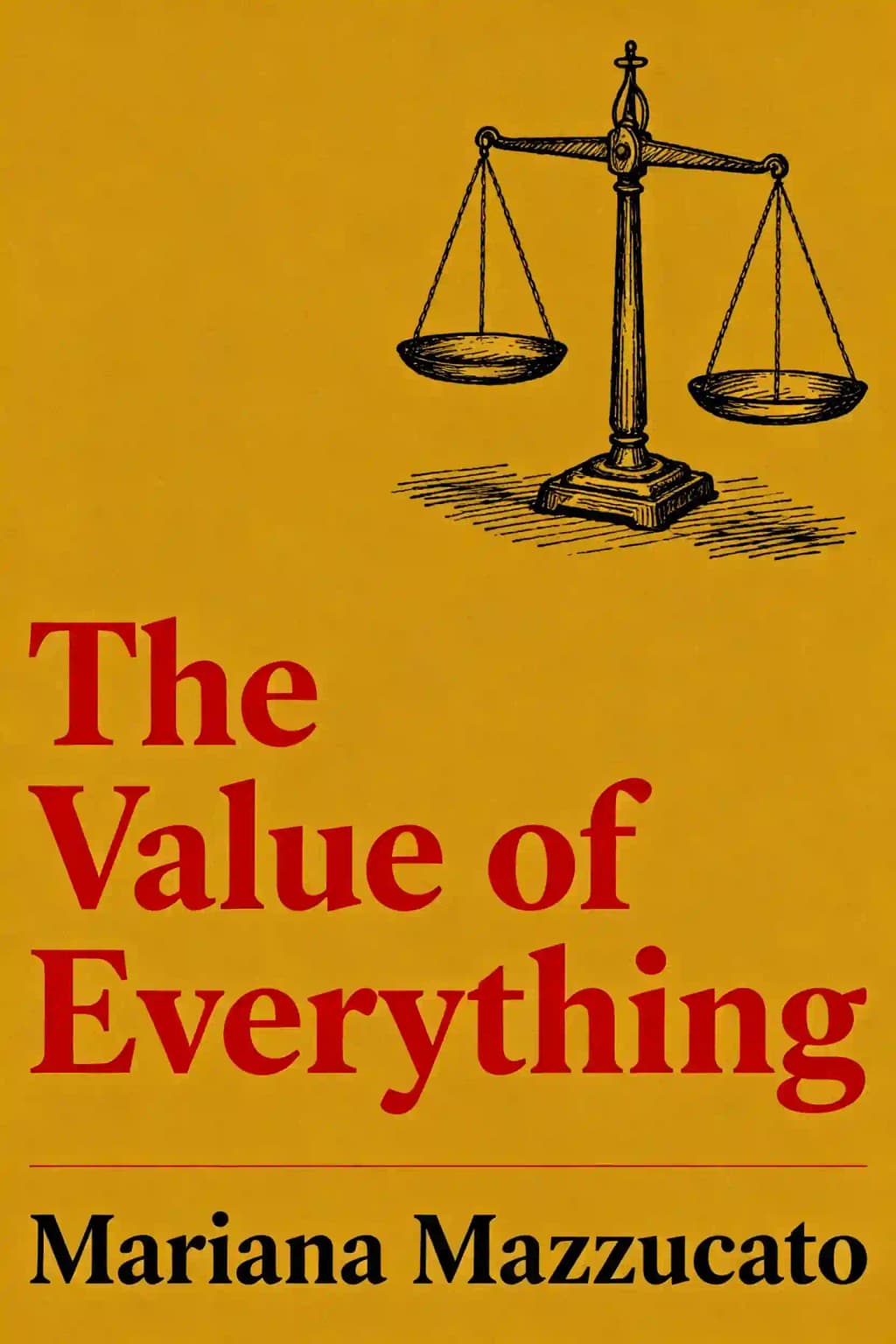
When Lloyd Blankfein, CEO of Goldman Sachs, claimed his employees were "among the most productive in the world" just months after the 2008 financial crisis that his bank helped create, he wasn't just defending his company-he was perpetuating a dangerous myth about value creation that has come to dominate our economic thinking. This audacious statement came shortly after Goldman received a $125 billion government bailout, yet still managed to generate $63 billion in profits over the next seven years while laying off thousands. Mariana Mazzucato's "The Value of Everything" has become a sensation among economists, policymakers, and even celebrities like Beyonce, who reportedly gifted copies to her entire business team, precisely because it challenges these self-serving narratives. The book has been praised by Nobel laureates and featured on Barack Obama's reading list for its revolutionary reexamination of who truly creates economic value versus who merely extracts it.
第2章
The Great Value Confusion: How Price Came to Define Worth
For centuries, economists debated what value actually was. Classical economists like Adam Smith and David Ricardo believed value derived from production conditions, particularly labor. By the mid-nineteenth century, this "objective" theory was replaced by "subjective" concepts where value became determined by market price-whatever consumers would pay. This shift from "value determining price" to "price determining value" coincided with the rise of socialism and consolidation of capitalist producers, who preferred the price-determines-value theory to justify their larger share of output.
This transformation had profound consequences. When value is simply defined by price, activities can shift from unproductive to productive with minimal scrutiny. Who can challenge Goldman Sachs when they declare their employees "the most productive in the world" or pharmaceutical companies charging exorbitant prices based on claimed "value"? The circular reasoning becomes: incomes are justified by producing something valuable, and value is measured by earning income. This tautology eliminates the concept of unearned income entirely-you earn income because you're productive, and you're productive because you earn income.
The disappearance of value theory from economic debate hides what should be publicly contested. It has enabled massive value extraction, concentrating wealth while wages stagnate. Despite US GDP tripling between 1975-2015 and productivity growing 60%, real hourly wages have stagnated or fallen. The result is growing inequality exemplified by figures like Mark Zuckerberg, whose fortune increased by $18 billion in a single year.
Value concepts inevitably influence policymaking. When trying to make growth "smarter," "more sustainable," or "more inclusive," we must decide which activities are more important than others. The distinction between productive and unproductive activities has never been purely "scientific" but always involves socio-economic arguments reflecting particular political perspectives on how society should be constructed.
第3章
The Production Boundary: Drawing the Line Between Creation and Extraction
For centuries, economists have divided economic activities into "productive" and "unproductive," creating what's called a "production boundary." Inside this conceptual boundary are wealth creators; outside are those who benefit either through rent-seeking or redistribution. This boundary has never been fixed-its shape and size have shifted with social and economic forces.
The eighteenth century saw controversy when physiocrats called landlords 'unproductive,' questioning whether landlords were merely extracting wealth from tenant farmers or providing essential land contributions to value creation. Today, similar debates continue about the financial sector, with post-2008 calls to boost "makers" in industry over "takers" in finance.
But the relationship is complex-activities outside the boundary may facilitate production, like merchants ensuring goods reach markets efficiently or finance enabling business transactions. The central question isn't simply labeling some as makers and others as takers, but how these activities can be shaped to truly serve their value-producing purpose.
Consider Apple's tax avoidance strategies. Despite Ireland's 12.5% corporate tax rate, Apple paid just 0.005% in 2014 through subsidiaries that existed only on paper and weren't tax resident anywhere. The European Commission ordered Apple to pay 13 billion in back taxes, calling Ireland's arrangement illegal state aid. Apple's value extraction extends beyond international tax operations-the company created intellectual property in California but formed a Nevada subsidiary to avoid California taxes, channeling $2.5 billion in interest and dividends there between 2006-2012.
The way we define the production boundary shapes our economic priorities and policies. It determines what activities we encourage through tax incentives, regulations, and public investment. When we fail to distinguish between value creation and extraction, we enable extractive activities to masquerade as productive ones, leading to misallocated resources and growing inequality.
第4章
From Classical Economics to Modern Confusion: The Evolution of Value Theory
The concept of value has evolved dramatically through economic history, with each era's dominant theory reflecting its social and political context. As industry developed through the 18th and 19th centuries, economists like Adam Smith, David Ricardo and Karl Marx began measuring a product's market value by the labor that produced it. These "classical" economists redrew the production boundary to reflect industrialization, focusing on how changes in work organization and technology affected productivity and wealth.
Smith's "The Wealth of Nations" (1776) demonstrated how division of labor dramatically increased productivity through specialization. His famous pin factory example showed how ten specialized workers could produce 48,000 pins daily, while working independently they might struggle to make twenty each. Smith drew a clear production boundary between material production (agriculture, manufacturing, mining) and immaterial production (services). For him, productive labor created tangible objects, while services-even essential ones-were "unproductive" because they didn't reproduce the value needed for workers' subsistence.
Ricardo further developed his model of accumulation by distinguishing between productive and unproductive consumption. He argued that capital consumed productively-like a capitalist buying labor that reproduces capital and generates profit-was fundamentally different from unproductive consumption on luxuries. His heroes were industrial capitalists who ensured workers could subsist while generating surplus for productive reinvestment, while his villains were the landed nobility who charged exorbitant rents and wasted surplus on lavish lifestyles.
Marx refined these theories by distinguishing between different capitalist functions in the economy. He identified production (industrial) capital that produces commodities, commercial capital that circulates them, and interest-bearing capital like banks. Only production capital directly creates surplus value, while commercial capital "realizes" it by selling commodities. For Marx, labor is productive only if it produces surplus value for production capital. His production boundary runs between goods and services production versus functions not creating additional surplus value like interest charges or speculative trading.
This classical understanding of value was challenged in the late 19th century by the marginalist revolution, which shifted the focus from objective production costs to subjective consumer utility. Economists like Walras, Jevons and Menger developed a "scientific" view of economics based on marginal utility-a slow but revolutionary shift in value theory. This approach had historical roots in medieval "just price" concepts, but evolved beyond moral judgments to focus on individual utility maximization.
The marginalist approach fundamentally redefined productivity by establishing that only activities fetching a legal market price are productive. Under this theory, productivity fluctuates with prices since prices determine value, not vice versa. The productive/unproductive distinction effectively disappeared, with nearly all market-exchanged products becoming productive. In Marshall's equilibrium state, everyone gets paid what they're worth-workers earn their marginal productivity, and unemployment becomes a rational choice between work and leisure. The concept of exploitation vanishes as wages and profits are seen as just rewards for productive contributions.
第5章
Measuring the Wealth of Nations: How GDP Shapes Our Economic Vision
GDP measurements fundamentally shape economic policy, yet they're profoundly influenced by underlying value theories. Following marginalist thinking, GDP includes anything fetching a legal market price, assuming high salaries indicate productivity and worth. But if income reflects rent extraction rather than productivity, GDP becomes a misleading measure of economic health.
National accounts contain several accounting oddities. GDP fails to distinguish between costs and investments in future capacity like R&D; valuable unpaid services like care work remain invisible; illegal black-market activities go uncounted; and environmental destruction isn't subtracted from GDP (though cleanup services increase it). Most significantly, questions remain about whether the financial sector facilitates exchange of existing value or creates new value-a billion-dollar question with profound implications for understanding economic growth versus rent capture.
The most glaring weakness in the System of National Accounts is its confusion between profits and rents. Classical value theory distinguished between earned income from productive activities and unearned income (rent) from activities outside the production boundary. But under marginal utility theory, services of landlords and hedge fund managers are treated as productive and included in GDP, transforming value extraction into value creation.
National accounts exclude housework-and thus much of women's work-from production, a decision originally justified by Richard Stone (the "father of national income accounting") as both technically difficult and socially awkward. Paradoxically, a nation would increase its GDP if neighbors paid each other to do each other's housework. Meanwhile, national accountants go to great lengths to include owner-occupied housing in GDP by imputing rental values that owners theoretically pay themselves. This adds roughly 6% ($1 trillion) to US GDP despite no actual money changing hands.
While economists rarely acknowledge government as a value creator, national accounting has quietly tracked its substantial contribution for half a century. Government value added in the US has consistently represented 11-15% of GDP throughout the post-war period-significantly larger than finance's contribution. The discrepancy between government value added and expenditure (20-25% of GDP) reflects a measurement challenge: government activities aren't sold at market prices that cover costs plus profit. National accountants have adopted the "inputs = outputs" approach, where government value added equals employee salaries with no profit margin. This accounting convention makes government seem unproductive in a system where profit equals productivity.
第6章
Finance: From Servant to Master of the Economy
The financial sector's growth has been celebrated as a sign of economic success in the UK and US, credited with mobilizing capital and generating exports as manufacturing declined. This model became aspirational for other countries in the 1990s. Yet this celebration clashes with common experience, as financial institutions seem to guarantee their own prosperity more readily than their customers'. The 2008 global financial crisis revealed the fictional nature of banks' "net worth," requiring government bailouts that continue to impose heavy social costs through squeezed public budgets, household debt, and negative returns for savers.
The belief that economic progress requires a growing financial sector contradicts several logical expectations. If financial intermediaries truly promoted growth by mobilizing capital, their share of GDP should diminish over time. Similarly, if banks become more efficient, firms should increasingly use their services rather than internal financing. Yet studies show firms still finance most investment internally through retained profits, as external financers demand higher returns due to information asymmetry. Meanwhile, banks have entrenched their central role in the financial system despite theoretical predictions that efficient markets should expand at their expense.
Banks' contribution to national output is now measured through "financial intermediation services, indirectly measured" (FISIM), calculated by the markup banks charge above a reference interest rate. This accounting change transformed what was previously considered a deadweight cost into a source of added value, incorporated into most national accounts just before the 2008 crisis. Paradoxically, the riskier the lending and the wider the interest spread, the greater the banks' measured contribution to GDP-even when these practices ultimately harm the economy.
For centuries, finance was viewed not as productive but as extractive-a moral and economic judgment reflected in the medieval Church's ban on interest and Enlightenment philosophers like Locke viewing bankers as mere middlemen "eating" trade gains rather than creating value. The physiocrats excluded finance from productive sectors, while Adam Smith similarly doubted money could create more than it started with. Marx positioned finance in capital's circulation phase-a catalyst transforming money into production capital, but ultimately taking a portion of surplus value generated elsewhere rather than creating new value.
This understanding was challenged as financial trading vastly outgrew trade in real products, with systemic market fluctuations causing crashes roughly every fifteen to twenty years. Keynes, observing Wall Street's evolution in the 1930s, argued it had abandoned its proper social purpose of directing investment toward productive channels, instead becoming a glorified betting parlor where profits were "mere transfers" that should be limited and taxed.
第7章
Casino Capitalism: When Money Makes Money From Money
Finance has evolved far beyond traditional banking activities into a sprawling sector where money increasingly makes money from money itself. By 2014, "shadow banking"-unregulated financial intermediaries performing bank-like functions-had grown to $80 trillion globally, potentially representing a quarter of the financial system. Meanwhile, asset management has expanded dramatically as households face pressure to make their savings work harder amid reduced government pension provisions. Together with deregulated traditional banking, these forces have created a disproportionately large financial sector that largely serves itself rather than the real economy-with only 15% of funds generated going to non-financial businesses.
The post-war accumulation of savings transformed asset managers into central economic actors. In the US, assets under management grew dramatically from $3.1 billion in 1951 to $17 trillion by 2015. In the UK, the asset management industry reached 5.7 trillion by 2015-more than three times the country's GDP. Individual ownership of stocks plummeted-from 92% in 1950 to about 30% today in the US, and just 11% in the UK. Meanwhile, the industry consolidated, with about twenty-five fund managers controlling 60% of institutional equities in the US.
Finance extracts value through three primary mechanisms: transaction costs between providers and receivers of finance, monopoly power (especially in banking), and charging high fees relative to risks taken. Despite technological advances, financial intermediation costs have barely fallen over the past century. As John Bogle, founder of Vanguard, demonstrated, active fund management fees (averaging 2.27%) dramatically reduce investor returns through "the tyranny of compounding costs." Over a 40-year investment period, these fees can reduce final returns by 40%, turning a potential $165,000 retirement fund into just $100,000.
Hedge funds exemplify this value extraction through their "2 and 20" fee structure (2% of assets managed plus 20% of profits), despite mediocre average performance and high failure rates (about 20% annually). Similarly, private equity firms charge comparable fees plus additional transaction, monitoring and service fees, making approximately two-thirds of their compensation fixed rather than performance-based. They further protect themselves by loading acquired companies with debt (typically 60-80% of acquisition costs) while holding only about 2% of the funds they manage.
When adjusted for risk and compared to appropriate benchmarks, private equity's claimed outperformance largely disappears. The industry's reported 27% outperformance over a decade translates to just 2.4% annually, which is negated when accounting for increased risk from highly leveraged, illiquid investments and using more relevant comparison indices.
第8章
The Financialization of Everything: How Wall Street Captured Main Street
Finance's extraordinary growth has permeated beyond the financial sector into manufacturing and non-financial services companies. This financialization of the "real economy" represents a central development of modern times, particularly advanced in the US and UK. With the 500 largest US public companies employing 25 million people and generating over $9 trillion in revenues in 2015, and UK counterparts employing 8 million with turnover exceeding 1.5 trillion, corporate decisions about capital allocation are critical to value creation.
Share buy-backs transfer money from corporations to shareholders similarly to dividends, but with crucial differences. While dividends distribute evenly to all shareholders, buy-backs give cash only to those selling shares. More importantly, buy-backs reduce share count, automatically boosting earnings per share (EPS)-a key metric determining executive compensation. This creates perverse incentives for management.
The scale is staggering: between 2003-2012, 449 S&P 500 companies spent $2.4 trillion (54% of their collective earnings) on buy-backs, while another 37% went to dividends, leaving just 9% for capital investment. The ten largest repurchasers spent $859 billion (68% of their combined income), with seven committing over 100% of net income to buy-backs and dividends.
The "maximizing shareholder value" (MSV) doctrine became deeply entrenched in business schools and economics departments, establishing share price as the corporation's primary goal. Far from improving corporate management, MSV catalyzed short-termism, outsourcing, and job losses while communities suffered. Rather than developing sectoral expertise, top business graduates increasingly chose Wall Street careers-by 1985, 41% of Harvard Business School MBAs entered finance, up from just 11% in 1965.
Keynes warned in the 1930s that stock markets would become "a battle of wits to anticipate the basis of conventional valuation a few months hence, rather than the prospective yield of an investment over a long term of years." This prediction has materialized through dramatically shortened equity holding periods-from four years in 1945 to eight months in 2000, two months in 2008, and just twenty-two seconds by 2011 with high-frequency trading.
This short-termism creates a vicious circle: quarterly performance pressure leads companies to maintain artificially high hurdle rates (18% median for S&P 500 companies despite only 8.5% weighted average cost of capital), causing them to forego viable long-term investments in favor of share repurchases. The resulting underinvestment in real capital goods and R&D ultimately suppresses productivity, wages, and domestic demand.
第9章
The Innovation Illusion: Extracting Value While Claiming to Create It
Silicon Valley has created thousands of millionaires and numerous billionaires whose ingenuity has transformed how we communicate and conduct business. These entrepreneurs are often portrayed as heroic do-gooders-Google's mission statement was "Do No Evil"-while innovation is celebrated as the driving force of modern capitalism. The market dominance of tech giants is staggering: Google controls over 80% of the global desktop search market, while just five US companies (Google, Microsoft, Amazon, Facebook and IBM) own most of the world's data. Their enormous profits and market domination are justified as reflecting their wealth-creating power.
However, innovation rarely occurs in isolation but is deeply cumulative, collective, and uncertain. Today's innovations build on previous investments, often representing decades of collaborative research rather than sudden discoveries. The iPhone exemplifies this, relying on publicly funded technologies: DARPA developed the internet and SIRI, the Navy created GPS, and the CIA funded touchscreen displays. Similarly, two-thirds of breakthrough drugs trace back to NIH funding, while energy innovations from nuclear to solar to fracking received Department of Energy support.
Innovation financing follows a pattern where returns start low due to high risks, then potentially increase exponentially before leveling off. Different actors enter at different stages-public R&D agencies and universities typically fund early basic science when risks are highest, while private investors enter later when commercial applications become visible. Silicon Valley itself emerged from government-funded military technology development during the Cold War.
Patents have transformed from innovation stimulants to innovation blockers, becoming a key mechanism for value extraction in the innovation economy. The patent system has shifted dramatically toward private reward over knowledge diffusion. Patentability has expanded "upstream" from concrete inventions to include discoveries and knowledge that might lead to future innovations. The 1980 Bayh-Dole Act, allowing universities and government labs to patent publicly funded research results, has often delayed rather than accelerated technology transfer.
The pharmaceutical industry exemplifies how patents enable extreme value extraction. Manufacturing costs for Gilead's hepatitis C drug Sovaldi's twelve-week course are estimated between $68-$136, yet the company charges $84,000 for treatment. When challenged about these prices, pharmaceutical companies have shifted from claiming high R&D costs to arguing prices reflect the drugs' "intrinsic value." However, research disproves the R&D cost justification: pharmaceutical companies spend more on marketing and share buybacks than basic research, and most breakthrough innovations come from publicly funded laboratories.
第10章
Reclaiming Public Value: The State as Entrepreneur and Investor
The public sector has been persistently undervalued despite its crucial role in value creation. The Economist's 2010 depiction of government as a "monster" reflects the widespread view that government should merely set rules and provide basic infrastructure before "getting out of the way" of business. Throughout economic history, government has been seen as necessary but unproductive-a spender and regulator rather than a value creator.
This narrative has enabled financial actors and tech companies to exaggerate their wealth-creation claims while government's productive contributions go unrecognized. The concept of "public value" remains absent from economics, despite being debated philosophically since Aristotle. While economics acknowledges "public goods," this concept often restricts rather than expands government's creative potential.
National accounts fail to capture government's full value. Government appears primarily as expenditure rather than production, reinforcing the image of government as spender rather than producer. Government value is measured only as costs without an operating surplus, return on government investment is assumed to be zero, and defining government output as equal to input means government activities cannot increase productivity.
Following the 2008 financial crash-a crisis caused primarily by private rather than public debt-governments rescued the capitalist system from collapse. They not only injected money into the financial system but took over private assets. In the aftermath, the US government controlled General Motors and Chrysler, the British government ran high street banks, and across OECD countries, governments committed 2.5% of GDP to system rescue operations.
Yet paradoxically, governments became villains rather than heroes. Despite saving the financial system, the narrative twisted to blame public spending. This distortion was enabled by the 1970s view that the public sector is less capable of generating growth than the private sector. The result was austerity across Europe, with countries forced to cut spending rather than invest their way back to growth.
Kennedy's bold 1962 moon speech exemplified mission-oriented government thinking: "We choose to go to the moon...not because it is easy, but because it is hard." This contrasts sharply with Public Choice theory's timid vision that leads to lackluster agencies ripe for privatization. When governments stop investing in their own capacity, failure becomes a self-fulfilling prophecy. While government innovation occasionally fails (like the $528 million Solyndra investment), venture capitalists understand that innovation requires risk-taking. Yet public failures are condemned while private ones are accepted as part of progress.
第11章
Toward an Economics of Hope: Redefining Value for a Better Future
The 2008 financial crisis triggered widespread criticism of modern capitalism as too speculative, rewarding rent-seekers over wealth creators, and allowing speculative financial exchanges to be valued more than productive investments. While reforms have been proposed-making finance focus on long-term investments, changing corporate governance, taxing speculation, curbing executive pay-these critiques remain powerless without grounding in a proper understanding of economic value creation.
Redefining value requires deeper interrogation of fundamental concepts. Markets aren't autonomous entities but outcomes shaped by society through multi-agent processes. Government policy isn't an "intervention" in markets but part of the social process that co-creates them. Economists should abandon physics-like thinking and embrace biological models that distinguish between mutualistic ecosystems and parasitic relationships.
Economic direction matters more than mere growth rates. GDP growth and fiscal probity are crude targets; the real question is how government spending creates long-term growth. While investments might require short-term deficits, they keep debt-GDP ratios in check through value creation. We can learn from historical mission-oriented approaches like the Apollo program. First, agencies built in-house capacity rather than outsourcing knowledge. Second, missions required cross-sector collaboration focused on problem-solving rather than subsidizing specific industries.
Value must reclaim its central place in economic thinking. We must decide what kind of economy we want-with fulfilling jobs, less pollution, better care, more equal pay-and shape economic activities accordingly, bringing desirable activities inside the production boundary while reducing rent-seeking.
This book doesn't argue that one value theory is better than another, but aims to stir debate, putting value back at the center of economic reasoning. We need a dynamic understanding of making versus taking in the context of societal objectives, recognizing that both objective and subjective factors matter, but avoiding reduction to individual choice stripped from social context.
Value creation is collective. Policy can actively co-shape markets. Progress requires a dynamic division of labor focused on twenty-first-century problems. Criticism is necessary to create an economics of hope-because if we cannot dream of and work toward a better future, there's no reason to care about value at all.