第1章
The Cosmic Symphony: Unveiling the Universe's Hidden Score
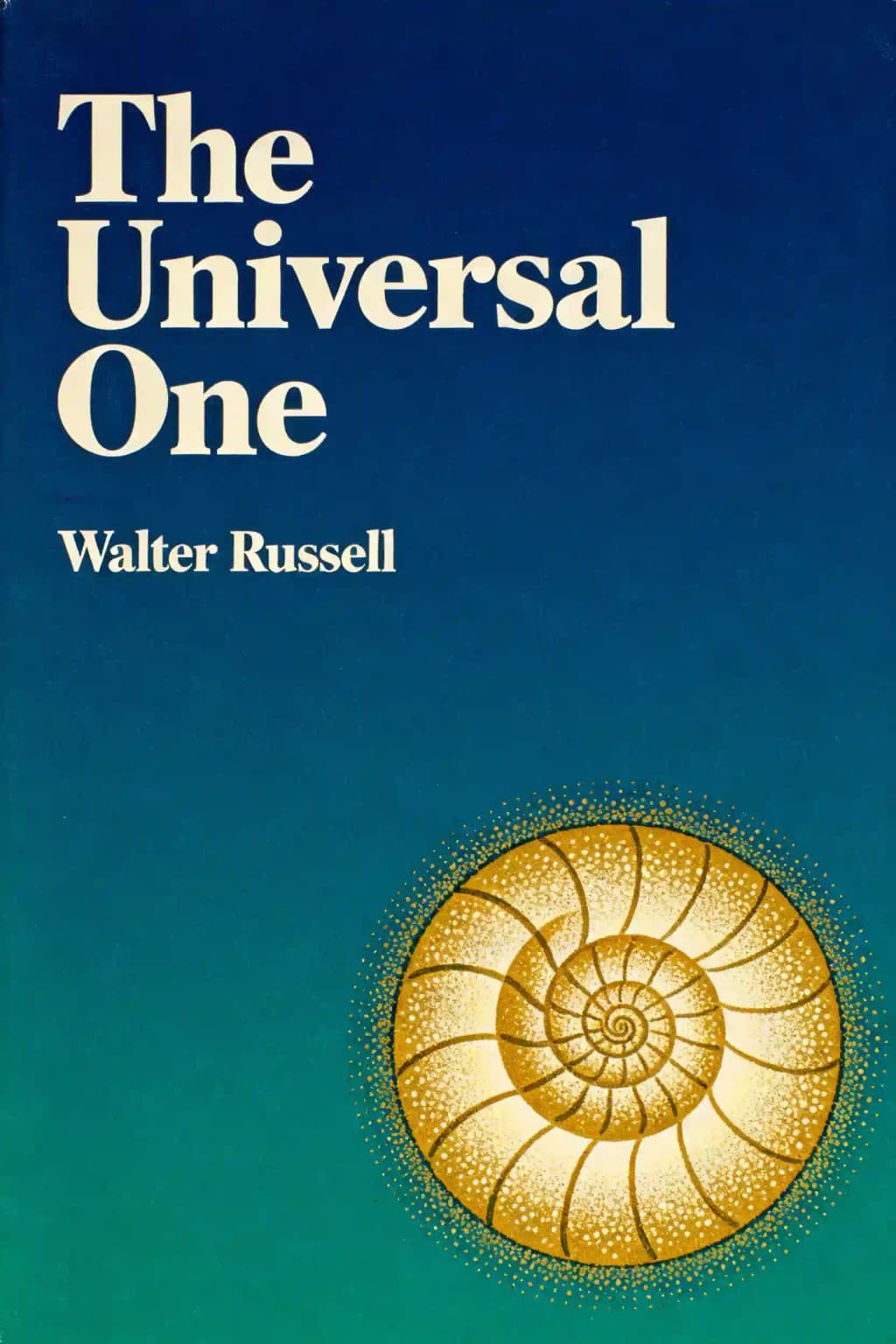
Have you ever considered that the entire universe might be composed of a single substance? That you and I, the stars and planets, even the empty space between galaxies, are all manifestations of one fundamental reality? Walter Russell's groundbreaking work "The Universal One" presents exactly this vision-a unified cosmology that bridges science and spirituality in ways that continue to challenge conventional thinking nearly a century after its publication. This masterwork, which Russell claimed came to him during a period of cosmic illumination in 1921, has influenced thinkers from Nikola Tesla to modern quantum physicists. What makes this work particularly fascinating is how Russell, with no formal scientific training, developed detailed models of atomic structure that anticipated discoveries in quantum mechanics decades before their time. The book remains a cult classic among those seeking to understand the deeper patterns governing reality, with devotees ranging from scientists exploring consciousness to artists seeking inspiration from universal principles.
第2章
Mind as the Universal Substance: Rethinking Reality's Foundation
Everything you perceive - every object, every energy, every thought - is composed of one substance: Mind. This isn't merely philosophical conjecture but the cornerstone of Russell's cosmology. Mind isn't something separate from the universe; it is the universe itself. What we call "creation" isn't something conjured from nothing but rather the integration of what has always existed, merely changing form through rhythmic thinking processes. This fundamental unity underlies all apparent diversity in the cosmos, from subatomic particles to galactic superclusters.
Think about water transforming into ice or steam. The substance remains water molecules throughout, merely changing its appearance and properties. Similarly, Russell proposes that all matter and energy are manifestations of the same universal substance - light - which he describes as the storehouse of thinking Mind's energy. This light isn't just the visible spectrum we see but encompasses all frequencies of electromagnetic radiation. Just as water can exist in multiple states while maintaining its essential nature, light can manifest as seemingly solid matter through specific patterns of motion and rest.
This perspective fundamentally challenges our conventional understanding of reality. We typically perceive ourselves as separate entities navigating through an external world. Russell invites us to recognize that this perception of separateness is an illusion - similar to how waves might perceive themselves as distinct from the ocean. The universe isn't infinite in the sense of boundless extension but finite in its cause-effect relationships, operating within precise limitations that govern all natural phenomena. These limitations aren't restrictive but rather provide the framework through which all creation expresses itself.
When we look at a tree, a mountain, or even another person, we're not seeing something separate from ourselves but different expressions of the same universal substance. This understanding transforms our view of physical phenomena. If all matter is light in various states of motion, then transmutation of elements isn't just possible; it's inevitable when we understand the underlying processes that govern matter's formation. This explains phenomena like radioactive decay and nuclear fusion, where elements transform into other elements through changes in their underlying light patterns.
The implications of this unified field theory extend beyond physics into consciousness itself. Our thoughts, emotions, and awareness are not byproducts of matter but rather fundamental aspects of the universal Mind expressing itself through individualized forms. This suggests that consciousness isn't produced by the brain but rather focused through it, like light through a lens. The brain doesn't generate consciousness any more than a radio generates the music it plays - it's a receiver and translator of universal Mind's infinite potential.
This understanding revolutionizes our approach to scientific inquiry. Instead of studying phenomena as isolated events, we must recognize their interconnected nature within the cosmic web of Mind. Every discovery in quantum physics, from wave-particle duality to quantum entanglement, supports this unified view of reality. When we truly grasp this principle, we begin to see that all separation is illusion - we are individualized expressions of one infinite Mind, temporarily manifesting in countless forms while remaining eternally unified at our source.
第3章
The Living Universe: Redefining Life Beyond Organic Matter
Life isn't something that inhabits matter - it is matter. Russell boldly asserts that all matter, whether organic or inorganic, is living, evolving matter. This shatters our conventional distinction between living and non-living things, suggesting instead that what we call "life" is simply the effect produced by alternating electromagnetic pulsations of thinking Mind. This radical reconceptualization challenges centuries of scientific orthodoxy that has drawn sharp boundaries between animate and inanimate matter.
Consider a crystal. Traditional science views it as inert, non-living matter. Yet crystals grow, respond to environmental conditions, and evolve through time. They exhibit ordered growth patterns that Russell would attribute to the same life principle that governs more complex organisms. Crystals demonstrate remarkable self-organizing properties - they can heal themselves when damaged, grow in systematic patterns, and even appear to "reproduce" by seeding new crystal formation. The difference isn't in the presence or absence of life but in the complexity of its expression. Similarly, metals show "fatigue," rocks undergo transformation, and even seemingly static substances like glass continue to flow over extended periods.
This perspective transforms our understanding of evolution. Rather than seeing life as something that mysteriously emerged from non-living matter, Russell suggests that evolution is simply the increasing complexity of expression of the universal life principle. The universe consists of ten octaves forming a cycle of evolving states of motion, with inert gases serving as the master-tones marking transitions between states. Each octave represents a different level of complexity and organization, from the simplest atomic structures to the most complex biological systems. This unified field of living energy manifests in countless forms, from subatomic particles to galaxies, all following the same fundamental principles of organization and growth.
What we conventionally call "death" isn't the cessation of life but merely a phase in the eternal cycle of assembling and disassembling processes. Just as water doesn't cease to exist when it evaporates, life doesn't end when a form dissolves - it simply changes state. This eternal cycling mirrors processes we observe throughout nature: the water cycle, carbon cycle, nitrogen cycle, and the continuous exchange of matter and energy in ecosystems. Even stars undergo cycles of birth, death, and regeneration, dispersing their elements across space to form new stars and planets.
Imagine how this perspective might transform our relationship with the natural world. If we truly understood that mountains, oceans, and atmosphere are as alive as forests and animals - just expressing life at different frequencies - might we approach environmental stewardship differently? This understanding could revolutionize our approach to technology and resource management. Instead of seeing nature as a collection of resources to be extracted, we might develop technologies that work in harmony with these living processes. For instance, biomimicry - the practice of emulating nature's time-tested patterns and strategies - becomes not just a clever design approach but a fundamental recognition of the living intelligence inherent in all matter. Would our technological development follow different paths if we recognized that we're not manipulating dead matter but engaging with different expressions of the same life principle that animates us? This shift in perspective could lead to more sustainable and regenerative practices across all fields of human endeavor.
第4章
The Thinking Process: How Universal Mind Creates Reality
Thinking isn't just something that happens in our brains-it's the fundamental creative process of the universe. Russell describes thinking as a simple pendulum swing from stability to apparent instability and back again, registering in universal Mind as an elongated sphere containing two opposing spiral waves. These waves represent the entire process of thinking and express all phenomena-light, heat, electricity, form, time, space, and more.
When you have a thought, you're participating in this universal process. Your thinking creates a pattern of motion in Mind substance that follows the same principles governing the formation of galaxies and atoms. Thinking consists of action followed by reaction, creating a sequence that constitutes what we experience as time. Without this sequence, time as we know it couldn't exist.
The process alternates between generation and radiation-opposing forces that constitute motion-in-opposition. Generation is the attractive, gravitative, positive, electric force, while radiation is the repulsive, emanative, negative, magnetic force. These forces appear to vary in dimension, but the energy expended in their opposing oscillations remains constant throughout all ten octaves of creation.
Visualize a breath cycle. Inhalation draws air inward, concentrating it (generation), while exhalation releases it outward, dispersing it (radiation). The universe "breathes" through similar opposing impulses, with all matter being simultaneously generative and radiative.
This understanding transforms how we might approach creative thinking. If thinking is literally a creative force shaping reality, not just abstract mental activity, how might we harness this power more consciously? Could we learn to "think in light"-in the higher octaves of Mind-accessing creative capacities that remain dormant in most people? Russell suggests that genius is simply the ability to think from these higher octaves and bring that knowledge back to conscious awareness.
第5章
Sex as the Universal Creative Principle
When Russell speaks of sex, he's not referring merely to biological reproduction but to a fundamental cosmic principle that controls both force and motion. Sex is the apparent division of the father-mother substance of Mind into opposites, arising from the contrary desires of electricity and magnetism expressed in thinking.
This principle exists in everything from subatomic particles to galaxies. All things are both male and female in varying proportions, first predominantly one, then the other. What we perceive as male and female in biological organisms is simply a more complex expression of this universal principle.
Consider how this applies to creative processes. Idea evolves into form through male, generative thinking, and devolves back to idea through female, radiative thinking. Reproduction occurs through the regenerative union of sex thinking in equilibrium. All motion is expressed in waves that are both male and female. Action is male and electropositive; reaction is female and electronegative.
This perspective offers a profound reframing of gender beyond biological categories. If maleness and femaleness are universal principles present in all things in varying proportions, then rigid gender distinctions become less meaningful. Every person, regardless of biological sex, embodies both principles in unique combinations.
The implications extend to how we understand creativity and innovation. True creation requires the balanced integration of generative (male) and radiative (female) thinking-the ability to both manifest new forms and allow them to evolve and transform. A society that overvalues one principle at the expense of the other will produce imbalanced results, just as chemical elements with extreme predominance of either principle form unstable compounds.
How might our creative processes-in art, science, business, or governance-change if we consciously worked with both principles in balance? What new possibilities might emerge if we recognized that the most stable and powerful creations arise from the perfect mating of equal and opposite forces?
第6章
The Illusion of Dimension: Rethinking Space and Time
Our perception of three-dimensional space extending infinitely in all directions is, according to Russell, a fundamental misconception that shapes our entire worldview. Dimension is merely an appearance - an effect of motion with no actual existence. When objects disappear from our perception, the distance between them ceases to exist. This distance was never an actual thing but merely a relationship between appearances, much like how a hologram appears to have depth despite existing on a flat surface.
This radical perspective challenges our most basic assumptions about reality. We navigate daily through what seems to be a world of solid objects separated by empty space, yet Russell suggests this entire framework is illusory. Matter itself is "frozen light," crystallized from our lower octaves of thinking, similar to how water vapor crystallizes into ice. The inner Mind operates at higher octaves where matter is dimensionless - a state difficult to comprehend with our sensation-based consciousness but mathematically coherent with quantum mechanical descriptions of reality.
Einstein's theory of relativity approached this understanding by showing that space and time are not absolute but relative to the observer's frame of reference. The famous twin paradox demonstrates how time dilation can cause two observers to experience different temporal realities. Russell takes this revolutionary concept further, suggesting that space itself is non-existent, and therefore extension and continuity are also non-existent. Any line of direction in apparent space is curved and would eventually return to its starting point - not because Mind has finite form, but because all effects of motion are universal actions that must complete their cycles.
This perspective transforms how we might understand phenomena like quantum entanglement, where particles separated by vast distances appear to communicate instantaneously. If space is ultimately an illusion, then "distance" becomes meaningless at certain levels of reality. The quantum tunneling effect, where particles appear to traverse barriers instantaneously, might be better understood through this lens of dimensionless reality.
The implications extend beyond theoretical physics into practical applications. If the universe is dimensionless at its foundation, might there be ways to access distant points without traversing the apparent space between them? This suggests possibilities for new forms of communication and transportation technologies. Consider how quantum computers already utilize entanglement to perform calculations that seem to transcend spatial limitations. Future technologies might exploit these principles to achieve what now seems impossible - instantaneous communication across vast distances or new forms of space travel that don't rely on conventional propulsion through three-dimensional space.
This understanding also aligns with ancient mystical traditions that speak of non-local consciousness and instantaneous connection across apparent distances. What mystics intuited through direct experience, modern physics now approaches through mathematics and experimentation - suggesting that the apparent separation of space might be our mind's way of organizing information rather than an fundamental aspect of reality.
第7章
The Formula of Locked Potentials: Nature's Mathematical Blueprint
Behind the seemingly infinite variety of natural phenomena lies a surprisingly simple mathematical pattern. Russell presents what he calls "the formula of locked potentials" (0, 1, 2, 3, 4, 3, 2, 1, 0), which represents the orderly progressions in potentials, pressures, and orbits that Mind has devised to evolve universal thinking into form and devolve it back into disappearance. This rhythmic sequence manifests throughout nature, from the smallest atomic structures to the grandest celestial bodies.
This formula governs everything from the periodic table of elements to color spectra, from musical scales to the life cycles of stars. It's like a cosmic clock measuring all dimensions by one formula, just as we measure time by hours, minutes, and seconds. The pattern reveals itself in wave mechanics, crystalline structures, plant growth patterns, and even in the cycles of human breath - inhalation building to a peak, followed by exhalation returning to rest.
Consider how a musical scale progresses through octaves, each note vibrating at precisely twice the frequency of its counterpart in the previous octave. The middle C on a piano vibrates at 256 cycles per second, while the C above it vibrates at 512 cycles - a perfect mathematical doubling. Similarly, Russell suggests that all elements are organized into octaves following precise mathematical relationships. Gold differs from carbon not in substance but in the relation of their intervals in motion. Each element represents a specific vibratory rate within its octave, much like musical notes within their scales.
The formula manifests in color spectra, where visible light progresses from red through violet in precise wavelength relationships. Even the periodic table of elements demonstrates this octave principle, with elements showing similar properties at regular intervals - the noble gases appearing at positions 2, 10, 18, 36, 54, and 86, following a mathematical progression.
This understanding has profound implications for technology and energy generation. If we truly comprehend the motion that assembles elemental forms, we could theoretically transmute elements through forced interchange of potentials. The alchemists' dream of transforming base metals into gold might not be fantasy but simply a matter of understanding and manipulating these mathematical relationships. Nature already demonstrates such transmutation in stellar nucleosynthesis, where elements transform through precise mathematical progressions.
Modern science has already demonstrated transmutation through nuclear processes, but Russell suggests more elegant approaches might be possible through working with these natural patterns rather than brute-force methods. For instance, cold fusion experiments might yield different results if approached through the lens of these natural octave relationships. What technologies might emerge from a deeper understanding of these universal mathematical relationships? Could we develop energy sources that harness the natural compression-expansion cycles evident in the formula? Might we create manufacturing processes that utilize harmonic resonance rather than destructive force? The potential applications range from new forms of propulsion to revolutionary methods of material synthesis - all based on working in harmony with nature's mathematical blueprint rather than against it.
第8章
Universal Oneness: The Interconnected Web of Creation
The principle that all elements of existence are fundamentally connected represents a core insight of Russell's cosmological framework. This interconnection operates at every scale - from subatomic particles to celestial bodies - through fundamental forces that link all matter and energy in continuous interaction. The subtle movements of a flower affect the broader cosmic system through these intricate relationships between particles and their electromagnetic properties.
This fundamental unity expresses what Russell describes as "the principle of universal harmony" - the understanding that apparent separation masks a deeper connection where all phenomena emerge from unified cosmic principles. This perspective suggests that perceived limitations dissolve when we recognize our essential connection to the greater whole. The unity manifests across physical, energetic, and conscious dimensions, similar to how ocean waves maintain their connection to the whole body of water while expressing distinct forms.
Contemporary quantum mechanics provides scientific support for aspects of this framework through established phenomena like quantum entanglement and non-local correlation. Research demonstrates that particles maintain their relationship regardless of spatial separation, indicating a deeper level of reality beyond apparent divisions. Experimental evidence, including the well-documented double-slit experiment, suggests consciousness plays a role in quantum behavior, while Bell's theorem provides mathematical validation of non-local connections transcending conventional space-time limitations.
This understanding has profound implications for both individual growth and collective challenges. The recognition of fundamental interconnection suggests that actions affecting any part of the system influence the whole, including the actor. This principle manifests in natural systems - from ecological relationships to economic networks where individual and collective wellbeing are inseparable.
Russell suggests that inspired cognition aligns with this unity principle - harmonizing human consciousness with higher-order universal patterns. This alignment enables perception beyond surface appearances to grasp deeper principles, resulting in intuitive insights, creative innovation, and elegant solutions to complex challenges.
The concept of universal interconnection informs multiple fields of human endeavor. It suggests holistic approaches in healthcare, integrated perspectives in environmental science, and inclusive models in economic theory that recognize the inherent relationships between all participants in global systems.
This framework raises important questions about addressing contemporary challenges. How might our approach to environmental sustainability, conflict resolution, or economic disparity evolve through the lens of fundamental interconnection? What innovations might emerge from a consciousness that recognizes unity rather than separation as the basic reality? Progress may depend on developing technologies and social structures that work in harmony with, rather than in opposition to, this fundamental interconnectedness.
第9章
Awakening the Genius Within: The Path to Cosmic Consciousness
Within every human lies dormant genius waiting to be awakened. Russell suggests that genius isn't a rare gift bestowed on few but the natural state of mind thinking in its higher octaves. The difference between ordinary thinking and genius is simply the ability to access these higher frequencies of consciousness.
Knowledge isn't something we acquire from outside ourselves but something we recollect from within. When we learn something new, we're actually remembering experiences of our thinking from higher octaves. All thinking is universal thinking, and all thinking things create in unison.
This perspective transforms how we might approach education and personal development. Rather than seeing learning as filling an empty vessel with external knowledge, it becomes a process of awakening innate understanding-removing the barriers that prevent us from accessing our inherent genius.
Russell describes inspiration as the process through which man becomes "a divine messenger delivering revelation from the Holy of Holies." The inspired person-the genius, the super-thinker with imagination who brings beauty to the world-is someone thinking in light, accessing higher octaves of consciousness.
"No work of man can endure which is not born of inspiration and created in ecstasy." This suggests that our most valuable creations come not from intellectual effort alone but from aligning with these higher frequencies of Mind. The greatest scientific discoveries, artistic masterpieces, and humanitarian innovations throughout history have often been described by their creators as moments of inspiration rather than logical deduction.
The path to awakening this genius involves shifting from the outer, objective mind primarily concerned with bodily continuance to the inner, subjective Mind that perceives universal existence. This isn't mystical abstraction but a practical shift in consciousness available to anyone willing to develop the capacity.
What might our world look like if education focused on awakening this innate genius rather than merely transferring information? How might our technological, artistic, and social innovations transform if more people accessed these higher octaves of thinking? Russell's work suggests that humanity's evolution depends on this awakening-on more individuals learning to "think in light" and bring that illumination into manifest expression.