第1章
When Reality Is Just a Hologram: The Universe as a Cosmic Projection
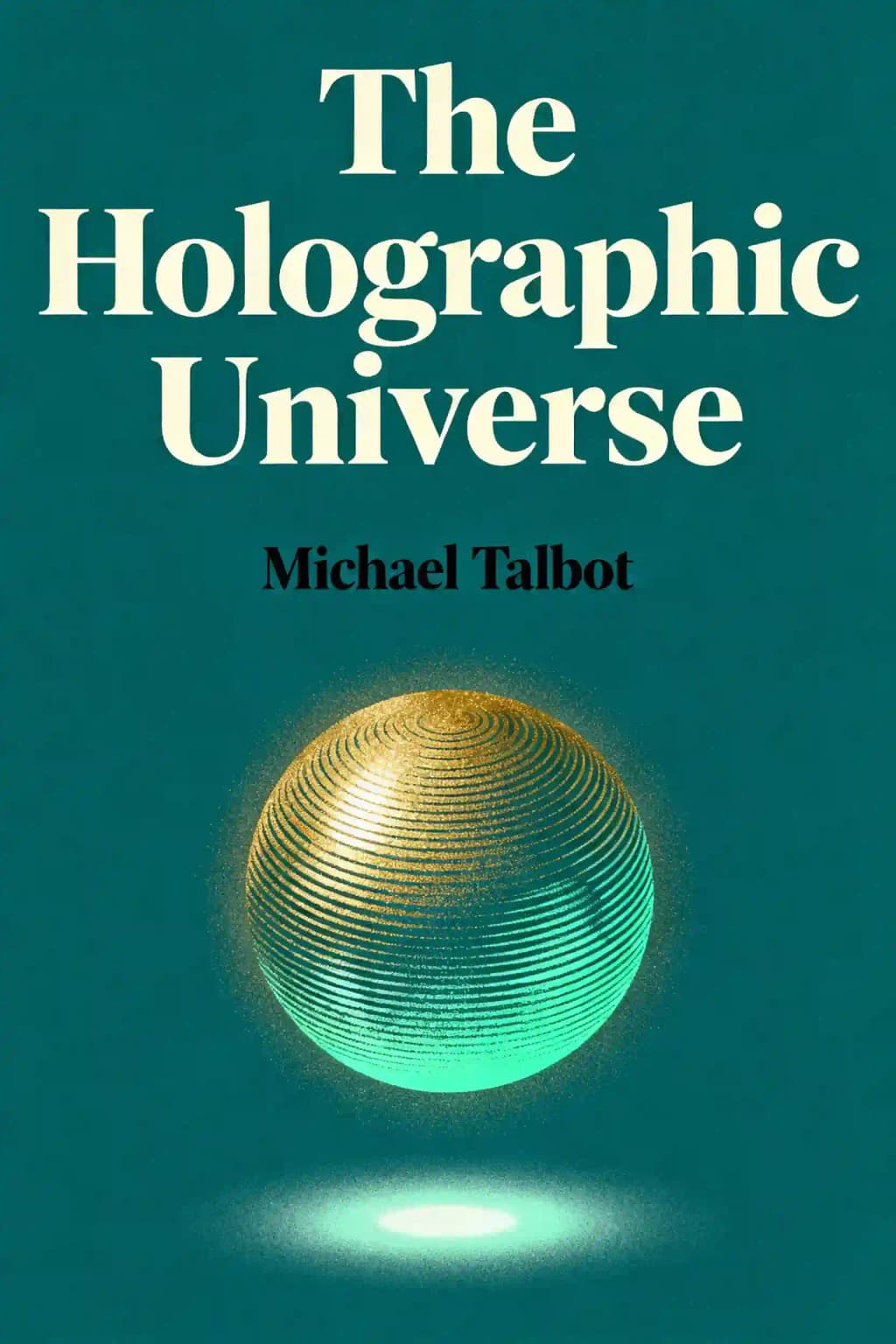
What if everything you see, touch, and experience is actually a detailed illusion-a three-dimensional projection from a deeper level of reality beyond space and time? This mind-bending proposition forms the core of Michael Talbot's groundbreaking work "The Holographic Universe," which has captivated readers since its publication in 1991. The book has become something of a cult classic among spiritual seekers, quantum physics enthusiasts, and consciousness researchers, with notable fans including filmmaker David Lynch and author Deepak Chopra. Despite being written decades ago, its ideas continue to resonate in our increasingly virtual world, where the lines between simulation and reality grow ever blurrier. As physicist David Bohm, one of the theory's architects, once remarked: "Reality is what we take to be true. What we take to be true is what we believe. What we believe is based upon our perceptions. What we perceive depends upon what we look for. What we look for depends upon what we think. What we think depends upon what we perceive. What we perceive determines what we believe. What we believe determines what we take to be true. What we take to be true is our reality."
第2章
The Brain as a Magnificent Hologram
In the early 1940s, neurosurgeon Wilder Penfield made a remarkable discovery while treating epileptic patients. By electrically stimulating their temporal lobes, he triggered vivid memory flashbacks-suggesting memories were stored in specific brain locations. This aligned with the prevailing scientific belief that memories existed as "engrams" in particular neural regions.
However, neuropsychologist Karl Lashley's thirty years of research with maze-running rats revealed something puzzling. No matter which portions of their brains he surgically removed, the rats' memories persisted. Even with significant brain damage, they remembered how to navigate mazes, though their motor skills deteriorated. This contradicted the localized memory theory, suggesting instead that memories were somehow distributed throughout the brain.
This mystery remained unsolved until the mid-1960s, when neuroscientist Karl Pribram encountered an article about holography in Scientific American. Holography, invented by Dennis Gabor (who later won a Nobel Prize), uses laser light to create three-dimensional images. When a laser beam is split, with one part bouncing off an object while the second beam collides with the reflected light, they create an interference pattern recorded on film. Though this pattern looks nothing like the original object, when illuminated by another laser, it projects a convincing three-dimensional image.
Most remarkably, if you cut a holographic film into pieces, each fragment contains information to reconstruct the entire image, though with less detail. This was precisely the model Pribram needed to explain distributed memory. The brain, he realized, might store memories holographically, with information distributed throughout neural tissue rather than in specific locations.
Vision provided further evidence for this theory. Researchers discovered that cats with 98% of their optic nerves severed could still perform complex visual tasks. This contradicted the standard theory that visual processing involved a one-to-one correspondence between external images and brain representation. After seven years measuring electrical activity in monkey brains during visual tasks, Pribram found no direct correspondence between images and brain activity patterns. The holographic model explained how vision could remain functional despite massive cortical damage.
The holographic brain theory elegantly explains several puzzling aspects of human cognition. Our brain's enormous storage capacity-calculated by mathematician John von Neumann at approximately 2.8 x 10^20 bits of information over a lifetime-makes sense through holography's remarkable information density. Just as multiple images can be stored on a single piece of holographic film by changing the angle of the recording lasers, our brains might store vast amounts of information in overlapping patterns.
Our ability to instantly recognize familiar faces in crowds parallels "recognition holography," where a holographic image compared with a similar object produces a bright point of light-the brighter the point, the greater the similarity. This technique is so sensitive it can detect even the pressure of a finger on granite.
The theory also explains how we transfer learned skills between body parts-like writing your name with your elbow despite never having done so before. By converting memories into a language of interfering wave forms, the brain becomes remarkably flexible, able to shift stored information around like a pianist transposing music to different keys.
Perhaps most compelling was the 1979 discovery by Berkeley neurophysiologists Russell and Karen DeValois that brain cells in the visual cortex respond not to simple patterns but to Fourier translations of patterns-the same mathematics used in holography. Further research revealed that our other senses-hearing, smell, touch, and possibly taste-also involve frequency analysis.
第3章
The Cosmos as Hologram
While Pribram was developing his holographic brain theory, physicist David Bohm was independently reaching similar conclusions about the universe itself. As a brilliant young physicist who had worked with Einstein at Princeton, Bohm became troubled by the bizarre implications of quantum physics.
Quantum theory revealed that subatomic particles possess no actual dimensions and can manifest as either particles or waves. When observed, electrons appear as tiny points of light on a screen; when not observed, they behave as waves spread across space. Even more puzzling was the strange interconnectedness between seemingly unrelated subatomic events.
This interconnectedness was dramatically demonstrated in Bohm's early research at Berkeley Radiation Laboratory, where he studied plasmas-gases containing high densities of electrons and positive ions. He observed that electrons in plasma stopped behaving as individuals and started acting as parts of an interconnected whole. Despite seemingly random individual movements, vast numbers of electrons produced remarkably organized collective effects. The plasma behaved almost like a living organism, regenerating itself and walling off impurities like a biological system creating cysts around foreign substances.
These observations led Bohm to develop a radical new interpretation of quantum physics. He proposed the existence of a "quantum potential"-a new kind of field that pervaded all space with equal power everywhere, unlike gravitational or magnetic fields whose influence diminishes with distance. This quantum potential suggested that the whole organized the behavior of parts, rather than parts determining the whole.
By the late 1960s, Bohm's encounter with holography crystallized his thinking. He proposed that our tangible reality is like a holographic image emerging from a deeper level he calls the "implicate" (enfolded) order, while our existence is the "explicate" (unfolded) order. All forms in the universe result from countless enfoldings and unfoldings between these orders.
In this view, an electron isn't a discrete particle but a totality enfolded throughout space. When detected at a specific location, we're simply observing one aspect that has momentarily unfolded there. Particles are sustained by constant influx from the implicate order, not destroyed but merely enfolded back when they disappear. This explains how particles can shapeshift between particle and wave forms depending on how an observer interacts with them.
Bohm's ideas about wholeness are mind-boggling. Since everything is made from the seamless holographic fabric of the implicate order, viewing the universe as composed of "parts" is as meaningless as seeing fountain geysers as separate from their water. Despite apparent separateness at the explicate level, everything is a seamless extension of everything else. Your hand, the lamp light, your dog-you are not merely made of the same things, you are the same thing-one enormous something extended into all apparent objects in the cosmos.
Bohm rejects the idea that consciousness and matter are separate entities. Since all things are aspects of the holomovement, "the observer is the observed." Consciousness is a more subtle form of matter, with their relationship rooted in the implicate order. Consciousness exists in varying degrees throughout all matter-"The ability of form to be active is the most characteristic feature of mind, and we have something that is mindlike already with the electron."
Beyond our shadow reality lies an astonishing hidden dimension. Physicists calculate that every cubic centimeter of empty space contains more energy than all matter in the known universe! Bohm believes this infinite ocean of energy exists and reveals something about the implicate order's vast nature. Despite its apparent materiality and size, our universe is just a passing shadow, a mere hiccup in the greater scheme.
第4章
The Holographic Model and Psychology
The holographic model has profound implications for psychology. Psychiatrist Montague Ullman found the concept compelling because it suggests all people are interconnected. His ESP dream experiments provided evidence that people can communicate in dreams in unexplainable ways, with volunteers often dreaming of images related to paintings that others were concentrating on in separate rooms.
Ullman observed that dreams demonstrate wisdom beyond our waking consciousness. Even patients who seemed spiritually blind while awake-mean, selfish, arrogant-would have dreams that honestly depicted their shortcomings through metaphors designed to increase self-awareness. He suggests dreams might be a bridge between the implicate and explicate orders, transforming hidden wisdom into conscious awareness.
The holographic model also explains psychosis. Ullman proposes that schizophrenics express their perception of holographic reality through their view of space and time. In their perception, precise locations and spatial relationships lose meaning, similar to how points in a hologram have no fixed position. Manic-depressives experience even more pronounced holographic thinking-while schizophrenics get only glimpses of the implicate order, manics become deeply immersed in its infinite potential, unable to process the overwhelming flood of thoughts and ideas.
Lucid dreams-where dreamers maintain full waking consciousness while dreaming-offer unique opportunities for controlling dream content and experiencing extraordinarily vivid sensory impressions. Physicist Fred Alan Wolf suggests these might be visits to parallel universes-smaller holograms within the larger cosmic hologram.
Stanislav Grof, after thirty years studying nonordinary states of consciousness, concluded that our psyches can access virtually endless avenues of exploration through holographic interconnectedness. He believes holograms' vast information storage capacity explains why psychological images contain enormous amounts of personal information. A single image might reveal attitudes about life, childhood trauma, self-esteem, and relationships, all embedded in the scene's metaphor.
With his wife Christina, Grof developed "holotropic therapy" using only rapid controlled breathing, evocative music, and bodywork to induce altered states. They define holotropic states as those allowing access to the holographic labyrinth connecting all aspects of existence-biological, psychological, racial and spiritual history, past, present and future.
Jung's synchronicities-meaningful coincidences between psychological processes and physical events-reveal moments when psychological processes spill into physical reality. Physicist F. David Peat sees synchronicities as "flaws" in reality's fabric that momentarily reveal the underlying unity between mind and matter in the implicate order. These experiences suggest objective reality may be more dreamlike than we assume, with apparent separateness being illusory.
第5章
I Sing the Body Holographic
The holographic model elegantly explains the mind's remarkable influence over the body. When cancer patient "Frank" worked with Dr. O. Carl Simonton to visualize radiation as energy bullets and white blood cells removing cancer cells, his recovery was extraordinary-completely eliminating his cancer while avoiding typical side effects. In follow-up studies with 159 "incurable" cancer patients, Simonton found their average survival time doubled, with many showing disease regression or stabilization.
Our mental pictures directly influence physical conditions, as Bernie Siegel observed with patients whose descriptions of their conditions matched their illnesses-like the woman who "needed to get something off her chest" before developing breast cancer. This mind-body connection is so powerful that researchers can predict survival rates with 95% accuracy simply by analyzing patients' drawings of themselves, their cancers, and their immune systems.
Mental imagery dramatically affects physical performance beyond health outcomes. Soviet studies revealed athletes who spent more time visualizing (75%) than physically training (25%) showed greater performance improvements than those who primarily trained physically. Australian psychologist Alan Richardson demonstrated this with basketball players-a group practicing only mental imagery of perfect free throws improved 23%, nearly matching the 24% improvement of those who physically practiced.
The placebo effect demonstrates the mind's remarkable control over the body. In double-blind studies, placebos prove 54% as effective as aspirin and 56% as effective as morphine for pain relief. Conditions responsive to placebos range from minor ailments to life-threatening diseases. Even wart removal through placebos requires sophisticated physiological responses that Lewis Thomas calls miraculous.
Multiple Personality Disorder provides striking evidence of the mind's control over biology. When multiples switch personalities, their bodies undergo remarkable transformations-allergies appear and disappear, wasp stings can swell or heal instantly, and drug responses change dramatically. One multiple required different eyeglasses for different personalities, while another switched from drunk to sober by changing personalities. Some multiples display varying medical conditions between personalities: different menstrual cycles, color blindness, handedness, voice patterns, and even diabetes symptoms that appear and vanish.
Acupuncture microsystems provide compelling evidence of the body's holographic nature. Dr. Terry Oleson at UCLA found the ear's acupuncture points diagnostically accurate-electrical activity in ear points corresponds to pathological conditions in matching body areas. Dr. Ralph Alan Dale has discovered eighteen different microacupuncture holograms throughout the body-in hands, feet, arms, neck, tongue and gums. These findings support the holographic model's assertion that every portion of the body contains information about the whole.
第6章
A Pocketful of Miracles
The holographic model helps explain seemingly miraculous phenomena that have baffled scientists for centuries. Robert G. Jahn, a Princeton aerospace sciences professor and former NASA consultant, discovered through extensive experiments that volunteers could mentally influence random event generators (REGs) to produce statistically significant deviations from random output. Most people possessed some psychokinetic ability, with each person demonstrating a unique "signature" pattern of influence.
Jahn and psychologist Brenda Dunne believe consciousness has wave-particle duality like physical processes-particlelike when localized in our heads, but wavelike when producing remote effects. Rather than involving force transmission, they propose psychokinesis represents a resonance between mind and matter, an information exchange where reality emerges from the interpenetration of consciousness and physical wave patterns.
Even more dramatic psychokinetic effects have been documented throughout history. The Jansenist miracles in Paris became an international sensation, drawing thousands of witnesses from all social strata. The convulsionaires displayed seemingly impossible abilities while in trance states-not only healing conditions like cancer and blindness but also demonstrating complete invulnerability to torture. Louis-Basile Carre de Montgeron documented how twenty-year-old Jeanne Maulet endured one hundred blows to her stomach with a thirty-pound hammer without injury. Another convulsionaire bent backward over a peg while a fifty-pound stone was repeatedly dropped onto her stomach.
Similar invulnerability to fire has been documented across cultures and eras. Hawaiian kahunas demonstrated the ability to walk across hot lava, as witnessed by researcher William Brigham. The Jansenist "human salamanders" Marie Sonnet and Gabrielle Moler could remain over blazing fires or stick their heads into hearths without injury. Protestant Camisards in the 1600s remained unharmed when wrapped in oil-soaked cotton and set afire.
In a holographic universe where consciousness can mediate directly in the implicate order, such phenomena become more understandable. The rule that "fire burns human flesh" may just be one program in the cosmic computer-a habit repeated so often it seems inviolable. Matter itself is a kind of habit constantly born anew from the implicate, like a fountain's shape emerges from flowing water.
Perhaps the most astonishing manifestations of consciousness's power over reality are materialization phenomena. Pakistani woman Kamro survived catastrophic blood loss during childbirth, somehow producing new blood "out of thin air" since humans cannot produce blood quickly enough to replace such losses. Sathya Sai Baba, an Indian holy man extensively studied by psychologist Erlendur Haraldsson, produces jewelry, food, and sacred ash seemingly from thin air. After a decade of investigation, Haraldsson found no evidence of trickery.
Therese Neumann demonstrated even more remarkable materializations. Beyond her stigmata, she displayed inedia-living without food or water for thirty-five years, beginning in 1927. A fourteen-day medical investigation confirmed she neither ate, drank, nor showed signs of dehydration despite losing blood weekly through her stigmata. Her weight remained constant, suggesting she was materializing both blood and nutrients needed to sustain life.
第7章
Seeing Holographically
Our perception itself shapes our experience of reality in ways that support the holographic model. Less than 50 percent of what we "see" comes from our eyes, while the remainder is constructed from our expectations and possibly other sources like reality fields. The brain's ability to fill in blind spots in our vision demonstrates how masterfully it constructs our visual experience without our awareness.
Many clairvoyants can adjust their vision to look inside a person's body as if flesh and bones were merely layers of colored mist. Researcher Shafica Karagulla extensively tested one such woman, Diane, who could see through people with remarkable accuracy. In one test, Diane detected an intestinal blockage near a woman's spleen that showed no external symptoms but was later confirmed by X-rays, requiring emergency surgery.
The ability to see inside the body is recognized across shamanic traditions worldwide. Among the Araucanian Indians of Chile and Argentina, it's considered essential for healers and specifically prayed for during initiation. Australian shamans call it the "strong eye" or "seeing with the heart." Jivaro shamans of Ecuador acquire this ability by drinking ayahuasca, a hallucinogenic plant extract that allows them to "see into the body of the patient as though it were glass."
Many psychics believe disease originates in the energy field weeks or months before manifesting physically, suggesting the field functions as a blueprint from which the body takes its structural cues-the body's own implicate order. This may explain why patients unconsciously "image" illnesses before they develop. By repeatedly reinforcing illness images in the energy field, we may effectively program our bodies to manifest disease. Conversely, healing imagery works through the same mechanism.
Examining the human energy field leads to the same conclusion Karl Pribram reached about the brain-we exist in two realities simultaneously: one where our bodies appear solid with precise locations, and another where we exist as shimmering clouds of energy with ambiguous locations. Recent research by neurophysiologists Benjamin Libet and Bertram Feinstein revealed that while the brain registers touch stimuli in 0.0001 seconds, conscious awareness lags significantly behind at 0.5 seconds. Their experiments showed that patients' unconscious minds decided to respond to stimuli long before they became consciously aware of either the stimulus or their response.
第8章
Time Out of Mind
Time itself may be just another construct of the mind in a holographic universe. Bohm believes that time unfolds from the implicate order, suggesting that our linear division of past, present, and future is merely another mental construct. Evidence for this view comes from remarkable cases of retrocognition-the ability to see into the past.
Stefan Ossowiecki, a gifted Polish clairvoyant, could hold archaeological artifacts and see detailed three-dimensional scenes of their origins. When handling a fragment of petrified human foot, he described an Egyptian princess's entire life, including her jewelry, clothing, husband, and death in childbirth. Working with Professor Poniatowski of Warsaw University, Ossowiecki repeatedly identified stone tools correctly, describing their age, culture, and geographical origins-sometimes correcting the professor's own notes.
The ability to access the past suggests it isn't lost but still exists in a form accessible to human perception. The holographic model offers an explanation: as the present becomes past, it doesn't cease to exist but returns to the cosmic storehouse of the implicate order. As Bohm puts it, "The past is active in the present as a kind of implicate order."
While accessing the past is remarkable, evidence suggests the future is equally accessible in the cosmic hologram. Hundreds of studies demonstrate precognition. The Rhine experiments showed people could guess randomly drawn cards at odds of three million to one against chance. Physicist Helmut Schmidt's tests yielded results one billion to one against chance. Dream research found subjects could accurately dream about randomly selected pictures shown to them the next day.
If precognition exists, does this mean the future is predetermined with no free will? Evidence suggests otherwise-many people have used precognitive glimpses to avoid disasters, like the nineteen documented cases of people foreseeing the Titanic's sinking. This paradox of how the future can both exist and not exist may be explained by what psychologist David Loye calls "hololeaps." He proposes that reality consists of multiple holographic entities floating in the implicate order. The future of any particular hologram is predetermined, but when we act on premonitions, we leap from one hologram to another.
Dr. Ian Stevenson at the University of Virginia has spent over thirty years interviewing children who spontaneously remember previous lives. These children, typically between ages two and four, often recall precise details about their past incarnations that Stevenson has verified. Most remarkably, Stevenson discovered physical evidence of reincarnation-birthmarks and deformities corresponding to wounds from previous lives. In hundreds of cases, he's documented birthmarks matching fatal injuries from past incarnations, sometimes verified through autopsy reports.
第9章
Traveling in the Superhologram
Space too must be viewed as a product of our perception. Out-of-body experiences reveal our consciousness can function independently of our physical bodies. After cardiac arrest, patient Maria viewed a tennis shoe on a hospital ledge with details only visible from outside the building. When social worker Kimberly Clark investigated, she found the shoe exactly as described. Similarly, cardiologist Michael Sabom compared cardiac patients who reported OBEs with those who hadn't. While non-experiencers made major mistakes describing their resuscitations, OBE patients gave accurate details-some with astonishing precision.
In a holographic universe, these experiences make sense. Consciousness isn't necessarily confined to our heads but can appear anywhere. The forms people assume during OBEs-from human bodies to balls of light-suggest we are fundamentally vibrational patterns that our minds convert into holographic forms.
Near-death experiences (NDEs) represent an even more profound contact with the frequency domain. A 1981 Gallup poll revealed that eight million American adults had experienced an NDE-roughly one person in twenty. These experiences transcend cultural and historical boundaries, appearing in texts from the 2,500-year-old Egyptian Book of the Dead to Plato's Republic to medieval Christian accounts.
The typical NDE follows a consistent pattern: floating above one's body, traveling through darkness or a tunnel, entering a realm of dazzling light, meeting deceased loved ones, experiencing beautiful landscapes and music, encountering a "being of light," undergoing a panoramic life review, feeling overwhelming peace and love, and reluctantly returning to physical life.
Evidence supporting NDEs as glimpses into another level of reality includes NDEers accurately reporting details they couldn't have perceived through normal senses-like a woman who saw her daughter's mismatched clothing in another room, or blind patients accurately describing their surroundings. Most compelling are cases where multiple individuals share connected experiences, such as encountering each other during their respective NDEs.
After detaching from their physical bodies, NDEers find themselves either as disembodied clouds of energy or as hologram-like bodies sculpted by thought. These holographic bodies reveal how our innermost feelings and desires shape our form in the afterlife dimension-wheelchair-bound individuals find themselves able to run, amputees have their limbs restored, the elderly inhabit youthful bodies, and children often see themselves as adults.
In the presence of the light, NDEers discover they have direct access to all knowledge. This information arrives not in linear fashion but in instantaneous "chunks" or what Monroe calls "thought balls"-complete packages of information that burst into awareness all at once. This is similar to how psychic information and dream knowledge are received-as holographic wholes that must be unraveled into sequential parts by our time-oriented minds.
第10章
Return to the Dreamtime
The holographic model represents a profound shift in our understanding of reality, yet its core ideas have been foreshadowed in numerous ancient traditions. Bohm's concept of implicate and explicate orders parallels the Tibetan Buddhist notion of void and nonvoid. Similarly, Pribram's ideas about perception were anticipated by Tibetan yogin Milarepa, who taught that our "inner consciousness" is too conditioned to perceive "the border between mind and matter."
The nonlocal properties of holographic film find parallels in ancient thought. The Sufis declared "the macrocosm is the microcosm," while ancient Greek philosophers, Gnostics, and Jewish thinkers embraced similar ideas. Egyptian prophet Hermes Trismegistus stated "the without is like the within of things; the small is like the large," a concept medieval alchemists distilled to "As above, so below."
Some thinkers used elaborate analogies to communicate reality's holographic nature. The Hindu Avatamsaka Sutra likened the universe to Indra's network of pearls, each reflecting all others. Similarly, seventh-century Buddhist Fa-Tsang described the cosmos as a multidimensional network of jewels, each reflecting all others infinitely.
Science has repeatedly fallen short when explaining psychic and spiritual dimensions of human existence. Willis Harman, president of the Institute of Noetic Sciences, believes accepting these phenomena is crucial not just to science but to human civilization's survival. Science must replace its attachment to detached objectivity with a more participatory approach. In a holographic universe where consciousness affects subatomic particles, doctors' attitudes influence placebos, and experimenters' minds affect machines, strict objectivity becomes impossible.
Evidence suggests we're experiencing an evolutionary transformation. Ancient traditions speak of a time when physical reality was more fluid and dreamlike. Australian aborigines describe an early "dreamtime" while Edgar Cayce claimed Earth began as "thought-forms or visualization" before materiality emerged "through Spirit pushing itself into matter." The aborigines prophesy Earth will return to dreamtime-perhaps as we learn to manipulate the hologram of reality more skillfully.
Beyond our physical reality lie increasingly subtle realms-Swedenborg described a heaven beyond heaven appearing only as "a streaming of light," while NDEers report "many higher planes... each one lighter and brighter than the one before." We're learning to navigate increasingly frequency-like realms, confronting the imaginal through UFOs and similar experiences, gradually developing the maturity to handle reality's inherent plasticity. As the aborigines say, we're "just learning how to survive in infinity."