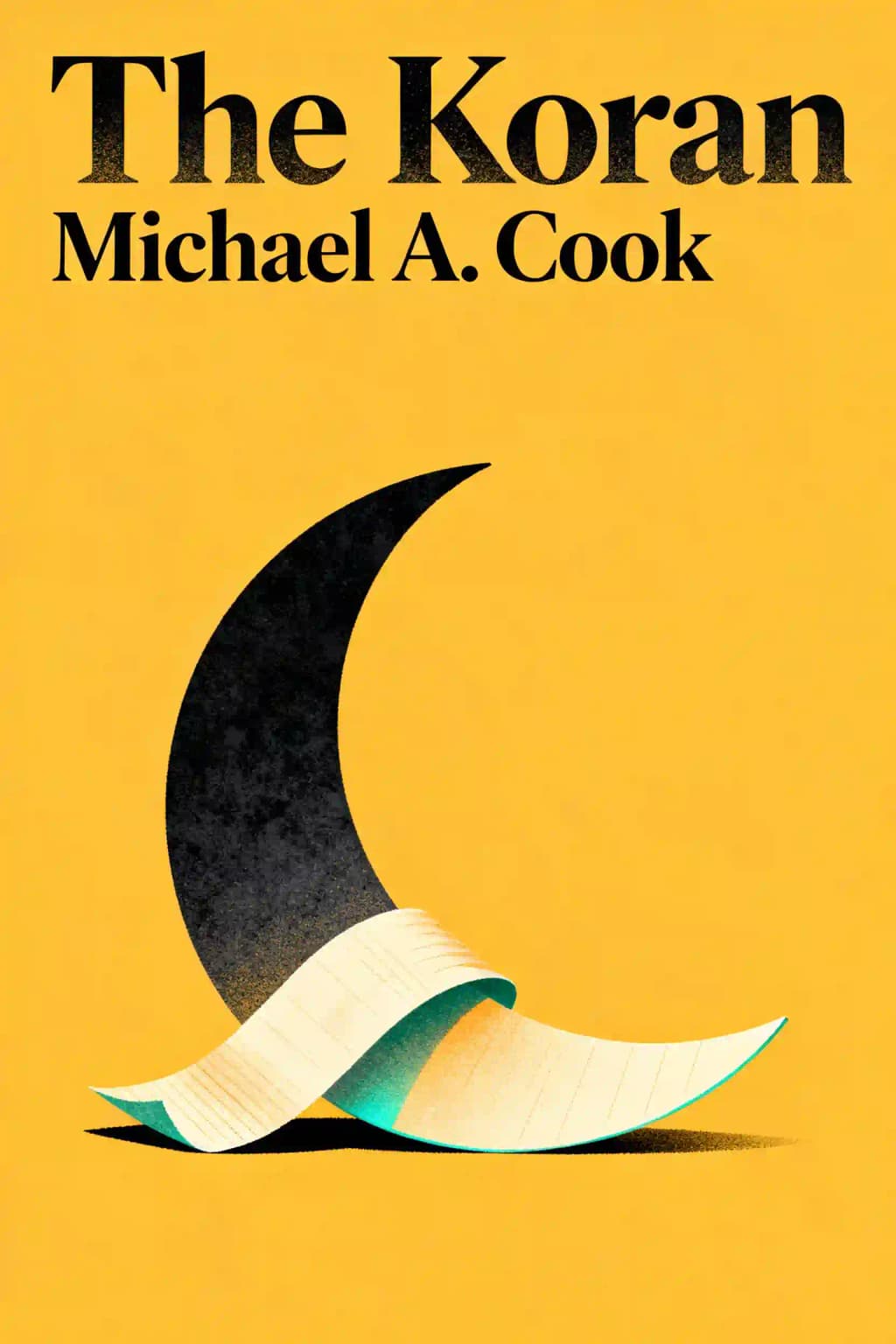
Renowned Princeton scholar Michael Cook deconstructs Islam's sacred text through rigorous linguistic analysis. This challenging academic journey has earned Cook prestigious accolades like the Holberg Prize. Can a 176-page introduction illuminate fifteen centuries of one of humanity's most influential spiritual documents?
Michael A. Cook is a British historian and the author of The Koran: A Very Short Introduction, widely regarded as a leading expert in Islamic history and religious thought. Born in 1940, Cook is the Class of 1943 University Professor of Near Eastern Studies at Princeton University, where he has taught since 1986.
His scholarship spans early Islamic civilization, Quranic studies, Islamic theology, ethics, and law, combining rigorous textual analysis with historical context.
Cook's other influential works include Commanding Right and Forbidding Wrong in Islamic Thought, which won the Albert Hourani Book Award, Ancient Religions, Modern Politics, and A History of the Muslim World. He served as general editor of The New Cambridge History of Islam, a monumental six-volume reference work. His groundbreaking research has earned him the Holberg Prize (2014) and the Balzan Prize for Islamic Studies (2019).
The Koran: A Very Short Introduction remains an accessible, authoritative guide for readers seeking to understand one of the world's most important religious texts.
The Koran by Michael A. Cook is a concise scholarly introduction that explores the significance of the Koran in both traditional Islam and the modern world. Cook examines the text's role in Muslim civilization, its origins and compilation process, and how it compares to other sacred scriptures like the Bible and Vedas. The book covers essential topics including the Koran's content, organization, translation practices, pronunciation rules, and diverse interpretations across different historical periods and cultural contexts.
Michael A. Cook is a British historian and Princeton University Professor of Near Eastern Studies, recognized as one of today's leading experts on Islamic history and religious thought. Born in 1940, Cook is the general editor of The New Cambridge History of Islam and winner of the 2014 Holberg Prize. He wrote this book as part of Oxford's Very Short Introductions series to provide an accessible yet authoritative account of the Koran's significance, bringing his decades of scholarship in Islamic studies to general readers seeking to understand this foundational religious text.
The Koran by Michael A. Cook is ideal for students, educators, and general readers seeking an academic yet accessible introduction to Islamic scripture. This book serves those interested in comparative religion, interfaith dialogue, and understanding the historical development of sacred texts. It's particularly valuable for non-Muslims wanting to learn about the Koran's role in Muslim culture, scholars researching scriptural traditions across civilizations, and anyone curious about how religious texts shape identity and continuity in religious communities.
Yes, The Koran by Michael Cook remains highly relevant as it addresses contemporary issues including modern interpretations, scientific compatibility, and gender equality within Islamic texts. The book's comparative approach—contrasting the Koran with other scriptures—provides valuable context for understanding religious diversity in our globalized world. Cook's balanced, fair treatment combined with fascinating details like Arabic-script Spanish translations makes this short introduction both informative and engaging. Its discussion of how ancient texts interact with modern values continues to resonate with current interfaith conversations and cultural understanding.
Michael Cook defines scripture as a text claiming authority that becomes sacred and central to a culture's identity. In The Koran, he explores how societies preserve authoritative texts through oral traditions or written forms, examining the unique challenges each method presents. Cook emphasizes the Koran's distinctive status as both an oral and written scripture with strong emphasis on unaltered transmission. He provides comparative perspective by analyzing how the Koran's scriptural authority differs from the Bible and Vedas in preservation methods and cultural function.
The Koran by Michael Cook explains how Caliph 'Uthman standardized the text around 650 CE by creating a single authoritative version to prevent divergent recitations. The compilation process involved collecting various written and oral fragments from Prophet Muhammad's companions and scribes. 'Uthman ordered the destruction of non-standardized versions to ensure textual uniformity, though Cook notes some early variants persisted. This process reveals the historical challenges of maintaining textual fidelity while preserving both the written and oral dimensions of Islamic scripture.
Michael Cook systematically compares the Koran with the Bible and the Vedas throughout his book, highlighting differences in preservation methods, authority structures, and cultural roles. He demonstrates how these scriptures function differently within their respective religious traditions while serving similar purposes as sources of identity and continuity. Cook's comparisons are described as "illuminating, enlightening, and generally even-handed," providing readers with valuable context for understanding scriptural traditions across civilizations. These cross-cultural insights help readers appreciate both the unique features of the Koran and universal aspects of sacred texts.
The Koran by Michael Cook identifies monotheism and God's oneness as the central theme, alongside guidance for moral and legal conduct. Cook explores how the text includes prophetic stories of Moses, Jesus, and other figures to illustrate moral lessons and divine intervention. The book discusses recurring themes of judgment, the afterlife, and consequences of human actions. Additionally, Cook examines how the Koran outlines duties and responsibilities for the Muslim community, including principles of social justice and legal frameworks that continue shaping Islamic societies.
Michael Cook examines the challenges of interpreting the Koran in contemporary contexts, including issues of scientific compatibility and gender equality. The Koran presents the diversity of interpretive approaches—from traditional to modernist and fundamentalist perspectives—reflecting varying cultural and historical influences. Cook emphasizes the crucial role of commentaries, noting how modern commentators grapple with reconciling ancient texts with contemporary values. He points out that what bothered older commentators versus modern liberals can differ significantly, while some ancient interpretations surprisingly align with modern sensibilities.
Michael Cook explains the Koran was revealed to Prophet Muhammad in early 7th-century Arabia through the angel Gabriel, primarily in Mecca and Medina. The book describes the Arabian Peninsula as a tribal society with mixed polytheistic and monotheistic beliefs, setting the stage for Islam's emergence. Cook discusses how Muhammad's success in Medina led to establishing an Islamic state that proved crucial for the Koran's dissemination and preservation. The text also explores interactions between early Muslims and other religious communities, showing how these encounters influenced the Koran's content and interpretation.
Michael Cook writes with fairness and balance while incorporating a touch of levity that some Muslims might find initially disconcerting. His tone is scholarly yet accessible, as demonstrated when he describes Islamic concepts with contemporary clarity—for example, defining al-amr bi'l-ma'ruf as "the duty of each Muslim to tell people off for violating God's law". The text is packed with "fascinating little nuggets" and manages to touch on numerous issues despite the book's brevity. Cook's comparative approach and even-handed treatment make complex topics understandable for general readers while maintaining academic rigor.
The Koran by Michael Cook excels in providing comprehensive coverage despite its short length, touching on origins, content, organization, translation, pronunciation, commentaries, and dissemination. Reviewers praise Cook's illuminating cross-cultural comparisons and his ability to spark curiosity about learning more with each chapter. The book's strength lies in its balanced, fair treatment of contemporary hot topics like tolerance and women's rights while acknowledging historical perspectives. However, some readers note Cook's secular academic tone might feel out of place to pious Muslims, though most agree his approach remains generally fair and never unfair in its treatment of Islamic scripture.
著者の声を通じて本を感じる
知識を魅力的で例が豊富な洞察に変換
キーアイデアを瞬時にキャプチャして素早く学習
楽しく魅力的な方法で本を楽しむ
The Koran isn't merely a religious document-it's the beating heart of an entire civilization.
The worshippers pledge exclusive devotion to God, hoping for guidance and blessing in return.
God is both merciful and wrathful.
My mercy embraces all things.
The greatest fault-line isn't sectarian but linguistic.
『The Koran』の核心的なアイデアを分かりやすいポイントに分解し、革新的なチームがどのように創造、協力、成長するかを理解します。
鮮やかなストーリーテリングを通じて『The Koran』を体験し、イノベーションのレッスンを記憶に残り、応用できる瞬間に変えます。
何でも質問し、学習スタイルを選び、自分に本当に響くインサイトを一緒に作れます。

"Instead of endless scrolling, I just hit play on BeFreed. It saves me so much time."
"I never knew where to start with nonfiction—BeFreed’s book lists turned into podcasts gave me a clear path."
"Perfect balance between learning and entertainment. Finished ‘Thinking, Fast and Slow’ on my commute this week."
"Crazy how much I learned while walking the dog. BeFreed = small habits → big gains."
"Reading used to feel like a chore. Now it’s just part of my lifestyle."
"Feels effortless compared to reading. I’ve finished 6 books this month already."
"BeFreed turned my guilty doomscrolling into something that feels productive and inspiring."
"BeFreed turned my commute into learning time. 20-min podcasts are perfect for finishing books I never had time for."
"BeFreed replaced my podcast queue. Imagine Spotify for books — that’s it. 🙌"
"It is great for me to learn something from the book without reading it."
"The themed book list podcasts help me connect ideas across authors—like a guided audio journey."
"Makes me feel smarter every time before going to work"

The Koranの要約をPDFまたはEPUBで無料でダウンロード。印刷やオフラインでいつでもお読みいただけます。
Imagine a book so powerful it transformed a regional dialect into a world language, shaped the daily lives of over a billion people, and continues to influence global politics fifteen centuries after its creation. The Koran stands as one of humanity's most remarkable literary achievements-yet remains profoundly misunderstood in the West. This isn't merely a religious document but the beating heart of an entire civilization, a linguistic masterpiece that continues to shape history through its extraordinary resilience. What makes this text so enduring? Unlike other scriptures that have been marginalized by modernity, the Koran maintains its central position in contemporary Muslim life. Its verses adorn everything from grand mosque walls to social media posts, its recitation fills homes and public spaces, and its teachings continue to inspire believers across vastly different cultural contexts. Even figures like Muhammad Ali and Malcolm X found their lives transformed by its message. The Koran occupies a unique position among world scriptures-remarkably compact and well-defined compared to the multiple Vedas, numerous Biblical books, or vast Buddhist Tripitaka. Though relatively recent compared to other major scriptures, it achieved canonical status in a world civilization with remarkable speed, establishing itself as perhaps the paradigmatic scripture-God's direct, uncompromised word.
The Koran's fundamental message appears in its opening chapter, the Fatiha - seven verses establishing a worldview with remarkable economy. This prayer introduces a single, cosmic God who is both merciful and wrathful, the "Lord of all Being" and "Master of the Day of Judgment." Humanity divides between those following the "Straight Path" and those earning divine anger by straying. This covenant has worshippers pledging devotion to God for guidance. True believers demonstrate faith in "God, the Last Day, the angels, the Book, and the Prophets" while performing good deeds. The blessed are promised Paradise with "gardens underneath which rivers flow." Believers must practice strict monotheism, making their "religion His entirely." This complete surrender (islam) forms the faith's essence. At the center stands God - uniquely One, with absolute authority over creation. Despite His cosmic grandeur, God remains intimately aware of every detail: "not a leaf falls, but He knows it" and "We are nearer to Him than the jugular vein."
Have you ever wondered how sacred texts reached believers before modern printing? Pre-modern Korans required painstaking scribal effort, taking days to months to complete. While printing revolutionized scripture access in Europe by 1500, Muslims only widely accepted printed Korans in the nineteenth century, nearly four centuries after Gutenberg's Bible. This resistance stemmed from profound reverence - many Muslims believed only human hands should reproduce divine words. Today, the 1924 Egyptian standard edition has become ubiquitous, likely exceeding all manuscript copies ever made. Modern recording technologies have dramatically increased access to oral recitation. Rising literacy has further expanded the Koran's reach, though these quantitative changes have qualitative effects, primarily homogenizing text and recitation styles at the expense of local variations. The greatest fault-line isn't sectarian but linguistic: less than 25% of Muslims are native Arabic speakers. Most Indonesian Muslims learn to recite portions without understanding the meaning, creating a duality between sacred text and daily religious life.
Modern Koranic interpreters face the challenge of bridging ancient scripture with contemporary values, especially against Western post-Christian thought. Three main challenges dominate: science, religious tolerance, and gender equality. Some interpreters claim the Koran anticipates scientific discoveries in verses about embryology or cosmology. More thoughtful scholars avoid this approach, recognizing its vulnerability when scientific theories evolve. Religious tolerance creates tension between modern Western values and traditional Islamic emphasis on absolute religious truth. The Koran contains seemingly contradictory guidance - the "sword verse" demanding polytheists convert or face death, the "tribute verse" allowing Jews and Christians to live under Muslim rule with payment, and another stating "No compulsion is there in religion." Gender equality remains perhaps the most challenging issue, with commentators struggling to contextualize verses on male authority. Unlike Western religious evolution, Muslims have largely rejected approaches treating the Koran as merely a cultural product.
For Muslims, the Koran functions primarily as recited word rather than written text. Islamic worship centers on memorization and recitation, with daily prayers requiring the Fatiha plus another Koranic portion. Devout Muslims often recite the entire Koran regularly - some every three days, others daily. By mid-twentieth century Egypt, Koranic recitation had so permeated daily life that people would silently recite scripture even on public transport. Scriptural phrases like "If God wills!" and "Praise be to God!" have become embedded in everyday Muslim speech. Unlike Protestant scripture reading, Koranic recitation is chanted - creating tension for scholars who view recitation as virtuous but music as sinful. Two main styles exist: tartil (plain style for clarity) and tajwid (musically complex professional performances). The Koran remains fundamentally Arabic, unlike Christianity's Bible which transitioned to vernacular translations. Translations exist only as aids to understanding the original Arabic, which the Koran itself declares: "We have sent it down an Arabic Koran; haply you will understand."
Unlike Jewish and Christian traditions that separate sacred text from physical book, most Muslims consider the Koranic codex itself sacred. This reverence manifests in keeping the Koran above waist level, atop other books, and on elevated stands. The belief that "none but the purified touch it" prohibits handling while ritually impure. For worn copies, Muslims developed respectful disposal methods: washing away ink, careful burial, or secure storage - creating valuable manuscript repositories in Damascus and San'a'. Recently, the Taliban even banned paper bags, fearing they might contain recycled Koranic pages. Muslims preserved the text through a definitive master text and entrusting preservation to copyists. Though Caliph 'Uthman reportedly kept a master-copy, the distributed approach of countless copyists proved more successful, supported by oral recitation traditions. The Arabic script presented challenges with diacritical dots distinguishing similar consonants. Early Korans used angular "Kufic" script, unlike today's rounded "Naskhi" style. By the tenth century, seven authoritative reading traditions were established, with "Hafs from 'Asim" now dominant.
"Is the Koran created or uncreated?" This question sparked one of Islam's most significant theological controversies. The debate focused on whether God's speech was literal or created, with critics arguing that viewing the Koran as "uncreated" and co-eternal with God constituted polytheism. The dispute peaked in the ninth century when Caliphs attempted to enforce the "created" doctrine. Ibn Hanbal famously suffered flogging rather than accept this view. Eventually, the "uncreated" position prevailed-extending to God's word in all forms, whether in heaven, on earth, written, or recited. The Koran was deemed inimitable, challenging humans and jinn to produce anything comparable. Two interpretations emerged: either God prevented challengers from succeeding, or the Koran possessed inherent perfection beyond human capacity. The latter view dominated. These doctrines had few monotheistic parallels, though similar to Indian debates about the Vedas. While Jewish tradition considered the Torah pre-creation, mainstream Islam uniquely established the Koran as God's literal speech, rejecting alternatives as apostasy.