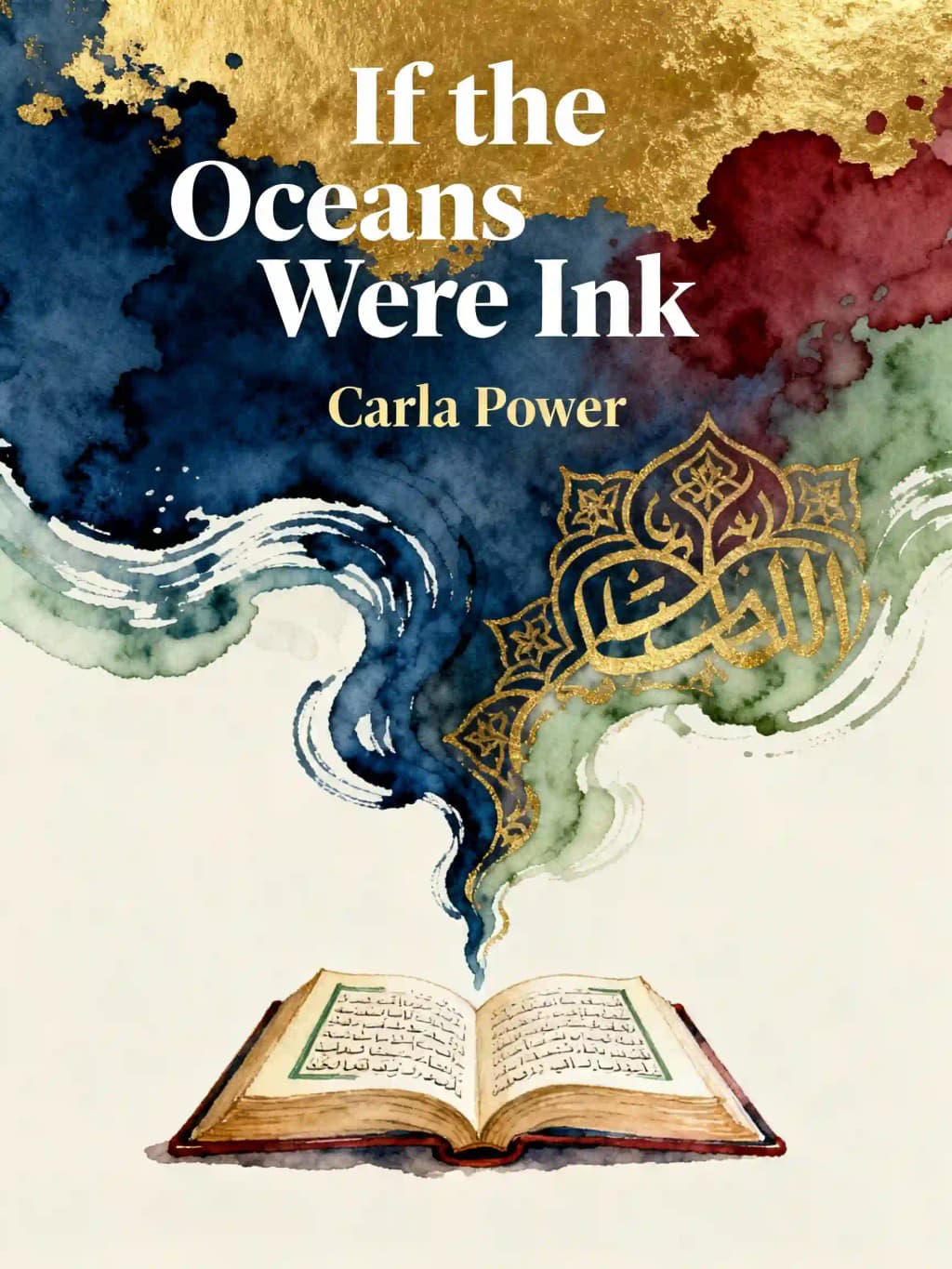
A Pulitzer finalist exploring Islam through friendship, "If the Oceans Were Ink" follows journalist Carla Power's year studying the Quran with Sheikh Akram Nadwi. Praised by Fareed Zakaria as "the conversation that needs to be taking place around the world."
Carla Power, Pulitzer Prize-finalist author of If the Oceans Were Ink: An Unlikely Friendship and a Journey to the Heart of the Quran, is celebrated for her nuanced exploration of cross-cultural and interfaith dialogue. A narrative nonfiction work, the book intertwines her decade-long friendship with a conservative Islamic scholar, offering a deeply personal lens into Quranic teachings and Muslim identity.
Power’s global upbringing across Iran, India, Afghanistan, and Egypt informs her empathetic approach to bridging cultural divides, further enriched by her academic background in Middle Eastern studies from Oxford and Columbia.
A seasoned journalist, Power’s career began at Newsweek, with bylines in Time, The New York Times, and The Guardian. Her follow-up book, Home, Land, Security: Deradicalization and the Journey Back from Extremism, was also a Pulitzer finalist, cementing her authority on global security and ideological reconciliation. Translated into multiple languages, If the Oceans Were Ink has been hailed as a seminal work in understanding contemporary Islam, lauded for its “lyrical precision” (The Washington Post) and adopted in university curricula worldwide.
If the Oceans Were Ink by Carla Power is a memoir exploring Islam through dialogues with Oxford scholar Sheikh Mohammad Akram Nadwi. Structured around Quranic lessons, it addresses misconceptions about jihad, women’s rights, and Sharia, blending personal narrative with theological insights. The book humanizes Islamic teachings by framing them within a cross-cultural friendship and post-9/11 societal tensions.
This book is ideal for readers seeking to understand Islam beyond stereotypes, including interfaith dialogue enthusiasts and those interested in Quranic interpretation. It appeals to fans of memoirs blending personal growth with cultural exploration, offering nuanced perspectives on contentious topics like the niqab and political Islam.
Key themes include reconciling faith with modernity, the role of women in Islamic history, and jihad as spiritual self-improvement. Power and Akram challenge stereotypes by emphasizing education’s role in empowerment and contrasting cultural practices with Quranic principles. Their friendship symbolizes bridging divides through mutual respect.
The book redefines jihad as a personal struggle for moral growth, not violence. Akram explains its Quranic roots in justice and self-discipline, citing historical examples. Power contrasts this with post-9/11 media narratives, highlighting how extremist groups distort the term.
It uncovers forgotten legacies of female Islamic scholars, showcasing their historical influence on theology and law. Akram’s 57-volume work on women hadith experts underscores their intellectual contributions. The book critiques patriarchal cultural practices misattributed to Islam, advocating for Quran-based gender equity.
Power contrasts literalist and contextual approaches, analyzing verses on polygamy and inheritance. Akram emphasizes ijtihad (independent reasoning), arguing Islamic law adapts to time and place. Their discussions reveal the Quran’s layered meanings, from allegorical stories to ethical directives.
Power’s 30-year friendship with Akram models interfaith dialogue, demonstrating how trust dismantles prejudice. Their debates—whether on hijab or Sufism—show respectful disagreement fostering deeper understanding. This dynamic humanizes theological debates, making abstract concepts relatable.
While Power admires Akram’s scholarship, she critiques issues like gender segregation and apostasy laws. The book balances reverence for Quranic wisdom with journalistic scrutiny of rigid interpretations, offering a secular Jewish perspective on Islamic traditions.
Metaphors like “oceans as ink” (from Quran 18:109) symbolize divine knowledge’s vastness. The “cycle of life” analogy illustrates surrendering control to faith. Power interweaves memoir, reportage, and Quranic exegesis, creating a hybrid narrative accessible to non-academic readers.
Some readers note Power’s limited challenges to Akram’s views, wishing for deeper theological rigor. Others praise its accessibility but desire more Muslim voices beyond Akram. Despite this, it’s widely lauded for bridging divides in an era of rising Islamophobia.
It contextualizes debates on immigration, terrorism, and religious freedom, showing how Quranic values intersect with contemporary life. Akram’s progressive stances on education and gender equality offer a counter-narrative to extremist ideologies.
For deeper dives, consider Akram’s Al-Muhaddithat on female scholars or Reza Aslan’s No God but God for Islamic reform history. Memoirs like Lesley Hazleton’s The First Muslim complement its personal approach to theology.
著者の声を通じて本を感じる
知識を魅力的で例が豊富な洞察に変換
キーアイデアを瞬時にキャプチャして素早く学習
楽しく魅力的な方法で本を楽しむ
I'm not this, I'm not that. I'm just Muslim.
It is You we serve.
Islam is not an idea. It is a history.
I think we know what they're thinking.
『If the oceans were ink』の核心的なアイデアを分かりやすいポイントに分解し、革新的なチームがどのように創造、協力、成長するかを理解します。
鮮やかなストーリーテリングを通じて『If the oceans were ink』を体験し、イノベーションのレッスンを記憶に残り、応用できる瞬間に変えます。
何でも質問し、学習スタイルを選び、自分に本当に響くインサイトを一緒に作れます。

"Instead of endless scrolling, I just hit play on BeFreed. It saves me so much time."
"I never knew where to start with nonfiction—BeFreed’s book lists turned into podcasts gave me a clear path."
"Perfect balance between learning and entertainment. Finished ‘Thinking, Fast and Slow’ on my commute this week."
"Crazy how much I learned while walking the dog. BeFreed = small habits → big gains."
"Reading used to feel like a chore. Now it’s just part of my lifestyle."
"Feels effortless compared to reading. I’ve finished 6 books this month already."
"BeFreed turned my guilty doomscrolling into something that feels productive and inspiring."
"BeFreed turned my commute into learning time. 20-min podcasts are perfect for finishing books I never had time for."
"BeFreed replaced my podcast queue. Imagine Spotify for books — that’s it. 🙌"
"It is great for me to learn something from the book without reading it."
"The themed book list podcasts help me connect ideas across authors—like a guided audio journey."
"Makes me feel smarter every time before going to work"

If the oceans were inkの要約をPDFまたはEPUBで無料でダウンロード。印刷やオフラインでいつでもお読みいただけます。
What happens when a secular American journalist sits down with a conservative Islamic scholar to study the Quran? In a world quick to draw battle lines between East and West, Muslim and non-Muslim, religious and secular, Carla Power's friendship with Sheikh Mohammad Akram Nadwi shouldn't make sense. Yet their year-long journey through Islam's holiest text reveals something far more interesting than conflict: the messy, beautiful complexity of faith in practice. Power, raised Jewish-Quaker and shaped by feminist ideals, found herself spending weekly sessions in Oxford cafes with a man who seemed her opposite in every way. But the Sheikh defied easy labels. When asked if he was Salafi, liberal, or conservative, he simply replied, "I'm not this, I'm not that. I'm just Muslim." This refusal to fit neatly into boxes would become the theme of their entire relationship-and perhaps the most important lesson about understanding Islam in our polarized age. Sheikh Akram's independence had a way of unsettling people on all sides. He'd stand before conservative congregations and declare that prayer caps were merely South Asian custom, not Islamic requirement. He'd tell traditional audiences that women could cut their hair short based on examples from the Prophet's wives. These weren't provocations for their own sake-they emerged from his meticulous research into Islamic history, which revealed a faith far more flexible than modern practice suggested.
Power's fascination with Islamic cultures began through sensory experience-mosque domes, wool carpets, women's chadors during her childhood in 1970s Iran and Afghanistan. Western assumptions that Islam was retreating before modernization shattered with Iran's 1979 revolution. She later discovered the treaty protecting Americans like her family had fueled Khomeini's 1964 sermon against imperialism. As a journalist, she fought headlines like "Jihad in the City" for stories about peaceful coexistence, challenging editors dismissing Palestinian perspectives. Even "Taliban" stereotypes collapsed when she met a press secretary rhapsodizing about Rome's gardens in perfect Italian. The Sheikh's life similarly transcended categorization-a village boy from India who became an Oxford scholar, embodying contemporary Muslim identity's complexity. "Islam is not an idea," he told her. "It is a history."
Power accompanied the Sheikh to Jamdahan, his ancestral village in Uttar Pradesh, where he was building two madrasas with Oxford earnings. While Westerners post-9/11 viewed madrasas as "jihad factories," his taught English alongside Quran and Islamic jurisprudence. When Power addressed the all-male audience, their questions cut to politics: "Is American media controlled by Jewish people?" and "Why does America act against Muslim interests?" For these villagers, Islam's intersection with the West was shaped by geopolitics, not platitudes. She was then taken to the family's zenankhaneh, built for purdah-women screened from the outside world except for a rectangle of sky above the courtyard. Akram observed strict gender separation in the village, yet in Oxford, purdah relaxed. His daughter Sumaiya laughed when asked if she could drive: "I could drive before my husband did!" At Nadwat al-Ulama, where Akram studied, he learned Islamic sciences alongside Shakespeare, Freud, and Sartre. His Leicester work restoring women's mosque access drew on historical precedent-during the Prophet's era, women attended freely, a practice later restricted by cultural norms masquerading as religious law.
When Prince Charles visited the Oxford Centre for Islamic Studies, administrators fussed over protocol while Akram stood unmoved in his gray karakul cap. His dignity stemmed from Islam's flattening of worldly hierarchies - there was only one power he truly respected. That first autumn, he missed Nadwah's spiritual continuity where worship and study formed an unbroken devotional chain. Asked what he missed most, he simply replied: "True friendship." Power's twenty-four-year-old American self couldn't grasp his unwillingness to return despite homesickness. Years later, she understood what she'd dismissed as passivity was actually "muscular submission." When Akram taught the Quranic story of Yusuf (Joseph), she saw beyond "a man with great clothes and horrible brothers" to find tools for enduring anywhere: humility, patience, and adaptability. He illustrated with a simple diagram - a line representing your space (circumstances) and a circle representing your cycle of faith. While your space isn't in your control, your cycle is. Yusuf never complained despite being thrown in a well, sold into slavery, or imprisoned. "When you have taqwa, you don't need fatwas," the Sheikh explained - a philosophy offering comfort to migrants worldwide.
While reporting on the Taliban's 1998 ban on women's education, Power discovered Akram was uncovering thousands of women hadith scholars throughout history. Fatimah bint Sa'd al-Khayr studied across Asia before teaching in Damascus, Jerusalem, and Cairo. Women scholars were renowned for accuracy - none were accused of fabricating hadith, unlike some men who invented traditions to flatter rulers. Umm al-Kiram Karimah taught Sahih al-Bukhari, second only to the Quran, attracting students from everywhere. Women's scholarship declined after the 17th century with European colonialism. Aisha, the Prophet's third wife, exemplified this tradition - a top scholar, women's rights champion, military commander, and jurist whose 2,210 preserved hadiths reveal a courageous voice on matters from prayer to sex. Muhammad prioritized her happiness, even racing with her. At Imperial College, the Sheikh lamented modern Muslims neglecting this example: "People, when they marry, they don't want to make their wives happy. Make them happy!" His work provides historical precedent for Muslim women's education today, arguing that denying women education resembles pre-Islamic customs of burying girls alive - "a live burial" of potential.
In a world demanding we choose sides, Power and Akram's friendship offered something rarer: the courage to sit with uncomfortable questions. Their year together didn't resolve into neat answers about women's rights, religious authority, or tradition meeting modernity. Their first lesson studied "Al-Fatiha," the Quran's opening chapter-twenty-five Arabic words recited seventeen times daily by devout Muslims. When Akram mentioned some interpret its final lines about "those who are objects of anger" as referring to Jews and Christians, Power felt the friction between their worldviews sharpen. When they tackled controversial verses about male guardianship or marital discipline, the Sheikh didn't dodge-*daraba* means "to beat," he acknowledged, not some sanitized euphemism. Yet he outlined strict conditions rooted in the Prophet's example, who never hit his wives and strongly reprimanded those who did. When Power pressed him about adapting guardianship systems to modern realities where women work and earn, Akram insisted the issue wasn't who was in charge but whether people feared God and acted justly. She didn't always agree, but she learned something more valuable: how deeply held convictions can coexist with genuine respect. Their conversations moved fluidly from the sublime to the mundane-from death and the afterlife to makeup and menstruation-challenging Western categorization.
After a year of lessons, Power asked what would happen to someone who believed in God but wasn't ready to submit to Islam. The Sheikh's answer was gentle but clear: without faith, good deeds might bring worldly rewards but not salvation. Yet he admitted his own uncertainty-everything depends on God. A week after their final lesson, Power's mother died. Shortly after the memorial service, she learned the Sheikh's own mother had died unexpectedly. He responded with the traditional phrase: "Inna lillahi wa inna ilayhi rajioon"-"We belong to God, and to God we return." Through their year together, Power came to understand the Quran not as a book to be read from beginning to end, but as a place to which the faithful return repeatedly. The Sheikh's journey from India to England meant a layering of cultures-his Western life provided perspective to distinguish Islamic faith from ancestral traditions while giving him resources to establish a girls' madrasa back home. These weren't the answers Power expected, but they were honest-and in our age of performative certainty, honesty matters more than we admit. Understanding doesn't require agreement; it requires the willingness to see the world through another's eyes.