第1章
When Organizations Become Battlegrounds and Temples
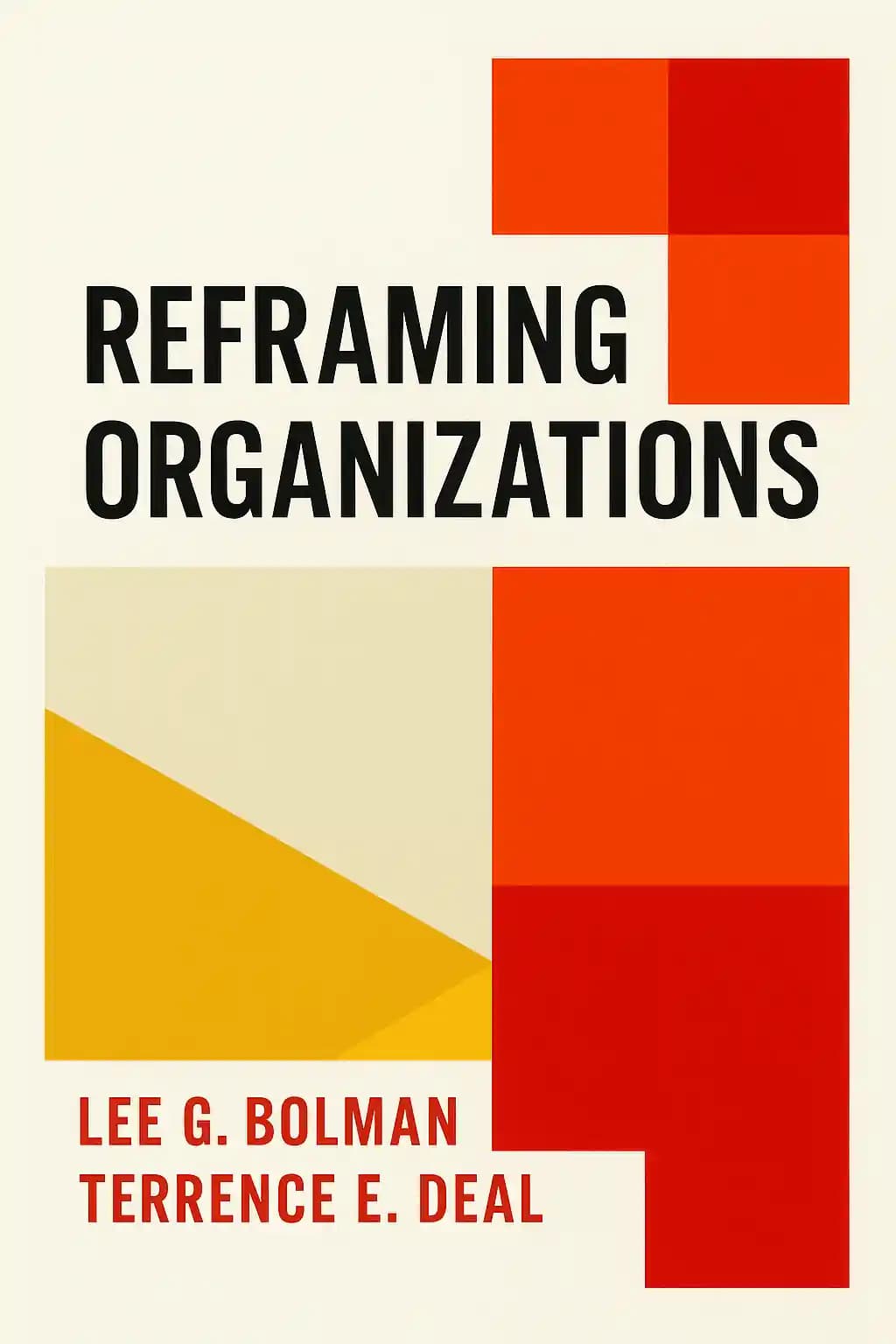
In the corporate jungle of the early 2000s, a book quietly revolutionized how leaders approached organizational challenges. "Reframing Organizations" by Lee G. Bolman and Terrence E. Deal didn't just join the crowded shelf of management texts-it fundamentally altered how generations of executives, consultants, and academics understood the complex ecosystems we call organizations.
The book's enduring appeal stems from its refreshingly practical approach to organizational complexity. While most management gurus were selling silver-bullet solutions, Bolman and Deal offered something more valuable: multiple perspectives. Their four-frame model has been embraced by Fortune 500 executives and translated into numerous languages, becoming required reading at top business schools worldwide. Even Barack Obama reportedly kept a copy on his nightstand during his presidency, drawing on its wisdom to navigate the ultimate organizational labyrinth-Washington politics.
What makes this work so compelling is its rejection of one-size-fits-all thinking. Instead, it invites us to see organizations simultaneously as factories, families, jungles, and temples-a kaleidoscopic view that transforms seemingly intractable problems into solvable puzzles. In a world where smart people consistently make terrible organizational decisions, Bolman and Deal's framework offers not just analysis but wisdom-the kind that transforms managers into leaders and bureaucracies into communities with soul.
第2章
The Four Frames: A Revolutionary Lens for Organizational Vision
Why do smart, well-intentioned managers so frequently make poor decisions? The answer lies not in their intelligence or intentions, but in how they perceive organizational reality. Bolman and Deal introduce their groundbreaking four-frame model as a solution to this persistent problem.
Consider the Capitol riot aftermath, where coordination failures between federal, state, and local agencies led to catastrophic delays in National Guard deployment despite desperate pleas from officials. This "cluelessness" exemplifies what happens when leaders misread situations and persist with ineffective approaches. The four frames-structural, human resource, political, and symbolic-offer a comprehensive toolkit for understanding such complex scenarios.
Each frame represents a distinct school of thought about organizations. The structural frame views organizations as rational systems designed to achieve goals efficiently, focusing on roles, policies, and environment. The human resource frame sees organizations as extended families where individual needs and organizational requirements must be aligned. The political frame portrays organizations as competitive arenas where different interests vie for power and scarce resources. The symbolic frame treats organizations as cultures bound together by shared values, rituals, and stories.
These perspectives aren't merely theoretical constructs-they're practical lenses that reveal different aspects of the same situation. Consider the historical conflict between the FBI and CIA. Structurally, they operated in disconnected departments with different reporting lines. From a human resource perspective, personal enmity between founding directors created lasting friction. Politically, they competed for turf and funding. Symbolically, they developed distinct cultures-the FBI preferred quick, public action while the CIA valued patience and secrecy.
Research consistently demonstrates that leaders who employ multiple frames are more effective than those relying on a single perspective. In one study, 98% of managers rated reframing as helpful, with 90% believing it gave them competitive advantage. Like adding lenses to Galileo's telescope, each frame brings the organizational landscape into sharper focus, revealing options that would otherwise remain invisible.
The power of reframing lies in its ability to liberate managers from mechanical approaches to leadership. When United Airlines faced backlash after forcibly removing a passenger from an overbooked flight, single-frame thinking saw only one possible response. Multi-frame thinking would have revealed multiple options, potentially avoiding the PR disaster that followed. By embracing both the engineering precision of analysis and the artistic sensibility of interpretation, leaders can transform confusion into clarity and constraints into choices.
第3章
The Structural Frame: Architecture of Organization
Structure represents far more than boxes and lines on an organization chart-it's the social architecture that shapes everything from daily operations to long-term success. The structural frame, one of the oldest and most influential perspectives on organizations, views them as rational systems designed to achieve established goals.
Consider the contrast between an eight-oar racing crew and the 9/11 emergency response. In the rowing shell, clear roles and precise coordination create harmony-from the bow seats' precision to the middle rowers' power to the stroke oar's pace-setting. This structural clarity helped America's first all-black rowing team overcome social barriers through disciplined teamwork. Conversely, the 9/11 tragedy revealed how structural breakdowns-particularly communication failures between fire and police departments-can magnify disaster despite individual heroism.
Six core assumptions underlie the structural perspective: organizations exist to achieve established goals; efficiency comes through specialization; coordination ensures diverse efforts mesh; rationality should prevail over personal agendas; structure must fit current circumstances; and performance problems stem from structural flaws. This view emerged from two intellectual traditions: Frederick Taylor's "scientific management" with its focus on efficiency, and Max Weber's analysis of bureaucracy as a rational alternative to patriarchal organizations.
Structure provides both opportunities and constraints, like a skeleton that enables movement while limiting its range. The variety of structural options is virtually infinite-from Apple's hub-and-spoke model to Amazon's tight bureaucracy. Contrary to popular belief, people don't always prefer structures with more latitude. UPS drivers follow computer-generated routes and precise instructions but consider themselves "happy robots" because the technology makes work easier. Structure enhances morale when it helps work get done but diminishes it when creating unnecessary obstacles.
Organizations face persistent structural dilemmas: differentiation versus integration, gap versus overlap, underuse versus overload, clarity versus creativity, autonomy versus interdependence, and loose versus tight control. These tensions have no permanent solutions-they require ongoing balancing acts. Mintzberg identified five structural configurations that address these challenges differently: simple structure (small entrepreneurial organizations), machine bureaucracy (standardized procedures like McDonald's), professional bureaucracy (skilled professionals with autonomy like universities), divisionalized form (semi-autonomous units like Johnson & Johnson), and adhocracy (flexible structures like W.L. Gore).
Effective structural design requires aligning with strategy, environment, technology, and people. McDonald's thrives with centralized control and standardization, while Harvard succeeds with decentralization and professional autonomy. Every structure involves tradeoffs, and no perfect solution exists for the inherent tensions between different coordination approaches. The key is finding the right balance for your specific circumstances-as Haier did by restructuring into 4,000 self-managing microenterprises, or as Ford did when Alan Mulally flattened hierarchies and implemented matrix structures to reverse the company's decline.
第4章
Teams: Where Structure Meets Human Dynamics
The extraordinary success of SEAL Team Six in the Osama bin Laden raid didn't happen by accident. Their effectiveness stemmed from a structure perfectly aligned with their mission-clear roles, distributed leadership, and intensive coordination built through grueling training. This exemplifies how team structure must match task requirements for high performance.
Teams face fundamental structural choices based on their work's complexity and interdependence. Simple tasks work with basic structures and clearly defined roles, while complex projects need flexible roles and reciprocal coordination. The right configuration depends on whether your team's work resembles baseball (where players perform relatively independently), football (requiring coordinated plays), or basketball (demanding continuous mutual adjustment in crowded spaces).
Five basic structural configurations exist for small teams. The "one-boss" arrangement works efficiently for simple tasks but can overload the leader in complex situations. The "dual authority" structure divides responsibilities but adds communication layers. A "simple hierarchy" with a middle manager frees the top leader but may create friction. The "circle network" allows sequential information flow but risks breaking down with complex tasks. The "all-channel network" enables free information flow and works well for complex tasks requiring mutual adjustment, though it may slow decision making.
High-performing teams share six distinguishing characteristics: they shape purpose in response to demands, translate purpose into measurable goals, maintain manageable size (between 2-25 people), develop the right mix of expertise, establish common commitment to working relationships, and hold themselves collectively accountable. Many teams fail because they launch without proper training, support, or communication systems.
Self-managing teams represent the cutting edge of team structure, planning, organizing, controlling, staffing, and monitoring themselves. Companies like Trader Joe's exemplify this approach with a simple structure governed by core values. Research shows self-directed teams typically produce better results and higher morale than traditional top-down groups. Microsoft, Boeing, Google, W.L. Gore, Southwest Airlines, and Goldman Sachs have all implemented this approach successfully.
Every group inevitably develops a structure that either helps or hinders effectiveness. As work complexity increases, teams need more sophisticated structures with multifaceted communication patterns. Understanding whether your team's task resembles baseball, football, basketball, or another sport helps clarify appropriate teamwork options. The key is recognizing when the game changes and redesigning structure accordingly.
第5章
The Human Resource Frame: People as Assets, Not Expendables
The stark contrast between companies that exploit workers and those that treat them well reveals a fundamental organizational choice. While Apple reached a $2 trillion market value despite criticism for its offshore labor practices in China, companies like Wegmans Markets and Nucor Steel demonstrate how treating employees well drives business success. Wegmans consistently ranks as a top workplace with 90% employee satisfaction, while Nucor, America's largest steel producer, has never had layoffs and empowers frontline workers through a flattened hierarchy.
The human resource frame evolved from pioneers like Mary Parker Follett and Elton Mayo, who challenged the assumption that employees were only entitled to a paycheck for following orders. This perspective rests on four core assumptions: organizations exist to serve human needs; people and organizations need each other; poor fit between individuals and systems harms both; and good fit benefits everyone through meaningful work and organizational success.
Understanding motivation requires recognizing that people want things beyond money-such as doing good work, improving skills, connecting with others, and finding meaning. Abraham Maslow's influential needs hierarchy arranges human needs in five categories from lowest to highest: physical well-being and safety, social needs, ego needs, and self-actualization. Despite modest supporting evidence, Maslow's theory remains enormously influential. Companies like FedEx, Joie de Vivre hotels, and Airbnb have built successful management philosophies based on his ideas.
Douglas McGregor built on Maslow's work with his Theory X and Theory Y. Most managers hold "Theory X" assumptions that workers are lazy and need direction, creating self-fulfilling prophecies when they treat people accordingly. Theory Y proposes aligning organizational requirements with employees' self-interest. Similarly, Chris Argyris identified a fundamental conflict between human personality and traditional management practices. Organizations often treat workers like children rather than adults, creating narrow, mechanized jobs with tight controls that conflict with natural human development toward independence and self-actualization.
Global trends have pushed organizations in conflicting directions regarding human resources. Competitive pressures drive companies toward minimizing fixed human assets through downsizing, outsourcing, and temporary workers. Simultaneously, complex global operations require skilled, loyal workforces. Companies face a dilemma: pursue flexibility through temporary workers or loyalty through long-term commitment? Seek high skills or low costs?
While downsizing appears to offer lower costs and greater flexibility, it often creates long-term damage. Multiple studies show that cutting people typically hurts performance more than it helps, with downsized firms more likely to go bankrupt than those maintaining their workforce. Companies that invest in developing committed, talented employees gain powerful competitive advantages. Southwest Airlines maintained cost advantages through its highly productive, committed workforce that competitors couldn't duplicate. The contrast between pipe manufacturers McWane (with its abysmal safety record and 100% annual turnover) and American Cast Iron Pipe (consistently rated as a top workplace with less than 0.5% turnover) demonstrates the difference in approaches.
第6章
Building a People-Centered Organization
Progressive human resource management has evolved from Robert Owen's humane workplace practices in the early 1800s to modern companies like Ultimate Software that view talent and motivation as business essentials. Despite barriers like Theory X management fears and pressure for immediate results, many organizations successfully implement people-centered approaches that yield sustainable competitive advantages.
Effective human resource strategies begin with a clear philosophy about managing people. Cisco exemplifies this with its "Our People manifesto" organized around three values: connect everything, innovate everywhere, and benefit everyone. Named World's Best Place to Work in 2019, Cisco boasts remarkable statistics: 93% say it's a great place to work, 95% are proud to tell others they work there, and 87% call it psychologically safe.
Strong companies clearly define their ideal employees and hire accordingly. Southwest Airlines seeks positive attitudes and interpersonal skills, even asking pilot candidates to change into Bermuda shorts during interviews (rejecting those who refused). Enterprise overtook Hertz by deliberately hiring "from the half of the class that makes the top half possible"-college graduates stronger in social skills than academics.
Leading companies recognize turnover's high costs and focus on retaining talent through several key strategies. Costco exemplifies counterintuitive success by paying employees 70% more than competitor Sam's Club while charging customers less-yet generating twice the profit per worker. Their formula works through higher sales volumes, faster inventory turnover, lower shrinkage, and superior customer satisfaction. Companies like Publix have never had layoffs since founding in 1930, while Lincoln Electric maintained its no-layoff policy since 1914 by converting production workers to salespeople during a 40% demand drop.
Progressive organizations empower employees beyond merely keeping them informed. Open-book management gives employees access to financial and performance measures, encourages owner-like thinking, and provides stakes in the company's success. This approach works because it signals management trust, creates incentives for contribution, and provides information needed for problem-solving. Participation improves both morale and productivity by increasing individual effectiveness and enhancing organizational learning.
Job redesign experiments have been largely successful, particularly improving quality over productivity. Hackman identified three critical factors for meaningful work: seeing work as meaningful, using discretion and judgment, and receiving feedback. Self-managing teams take responsibility for meaningful whole products or services with autonomy, resources, and collective accountability.
Successful organizations take diversity seriously as both an ethical imperative and a business necessity. Research shows firms with diverse management are more productive, particularly when diversity extends to senior levels. Effective diversity initiatives include mentoring programs, tying executive bonuses to diversity goals, eliminating glass ceilings, diversifying boards, and using targeted recruiting practices.
When individuals find satisfaction and meaning in work, organizations benefit from their talent and energy. Progressive organizations implement comprehensive "high-involvement" strategies: strengthening bonds through good pay, job security, internal promotion, training, and profit sharing; while empowering workers through participation, job enrichment, teaming, egalitarianism, and diversity.
第7章
The Political Frame: Power, Conflict, and Scarce Resources
The Boeing 737 MAX crashes that killed nearly 350 people in 2018-2019 reveal how political dynamics shape organizational decisions. Despite engineers' warnings about the faulty MCAS system, business pressures to compete with Airbus led Boeing to downplay safety concerns and rush the aircraft to market. This parallels the 1986 Challenger space shuttle disaster, where Morton Thiokol engineers' warnings about O-ring failures were overruled by managers under pressure to launch.
The political frame views organizations as arenas hosting ongoing contests between competing interests. Five key propositions define this perspective: organizations function as coalitions of different individuals and interest groups; coalition members have enduring differences in values, beliefs, and interests; most important decisions involve allocating scarce resources; scarce resources and differences make conflict central and power crucial; and goals emerge from bargaining among competing stakeholders.
Organizations function as coalitions where all members make demands on resources and bargain for what they want. While executives have more authority, their influence depends on how much power they can mobilize compared to others in the coalition. Xerox's near-bankruptcy in 2001 under an outsider CEO who failed to master organizational politics illustrates this reality.
Power in organizations flows from multiple sources beyond position power. Reputation builds on expertise, with opportunities flowing to those with strong performance records. Alliances and networks are crucial-successful managers actively cultivate relationships with friends and allies. Access to decision arenas gives some individuals greater influence. Framing-the control of meaning and symbols-allows elites to shape how issues are viewed, which often determines outcomes. Personal power derives from charisma, social adeptness, and persuasive skills.
Organizations differ markedly in power distribution. Overbounded systems concentrate power tightly, while underbounded systems feature diffuse power with loose control. When power is highly regulated, political activity goes underground, as in the pre-glasnost Soviet Union where differences simmered beneath the surface until Gorbachev's openness led to the collapse of the old order.
From a political perspective, conflict is normal and inevitable-a natural byproduct of collective life where resources are scarce and individuals and groups compete. Conflict isn't necessarily problematic; it can stimulate creativity, innovation, and positive change. The key issue isn't conflict's quantity but its management-poorly handled conflict leads to destructive power struggles, while well-managed conflict drives innovation and adaptation.
Organizations can become moral mazes where power, self-interest and political games dominate. Jackall views corporations as worlds of "cabals and alliances" beneath "cheerful surfaces." Career advancement involves competition for scarce status, with the myth that better performers win. Yet performance assessment in management is highly ambiguous, with multiple criteria, subjective judgments, and difficulty separating individual from group contributions.
The political frame challenges traditional views of organizations as rational systems controlled by legitimate authorities. Instead, it portrays organizations as coalitions of individuals and groups with enduring differences competing for scarce resources. Power and conflict become central to decision making, with authorities possessing position power but competing against other forms of leverage.
第8章
The Manager as Politician: Navigating the Power Landscape
Jacinda Ardern's extraordinary leadership during New Zealand's crises-a terrorist attack killing 51 Muslims, a volcanic eruption claiming 21 lives, and the Covid-19 pandemic-demonstrates political leadership at its best. Her empathetic approach, including wearing a hijab while standing with Muslim victims and declaring "They are us," sparked global admiration. When the pandemic hit, she implemented a "hit hard and early" strategy, communicating frankly yet warmly via Facebook, bringing cases to zero and securing an overwhelming electoral mandate.
Effective managers need four essential political skills: agenda-setting that balances long-term interests with achievable strategies; mapping the political terrain to understand power dynamics; networking and building coalitions; and bargaining and negotiating. The politically savvy manager walks a tightrope between developing direction and building support among diverse stakeholders.
An effective political agenda combines vision with strategy. As Warren Bennis noted from his university presidency experience, "I was most effective when I knew what I wanted." Leaders must create an agenda balancing long-term interests of key stakeholders with strategies accounting for competing forces. This requires sensitivity to others' concerns and planting seeds of ideas throughout the system.
Politically savvy managers scout the territory before launching initiatives. Creating a two-dimensional map showing players, their power, and interests helps reveal potential resistance and necessary realignments. In both the 737 MAX and Challenger disasters, engineers presented data-based safety arguments but failed to overcome their bosses' resistance because they lacked political influence.
Building networks requires figuring out whose help you need and developing relationships before you need them. Successful change agents typically start by getting their boss onboard, then "preselling" to stakeholders individually, followed by "horse trading" for resources and support, and finally "securing blessings" from senior management. Networks perform crucial functions formal structures can't-moving projects forward, imparting culture, mentoring, and creating communities of practice.
Negotiation occurs whenever parties with both common and conflicting interests need agreement. The fundamental dilemma is choosing between "creating value" (seeking win-win solutions) and "claiming value" (maximizing your own gain). Fisher and Ury's "principled bargaining" approach recommends separating people from problems, focusing on interests rather than positions, inventing options for mutual gain, and insisting on objective criteria. The Israel-Egypt Camp David treaty exemplifies this approach-by looking beyond border positions to underlying interests, they found a solution giving Egypt the Sinai while demilitarizing large areas.
The ethics of political action present tricky questions for managers. Lax and Sebenius offer practical questions for ethical assessment: Are you following mutually understood rules? Would you be comfortable defending your choices publicly? Would you want to receive the same treatment? Would the world improve if everyone acted as you did? Are there alternatives on firmer ethical ground?
The question isn't whether organizations are political, but what kind of politics they will embrace. Political dynamics can be destructive, but also vehicles for noble purposes. Organizational change and effectiveness depend on managers' political skills. Constructive politicians know how to craft agendas, map political terrain, build support networks, and negotiate with allies and adversaries.
第9章
The Symbolic Frame: Culture, Meaning, and Soul
When the Catholic Church changed its liturgy from Latin to English, many parishioners rebelled despite greater accessibility. Similarly, when Coca-Cola changed its 99-year-old recipe in 1995, consumers protested vigorously despite blind taste tests favoring the new formula. Both examples demonstrate how symbols become embedded in myths that are "truer than true." The symbolic frame examines how myths and symbols help humans make sense of chaotic, ambiguous worlds by creating meaning.
Organizations reveal their culture through distinctive symbols-from GEICO's gecko to Harvard's academic rituals. These symbols take many forms: myths that function as collective dreams explaining and maintaining solidarity; vision and values that provide purpose; heroes whose words and deeds become icons; stories that reconcile contradictions; rituals and ceremonies offering direction and hope; and metaphor, humor and play that form communal bonds.
Myths undergird an organization's values and identity, providing meaning during challenges. Southwest Airlines' founding myth of persistence against established carriers shapes its unique culture today. Values define what organizations stand for-not just in mission statements but in lived practice. Collins and Porras found that extraordinary companies embed their core ideology into organizational fabric, as when Johnson & Johnson's commitment to customers drove the costly Tylenol recall, or when 3M's principle "thou shalt not kill a new product idea" led to Scotch Tape and Post-it Notes.
Organizations rely on exemplary figures whose words and deeds embody core values. Some are CEOs like Mary Barra, who transformed GM's culture with transparency while tripling profits, or Costco's James Sinegal, whose spartan office and personal phone-answering demonstrated the company's low-cost values. Heroes emerge at all levels-like Joe Vallejo, a school custodian whose influence extended far beyond maintenance to community relations and teaching advice.
Stories convey information, morals and myths more vividly than formal rules. They establish and perpetuate tradition, building loyalty and reinforcing organizational values. Costco's founder Jim Sinegal masterfully used stories like the "salmon fillet" narrative to reinforce the company's commitment to providing value-showing how they improved product quality while lowering prices from $5.99 to $4.79 per pound.
Ritual provides structure and meaning as a symbolic act that "alludes to more than it says, and has many meanings at once." Rituals anchor us while freeing us to confront life's unpredictability. When rituals are lost, as Campbell notes, "you lose a sense of civilization." Ceremonies are more elaborate than everyday rituals, marking transitions or special occasions. Boeing exemplifies this with the grand rollout of the 787 Dreamliner attended by 15,000 people-a massive event that brought together Boeing veterans from across generations to celebrate achievement and tradition.
Culture is both product and process-accumulated wisdom that's continuously renewed as newcomers learn and eventually teach others. Schein defines it formally as "shared basic assumptions" learned through problem-solving, while Deal and Kennedy offer the simpler "the way we do things around here." BMW's distinctive culture emerged from a near-bankruptcy experience in 1959 when the company misjudged the market with two failed models. This "near-death experience" story is retold to newcomers as foundational lore. The crisis transformed BMW from a top-down organization to one valuing openness, innovation, and worker commitment.
第10章
Integrating the Frames: The Art of Leadership
Harmonizing multiple frames and crafting inventive responses to new circumstances are essential to both management and leadership. Traditional mythology depicts managers as rational actors who plan, organize, and control, but watching managers at work reveals a hectic existence where they shift rapidly between situations, deal constantly with people and emotions, and make decisions in a fluid, swirling vortex.
Different situations call for different frames. The human resource and symbolic approaches work best when commitment and motivation are essential. The structural frame excels when technical quality matters. Political and symbolic perspectives become more relevant as ambiguity increases. When conflict and scarce resources dominate, political strategies and unifying symbols become vital-as when Nelson Mandela used rugby to unite post-apartheid South Africa.
Research on organizational excellence reveals that successful companies embrace paradox-being simultaneously loose yet tight, disciplined yet entrepreneurial. Studies of managers paint a more complex picture. Kotter and Lynn described executives facing enormous complexity and uncertainty who focused on three challenges: setting an agenda, building a network, and using the network to get things done. Interestingly, "effective" managers (rated highly by subordinates) spent more time on communication and human resources, while "successful" managers (who got promoted faster) devoted more time to networking. The most successful were those who balanced both internal and external issues-a multi-frame approach made them both effective and successful.
Research consistently shows that the ability to use multiple frames correlates with leadership effectiveness. Studies of managers in business and education found effectiveness as a manager was particularly associated with the structural frame, while symbolic and political frames were primary determinants of effectiveness as a leader. College presidents, nonprofit executives, and school principals who used multiple frames were viewed as more effective than those relying on a single frame.
The image of firm control and precision often attributed to managers bears little resemblance to the messy reality of complexity, conflict, and uncertainty they actually face. They need multiple frames to survive-diagnostic tools that help assess which lenses are salient in a given situation. Key variables include motivation, technical constraints, uncertainty, scarcity, conflict, and position in the hierarchy.
Reframing allows leaders to examine situations from multiple perspectives, generating new insights and options. Each frame offers distinct advantages but also has limitations. The structural frame may overestimate authority and neglect human variables. The human resource frame can be overly optimistic about integrating individual and organizational needs. The political frame risks becoming cynical and sacrificing collaboration. The symbolic frame requires artistry and can seem like empty manipulation if poorly executed.
By consciously choosing which "character" to play in organizational dramas, leaders can expand their repertoire and effectiveness. While reframing initially requires deliberate practice, like any new skill, it eventually becomes more fluid and instinctive. This capability is particularly valuable for marginalized individuals who often face additional barriers to success.
第11章
Ethics and Soul: The Heart of Sustainable Organizations
Beyond the public fascination with corporate scandals lies a deeper story about organizations with soul-those with a bedrock sense of character and values that sustains ethical behavior. Medtronic exemplifies this approach with its mission to serve patients rather than shareholders-a commitment reinforced through ceremonies where new employees receive medallions depicting patients walking into full lives. When CEO Bill George discovered a European executive maintaining a secret Swiss bank account for payments to doctors, he immediately demanded the executive's resignation despite cultural arguments about European business practices. Under George's ethical leadership, Medtronic's share price increased 36 percent annually.
Each frame offers a distinct perspective on ethical responsibilities. The structural frame views organizations as factories with an ethical imperative of excellence-ensuring work is done effectively and efficiently to produce high-quality outcomes. However, excellence requires more than top-down directives; it demands commitment and autonomy throughout the organization. Leaders must give the gift of authorship, which "turns the classic organizational pyramid on its side and provides space within boundaries."
The human resource frame sees organizations as families where caring forms the ethical foundation. Compassionate organizations require servant-leaders concerned with members' needs and well-being. The essential gift these leaders offer is love-a concept largely absent from modern corporations where managers shy away from its deeper meanings. Southwest Airlines has embraced love explicitly since its founding in 1971. Herb Kelleher believed companies are stronger when bound by love rather than fear, a philosophy continued by subsequent leaders who describe Southwest as a "family bound by love."
The political frame views organizations as jungles of competing interests where justice becomes the essential ethical consideration. In environments of scarce resources and conflicting demands, fairness in deciding "who gets what" becomes the glue holding stakeholders together. Leaders must offer the gift of shared power. People with a voice in decisions are more likely to feel treated fairly than those without. Leaders who hoard power create powerless organizations where people fight back through sabotage, resistance, or withdrawal.
The symbolic frame sees organizations as temples-hallowed places expressing human aspirations and beliefs. Members are bound by shared traditions and spiritual covenant, strengthened when the organization embodies excellence, caring, and justice. People need to believe their work adds value and makes a difference, as illustrated by the stonemasons who saw themselves as "cutting stone," "building a cathedral," or "serving God." Spiritual leaders bring genuine concern for the human spirit, helping people find meaning and answer fundamental questions about identity, purpose, ethics, and legacy.
Ethics must ultimately be rooted in organizational soul-a deep commitment to identity, beliefs, and values. Each frame offers a perspective on ethical responsibilities and moral authority, providing spiritual guidelines for organizations to discover their ethical core. With institutions globally suffering crises of meaning and moral authority due to rapid change, mobility, globalization, and various conflicts, leaders face their most important responsibility: serving as models and catalysts for values like excellence, caring, justice, and faith.