第1章
The Mind as a Reality-Creating Machine
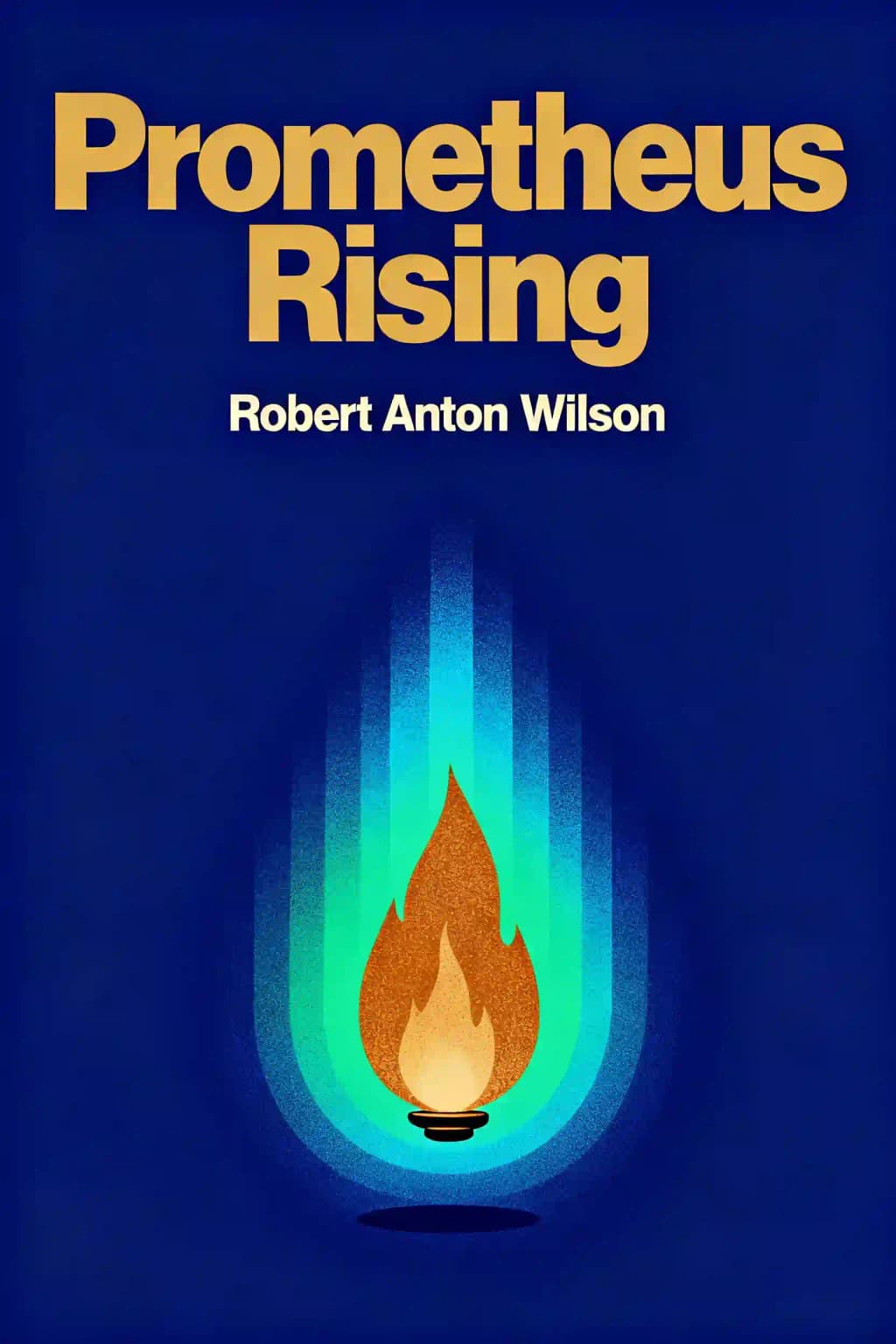
Have you ever wondered why some people seem to attract success while others struggle? Why two people can experience the same event yet walk away with entirely different perceptions? Robert Anton Wilson's "Prometheus Rising" offers a startling answer: we don't passively observe reality-we actively create it through the programming of our nervous systems. This cult classic, published in 1983, remains a favorite among Silicon Valley executives, consciousness researchers, and counterculture icons like Tool's Maynard James Keenan. Combining Timothy Leary's eight-circuit model of consciousness with General Semantics, quantum physics, and Western occultism, Wilson created what philosopher Deepak Chopra called "a guidebook to the future of the human species." The book's influence extends beyond philosophy-its practical exercises for "reprogramming your brain" have been incorporated into corporate training programs and therapeutic modalities. Let's explore how this revolutionary text reveals the machinery behind human consciousness and offers tools to hack your own reality tunnel.
第2章
The Thinker and the Prover: How Your Mind Creates Its Reality
Imagine meeting an elderly woman who insists the Earth rests on a giant turtle. When asked what supports the turtle, she confidently replies, "It's turtles all the way down!" While we might chuckle at this cosmology, Wilson suggests our own minds operate on remarkably similar principles.
According to psychologist Leonard Orr, the human brain functions as if divided into two parts: the Thinker and the Prover. The Thinker can entertain virtually any idea-that Earth floats in space, rests on infinite turtles, or contains a hollow interior populated by advanced civilizations. It can consider itself mortal, immortal, or even nonexistent, as in certain Buddhist philosophies. The possibilities are endless.
The Prover, however, operates on one simple law: Whatever the Thinker thinks, the Prover proves. If you believe all wealthy people are dishonest, your Prover will diligently collect evidence supporting this view while filtering out contradictory data. If you think you're unattractive, your Prover will ensure you notice every rejection while dismissing compliments as "just being nice." This mechanism explains why intelligent people can hold wildly different beliefs about politics, religion, or even scientific facts-each person's Prover faithfully gathers evidence supporting their Thinker's assumptions.
This isn't just abstract philosophy. When researchers asked subjects to hold a pencil between their teeth (forcing a smile), they rated cartoons funnier than when holding the pencil with their lips (forcing a frown). The physical act of smiling made things seem more humorous-the body influenced the mind. Wilson calls this the "reality tunnel"-each of us lives within a unique perceptual universe constructed from our experiences, beliefs, and biological programming.
"Science," Wilson notes, "achieves objectivity not because individual scientists are immune from the psychological laws that govern the rest of us, but because scientific method-a group creation-eventually overrides individual prejudices, in the long run." In the short run, however, whatever the Thinker thinks, the Prover will prove.
This explains why changing deep-seated beliefs is so difficult. Tell a person with low self-esteem they're wonderful, and their Prover will work overtime to dismiss this information. But understanding this mechanism gives us a powerful tool: we can deliberately reprogram our Thinkers, and our Provers will dutifully construct evidence supporting our new beliefs.
第3章
Hardware and Software: Your Brain's Operating System
Consider your brain as a bio-computer-not electronic like your laptop, but an electro-colloidal system operating on similar principles. While your brain's hardware is localized inside your skull, its software exists everywhere-in books you've read, conversations you've had, movies you've watched, and experiences you've lived. Without this software, you would have no personality, no Self at all.
What we call an individual emerges from how our particular brain processes this universal software ocean. The brain's programs get installed in discrete quantum stages, consisting of four fundamental parts:
1. Genetic Imperatives: The hard-wired "instincts" we share with other mammals
2. Imprints: Nearly permanent programs accepted during specific vulnerable periods
3. Conditioning: More flexible programs built upon imprints
4. Learning: The most changeable level of programming
Imprints deserve special attention because they essentially become hardware-frozen into neural pathways that determine the parameters within which all subsequent conditioning and learning occur. Before the first imprint, infant consciousness exists in a state of pure potential-"formless and void" like the universe before creation. Once imprinting occurs, structure emerges from this void, and the growing mind becomes trapped within this structure, identifying with it completely.
This process creates, out of an infinite ocean of possible signals, our particular constructs of "myself" and "my world." Each successive imprint further narrows and defines our reality tunnel. Conditioning and learning then build additional networks onto this foundation, forming our total map of reality.
The implications are profound: what we experience as "objective reality" is actually a construction-a map, not the territory itself. Our perceptions, beliefs, and even our sense of self emerge from this complex interplay of hardware and software. The person who believes themselves shy, uncoordinated, or unintelligent is experiencing the output of their particular programming, not an immutable fact about reality.
What's truly liberating about this model is the realization that software can be rewritten. While early imprints are difficult to change, understanding their nature allows us to work with rather than against our programming. We can create new imprints, modify conditioning, and add learning that expands rather than limits our potential.
第4章
The Bio-Survival Circuit: Your Primal Operating System
The most primitive neural circuit in our brain-the bio-survival circuit-operates on a simple binary: approach what nourishes, withdraw from what threatens. This circuit, shared with all organisms from amoebas to mammals, forms our most basic relationship with reality. When a baby smiles at its mother's breast and cries at perceived danger, this ancient circuit is at work.
Located in the brain stem and autonomic nervous system, the bio-survival circuit is intimately connected with our endocrine and immune systems. This explains why disturbances here manifest physically rather than mentally-as allergies, chronic pain, or digestive issues. According to a 1968 survey, approximately 85% of Americans show symptoms of bio-survival anxiety-dizzy spells, heart palpitations, wet palms, nightmares-making them effectively "the Walking Wounded."
This circuit operates mechanically and instantaneously-you aren't conscious of time when it's activated. Like a monkey encountering another animal, you make split-second decisions about threat levels without conscious deliberation. Without these automatic programs, no mammal would ever leave the mother's teat to explore the world.
Unfortunately, these crucial imprints happen largely by chance. Some people imprint bio-security and confidence, approaching the world with trust and curiosity. Others imprint insecurity and fear, perpetually scanning for threats. Extreme cases result in autism-complete withdrawal from threatening stimuli.
As civilization has advanced, the pack-bond (tribe, extended family) that provided bio-survival security has been broken, creating widespread "anomie" or "alienation." Modern humans no longer look to the gene-pool for security but instead to abstract "tickets" called money. This creates perpetual anxiety-imagine how you'd feel if all your sources of money were suddenly cut off.
Various political systems attempt to address this rupture. Welfare states try to make government a substitute for the tribe, while conservatives advocate for local charity. But the State can never truly replace the gene-pool, leading to paranoia among welfare recipients who fear being "exiled" for bureaucratic infractions. Real bonding can only occur in face-to-face groups of reasonable size, explaining the modern yearning to decentralize and return to tribal structures.
In a money economy, paranoia about who controls the "tickets" is inevitable-whether directed at "Jewish Bankers" or the "Yankee Establishment." Economist C.H. Douglas demonstrated this by showing identical curves between interest rates and suicide rates from 1812-1932. Bio-survival anxiety will only disappear when global wealth reaches a level where everyone has enough "tickets" without requiring totalitarianism.
第5章
The Emotional-Territorial Circuit: Power Politics in Your Brain
While the first circuit deals with nourishment and threat, the second circuit-emotional-territorial-deals entirely with power politics. This "patriotic" circuit exists in all vertebrates and activates when infants begin standing and walking. It's centralized in the thalamus (old brain) and connected to the voluntary nervous system and muscles.
The emotional-territorial circuit is chiefly imprinted by the father-the nearest alpha male. This creates our sense of "ego"-simply the mammalian recognition of one's status in the pack. The "egotist" behaves "like a two-year-old" because Ego is literally the imprint of the toddling and toilet-training stage.
This circuit creates a two-dimensional social space in conjunction with the first circuit's advance-retreat axis. The resulting grid creates four basic personality types that have been recognized across cultures and throughout history:
1. Friendly Strength (the confident leader, identified with the Lion)
2. Friendly Weakness (the dependent follower, identified with the Angel)
3. Hostile Weakness (the paranoid complainer, identified with the Bull)
4. Hostile Strength (the dominating tyrant, identified with the Eagle)
These four types appear in medieval psychology as the "humours," in Transactional Analysis as life scripts ("I'm okay-You're okay," etc.), and in numerous religious and mythological systems. They represent fundamental ways humans position themselves in relation to others.
Persons with heavy imprints on the territorial-emotional circuit tend to be musculotonic-holding energy in muscular attack-defense systems. They often become body-builders or weight-lifters, absorbed in demonstrating strength. Most societies channel these types into the military where their propensities defend tribal turf.
The ideally "balanced" person would not be robotized by these imprints but could move appropriately into each quadrant as circumstances require, maintaining centered detachment. Buddhist mandalas represent this ideal as circles, often cornered by four demons representing extremes to be avoided.
The contrast between maternal nurturing (first circuit) and paternal authority (second circuit) appears throughout literature and mythology as the Gracious Goddess and Terrifying Giant archetypes. James Joyce portrays the Father-God as the "goddinpotty" villain-the trickster-god of Eden and the god of thunder and wrath. Opposing him is Anna Livia Plurabella, the waters of life combined with all beautiful women, who is as oral and loving as "the Omniboss" is anal and threatening.
第6章
The Time-Binding Semantic Circuit: Language Creates Humanity
What truly separates humans from other animals is the third circuit-the semantic time-binding function that allows us to create maps of reality and transmit them across generations. This circuit handles artifacts and symbols, creating "reality-tunnels" that can be communicated through paintings, blueprints, words, tools, theories, and music.
As linguist Alfred Korzybski noted, humans are symbol-using creatures, and those who rule symbols rule us. Historical figures like Moses, Buddha, and Marx continue to influence humanity through symbol systems that transmit their signals across millennia.
The semantic circuit's left-brain functions are linked with right-handed manipulations, creating a neurological basis for mapping and manipulating the universe. The left brain is linear, analytical, computer-like and verbal, while the right brain handles holistic, supra-verbal, intuitive functions. This neurological structure places us in three-dimensional space, which explains why Euclidean geometry seems "natural" to us-it's a projection outward of how our nervous systems stack information.
Those heavily imprinted on this circuit tend to be cerebrotonic-tall, skinny "eggheads" who often ignore or fear their first and second circuit functions, finding playfulness puzzling and emotions baffling. They live primarily in a world of words and abstractions.
Like all circuits, the semantic circuit builds conditioning on imprinting, creating socially unthinkable thoughts despite their existential possibility. Geniuses break through to higher circuits through "intuition" and return with new semantic maps, threatening those trapped in old imprints. Even science, despite its self-correcting nature, shows a one-generation time lag in accepting new paradigms, as Thomas Kuhn demonstrated in "The Structure of Scientific Revolutions."
While bio-survival neurology has no time sense and emotional-territorial actions begin to include time, the third circuit fully conceptualizes time. We become creatures of time, understanding ourselves through historical narratives and scientific timescales. This time-binding function allows humans to pass information between generations, creating accelerating wealth that doubles every generation since the 18th century.
Evolution behaves as if always seeking higher coherence and intelligence. Our brains are "the greatest treasure in the universe" because they create all ideas which become materialized as roads, factories, medicines, technologies-all forms of negative entropy moving toward increasingly coherent order at an accelerating rate.
第7章
The Socio-Sexual Circuit: Tribal Morality and Reproduction
The fourth circuit, emerging at puberty, marks a crucial transition in human development by creating the "adult personality" through intricate sexual imprinting and tribal moral conditioning. While specific sexual taboos show remarkable variation across cultures-from strict monogamy to polyamorous arrangements-the universal meta-taboo remains constant: sexuality must never exist unregulated by tribal oversight. This isn't merely arbitrary control-our ancestors, though lacking modern genetic understanding, instinctively grasped that reproductive choices shape evolutionary trajectories across generations.
The socio-sexual circuit's primary function extends beyond mere reproduction to form a complete adult personality-specifically, a responsible parent capable of nurturing and protecting offspring. Physically anchored in the left neocortex and neurologically connected to reproductive organs and breasts, this circuit creates complex feedback loops between biological drives and social programming. Individuals strongly imprinted on this circuit often exhibit heightened sexual magnetism, frequently gravitating toward careers that capitalize on this energy-explaining why many models, actors, and performers show strong fourth-circuit dominance.
Morality, once established through this circuit, serves dual purposes: controlling genetic drift through sexual regulation and restraining potentially disruptive Circuit III innovations. Religious institutions particularly exemplify this conservative function, frequently branding novel ideas as "immoral" to maintain social stability. While Circuit III drives linear progress and innovation, Circuit IV creates stabilizing cyclical patterns-much like the reproductive cycles it governs.
Traditional child-rearing practices, often criticized as harsh or unenlightened, reveal their underlying logic when viewed through this lens. Their goal isn't to produce fully actualized individuals but rather to create reliable social components-semi-automated personalities who can dependably fulfill societal roles. The prison-like structure of traditional schools isn't accidental; it deliberately conditions children for similar adult environments they'll encounter. The relatively recent emergence of permissive parenting correlates directly with society's evolution beyond strict authoritarianism, as rapid technological and social changes demanded more adaptable, creative citizens rather than merely compliant ones.
Society's programming operates with remarkable precision, tailoring imprints to specific roles. The traditional differentiation between male and female upbringing-emphasizing greater Circuit II "sensitivity" in women-reflects this systematic conditioning. Social class structures function similarly to insect colonies, creating distinct imprint patterns for different social strata. The historical limitation of democracy stems partly from traditional society's deliberate suppression of advanced verbal skills among the majority, effectively programming reduced cognitive complexity to maintain social hierarchy and ensure a workforce suited to traditional labor roles.
Individual personality development typically results in one circuit becoming dominant-a "favorite" neural pathway that shapes how we process reality. This leads to predictable communication breakdowns when people operating from different circuit-bases interact. First-circuit types instinctively seek safety through dependency or react with infantile tantrums to challenges. Second-circuit personalities attempt to dominate problems through intimidation. Third-circuit individuals default to logical analysis, effective for mechanical issues but often inadequate for emotional complexities. Fourth-circuit types consistently apply tribal moral standards as their problem-solving framework, sometimes overlooking practical solutions in favor of maintaining moral conformity.
第8章
Reprogramming Your Brain: The Meta-Programming Circuit
We're learning more about pragmatic brain change-how to alter anyone's reality tunnel completely. This presents both our greatest utopian possibility and dystopian terror. While this knowledge could enable Orwellian control, we're also learning to change our own brains, using them for fun and profit rather than misery and robothood.
The process of brainwashing begins by attacking the bio-survival circuit through isolation and control. When the victim is separated from familiar bonds and security figures, their imprint vulnerability increases dramatically. After establishing bio-survival dependence, the brainwasher attacks the emotional-territorial circuit through constant humiliation. The subject is repeatedly told they are "all wrong" while the brainwasher is "all right." Eventually, the subject begins sincerely seeking approval from their captors, first as play-acting but gradually becoming genuine identification.
The semantic circuit is then reimprinted with a new reality-tunnel, often containing deliberate nonsense to separate believers from non-believers. This creates group solidarity and alienation from outsiders.
The Patty Hearst kidnapping in 1974 demonstrates how rapidly consciousness can be reprogrammed. In just 57 days, she transformed from a "normal" heiress into "Tania"-changing from heterosexual to bisexual, from politically moderate to violent revolutionary, from respectful daughter to one who denounced her parents as "corporate liars." This dramatic shift happened through a process similar to military induction, where subjects are reduced to infantile helplessness.
Every authoritarian structure resembles a pyramid with an eye on top. Those below bear a "burden of nescience"-they must ensure their perceptions align with their superiors' reality-tunnels rather than objective facts. Meanwhile, those at the top bear an opposite "burden of omniscience"-they must do all the seeing, hearing, and evaluating for the entire pyramid. Yet those with power to punish only hear what others think won't trigger punishment.
Over time, this creates a complex burden of nescience where nobody knows anything, or hides what they know. More of sensory experience becomes unspeakable and eventually unthinkable, as people stop noticing discrepancies between official reality and existential fact.
The meta-programming circuit allows us to become aware of these processes and consciously reprogram ourselves. As Wilson puts it: "The brain can be tuned like a TV to turn off any channel and bring in new ones." This circuit handles the programming of programming-the ability to step outside our imprints and conditioning to create new reality tunnels.
第9章
Beyond Space and Time: Higher Consciousness Circuits
Wilson's model introduces three sophisticated circuits that transcend ordinary human consciousness, representing evolutionary leaps in awareness and perception. The fifth circuit-the holistic neurosomatic circuit-enables what religious traditions call "the resurrection of the body." This transformation, Wilson emphasizes, "need not be postponed until after death. It can happen at any moment" through conscious activation of specific neurological pathways.
The neurosomatic circuit facilitates access to profound states of healing, transcendent bliss, and heightened sensory awareness. Unlike conventional "psychosomatic" phenomena-a term Wilson criticizes as borrowed from limited theological perspectives-neurosomatic experiences represent genuine, measurable changes in brain chemistry and nervous system functioning. This circuit typically emerges later in human development and remains dormant in many individuals, requiring specific triggers or practices for activation.
Temporary activation of neurosomatic consciousness can be achieved through various methods, particularly pranayama breathing exercises or, for suitable individuals, careful use of Cannabis substances. Aleister Crowley, known for his skeptical approach to spiritual claims, maintained an unusually serious stance regarding pranayama. He advocated its practice "never less than one hour daily," describing it as the ultimate purifying force for both physical and mental systems-a rare endorsement from someone typically critical of spiritual practices.
The sixth circuit-neurogenetic consciousness-represents an even deeper layer of awareness, enabling access to evolutionary memories and DNA-level wisdom accumulated over millions of years. This corresponds to Patanjali's concept of dhyana in the yogic system, describing a state of complete union with the object of meditation. In this state, the distinction between mind and its contents dissolves, allowing direct experience of genetic memory and ancestral knowledge. This circuit enables practitioners to literally become one with any focus of attention, accessing deep evolutionary wisdom stored in DNA.
The seventh circuit manifests as Samadhi-union with the divine or cosmic consciousness. Wilson notes that this state takes different forms depending on individual genetic and cultural imprinting patterns. Catholics might experience Samadhi through connection with the Virgin Mary, Sufis through Allah, and practitioners like Crowley through Pan-each accessing the same fundamental state through different archetypal channels.
The eighth circuit represents the pinnacle of consciousness evolution-cosmic awareness that transcends organic boundaries. This state creates union with the entire inorganic universe, reflecting Gandhi's insight that "God is in the rock, too!" Modern physics, particularly Bell's Theorem, provides scientific support for this perspective, demonstrating that no systems truly exist in isolation. Every particle maintains instantaneous communication with all other particles across vast cosmic distances-a faster-than-light connection that suggests an underlying unity binding all existence. This scientific validation of ancient wisdom points to a fundamental interconnectedness that transcends conventional space-time limitations.
第10章
Prometheus Rising: Human Evolution Accelerating
Wilson's ultimate message is one of evolutionary optimism. He sees humanity expanding through Space and Time despite, not because of, our current political and economic systems. The traditional establishments remain psychologically unprepared for our emerging cosmic situation.
Our planet is controlled largely by domesticated primates who aren't fully reasonable. Stupidity has murdered more geniuses, burned more books, and blocked progress more effectively than any other force, possibly killing more people than all diseases combined.
Intelligence-the capacity to receive, decode and transmit information efficiently-is our solution. If intelligence increased, scientific breakthroughs would accelerate, opposition to original thinking would decrease, and less money would be wasted on imbecilities like the Arms Race.
Modern neuroscience is showing how to alter any restrictive imprint or reflex. About 50% of humanity hasn't fully evolved into third-circuit rationality, 20% are "responsible adults" with developed third and fourth circuits, 20% are neurosomatic adepts, 5% have neurogenetic consciousness, 3% have mastered meta-programming, and 2% are neuro-quantum adepts beyond space-time categories.
The acceleration of human development continues exponentially-from revolutions per 10,000 years in the Old Stone Age to revolutions per decade now, heading toward revolutions per year in our near future. The future exists first in imagination, then in will, then in reality.
Wilson presents two views of human development. The first shows the cyclical aspect: from helpless infant (Circuit I), to walking-competing child (Circuit II), to word-tool-using child (Circuit III), to sexual imprinting into domesticated parenthood (Circuit IV), and finally reproduction to continue the cycle.
The second view reveals the upward-spiraling aspect: from primitive organisms recapitulated in infancy, to vertebrate struggle in childhood, to semantic-technological learning in school, to socio-sexual domesticity, to neurosomatic rapture (pre-capitulating zero-gravity and Space Migration), to neurogenetic vision (pre-capitulating Longevity-Immortality), to meta-programming skill (pre-capitulating Intelligence Intensification), and finally to meta-physiological cosmic vision.
Like Prometheus who stole fire from the gods, Wilson suggests humanity is on the verge of stealing the secrets of consciousness itself-rising from the long nightmare of domesticated primate history into a cosmic future limited only by our imagination and will.