第1章
The Timeless Self: Where Consciousness and Time Converge
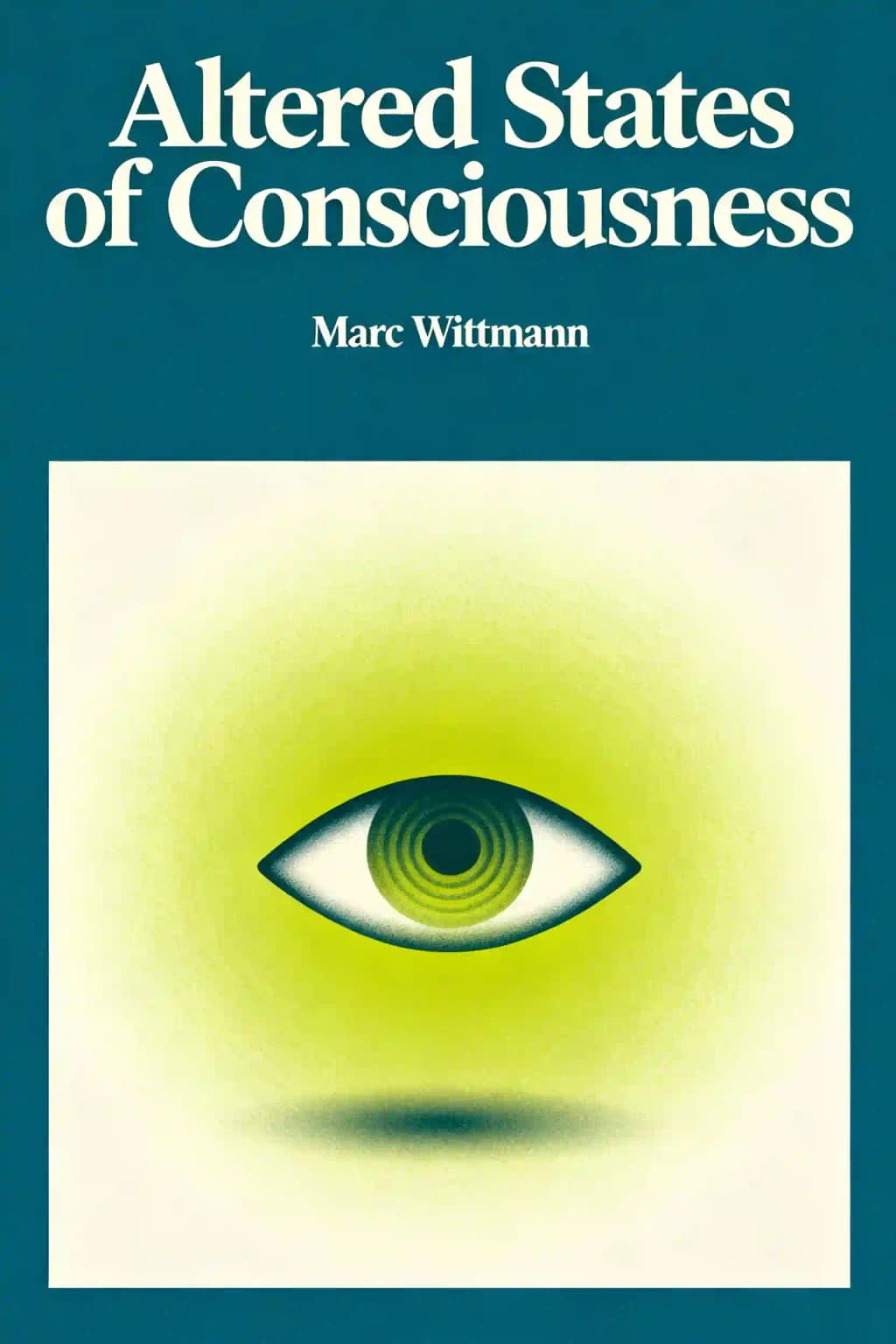
Have you ever woken up and, for a split second, had no idea who or where you were? This fleeting moment of pure awareness-consciousness without identity-offers a rare glimpse into the nature of our existence. Swedish poet Tomas Transtromer once described a similar experience as a "struggle in the hell of oblivion" before his identity returned "like an angel." These disorienting moments reveal something profound: while we may question the world around us, we rarely question our own existence. Yet in these brief gaps of memory, we experience only our "minimal self"-the basic feeling of existence without autobiographical knowledge. This phenomenon isn't just a curiosity; it's a doorway into understanding how consciousness, self-awareness, and time perception are fundamentally interconnected. Marc Wittmann's exploration of altered states of consciousness has become a cultural touchstone for those seeking to understand the nature of perception, with figures from neuroscientist Sam Harris to filmmaker Christopher Nolan citing its insights in their work.
第2章
When Time Slows Down: The Slow-Motion Effect of Fear
Time's elasticity becomes most apparent in moments of extreme emotion, a phenomenon that has fascinated researchers for decades. Laboratory studies consistently confirm that emotionally charged stimuli-whether negative like crying babies or positive like erotic images-are judged to last longer than neutral ones. Objects moving toward us are interpreted as potential threats and their duration overestimated compared to static or receding objects. This survival mechanism likely evolved to give our ancestors extra processing time when facing danger, allowing for more detailed analysis of threatening situations.
While controlled experiments can only produce marginal differences in time perception, real-life danger situations generate more dramatic effects. Researcher David Eagleman attempted to study this phenomenon by having subjects plunge from a 31-meter tower into a safety net. Though this generated genuine fear, the expected slow-motion effect couldn't be demonstrated through perceptual tests. However, subjects did estimate their own falls as lasting longer than the falls of others they observed afterward-suggesting time expansion may relate more to memory than real-time perception. Similar effects have been reported by car crash survivors, who frequently describe their accidents unfolding "in slow motion," with vivid recall of minute details.
The distinction between prospective and retrospective time judgments is crucial for understanding this phenomenon. The more powerfully experiences are remembered, the longer a past period seems in retrospect. Memory research confirms emotional events are remembered better and with more detailed precision, explaining why anxious skydivers experienced their first jumps as subjectively longer than subsequent ones. University studies showed horror movie clips were remembered as lasting longer than amusing or documentary clips of identical duration, with even stronger effects when subjects paid attention to their physical reactions-revealing how bodily awareness connects directly to time consciousness.
This time-stretching effect appears particularly pronounced in life-threatening situations. Combat veterans often report that moments of intense combat seemed to last far longer than they actually did. Mountain climbers who have experienced near-fatal falls describe being able to notice individual snowflakes and ice crystals during their descent. These accounts suggest that our perception of time is intimately linked to our survival instincts, with our brains recording threatening events in heightened detail, creating memories that seem to unfold at a slower pace when recalled later.
Research has also revealed that this temporal distortion isn't limited to negative experiences. Athletes in "the zone" report similar time-altering effects, where everything seems to slow down, allowing them to perform complex actions with extraordinary precision. This suggests that the phenomenon isn't solely tied to fear but may be related to states of intense focus and heightened awareness, regardless of the emotional valence of the experience.
第3章
Chemical Timescapes: How Drugs Transform Temporal Experience
Walter Benjamin's experiments with hashish in 1928 revealed profound alterations in time-space perception, leading him to declare "Versailles, for one who has taken hashish, is not too large, or eternity too long." His detailed accounts describe perceptual distortions where ordinary objects suddenly appeared enormous, faces seemed strangely familiar, and he experienced intense emotions alongside insatiable hunger.
Many writers and researchers-from Aldous Huxley and Charles Baudelaire to LSD discoverer Albert Hofmann-have documented how psychoactive substances dissolve the boundaries between subject and object, allowing reality to recede while revealing surprising new perspectives. The time expansion commonly reported with cannabis results from heightened sensory intensity and density of experience that impacts memory formation, creating time expansion both retrospectively (through vivid memories) and in the lived moment (especially during periods of waiting).
Different substances create distinctive temporal distortions. Alcohol produces the opposite effect of cannabis, making time pass more quickly by impeding memory storage and reducing concentration. Stimulants like cocaine and MDMA create experiences of time "racing"-users dance through entire nights without realizing how much time has passed. Amphetamines accelerate thought processes, causing overestimation of short intervals but making longer periods seem shorter in retrospect because experiences aren't stored sustainably as attention rapidly shifts between thoughts.
With powerful hallucinogens like LSD, psilocybin, and opium, time and space can completely dissolve. Thomas De Quincey's 1822 opium experiences described time expanding "far beyond the limits of any human experience"-feeling he'd lived 70-100 years in one night, sometimes experiencing sensations representing millennia. For addicts experiencing withdrawal, time perception becomes painfully distorted-time expands, making future events seem impossibly distant. This altered time perception makes it difficult to imagine a drug-free future, as the intensified present overwhelms long-term thinking.
第4章
Dissolving Boundaries: Mystical States and Oneness
Alterations in time consciousness are hallmarks of extraordinary states of consciousness. While dangerous situations and drug intoxication typically maintain linear time progression (though expanded or contracted), more profound states transform time entirely. In meditative contemplation, rhythm-induced trance, near-death experiences, and certain drug states, felt time progressively slows until reaching complete standstill. Linear time transforms into timelessness as perceived moments expand until future, present, and past merge into a unified "eternal" present.
These states of timelessness often coincide with the dissolution of physical and spatial boundaries, creating profound experiences of oneness with the universe accompanied by feelings of bliss. Medieval mystic Meister Eckhart captured this experience theologically: "In eternity there is no before and after... what God did a thousand years ago, what he will do in a thousand years' time and what he is doing now are all one."
According to philosopher Ernst Tugendhat, mysticism differs from religion in that religion provides wish projections related to one's self, while mysticism involves denying or relativizing one's will through renunciation. The mystic seeks peace of mind through liberation from desire, achieving calmness amid life's contingencies by abandoning self-love, physicality, and temporality.
The spiritual experience fundamentally involves merging with the whole-whether through dissolution into oneness or perceiving universal interconnection. This dissolution of the self-world boundary creates inner peace and empathy. As Kant observed, time and space are forms of intuition dependent on the self; without self-consciousness, time ceases to exist.
Mystical experiences aren't limited to spiritual masters. Ordinary people experience moments of timelessness through intense concentration, spontaneous clarity in nature, or profound connection with others-whether in family gatherings, romantic love, communal celebrations, or while absorbed in music.
第5章
At the Edge of Existence: Near-Death Experiences
Timelessness manifests in two distinct forms: either as the perception of time slowing to a complete standstill (creating a sense of eternity), or as time losing all relevance while still being perceptible. Near-death experiences represent perhaps the most extreme form of altered time perception. Peter Nadas vividly describes his own heart attack in "Own Death," detailing how conventional chronology completely lost meaning as his brain was deprived of oxygen. Despite the cessation of normal time perception, his consciousness remained active, experiencing what he called "timelessness reigning in the universe"-a cosmic experience where past and future became inseparable in "the immeasurable void of timelessness."
In this state, Nadas experienced extreme ecstasy beyond verbal description while simultaneously watching paramedics tend to his body. With time and space dissolved, he perceived his entire life in its totality, was drawn toward a distant light source, and observed medical procedures from an elevated position before eventually returning to normal consciousness.
Dutch cardiologist Pim van Lommel has documented hundreds of similar near-death experiences from cardiac arrest patients. These experiences share common elements: feelings of peace, out-of-body sensations, tunnel experiences with light, and sometimes encounters with deceased relatives. These profound experiences often transform individuals' relationship with death and life, making them less fearful and more spiritually attuned.
The scientific paradox of near-death experiences lies in their occurrence during periods of minimal or absent brain activity, challenging materialist conceptions that consciousness requires functioning neural activity. Some patients report verifiable details of medical procedures performed while they were clinically unconscious. The case of Pam Reynolds, who underwent a procedure requiring complete blood drainage from her brain yet reported detailed observations from her operation, exemplifies this scientific conundrum.
第6章
The Present Moment: Where Life Actually Happens
Experience exists only in the present moment-our immediate connection to reality. As Karl Jaspers wrote in 1919, "The moment is the only reality, the essential reality in intellectual life... the totality of the real, the only concrete thing." Rather than losing ourselves in past and future, we find existence and the absolute only in the moment, which can transcend ordinary time to become "the present of the eternal."
Yet modern life often reduces the moment to merely a stepping stone toward future goals. In our clock-watching, appointment-driven existence, we've forgotten how to experience the present, accelerating our perception of life's passage. As philosopher Byung-Chul Han observes, when solely focused on destinations, we empty the journey of meaning, turning life into "a corridor without any value of its own." This goal-fixation makes us try to eliminate the temporal interval itself, robbing the present of value.
A life fully lived consists of consciously experienced moments. Being present-attending fully to lived experience-not only enriches our immediate existence but expands life in retrospect through meaningful memories. The mystical conception sees the moment as transcending ordinary time altogether, dissolving the self into the whole.
As Wittgenstein wrote: "If we take eternity to mean not infinite temporal duration but timelessness, then eternal life belongs to those who live in the present." This present-focused attitude suggests there would be no death, since death is always a future event we cannot experience. Yet excessive present-orientation risks becoming mere impulsive hedonism. The ideal is temporal freedom-the ability to move flexibly between time orientations rather than being fixed in past, present, or future.
第7章
The Architecture of Now: How We Structure Time
The question of the moment's duration presents a fascinating challenge, requiring us to harmonize subjective first-person experience with objective third-person measurement. We can distinguish three different levels of present-time experience, each with varying durations, forming a nested hierarchy of temporal awareness.
Mental presence represents the longest duration (seconds to minutes), encompassing everything available to consciousness in working memory. This includes our narrative understanding of self, immediate memories, future plans, and ongoing thought processes. Research suggests a capacity of several seconds to perhaps half a minute, during which we can hold and manipulate complex thoughts and experiences. This corresponds with Husserl's phenomenological analysis of time consciousness with its three essential components: Urimpression (now-perception), retention (just-perceived elements), and protention (anticipation of what's coming). The brain constantly makes predictions to minimize surprise and energy consumption, creating a seamless experience of the present moment. This predictive processing helps us navigate social interactions, follow conversations, and maintain a coherent sense of self across time.
The experienced moment lasts a few seconds (approximately 300ms to 3 seconds). This is the window within which perception and action function optimally, creating what we might call the "psychological present." Events within this window are experienced as belonging to one unified moment. This temporal structure appears consistently across various domains: metronome beats automatically grouped in rhythms of two or three, visual alternations in bistable images like the Necker cube, and cross-cultural patterns in handshakes, greetings, and conversational turn-taking. Artist Karl Otto Gotz developed painting techniques explicitly utilizing this temporal structure, creating works in 3-4 seconds with three distinct subunits, demonstrating how artistic expression can align with fundamental cognitive rhythms. Similar patterns emerge in music, poetry, and dance across cultures, suggesting this temporal window may be a universal feature of human experience.
The functional moment represents the shortest duration (milliseconds: 30-300ms) and marks the lower temporal limit for conscious perception. Events occurring closer together than this threshold cannot be perceived in sequence - they blur into a single moment without discernible temporal order. This limitation shapes our experience of motion pictures, where individual frames presented faster than this threshold create the illusion of continuous movement. This fundamental constraint of consciousness affects everything from speech perception to musical appreciation, determining how we process rapid sequences of sensory information. Research in neuroscience has shown that this minimal temporal unit corresponds to basic neural processing cycles and may represent a fundamental building block of conscious experience.
These three temporal levels interact dynamically, creating our rich experience of the present moment while revealing the intricate architecture of temporal consciousness. Understanding these structures helps explain phenomena ranging from aesthetic appreciation to the nature of consciousness itself.
第8章
Mindful Time: Expanding Experience Through Attention
Heightened attention fundamentally alters our experience of time, creating a richer and more expansive sense of temporal awareness. Through systematic mindfulness practice, we develop sophisticated self-regulation of attention by anchoring ourselves in immediate bodily sensations, particularly the rhythm of breathing. This embodied awareness creates a stronger sense of presence in the here and now, allowing us to step out of automatic pilot and fully inhabit each moment.
Research demonstrates that meditation improves various components of attention even after relatively brief practice periods. These improvements include enhanced sustained attention (maintaining focus over extended periods), strengthened focused attention (effectively resisting both internal and external distractions), and expanded working memory capacity. In controlled studies, experienced meditators demonstrate remarkable control over their perceptual experience-when viewing ambiguous images like the Necker cube, they could maintain one perspective for almost 8 seconds compared to 6.2 seconds for non-meditators. This increased perceptual stability suggests an expanded and more stable experience of the present moment.
Neuroscience research reveals that mindful individuals experience greater temporal freedom across multiple dimensions. They demonstrate stronger present-moment focus while simultaneously showing reduced impulsivity in decision-making. Their enhanced temporal awareness leads to more effective future planning and significantly more accurate estimation of time durations. This mindfulness-induced temporal expansion operates through three primary mechanisms: heightened metacognitive awareness of time itself, increased interoceptive awareness of bodily states, and fuller engagement with emotional experience.
The effects of mindfulness on temporal experience extend beyond immediate perception into memory and retrospective time estimation. Regular meditators consistently perceive past time periods as having lasted longer than non-meditators do, reporting reduced time pressure in daily activities and a generally slower subjective passage of time. This expanded temporal experience correlates with increased activation in brain regions associated with present-moment awareness and reduced activity in areas linked to mind-wandering and temporal rushing.
For those who cultivate mindful awareness as a regular practice, life literally feels longer and fuller. This expanded temporal experience manifests in both immediate perception and long-term memory formation, creating a richer tapestry of lived experience. Studies of long-term practitioners show lasting changes in brain regions involved in attention regulation and time perception, suggesting that mindfulness can fundamentally reshape our relationship with time. This transformation extends beyond subjective experience to impact behavioral measures of time management, decision-making, and life satisfaction.
第9章
When Time Disappears: Awakening Beyond Self
In extreme altered states of consciousness, our perception of time undergoes radical transformation. Whether induced by hallucinogens like mescaline, LSD, or psilocybin, or occurring during near-death experiences, people report that time and space lose all meaning. These rare mystical experiences create a sensation of unity with the world while temporal and spatial boundaries dissolve. Such experiences provide crucial insights into self-consciousness formation, revealing the intimate connection between our awareness and our perception of time, space, and body.
Experienced meditators offer valuable insights into these states through neurophenomenological research. In one study, meditators with an average of 16.5 years' experience showed altered brain activity in the theta band during states where "time lost its linear form" or "time didn't exist." The path toward timelessness begins with concentration on the present moment.
According to meditation teacher Tilmann Lhundrup Borghardt, with 35 years of spiritual practice including 50,000 hours of meditation, "Timeless awareness during meditation is an awakening. It has neither beginning nor end." In this state, perception and perceiver become one-there is no observer, no self. This differs from mystical experiences where a self still experiences unity with the world. In true awakening, the duality between subject and object completely disappears, leaving only pure consciousness without center or borders.
The dissolution of the "center-self" reveals what Borghardt calls the "networked self"-our capacity for responsiveness, empathy and love without a fixed individual essence. This aligns with philosopher Thomas Metzinger's view that there is no static self, only a continuously created self-model. The path to awakening involves presence in the moment through "open awareness without controlling entities," focusing on "how" rather than "what" happens.
第10章
The Embodied Mind: How Body Creates Time and Self
The intricate relationship between physical sensations, emotions, and time perception has been validated by modern research. William James and Carl Lange had already proposed that emotions were grounded in physical reactions, and today we understand emotions are inseparable from bodily responses-from accelerated heartbeat to butterflies in the stomach. These physiological processes, regulated by the autonomous nervous system, are integral components of our emotional experiences.
Contemporary neuroscience embraces "embodiment"-the understanding that our mind isn't separate from our body but thoroughly body-bound. We think, feel, and act with our bodies in the world, with all experience embedded in our physical being. Brain researcher A.D. "Bud" Craig's work confirms that temporal experience depends on body signals, with the insular cortex gradually processing bodily information to create what he calls a "global emotional moment"-our sense of "how I feel now." Research shows activity in the insular cortex increasing during time estimation tasks, suggesting time is coded through accumulating body signals.
The consciousness of self-as both physical and emotional-is inextricably linked with time consciousness. As Maurice Merleau-Ponty wrote, "We must understand time as the subject and the subject as time." Unlike other senses with specific organs, time perception has no dedicated receptor. Rather, subjective time exists as a physically and emotionally felt wholeness of our entire self moving through time.
This relationship becomes starkly evident in boredom, when we're forced back upon ourselves in an unpleasantly intensive way. People prone to boredom experience time passing more slowly during monotonous activities. Depression manifests this relationship dramatically-depressives report time passing excruciatingly slowly, with hours feeling like days. They become temporally desynchronized from their social environment.
第11章
Windows Into Consciousness: From Disorder to Discovery
Through greater or lesser variations in consciousness we can learn much about the processes underpinning the self-conscious mind. For too long, extraordinary consciousness experiences were ignored or denigrated by mainstream science as nonexistent fantasies. Yet these experiences-whether mystical, meditative, drug-induced, hypnotic, or musical-produce extreme alterations in time, space, and self-perception.
Epileptic auras represent a neurological window into these extraordinary states. During epileptic seizures, clusters of neurons discharge simultaneously, sometimes confined to particular brain structures, producing unique perceptual impressions. Fyodor Dostoyevsky, who suffered from epilepsy, documented his ecstatic auras in novels and letters-brief moments before seizures that brought incredible feelings of happiness and meaning. Recent neurological studies using imaging technology have located these ecstatic auras in the anterior and central insular cortex. Patients report intensified physical and mental presence, heightened sensory impressions comparable to intense orgasms, harmonious unity with the world, and the dissolution of time and space.
Schizophrenia represents another profound disorder of self-experience, characterized by delusional thinking, auditory hallucinations, and a terrifying dissolution of self-boundaries. Recent research has developed promising objective methods to measure time consciousness in schizophrenic patients. Using computerized tests of temporal sequence recognition, researchers discovered that patients have an extended "now" moment-they need longer intervals between stimuli to experience them as temporally distinct, providing an objective correlate to patients' subjective reports of time standing still.
Today, a renaissance in hallucinogen research has emerged free from ideological battles. At Johns Hopkins University, Roland Griffiths has demonstrated that psilocybin can produce lasting positive personality changes, particularly increased "openness to new experiences," and can significantly reduce death anxiety in terminally ill patients. These benefits appear connected to mystical-type experiences characterized by feelings of oneness with the universe, timelessness, intense happiness, and perception of sacred truth.
Scientific dogmas rarely change through rational argument alone. They require emotionally affecting, life-changing experiences. As philosopher Thomas Nagel writes, understanding consciousness requires transcending self-created boundaries: "I believe that the methods needed to understand ourselves do not yet exist... nothing but radical speculation gives us a hope of coming up with any candidates for the truth." By synthesizing empirical findings across disciplines, we form a coherent picture of time consciousness and its relationship to self-consciousness-revealing that who we are and how we experience time are not separate questions, but aspects of the same fundamental mystery.