第1章
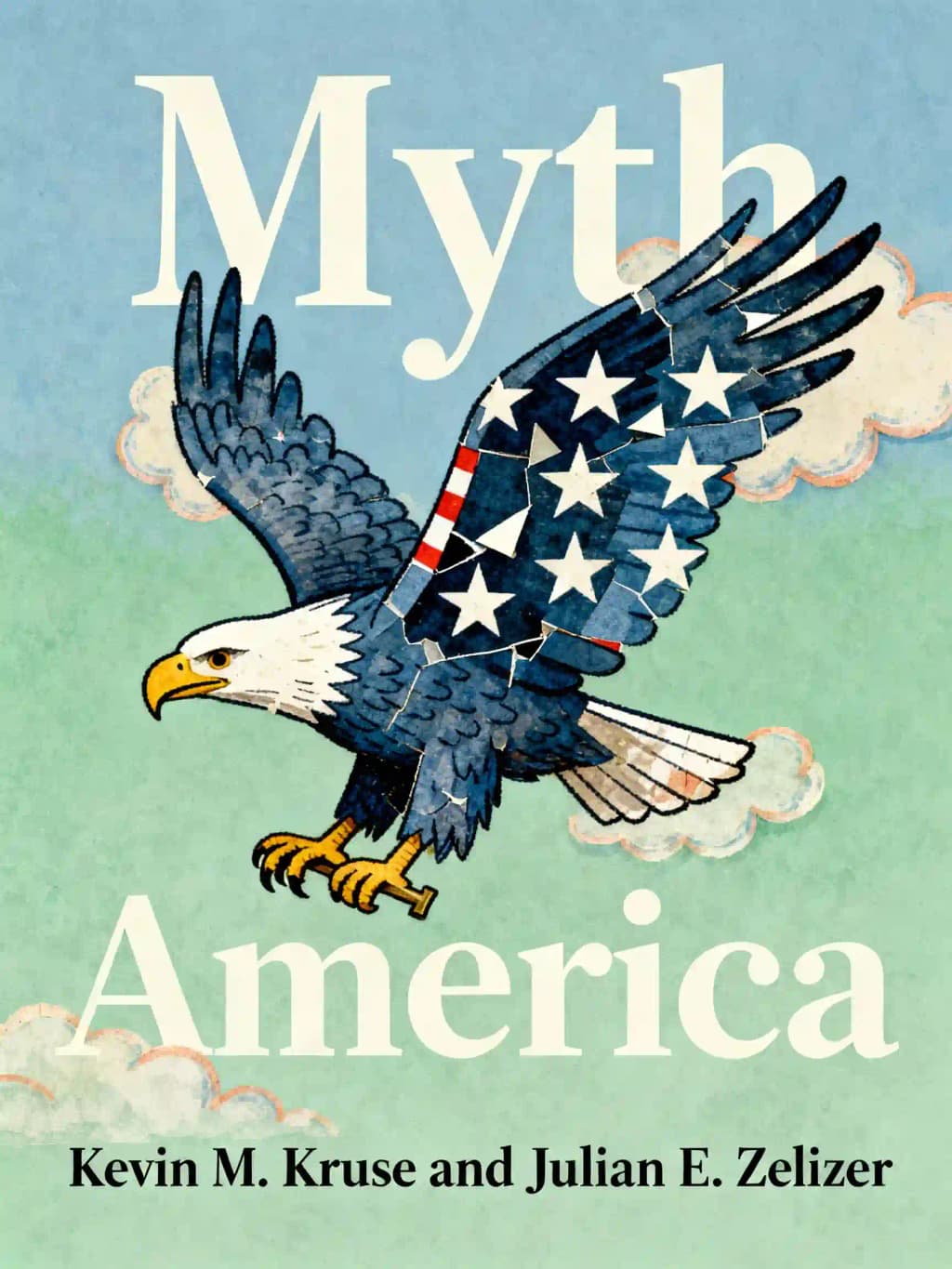
Rewriting America's Past: How Myth America Challenges Our National Narratives
Have you ever wondered why history feels like a battleground these days? Kevin M. Kruse and Julian E. Zelizer's "Myth America" couldn't be more timely. As misinformation floods our public discourse, this collection of essays by leading historians tackles the most persistent myths distorting American history. The book has become required reading in university history departments nationwide and has been praised by figures ranging from filmmaker Ken Burns to former President Barack Obama, who included it in his 2023 summer reading list. Its cultural impact extends beyond academia-the book sparked heated debates on cable news when several contributors appeared to challenge common historical misconceptions that have shaped contemporary political debates.
第2章
The War on Truth: How Historical Myths Shape Modern America
We live in an age where the line between fact and fiction has become dangerously blurred. While lies have always existed in public discourse, recent years have witnessed an unprecedented assault on objective truth, with misinformation flooding our national conversation through both traditional and social media channels. The Trump administration bears significant responsibility for this shift, having elevated "alternative facts" to mainstream discourse while systematically dismissing factual corrections as "fake news." Their war on truth reached its apex with the "big lie" about the 2020 election, a fabrication that not only fueled the January 6th Capitol insurrection but continues to undermine democratic institutions.
This deterioration of truth stems from two major developments that have fundamentally altered America's information landscape. First, the conservative media ecosystem has largely abandoned traditional objective journalism for a "narrowcast" model that prioritizes viewer engagement and ideological alignment over accuracy. Fox News, Newsmax, and similar outlets have created parallel information universes where facts become malleable tools serving predetermined narratives. Second, the Republican Party has undergone a dramatic transformation, embracing conspiracy theories and rejecting empirical evidence in favor of ideologically convenient alternatives. This shift represents a stark departure from the party's former self-image as clear-eyed realists and pragmatists.
History has become a primary battleground in this war on truth, with particularly intense conflicts erupting over how America's past should be understood and taught. The Trump administration's "1776 Commission" exemplified this trend, attempting to mandate a sanitized version of American history that downplayed slavery and racism while promoting nationalist mythology. Similarly, Republican-led state legislatures have launched coordinated efforts to block teaching of the 1619 Project and have deliberately mischaracterized critical race theory to justify censoring discussions of systemic racism in classrooms.
What makes today's battles fundamentally different from previous historical debates is the wholesale rejection of shared empirical reality. We're no longer simply arguing about which facts deserve emphasis or how to interpret evidence - we're witnessing the denial of basic documented facts themselves. This shift has been accelerated by amateur partisan historians who reverse-engineer historical narratives, starting with ideologically motivated conclusions and working backward to cherry-pick or manufacture supporting evidence. Social media has amplified these voices, allowing debunked claims to reach millions before fact-checkers can respond.
Professional historians have long worked to engage the public and combat historical misconceptions, from John Hope Franklin's groundbreaking work confronting segregation myths to social historians expanding historical narratives beyond traditional "Great Man history." Today, a new generation of historians is actively pushing back against misinformation through multiple channels - writing op-eds, appearing on news programs, maintaining active social media presences, and engaging directly with public audiences. This volume brings together twenty essays from leading scholars addressing some of the most persistent historical distortions in contemporary discourse, offering evidence-based corrections to popular misconceptions while examining how these myths gained traction in the first place.
第3章
American Exceptionalism: The Myth of National Superiority
"American exceptionalism" carries a double meaning that reveals more about our national psychology than our actual history. The term originated as an analytical concept suggesting the United States represented an exception to normal historical development patterns-initially a negative judgment implying America was failing to evolve properly along expected socioeconomic lines. More recently, it has morphed into a prescriptive, moralizing term in political discourse, referring to American superiority rather than mere difference, becoming a rhetorical tool wielded in debates about America's role in the world.
The concept makes little analytical sense when examined closely. Most nations can be considered "exceptional" in some way-scholars have identified French exceptionalism (based on revolutionary heritage), German exceptionalism (focused on cultural uniqueness), Chinese exceptionalism (centered on civilizational continuity), Serbian exceptionalism (rooted in historical martyrdom), and even Tunisian exceptionalism (emphasizing democratic transition). Few contemporary discussions of American exceptionalism demonstrate that America truly deviates from significant international norms, as doing so would require systematic comparison with other countries across multiple dimensions - political systems, economic development, social mobility, and cultural influence. Politicians who invoke the term rarely mention other nations except in the vaguest sense, avoiding substantive comparative analysis.
Ironically, "American exceptionalism" originated not in patriotic discourse but in communist debates of the 1920s. American communist leader Jay Lovestone, attempting to explain to Stalin's Comintern why communist revolution had failed to materialize in America, suggested American capitalism represented an "exception" to Marx's normal stages of historical development. Stalin forcefully condemned this as heretical "deviationism," viewing it as an excuse for American communists' failure to mobilize workers.
Between 1985 and 2010, "American exceptionalism" underwent a remarkable transformation, jumping from academic discourse to mainstream political rhetoric, with usage increasing 12-25 fold in media and political speeches. Newt Gingrich, strategically leveraging his academic background, became its chief promoter, making it central to his 1994 "Contract with America" campaign and later producing numerous books and documentary films on the subject. Gingrich effectively weaponized the concept against Democrats, portraying them as unpatriotic cosmopolitans who rejected fundamental American values and traditions.
The COVID-19 pandemic starkly challenged the myth of American exceptionalism, with the United States proving "exceptional" primarily in governmental incompetence, fragmented response, and widespread resistance to basic public health measures. America's death rate, testing delays, and vaccine distribution challenges contradicted claims of superior capabilities. Yet the concept's very vacuity has proven to be its strength-it functions as an empty vessel that can be filled with whatever content is politically expedient while flattering Americans' self-image as members of a chosen nation. This malleability helps explain its enduring appeal in political discourse despite its analytical weaknesses.
第4章
Founding Myths: Washington, Madison, and the Constitution's Creation
Those who misunderstand the Founding inevitably misread the Constitution. Contrary to popular belief, George Washington-not James Madison-was the true father of the Constitution. When the Philadelphia Convention met in 1787, Madison was relatively unknown, while Washington was universally revered as the hero of the Revolution. The Convention was Washington's, not Madison's-delegates unanimously made him their presiding officer, and a third were veterans of his Continental Army. His mere presence lent crucial legitimacy to the proceedings, and his silent leadership shaped the debates in profound ways.
The resulting Constitution reflected Washington's geostrategic vision of a strong, indivisible union capable of defending against European powers. Having witnessed the near-collapse of the Continental Army due to weak central authority, Washington advocated for robust federal powers. The Constitution's most distinctive element-an unprecedentedly powerful chief executive who could win independent election and reelection, wield veto and pardon powers, and command the military-was clearly designed with Washington in mind. The delegates created this role knowing he would be its first occupant, trusting his character to set proper precedents. Madison, by contrast, saw most of his pet projects defeated, including population-based Senate apportionment and congressional veto over state laws. His Virginia Plan was substantially modified, and key elements like proportional representation in both houses were rejected.
Another persistent myth claims the framers believed in "republics" but disdained "democracy." Despite certain language in Madison's Federalist No. 10, "republic" and "democracy" were more synonymous than oppositional in general 1780s discourse. Contemporary writings show that most founders used these terms interchangeably. The Anti-Federalists, who opposed the Constitution, often praised democracy, while Federalists sometimes criticized certain forms of it, but both sides fundamentally supported popular sovereignty. This is evidenced by the ratification process itself-the most democratic deed in human history up to that point, involving specially elected conventions in each state and unprecedented public debate.
Perhaps most dangerous is the myth that the Constitution was indeterminate on secession. This claim is demonstrably false. Washington's geostrategic Constitution categorically repudiated unilateral state secession, as demonstrated by both its text and contemporary understanding. The Federalist described the new plan as a "strict and indissoluble" union, using terms like "perpetual" and "permanent." Anti-Federalists highlighted this irreversibility in their opposition, while Federalists openly embraced it in their advocacy. The ratification debates in every state show that Americans everywhere understood exactly what they were agreeing to-an indissoluble union with no right to secede. This understanding was reinforced by the Constitution's explicit prohibition of state treaties and alliances, and its provision for federal suppression of domestic insurrections.
第5章
The Vanishing Indian: A Persistent American Myth
The myth of the "vanishing Indian" has persisted for centuries as settlers absolved themselves of guilt by portraying imperial violence as innocent virtue. Colonial narratives depicted Native disappearance as merely a milestone on the path to civilization. Founding figures like Supreme Court Justice Joseph Story embraced this view, claiming Indians were "destined to a slow, but sure extinction" by "a law of their nature."
After the War of 1812, the vanishing Indian myth spread widely, providing both explanation and exculpation for America's anti-Indigenous policies. By the 1820s, even the "Five Civilized Tribes" who had adopted Christianity, farming, and slaveholding were viewed as impediments to progress, leading to Andrew Jackson's 1830 removal policy, which he cynically framed as humanitarian intervention.
During the Civil War, as Republicans passed legislation expanding America's coast-to-coast empire, Native peoples fought fiercely for their sovereignty. In 1862, Dakota peoples launched a territorial counterrevolution in Minnesota, leading to federal retaliation and the largest public execution in American history-thirty-eight Dakotas hanged after Christmas. The 1864 Sand Creek Massacre saw Colorado volunteers slaughter over 150 peaceful Arapaho and Cheyenne people, mostly women, children, and elderly.
Federal officials were shocked when Indigenous people, supposedly destined to vanish, kept adapting and fighting. In 1876, just before America's centennial, Arapaho, Cheyenne, and Lakota warriors destroyed Custer's Seventh Cavalry. President Grant, who initially preferred peaceful relations with Native peoples, reversed course after Little Bighorn. The Indian Wars continued until federal troops massacred hundreds at Wounded Knee in response to the Ghost Dance religious revival.
Ironically, as the vanishing Indian myth became more deeply ingrained in American culture, federal treatment of Indigenous people improved somewhat. During the New Deal, FDR appointed John Collier as Commissioner of Indian Affairs, who crafted the Indian Reorganization Act of 1934, which reversed decades of assimilation policy to instead respect Native political and cultural sovereignty.
Despite ongoing challenges from settler colonialism, Native nations increasingly fought for recognition on their own terms. Dee Brown's "Bury My Heart at Wounded Knee," while sympathetic, inadvertently reinforced the vanishing Indian narrative. In response, Native writers pushed back against this legacy. Gerald Vizenor theorized "survivance," rejecting Brown's portrayal, while David Treuer's "The Heartbeat of Wounded Knee" explicitly rejected Brown's framing, insisting that Native "cultures are not dead" and "civilizations have not been destroyed."
第6章
America First: The Dark History of a Nationalist Slogan
When Donald Trump revived "America First" in 2016, supporters defended it as pragmatic nationalism divorced from its historical baggage. Critics, however, recognized its enduring ethno-nationalist dog whistle-the nativist idea that America belongs to those "here first," prioritizing some citizens over others.
Far from being a simple statement of patriotic self-interest, "America First" has consistently served as divisive code for internal power struggles, more about domestic bigotry than foreign policy. The phrase has always been entangled with conspiratorial thinking, from anti-Catholic paranoia of the 1850s to QAnon today.
America First originated not in the 1940s or even with Woodrow Wilson in 1915, but with the nativist American Party ("Know Nothings") of the 1850s. At an 1855 "American convention," a New York politician declared himself for "America first, last and always" while supporting restrictions on immigrant naturalization and prohibiting foreign-born citizens from holding office.
Throughout the late 19th century, "America First" expressed fears of Catholic and British conspiracies. By 1888, "America First, and the World Afterwards" had become a Republican campaign slogan protecting "industrial patriotism" against foreign interests.
When the America First Committee formed in 1940, the phrase carried a century of nativist, conspiratorial nationalism. Charles Lindbergh became its spokesman in 1941, delivering speeches with eugenicist arguments against intervention that were praised by Nazi press. After Pearl Harbor, "America First" rapidly fell into disrepute, suddenly denoting "un-American" fascist sympathies.
White supremacism remained intrinsic to the slogan. George Wallace supporters in 1968 praised his "America first, last, and all the time" stance. David Duke, notorious Klansman, has been associated with it since 1976. In 2000, Donald Trump briefly challenged Pat Buchanan for the Reform Party nomination, calling him a "Hitler lover" and rejecting David Duke as "a bigot." Yet by 2016, Trump himself ran on "America First," no longer repudiating the far-right.
After Trump's 2020 defeat, Republicans Matt Gaetz, Marjorie Taylor Greene, and Paul Gosar formed an "America First Caucus" partnering with Nicholas Fuentes, a Christian nationalist Holocaust denier with an "America First" program. Their platform endorsed "uniquely Anglo-Saxon political traditions" and opposed "mass immigration." Capitol insurrectionists on January 6, 2021, included "Women for America First" and Fuentes's "AF" flag-bearers.
第7章
The United States Is an Empire: Confronting Our Imperial Reality
In November 1999, George W. Bush claimed "America has never been an empire. We may be the only great power in history that had the chance, and refused." This denial of imperial status is a presidential tradition. Richard Nixon wrote that America is "the only great power without a history of imperialistic claims," while Bill Clinton declared "Americans never fought for empires, for territory, for dominance."
But this self-image contradicts historical reality. By the narrowest definition-a country with colonies-the United States has been and remains an empire.
The founders called their country "the United States of America"-more an ingredients list than a name. "United" meant a voluntary union, not an empire, and "states" meant self-governing entities, not colonies. Yet this name was immediately inaccurate. By the time Britain formally recognized American independence, eastern states had ceded their western territorial claims to the federal government. These lands weren't states but "territories," comprising around 45% of American land by 1791.
While the Northwest Ordinance of 1787 established a pathway for territories to become states, this process came with significant caveats. The federal government held absolute power over territories until statehood, which wasn't guaranteed-Congress rejected many proposed states. Population thresholds weren't binding, and territories averaged 45 years before becoming states. Oklahoma took over a century-longer than France held Indochina or Belgium held the Congo.
Moreover, the United States did engage in administrative colonialism abroad like its European rivals. In the 1850s, America began expanding overseas, claiming nearly 100 uninhabited Caribbean and Pacific islands. In 1898, it won three Spanish colonies (Puerto Rico, Guam, and the Philippines) through war while annexing Hawai'i and American Samoa.
Colonial rule often met violent resistance, particularly in the Philippines. After initially supporting Filipino nationalists against Spain, the United States turned against them once Spain surrendered. The resulting Philippine-American War (1899-1902) killed 775,000 Filipinos by 1903, mostly from disease-bloodier than the US Civil War.
This empire continues today. The Philippines gained independence in 1946, and Hawai'i and Alaska became states in 1959. But Puerto Rico, Guam, US Virgin Islands, American Samoa, and the Northern Mariana Islands remain unincorporated territories containing over 3.6 million people who cannot vote for president, have no voting representatives in Congress, lack full constitutional protection, and are poorer than the poorest US state.
第8章
The Myth of the Border: Beyond Immigration Politics
During the twentieth century, the US-Mexico border and undocumented immigration became synonymous for many Americans. Our national immigration debates focus almost exclusively on the border, with media showing migrants in detention centers, wrapped in Mylar blankets, or peering through border wall slats. These powerful images dominate news cycles and social media, creating an oversimplified narrative of crisis and conflict. Both political sides use these border images to support their arguments-the left emphasizing immigrant rights, humanitarian concerns, and US responsibility for migration pressures through past interventions in Latin America, while conservatives portray the border as our "soft underbelly" exposing America to various threats including drug trafficking, terrorism, and economic strain.
Both perspectives perpetuate the myth that undocumented immigration and the border are inextricably linked. They obscure a deeper truth: while the border is portrayed as a place of danger, dysfunction, and illegality, it is even more a place of creativity, community, cooperation, and connection-and has been for nearly two centuries. This reality is evident in the vibrant art scenes, shared cultural festivals, and thriving binational business partnerships that characterize border communities.
The borderland existed as a unified ecological and cultural space long before modern political boundaries. Indigenous peoples inhabited this region for centuries before European arrival, with groups like the Apache, Yaqui, Kickapoo, and Tohono O'odham later finding their communities divided by the new border. These nations developed sophisticated trading networks and cultural exchanges that spanned thousands of miles, creating a rich tapestry of interconnected societies that persists today.
The modern border emerged through violent conquest. The US-instigated war of 1846 resulted in the 1848 Treaty of Guadalupe Hidalgo, which annexed half of Mexico's territory and instantly made tens of thousands of Mexicans into US citizens. This arbitrary line cut through ranches, villages, and sacred sites, forcing families to choose sides or maintain connections across an increasingly militarized boundary. Despite this new boundary, Indigenous peoples continued crossing freely between their communities until gradually becoming alienated from one another through different national experiences and government policies.
Despite increasing border militarization, the US-Mexico borderland has maintained its character as a zone of cultural exchange and economic interdependence. Border cities grew dramatically between 1940-1960, developing diverse populations and cross-cultural celebrations like the Fiesta de las Flores in El Paso and the Feria Binacional in Nogales. Residents of twin cities like El Paso-Ciudad Juarez or San Diego-Tijuana lived transnational lives, with businesses on both sides thriving from cross-border commerce, creating unique hybrid cultures that blend American and Mexican influences in food, music, language, and daily life.
The borderland reality extends far beyond immigration concerns: over 15 million people live within 62.5 miles of the US-Mexico border, with millions crossing legally each year for education, work, shopping, and family visits. The economic interdependence is significant, with Mexico being America's second-largest trading partner at $47.5 billion in monthly trade. This includes crucial supply chains in automotive manufacturing, agriculture, and technology sectors. Border communities have developed sophisticated systems for managing this massive flow of people and goods, from special commuter lanes to binational emergency response protocols, demonstrating that cooperation, not conflict, is the true hallmark of border life.
第9章
American Socialism: A Forgotten Legacy of Reform
Despite Donald Trump's 2019 declaration that "America will never be a socialist country," socialism has a long and influential history in the United States. In 1825, Welsh manufacturer Robert Owen addressed joint sessions of Congress, proposing a "New System of Society" based on "strict justice and impartial kindness" rather than competition. His ideas received respectful attention from Supreme Court justices and multiple presidents.
Throughout American history, socialist movements have advocated for reforms now considered mainstream: women's suffrage, Medicare, minimum wage laws, workplace safety regulations, and civil rights. In 1912, Oklahoma's Socialist Party was remarkably strong, with one-sixth of state voters supporting Eugene Debs for president and six socialists serving in the state legislature. Many prominent Americans have embraced socialism, including Ralph Waldo Emerson, W.E.B. Du Bois, Helen Keller, Ernest Hemingway, Albert Einstein, and even Martin Luther King Jr., who advocated for "democratic socialism" with better wealth distribution.
Despite individual socialists gaining popularity and thousands winning local offices in the early 20th century, socialist parties struggled in national elections. Only two Socialists ever won seats in the House of Representatives, and none came close to the Senate or state executive offices. Eugene Debs, despite his charisma, never exceeded 6% of the presidential vote.
Throughout American history, socialists have worked to force elites to reform the existing order, but paradoxically, their success often limited socialism's growth as politicians co-opted their ideas. During the Progressive Era, both major parties shifted left to neutralize the socialist threat. Democrat William Jennings Bryan praised European public ownership models, while Republican Theodore Roosevelt promoted corporate regulation despite despising radicals.
Socialists played crucial roles in movements that shaped the New Deal. General strikes led by radicals in 1934 helped pass the National Labor Relations Act. Socialist artists created historical murals through the WPA that still adorn public buildings. The enduring Social Security Act built on European pension models, though Socialist congressman Victor Berger had introduced the first federal elderly pension bill years earlier.
Since the 2008-2009 recession, socialism has experienced a revival. The Democratic Socialists of America has grown tenfold to nearly 100,000 members. Bernie Sanders ran competitive presidential campaigns and chairs the Senate Budget Committee. Over two-fifths of Americans, and a majority of young people, view socialism positively. By 2021, some 101 DSA members held office nationwide, including four members of Congress-double what the Socialist Party achieved a century earlier.