第1章
When Death Came Knocking on Valentine's Day
"How does it feel to know you have just been sentenced to death by Ayatollah Khomeini?" The BBC reporter's name would forever escape him, but her question on that Valentine's Day in 1989 would forever change Salman Rushdie's life. "It doesn't feel good," he replied simply, thinking to himself, "I'm a dead man." With those words, one of the most extraordinary sagas in literary history began - a novelist forced underground for over a decade, protected by armed guards while his very existence became a symbol in a global conflict between religious extremism and freedom of expression.
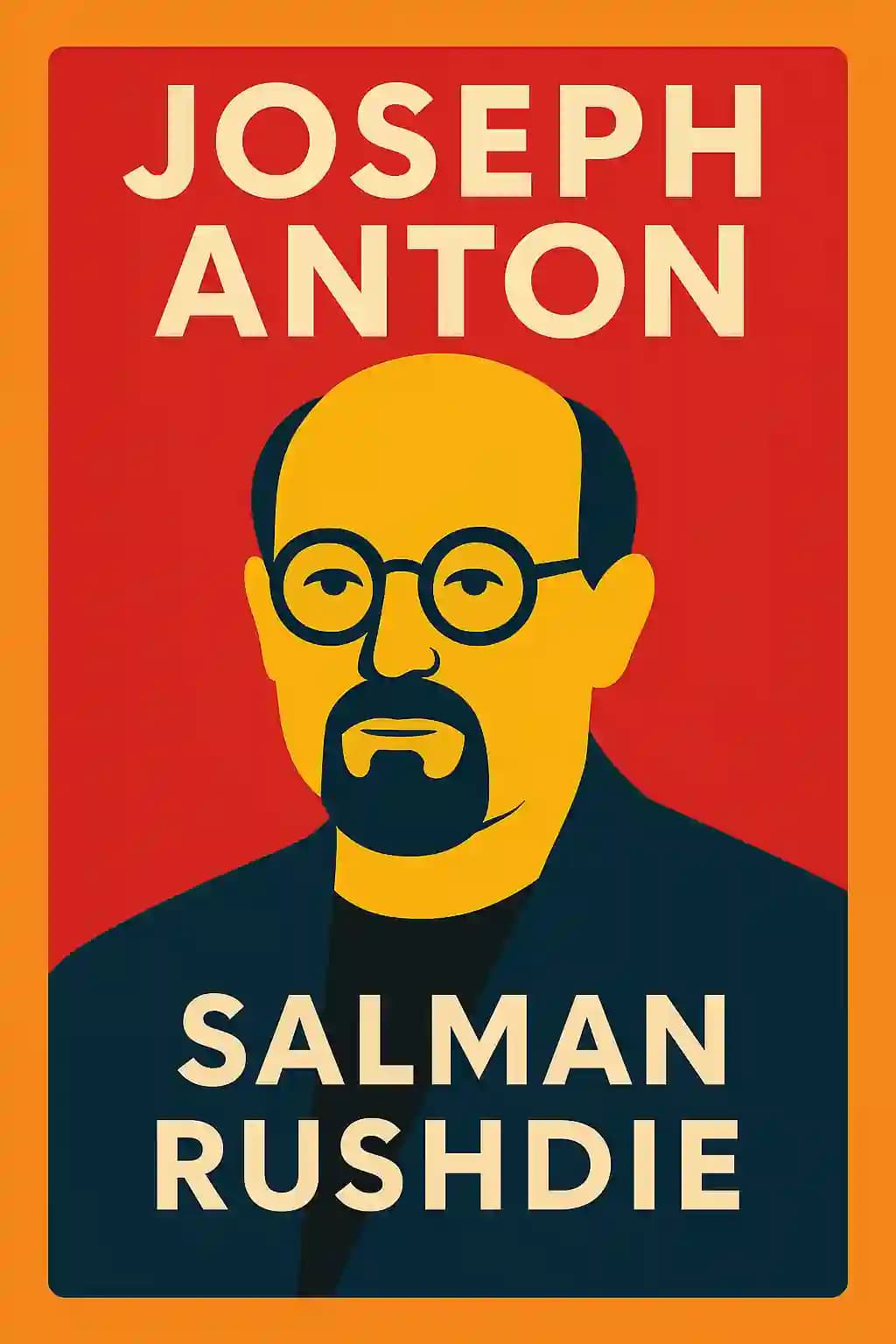
"Joseph Anton: A Memoir" chronicles this astonishing journey from Rushdie's perspective. The book's title comes from his chosen alias during his years in hiding - a combination of Joseph Conrad and Anton Chekhov. Named one of Time magazine's 100 most influential books since 1923, this memoir has been praised by Christopher Hitchens as "a triumph of literature over politics." Remarkably, despite the gravity of its subject, the book maintains Rushdie's characteristic wit and literary flair, offering readers both a political thriller and a deeply personal account of a writer determined to reclaim his life and identity.
第2章
The Birth of a Controversial Masterpiece
The Satanic Verses began taking shape as fragments coalesced around migration and transformation - themes deeply personal to Rushdie as an Indian-born writer living in Britain. The novel's genesis came from disparate elements: Shia pilgrims drowning in the Arabian Sea, reimagined with Sunni Indians and a female mystic from a fictional town where butterflies swarmed around a massive banyan tree; immigrant London in Thatcher's era transformed into "Brickhall," a fusion of Southall, Brick Lane and Brixton; characters inspired by people in his own life, including his partner Clarissa who became "Pamela Lovelace."
Flying over India, Rushdie noted how an Indian politician's mispronunciation of "Mrs. Thatcher" as "Mrs. Torture" might provide comic relief in his narrative. He wrote that migration "puts into crisis everything about identity and selfhood and culture and belief," so his novel "must perform the crisis it describes." The book would feature angels and devils whose roles might blur, with compassion for Lucifer, "confined to a vagabond, wandering, unsettled condition" like all exiles and migrants torn from their homes.
The novel's opening scene came to him a year later when Air India Flight 182 was destroyed by Sikh terrorists, killing 329 people including his childhood friend Neelam Nath. This tragedy inspired the beginning where Gibreel Farishta and Saladin Chamcha survive their plane's destruction by terrorists and land on an English beach.
The book took over four years to write - hardly the quick "insult" his opponents later claimed it to be. After two novels directly engaging with Indian subcontinent history, Rushdie saw this as a more personal, interior exploration of migration and metamorphosis - his least political book. He believed his treatment of the Prophet was essentially admiring, showing him as a man of his time who overcame temptation. The novel's Prophet wasn't called Muhammad, didn't live in Mecca, and created a religion not quite called Islam - appearing only in dream sequences of a man losing his faith. These distancing devices seemed to him clear indicators of fiction; to opponents, they were merely transparent concealment.
第3章
From Literary Celebration to Global Crisis
When The Satanic Verses was published in London on September 26, 1988, it briefly existed as merely a literary event, discussed in the language of books. Victoria Glendinning called it "better than Midnight's Children," Angela Carter praised it as "sometimes hilarious, extraordinary," while others like Claire Tomalin and Hermione Lee were more critical. But soon literary discourse would be drowned by political and religious outrage, as the real book vanished beneath an imaginary one that supposedly insulted Islam.
The first sign of trouble came when Madhu Jain of India Today, seeing the proofs, demanded to publish an extract. The magazine's misleading headlines - "AN UNEQUIVOCAL ATTACK ON RELIGIOUS FUNDAMENTALISM" and "MY THEME IS FANATICISM" - misrepresented the work and invited controversy. Indian parliamentarian Syed Shahabuddin responded with an "open letter" titled "You Did This with Satanic Forethought, Mr. Rushdie," beginning the demonization campaign that would create "Satan Rushdy." Breaking the publication embargo allowed critics to attack a book nobody in India could yet read or defend.
On October 6, 1988, Rushdie's friend Salman Haidar, India's deputy high commissioner in London, informed him that The Satanic Verses had been banned in India. Despite India's proclaimed secularism, Rajiv Gandhi's weak government had surrendered to pressure from two opposition Muslim MPs. The ban came from the Finance Ministry under the Customs Act, which bizarrely stated the ban "did not detract from the literary and artistic merit" of his work.
Rushdie responded with an angry open letter to Prime Minister Gandhi, asking "What sort of India do you wish to govern? Is it to be an open or a repressive society?" The day after its publication on October 9, the first death threat arrived at Viking Penguin.
By late 1988, prominent Islamic figures like Gad el-Haq Ali Gad el-Haq of al-Azhar University condemned the book, calling for legal action. In January 1989, protesters in Bradford burned his book - nailing it to wood before setting it aflame. The all-male crowd carried signs reading "RUSHDIE STINKS" while Bradford councilor Mohammad Ajeeb proclaimed "Islam is peace." Watching the footage later, Rushdie thought of Heinrich Heine's prophetic line: "Where they burn books they will in the end burn people too."
第4章
The Fatwa and a Life Underground
The burning of his book in Yorkshire ignited Rushdie's anger. "How fragile civilization is," he wrote in the Observer, "how easily, how merrily a book burns!" While some allies emerged-Aziz al-Azmeh, Gita Sahgal and her Women Against Fundamentalism-many Labour parliamentarians sided with Muslim protesters. W.H. Smith removed the book from all 430 stores.
Then on Valentine's Day 1989, a fatwa was issued against Rushdie by Iran's dying leader Ayatollah Khomeini, delivered as a simple typewritten sheet to Iranian television. The threat was classified "level two"-making him the most endangered person in Britain after the queen. Rushdie was immediately placed under police protection, given an armored Jaguar so tank-heavy it consumed six miles per gallon with doors so heavy they could injure if they swung shut.
Neither his son Zafar nor his former partner Clarissa received police protection, as they weren't considered targets. Still, fear for them preyed on Rushdie daily. His sister Sameen analyzed the fatwa as Khomeini's attempt to regain political momentum after the failed Iraq war. She offered to publicly counter the self-appointed Muslim "leaders" exploiting the situation, but he asked her not to, fearing for her young daughter Maya's safety.
At the Lygon Arms hotel, Rushdie was given a panic button that didn't work. Police presented him with a craven apology statement, hinting it was required for continued protection. His compromise statement expressing regret for distress but not apologizing for the book was rejected by both British Muslims and Iranian leadership. Meanwhile, he learned he must find his own safe accommodations, contrary to public belief about government "safe houses." Friends like Deborah Rogers and Michael Berkeley offered refuge at their Welsh farm, where he experienced the humiliation of hiding from a farmer - feeling deeply ashamed in a culture where honor mattered greatly.
第5章
The Trap of Wanting to Be Loved
In a desperate attempt to resolve the crisis, Rushdie agreed to meet with six Muslim "worthies" at Paddington Green. Instead of a roundtable discussion, they had arranged the room like a courtroom tribunal with him in a single chair facing their judgment. Though he should have left immediately, he was guided zombie-like to the empty chair.
Their demands escalated quickly - he should distance himself from his characters' statements, suspend the paperback edition, and ultimately recite the shahadah to prove his sincerity. When he mentioned a "secular Muslim identity," they recoiled at the word "secular." They presented a crude document for him to sign, which he revised while trembling with misery, seduced by their promises that the quarrel might end.
After signing, he was whisked away to press conferences and interviews, but inside he was castigating himself: "You are a liar and a coward and a fool." His sister Sameen called, shouting "Have you taken leave of your senses?" He had compromised his integrity - until now he could defend every word he'd written, but he had committed a crime against himself.
The agreement quickly unraveled - while the grand sheikh of al-Azhar initially supported him, Iran remained intransigent. Khamenei declared the fatwa would remain "even if Rushdie became the most pious man of all time." The Paddington Six began backing away from their promises under pressure, and Rushdie received warnings of "a specific threat" that had increased the danger.
He had fallen into "the trap of wanting to be loved" and made himself "foolish and weak."
第6章
America: Champion of Free Speech
While Britain's government seemed ambivalent about Rushdie's plight, America offered a dramatically different reception. At the Senate, Senator Daniel Patrick Moynihan took charge, proposing that he and Senator Leahy draft a resolution of support. The senators even brought copies of his earlier books for signing. They led him to an antechamber where journalists and photographers waited for a press conference.
There he stood at the heart of American power with senators behind him like a backup group, all holding copies of the paperback. He spoke about the larger war against intellectual freedoms across the Muslim world while Moynihan declared it an honor to stand beside him-a stark contrast to British politicians' attitudes.
Bob Woodward arranged tea with Katherine Graham, owner of The Washington Post. Though Mrs. Graham spoke little, her presence signaled support. The Post journalists questioned him extensively, with Graham only commenting that the Bush administration was "strange" with "few power centers." The New York Times soon published an editorial attacking the White House's hands-off approach, calling Western responses "shamefully squeamish" and arguing that Iran needed to see canceling the fatwa as in its self-interest.
Years later, Rushdie would meet President Clinton at the White House - a meeting that made front pages worldwide. Clinton got straight to business: "What can I do for you?" Rushdie had prepared for this moment: "Mr. President, when I leave the White House, I need to tell journalists that the United States is joining the campaign against the Iranian fatwa and supports progressive voices worldwide." Clinton nodded: "Yes, you can say that, because it's true." He mentioned their mutual friends - Styron, Mailer - and said the meeting was "intended to be a demonstration of American support for free speech."
第7章
Reclaiming the Writer's Life
After years of creative struggle under protection, Rushdie finally reconnected with his writing through vivid memories of Kerala, which sparked his novel The Moor's Last Sigh. Walking through Cochin's historic Jewtown district in his mind, he found himself drawn into the narrow lanes and spice-scented markets where the characters of Aurora Zogoiby and her son Moraes emerged, beckoning him into their richly imagined world. This creative breakthrough came despite the horrific violence that had engulfed literature itself-the shooting of his Norwegian publisher William Nygaard outside his Oslo home, the brutal stabbing of his Italian translator Ettore Capriolo in Milan, and the tragic murder of his Japanese translator Hitoshi Igarashi at a university near Tokyo. Against this backdrop of terror, Rushdie managed to rediscover his creative sanctuary within the written word.
Reclaiming his disciplined writing practice proved more challenging than he anticipated. He forced himself back into his old routines with methodical determination-writing in his pajamas before even brushing his teeth, following Ernest Hemingway's famous dictum about applying "the seat of the pants to the seat of the chair." The process was slow but steadying. During this period, he completed his East, West story collection, which showcased his range as a writer. The collection included "Chekov and Zulu," a playful tale about Indian diplomats whose lives revolve around Star Trek mythology, "The Harmony of the Spheres," a haunting story inspired by a Cambridge friend's descent into mental illness and eventual suicide, and "The Courter," which masterfully wove together his beloved ayah Mary Menezes's profound homesickness with the poignant story of a chess-playing janitor who finds connection in an alien land.
Freedom, when it finally came, arrived unexpectedly through a carefully arranged family escape to America. After a brief holiday in Scotland, he took an circuitous route via Oslo to New York, where-remarkably-no protection was offered or required. The sensation of anonymity was intoxicating, prompting repeated exclamations of "Freedom! Freedom!" as he experienced New York with fresh eyes, helicoptering around Manhattan's iconic skyline, cruising in a rented Lincoln Town Car, and enjoying unrestricted visits with literary friends like Paul Auster and Susan Sontag. Traveling with his fifteen-year-old son Zafar and his partner Elizabeth, they created a tapestry of normal family moments: staying with Vietnam War chronicler Michael Herr and his wife Valerie in upstate New York, visiting short story master Tobias Wolff, and later spending time with novelist John Irving at his Vermont home. Simple pleasures that had been denied them for years-state fairs with their carnival rides and cotton candy, public swimming pools, crowded beaches-brought them to near ecstasy. When the spell finally broke and they returned to England's security apparatus, the contrast was stark. America had given him a precious taste of liberty, and like any addict sampling freedom after long deprivation, he immediately began planning how to secure his next fix of normalcy.
第8章
Personal Losses Amid Public Battles
While fighting for his freedom and creative life, Rushdie faced devastating personal losses. His father Anis died of bone marrow cancer in Pakistan in 1987. Standing in his father's grave, placing his hand under the shrouded head, was a moment of immense power. He felt sad that his father, a cultured man from Old Delhi who had been happy in Bombay, ended his days disappointed in a place that never felt like his. In the years that followed, Anis visited his son's dreams monthly, always affectionate and wise - their relationship after death improving on what it had been in life.
Even more devastating was the loss of Clarissa, his first wife and mother of his son Zafar, to cancer that had been misdiagnosed by her GP. Rushdie had to tell his devastated son the grim news that his mother was dying rapidly. The cancer had spread to her lungs and bones, and despite Zafar's desperate internet searches for miracle treatments, the consultant confirmed she had very few days left.
In a heartbreaking moment, Clarissa briefly regained consciousness, looked at Rushdie with terror and asked, "I'm not dying, am I?" He lied to comfort her, saying "you're just resting," a decision he would question for the rest of his life. Rushdie and Zafar briefly left to rest, but while they were away, Clarissa passed. They rushed back to the hospital, with Zafar weeping in his arms the entire journey.
At the hospital, Zafar could not bear to look at his mother's body, saying "That's not my mother," while Rushdie sat with her through the night, talking about their long love and thanking her for their son. Clarissa was cremated on November 13, 1999, with over two hundred mourners gathering at Golders Green crematorium.
第9章
Rebuilding a Life in Freedom
Rushdie's strategy of "boring India into submission" through repeated visits proved effective. During a trip with his son Zafar, he reflected that habituation is key to normality-"'Rushdie returns again' wasn't much of a news story. And the third-'Oh, here he is once more'-barely sounded like news at all."
Despite security concerns and nervous protectors, Rushdie found the British officials in India deliberately distant-the British Council head refused him use of their auditorium, and the high commissioner stayed away on Foreign Office instructions.
What followed instead was an outpouring of joy and acceptance. At the Commonwealth Writers' Prize reception, journalists, friends, and literary figures embraced Rushdie. Nayantara Sahgal clasped his hands and whispered, "Welcome home." The media celebrated with headlines like "RUSHDIE IN INDIA: THERE IS ONLY JOY, LOTS OF JOY," with calls across publications to reconsider the ban on The Satanic Verses.
In America, Rushdie embraced Los Angeles with the wide-eyed wonder of a film fanatic rather than the cynicism one might expect from someone raised in Bombay, another movie capital. He delighted in exploring the city's iconic locations and cinematic history. Living with his new partner Padma Lakshmi in her West Hollywood apartment, he savored his newfound freedom, particularly the simple pleasure of driving after years of restriction.
As a newly arrived literary celebrity, Rushdie briefly became Hollywood's "flavor of the month." Director Michael Mann discussed a potential border film project, Will Smith shared stories about Muhammad Ali, and producer Brian Grazer proposed a biographical movie-which Rushdie declined, preferring to tell his story in book form first.
第10章
September 11 and a Changed World
Rushdie's novel Fury was officially published on September 11, 2001-a date that instantly transformed his ultracontemporary New York satire into a historical novel about a vanished golden age. The book, which celebrated the city's vibrant energy and limitless possibilities, became an unintended elegy for pre-9/11 New York. As Garry Trudeau's Doonesbury character would poignantly lament, "I really miss September 10th," capturing the collective nostalgia for that final day of perceived innocence.
After two weeks of processing the profound shock that gripped the city, Rushdie finally broke his silence with a powerful meditation on values and resistance. "The fundamentalist believes that we believe in nothing... To prove him wrong, we must first know that he is wrong. We must agree on what matters: kissing in public places, bacon sandwiches, disagreement, cutting-edge fashion, literature, generosity... How to defeat terrorism? Don't be terrorized." His words became a manifesto for defending secular pluralism against fundamentalist attacks on freedom.
He walked New York's transformed streets that eerily beautiful fall, documenting the city's gradual resurrection from trauma. The acrid smell of Ground Zero lingered for months, while makeshift memorials appeared on street corners and in fire stations. Yet amid the grief, he observed signs of resilience - the return of street vendors, the resumption of Broadway shows, and most tellingly, when people began growing angry rather than frightened about Brooklyn Bridge closures. That's when he knew the defiant "I'm-walking-here" New York spirit he loved was getting its groove back.
Rushdie made a conscious choice to reject anger after 9/11, drawing on his own experience with religious extremism to understand that rage makes you the creature of those who enrage you. Instead, he doubled down on his belief in universal human rights and secular ethics, standing firmly against both religious relativism and its Western apologists who suggested some cultures weren't "ready" for democracy or equal rights. Literature, he insisted, had always known what we were now tragically forgetting: that human identity is heterogeneous and multiple, not narrow and singular. While extremists pushed people toward tribal affiliations and conflict, great writing did the opposite - it pushed boundaries, crossed borders, and made the world feel larger and more interconnected. Through his essays and public appearances in this period, Rushdie became an important voice arguing that the best response to fundamentalism was not retreat into simplified identities, but an embrace of complexity, plurality, and the universal values of human rights.
第11章
The Final Message
Two days after attending the 2002 Oscars, Rushdie flew back to London where Nick Cottage, a genial Special Branch officer with an old-fashioned mustache, met him. He informed Rushdie that one of the higher-ups, Bob Sait, wanted to see him the next morning, adding mysteriously, "If I were you, I'd make your own arrangements for later in the day." He refused to explain further, offering only an enigmatic secret policeman's smile.
Rushdie stayed at the Halcyon Hotel in Holland Park while waiting to move into a new rental in Colville Mews. The next morning, Bob Sait and Nick Cottage delivered the news he had long awaited: the threat level had been drastically reduced. The protection was being withdrawn. After thirteen years, they simply shook his hand, turned, and walked out of his life with startling abruptness.
They later threw a party at the Yard where Rab Connolly, who had completed a degree in postcolonial literature during the protection, gave Rushdie the bullet that Mike Merrill had accidentally fired in the Bishop's Avenue house. Finally free, Rushdie walked out of the Halcyon Hotel and hailed a passing cab.
From his future vantage point, Rushdie witnessed his nieces flourish - Mishka's musical talent blossoming, Maya teaching children contentedly, Meena marrying. His sons Zafar and Milan grew into fine young men. He and Elizabeth found good terms again after their difficult divorce. Life continued, working out far better than he could have hoped on that dark Valentine's Day in 1989.
Not everything ended well - Robin Cook, the British foreign secretary who had helped resolve his case, died of a heart attack in the Scottish Highlands in August 2005. And Rushdie's relationship with Padma Lakshmi eventually ended after six tumultuous years.
But the most important victory was that Rushdie had survived, continued writing, and reclaimed his life. The battle over The Satanic Verses remained unresolved - neither the book nor he had been suppressed, but the dead remained dead, and a climate of fear made similar books harder to publish or even write. Yet Rushdie had returned to his essence as a storyteller, rededicating himself to the art that had claimed his heart, mind and spirit since youth - to live again in the universe of "once upon a time."