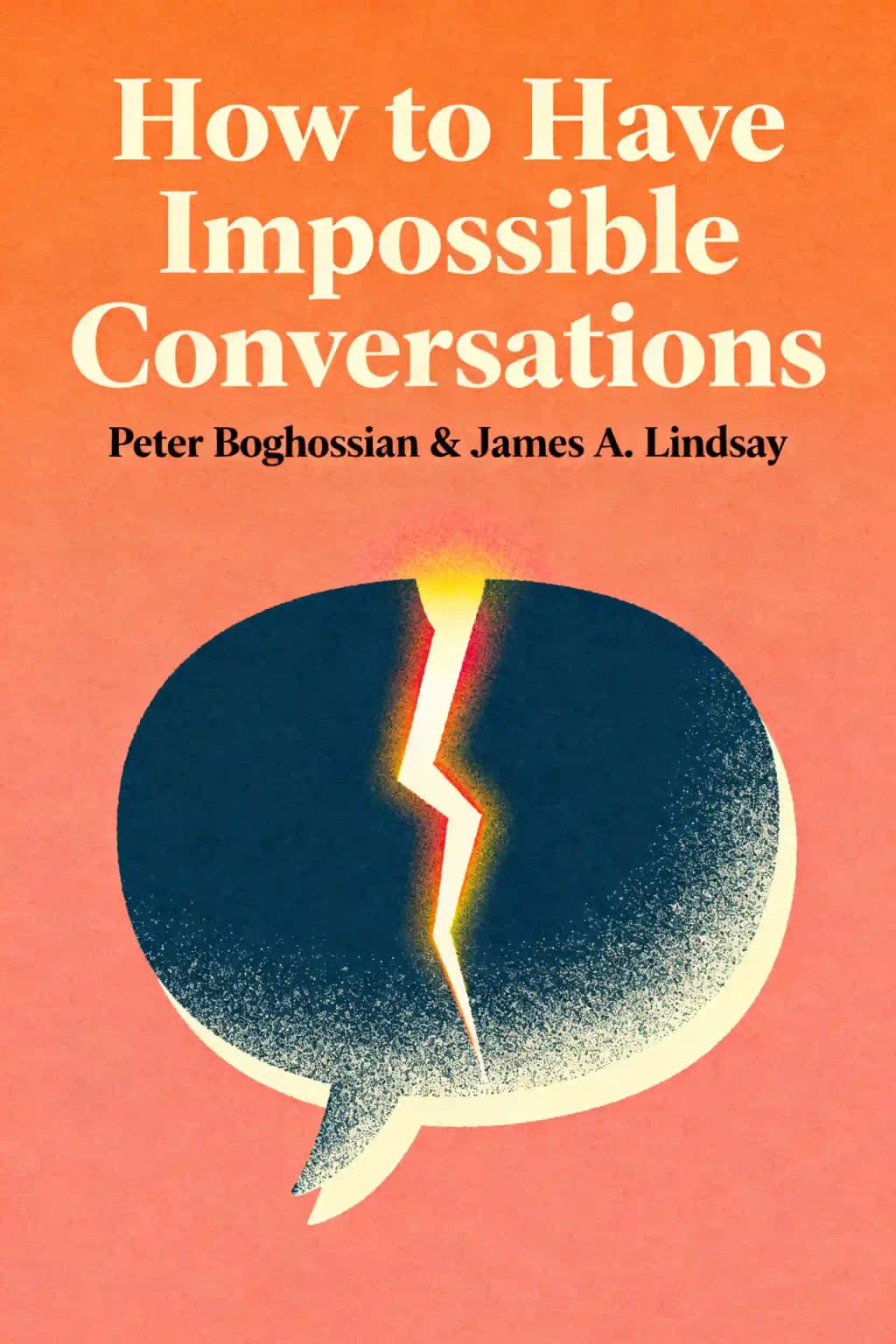
In a world where dialogue feels impossible, Boghossian's guide - endorsed by Richard Dawkins as "what everyone should read" - offers practical techniques for navigating polarized conversations. With a 4.26 Goodreads rating, it transforms conflict into understanding through epistemological approaches that make the impossible suddenly achievable.
Peter Boghossian and James A. Lindsay, authors of How to Have Impossible Conversations, are renowned critical thinking experts and bestselling authors who specialize in epistemology, cultural analysis, and constructive dialogue. Boghossian is a philosophy instructor, and Lindsay is a mathematician and founder of the New Discourses platform.
They combine academic rigor with real-world activism—most notably through their collaborative “Grievance Studies Affair,” which exposed methodological flaws in postmodern academic journals. Their book merges philosophical frameworks with practical communication strategies, offering tools to navigate polarized discussions on topics like identity politics and ideological differences.
Both authors co-wrote Cynical Theories, a critique of critical social justice theory, and Lindsay’s Race Marxism further examines ideological shifts in education and culture. Boghossian’s newsletter and Lindsay’s New Discourses podcast amplify their work bridging academic discourse and public debate.
Recognized for challenging ideological orthodoxy, their research has been cited in European Parliament testimonies and mainstream media. How to Have Impossible Conversations has become a staple in communication workshops and university courses, praised for its actionable approach to fostering empathy in contentious dialogues.
How to Have Impossible Conversations by Peter Boghossian and James Lindsay offers 36 evidence-based techniques to navigate polarized discussions on topics like politics, religion, and ideology. It focuses on building collaborative partnerships, asking probing questions, and understanding how people form beliefs (epistemology) rather than attacking conclusions. The methods draw from hostage negotiation, psychology, and philosophy to foster productive dialogue.
This book is ideal for anyone facing high-stakes conversations, including professionals in negotiations, educators, families navigating ideological divides, and individuals seeking to engage constructively in polarized settings. It’s particularly valuable for those aiming to bridge gaps without damaging relationships.
Yes, for its actionable strategies like rapport-building, epistemology-focused questioning, and de-escalation tactics. Critics note some methods may oversimplify complex dynamics, but the step-by-step frameworks (beginner to expert levels) provide tangible tools for improving discourse.
The authors emphasize asking how someone knows their claims (e.g., “What evidence would change your mind?”) instead of challenging beliefs directly. This approach, rooted in Street Epistemology, encourages critical self-reflection and reduces defensiveness.
Unlike conflict-resolution books focused on compromise, this guide prioritizes epistemic humility—helping others question their own beliefs. It shares similarities with Crucial Conversations but adds unique tools like “fishing for doubt” and Socratic questioning.
Critics argue some methods may oversimplify deeply entrenched ideologies or fail in asymmetric power dynamics. Others note the focus on individual conversations doesn’t address systemic issues driving polarization.
Use rapport-building to defuse tensions, ask clarifying questions (“How did you arrive at that conclusion?”), and reframe disagreements around shared goals. The “Listening Cycle” technique (paraphrase, validate, inquire) is particularly effective for managerial feedback.
Street Epistemology, developed by Boghossian, uses Socratic questioning to explore belief foundations. The book adapts this method for everyday conversations, teaching readers to gently expose flawed reasoning without confrontation—e.g., “How confident are you in that belief, and why?”
It advises acknowledging valid points in extremist views first (“Yes, I agree that…”), then introducing doubt via hypotheticals (“If X were true, would it change your perspective?”). The “Counterfactual Game” technique helps ideologues consider alternative scenarios.
Case studies include dialogues with creationists, political activists, and vaccine skeptics. For example, the authors demonstrate how asking a biblical literalist, “How do you distinguish metaphorical vs. literal scripture?” can prompt self-reflection.
著者の声を通じて本を感じる
知識を魅力的で例が豊富な洞察に変換
キーアイデアを瞬時にキャプチャして素早く学習
楽しく魅力的な方法で本を楽しむ
Winning guarantees failure.
Assume good intentions.
Deliver messages rarely works.
Make learning your primary goal.
Blame dissolves rapport.
『How to Have Impossible Conversations』の核心的なアイデアを分かりやすいポイントに分解し、革新的なチームがどのように創造、協力、成長するかを理解します。
『How to Have Impossible Conversations』を素早い記憶のヒントに凝縮し、率直さ、チームワーク、創造的な回復力の主要原則を強調します。

鮮やかなストーリーテリングを通じて『How to Have Impossible Conversations』を体験し、イノベーションのレッスンを記憶に残り、応用できる瞬間に変えます。
何でも質問し、声を選び、本当にあなたに響く洞察を一緒に作り出しましょう。

"Instead of endless scrolling, I just hit play on BeFreed. It saves me so much time."
"I never knew where to start with nonfiction—BeFreed’s book lists turned into podcasts gave me a clear path."
"Perfect balance between learning and entertainment. Finished ‘Thinking, Fast and Slow’ on my commute this week."
"Crazy how much I learned while walking the dog. BeFreed = small habits → big gains."
"Reading used to feel like a chore. Now it’s just part of my lifestyle."
"Feels effortless compared to reading. I’ve finished 6 books this month already."
"BeFreed turned my guilty doomscrolling into something that feels productive and inspiring."
"BeFreed turned my commute into learning time. 20-min podcasts are perfect for finishing books I never had time for."
"BeFreed replaced my podcast queue. Imagine Spotify for books — that’s it. 🙌"
"It is great for me to learn something from the book without reading it."
"The themed book list podcasts help me connect ideas across authors—like a guided audio journey."
"Makes me feel smarter every time before going to work"

How to Have Impossible Conversationsの要約をPDFまたはEPUBで無料でダウンロード。印刷やオフラインでいつでもお読みいただけます。
We've all been there-that moment when a casual conversation about politics or religion suddenly erupts into hostility. The air thickens, faces flush, and any hope for understanding evaporates. In our increasingly polarized society, meaningful dialogue across differences has become both rare and desperately needed. Drawing from diverse disciplines-from hostage negotiation to cognitive psychology-Peter Boghossian and James Lindsay offer a practical roadmap for navigating our most challenging conversations. Their approach has gained praise across the political spectrum precisely because it transcends partisan divides to focus on something more fundamental: how human minds connect, resist, and occasionally transform through conversation.