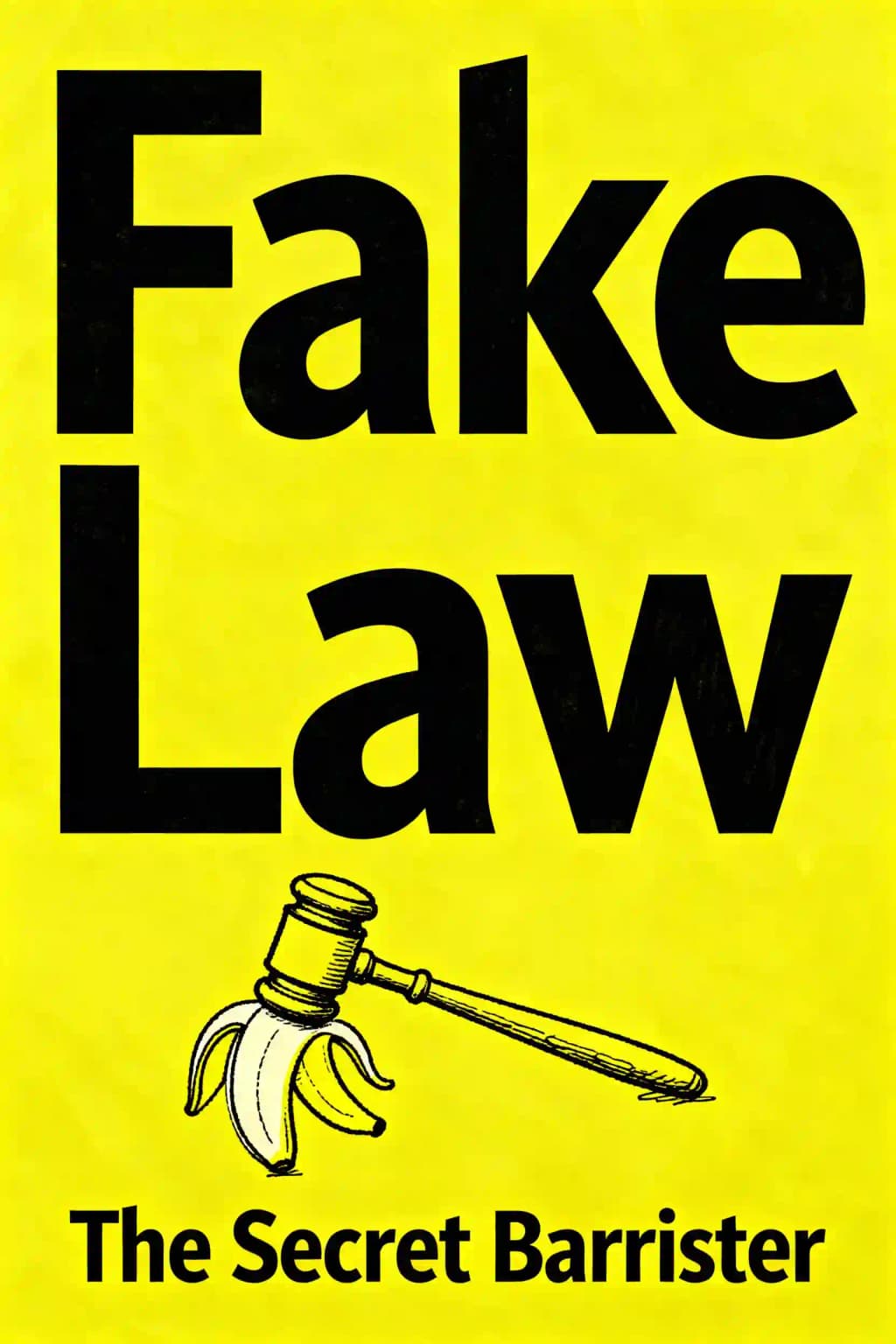
Unmasking legal deception: "Fake Law" reveals how media distorts justice, leaving citizens misinformed. Shortlisted for Parliamentary Book Awards, this eye-opening expose should be "required reading for law students" - and anyone who consumes news about courtroom drama.
The Secret Barrister, bestselling author of Fake Law and anonymous junior barrister specializing in criminal law, combines razor-sharp legal analysis with frontline courtroom experience to expose systemic flaws in England’s justice system. Their debut work, Stories of the Law and How It’s Broken (2018), spent 24 weeks in the Sunday Times Top 10 and won the Books Are My Bag Nonfiction Award, while Nothing But The Truth (2022) offers a revelatory memoir of legal practice.
A two-time Independent Blogger of the Year and 2018 Law Society Legal Personality of the Year, The Secret Barrister demystifies complex legal concepts through incisive commentary in The Guardian, The Times, and Channel 4’s documentary series Disordered Justice. Their writing dissects misinformation about rights, sentencing, and judicial processes, driven by firsthand encounters with underfunded courts and marginalized defendants.
All three of The Secret Barrister’s books became instant Sunday Times bestsellers, with Fake Law debuting at #2. Despite their anonymity—vigorously protected by 97% of surveyed barristers—their works have collectively sold over 300,000 copies, reshaping public debate about legal reform.
Fake Law exposes how media distortions and political narratives misrepresent the UK legal system, creating dangerous public misconceptions. The Secret Barrister debunks myths about "compensation culture," human rights laws, and judicial bias by contrasting sensationalized headlines with actual legal principles. Central themes include the manipulation of public opinion and threats to judicial independence, exemplified by high-profile cases like the 2019 prorogation controversy.
This book is essential for citizens concerned about media literacy, legal transparency, or democratic accountability. Law students, journalists, and policymakers will gain insights into systemic misinformation, while general readers benefit from its accessible explanations of complex legal issues. It’s particularly relevant for those seeking to critically evaluate news stories about courts, immigration, or personal injury claims.
Yes—Fake Law is a vital corrective to widespread legal misinformation, offering rigorously researched counterarguments to populist rhetoric. The Secret Barrister combines sharp analysis with dark humor, making intricate topics like judicial review and self-defense laws engaging. Its timeliness in an era of "fake news" and declining trust in institutions underscores its value.
The "Court of Public Opinion" symbolizes media and political campaigns that distort legal realities to煽动 outrage. Examples include misleading headlines about "lefty human rights lawyers" or exaggerated compensation claims. The book argues this fabricated narrative erodes trust in courts, enabling politicians to bypass legal accountability—as seen during the 2019 UK Parliament prorogation crisis.
Key cases include:
The book condemns outlets for oversimplifying court rulings, cherry-picking facts, and amplifying political attacks on judges. For instance, human rights cases involving criminals are framed as "putting offenders first," ignoring protections for vulnerable groups. This sensationalism fuels public distrust and empowers authoritarian policy shifts.
It clarifies that UK law permits reasonable force against immediate threats but prohibits premeditated violence. The Tony Martin case illustrates how media wrongly portrayed his actions as defensible, despite his ambush tactics violating proportionality principles. The book stresses that vigilantism undermines legal safeguards.
"The greatest trick they are pulling is convincing you that the alleged ‘criminal’ will never be you." This highlights how anti-legal rhetoric risks stripping protections everyone might one day need.
While Stories of the Law and How It’s Broken focused on systemic underfunding, Fake Law targets misinformation’s role in crippling justice. Both combine firsthand courtroom experience with public advocacy, but Fake Law delves deeper into media-political collusion.
Anonymity protects their courtroom career and avoids politicizing their critiques. It also emphasizes that systemic legal issues—not individual identity—are the book’s focus. The Secret Barrister’s arguments stand on evidence, not personal authority.
The book warns that demonizing courts and celebrating lawbreaking (e.g., Brexit-related ministerial conduct) normalizes authoritarianism. By defending judicial independence, it urges readers to recognize law as a safeguard, not an obstacle, to democratic values.
著者の声を通じて本を感じる
知識を魅力的で例が豊富な洞察に変換
キーアイデアを瞬時にキャプチャして素早く学習
楽しく魅力的な方法で本を楽しむ
When politicians declare 'burglars give up their rights'...they're not just misstating law but encouraging violence.
The British government has sentenced a baby to death.
The child's welfare shall be the court's paramount consideration.
This disconnect between rhetoric and reality is dangerous.
『Fake Law』の核心的なアイデアを分かりやすいポイントに分解し、革新的なチームがどのように創造、協力、成長するかを理解します。
鮮やかなストーリーテリングを通じて『Fake Law』を体験し、イノベーションのレッスンを記憶に残り、応用できる瞬間に変えます。
何でも質問し、学習スタイルを選び、自分に本当に響くインサイトを一緒に作れます。

"Instead of endless scrolling, I just hit play on BeFreed. It saves me so much time."
"I never knew where to start with nonfiction—BeFreed’s book lists turned into podcasts gave me a clear path."
"Perfect balance between learning and entertainment. Finished ‘Thinking, Fast and Slow’ on my commute this week."
"Crazy how much I learned while walking the dog. BeFreed = small habits → big gains."
"Reading used to feel like a chore. Now it’s just part of my lifestyle."
"Feels effortless compared to reading. I’ve finished 6 books this month already."
"BeFreed turned my guilty doomscrolling into something that feels productive and inspiring."
"BeFreed turned my commute into learning time. 20-min podcasts are perfect for finishing books I never had time for."
"BeFreed replaced my podcast queue. Imagine Spotify for books — that’s it. 🙌"
"It is great for me to learn something from the book without reading it."
"The themed book list podcasts help me connect ideas across authors—like a guided audio journey."
"Makes me feel smarter every time before going to work"

Fake Lawの要約をPDFまたはEPUBで無料でダウンロード。印刷やオフラインでいつでもお読みいただけます。
A masked intruder breaks into your home at 2 a.m. In the chaos, you defend yourself, and the burglar ends up injured. As sirens wail and paramedics rush past, one question pulses through your mind: *Will I go to prison for this?* This fear-that defending yourself makes you a criminal-has burrowed deep into our collective consciousness. Yet it's built on a foundation of distortion. The law in England and Wales actually provides robust self-defense protections, allowing you to use reasonable force based on what you genuinely believed in the moment, even if you were mistaken. The courts recognize that when your life is threatened, you can't calculate force with mathematical precision. So why do we believe we'll be prosecuted for protecting our families? Because certain cases have been stripped of crucial context and weaponized for political gain. Tony Martin, the Norfolk farmer who became a folk hero for shooting a teenage burglar, wasn't defending himself-he shot the boy in the back as he fled, using an illegal weapon, after previously declaring burglars should have their heads blown off. Munir Hussain wasn't prosecuted for stopping a home invasion but for hunting down a fleeing intruder and beating him with a cricket bat until he suffered permanent brain damage. Between 1990 and 2005, only eleven people were prosecuted for using force against intruders, and just seven involved actual burglaries. Politicians then exploited these rare cases to promise "reforms" that changed nothing substantively but allowed them to claim they'd protected homeowners. This cycle of manufactured outrage doesn't just mislead-it encourages violence as a first response and erodes our understanding of proportionality, pushing us toward a world where fatal force goes unquestioned.
Charlie Gard and Alfie Evans became global symbols when headlines claimed the British government had sentenced babies to death. Pope Francis and President Trump weighed in, and millions donated to experimental treatments abroad. But beneath the emotional firestorm lay a complex truth about medical decision-making for dying children. Both boys suffered terminal, degenerative conditions with no recovery prospects. When doctors sought to withdraw life support, courts conducted exhaustive hearings weighing medical evidence against one question: what serves this child's best interests? Charlie's proposed American treatment had never been tested on his condition, and the offering doctor eventually agreed his brain damage was irreversible. Behind these tragedies lurked networks with political agendas. American right-wing media attacked "socialized medicine." Nigel Farage called it "state-sponsored euthanasia" while advocating healthcare privatization. Nobody corrected the misinformation because confusion served everyone's agenda-except the families drowning in false hope. Hospitals were stormed. Doctors received death threats. The legal framework protecting children became collateral damage in culture wars that had nothing to do with the suffering at their center.
A woman spills hot coffee and wins millions. Stories like these fuel our conviction that Britain suffers from rampant compensation culture. But what if this narrative serves someone else's interests-and threatens protections you might desperately need tomorrow? Personal injury law rests on a straightforward principle: if someone breaches a duty of care and causes you harm, they should compensate you. This traces back to Anglo-Saxon "weregeld"-paying for injuries caused. Today's system requires proving three things: a duty of care existed, it was breached, and reasonably foreseeable injury resulted. Compensation covers actual losses-medical costs, lost earnings, future care needs-plus modest amounts for pain and suffering based on standardized guidelines. When you see headlines about million-pound payouts, you're reading about catastrophic injuries requiring lifetime care. Media outlets systematically strip context, presenting figures while omitting the defendant's fault or plaintiff's suffering. The debunked myths pile up: the McDonald's coffee victim actually suffered third-degree burns requiring skin grafts. Despite perceptions, personal injury claims have fallen to seven-year lows. The government's claim that Britain is the "whiplash capital of Europe" traces back to a flawed 2004 study selectively interpreted by insurance companies. While reforms promise drivers will save 35 annually on premiums, insurance companies stand to save 1.3 billion. We've been manipulated into resenting injured neighbors-forgetting we might be next to need these protections.
You'll spend roughly 85,840 hours at work-yet four out of five Britons can't name their basic employment rights. This ignorance isn't accidental. Media outlets portrayed employment tribunals as a "compensation gravy train," prompting the government to introduce fees in 2013 so prohibitive that recovering 70 in docked wages cost 390 upfront, while discrimination cases required 1,200. Claims dropped 70% overnight. The Supreme Court struck down these fees in 2017, declaring they "effectively prevented access to justice." Employment law establishes minimum standards-minimum wage, holiday pay, parental rights, protection against discrimination and unfair dismissal-because you need the job more than the employer needs you. Unfair dismissal protections only apply after two years of continuous employment. Despite headlines about "jackpot payouts," median awards are modest: 5,400 for race discrimination, 6,300 for sex discrimination, 8,600 for disability discrimination. Government reviews found "weak and vexatious claims make up only a small minority." Most telling: over half of tribunal awards are never paid in full. That reality rarely makes the news.
"Human rights are a charter for terrorists and criminals." This tabloid claim ignores reality: these protections primarily serve ordinary citizens. When serial rapist John Worboys assaulted over 100 women, police dismissed victim Fiona as "a drunk with a coke habit," ignoring witnesses and CCTV evidence. Traditional negligence law offered no recourse. Only the Human Rights Act enabled their landmark 2018 Supreme Court compensation victory. The European Convention has distinctly British origins-Winston Churchill called for it in 1943, and his Solicitor General drafted key provisions. Claims the UK "loses" most cases are false: just 1.3% of cases were lost in 2010, dropping to 0.6% by 2012-13. The Human Rights Act 1998 simply "brought rights home," enabling UK courts to handle cases domestically rather than forcing citizens to spend 30,000 and wait five years for Strasbourg hearings. Media routinely distorts cases. The Daily Mail claimed an "Iraqi insurgent" won 33,000, when Abd Al-Waheed was neither insurgent nor terrorist and received just 3,300 for unlawful detention plus compensation for beatings by British soldiers. Between 1975 and 2015, only 14 successful European Court cases involved terrorists, while 203 involved ordinary citizens. Human rights delivered justice at Hillsborough, helped families of soldiers killed in inadequate vehicles, and protected domestic violence survivors. These protections must apply equally to all-because rights that apply selectively aren't rights at all.
Rachel fled domestic violence but was denied legal help when her abuser sought contact with their children. Florence, an undocumented child abandoned in the UK, faced deportation alone. Rita was wrongfully evicted with no recourse. Jenna, severely burned in an acid attack, couldn't challenge the decision stripping her disability benefits. These aren't isolated cases - they're symptoms of systematic dismantling through deliberate misinformation. Legal aid matters because justice requires professional representation, not just courthouse access. Just as healthcare means trained doctors, not buildings, legal access means qualified advocates navigating complex systems. When introduced in 1949, 80% of the population qualified. By 2010, this had dropped to 29%. From 2010 onward, the Ministry of Justice deployed a powerful mantra: England and Wales had "the most expensive legal-aid system in the world," costing 2.2 billion annually. This claim was fundamentally dishonest. That 2.2 billion amounted to nine pence per person per day - a tiny fraction compared to 116 billion on health or 156 billion on welfare. A proper Council of Europe comparison showed England and Wales spent precisely the European average, not the inflated outlier suggested by a flawed 2009 report comparing just eight systems. The 2012 cuts devastated access to justice. Children like Florence represented themselves against Home Office lawyers. When legal challenges found the government acted unlawfully, ministers attacked "Left-wing campaigners" and restricted judicial review itself, cutting claims by 50% between 2013-2017. The damage extends beyond individual injustices - cases never pursued, precedents never set, unjust policies never challenged.
When RBS collapsed in October 2008, the UK government launched a 500 billion rescue to prevent what the Chancellor feared could be a "breakdown of law and order." CEO Sir Fred Goodwin left with a 703,000 annual pension. When this became public in February 2009, Harriet Harman declared the contract "might be enforceable in a court of law, but it is not enforceable in the court of public opinion and that is where the government steps in" - a minister explicitly calling for government to override a legally binding contract. This violated the principle that everyone must be subject to democratically created laws applied equally. Our constitutional system depends on separation of three branches: Parliament makes laws, ministers govern according to those laws, and independent courts apply and interpret legislation. This separation, established by the Act of Settlement in 1701, is vital for democracy. Ministers frequently violate their duty to uphold judicial independence. Theresa May declared she would "fight any judge" preventing her from deporting foreign criminals. Boris Johnson's government provoked constitutional crisis in 2019 when the Supreme Court unanimously ruled his five-week prorogation of Parliament unlawful. The Daily Mail's "Enemies of the People" headline placed judges' photos under a term historically used by authoritarian regimes against political opponents. Social media has amplified threats through mob pressure. Leave.EU tweeted "It seems our judges prefer paedophiles to patriots!" After the "Enemies of the People" headline, the Lord Chief Justice sought police protection for the first time. Over half of surveyed judges reported fearing for their personal safety, with threats of hostage-taking, assault, and death becoming common. If judicial independence is lost, the rule of law collapses - as seen in Poland, Turkey, and Hungary where authoritarian regimes have systematically removed unfavored judges. The remedy begins with public legal education: ensuring all legislation is freely available online, properly funding judgment publication with explanations, publishing judges' sentencing remarks, and improving access to court transcripts. Currently, a week-long trial transcript costs approximately 3,000 when new technology could cut costs by 90%. We need a politically independent guardian of the rule of law - someone to rapidly refute false stories, explain court decisions, and defend the justice system against political attacks. Despite a decade of devastating cuts leaving domestic violence victims unprotected and workers unable to claim unpaid wages, a 2018 survey found Britons felt unrepresented on justice not because the system was inaccessible, but because it wasn't "harsh enough." We've been convinced to surrender our rights. The law isn't perfect, but it's ours - built over centuries to protect the powerless from the powerful. When we allow misinformation to erode these protections, we dismantle the scaffolding that holds our entire society together. Every right we strip from someone we despise is a right we've removed from ourselves. We must reclaim our role not just as consumers of justice, but as its defenders.