第1章
When Freedom Meets the Legal Minefield
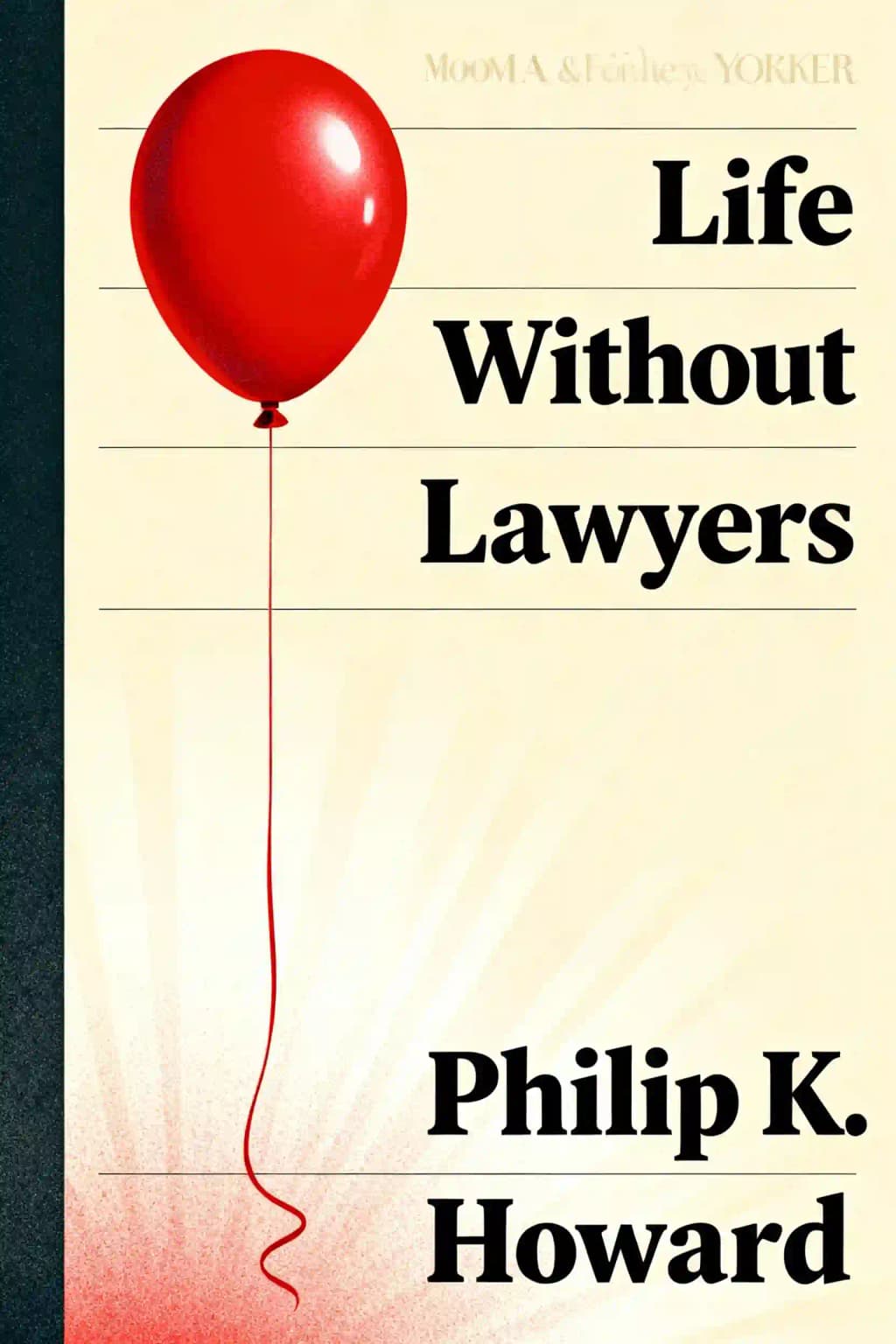
America was built on the promise of freedom-the liberty to make choices, take risks, and pursue happiness in our own way. Yet today, Americans find themselves tiptoeing through a legal minefield, constantly fearful that spontaneous actions might trigger lawsuits or violate obscure regulations. How did the land of the free become a place where teachers can't touch students to prevent harm, where playgrounds have been sanitized of all risk, and where doctors practice defensive medicine instead of healing? Philip K. Howard's "Life Without Lawyers" explores this transformation, revealing how excessive legalization has undermined the very freedoms that make America exceptional. The book has garnered praise from across the political spectrum, with both conservative and progressive leaders recognizing its diagnosis of a society paralyzed by legal fear. As one of The Economist's recommended reads, it offers a roadmap for restoring common sense to American law and revitalizing our civic culture.
第2章
The Boundaries of Freedom Under Siege
When John Tomlinson broke his neck diving into a lake in England, Britain's highest court dismissed his lawsuit with a profound observation: legal claims must consider "the social value of the activity which gives rise to the risk." The judges recognized that allowing such claims would restrict normal activities that bring joy to countless people. This decision highlights what American law has forgotten-that protecting daily freedoms is as important as protecting individuals from harm.
The problem in America isn't about pursuing our own good, but doing things "in our own way." Americans increasingly don't feel free to act according to their judgment when someone might disagree. We've forgotten that real people, not legal rules, make things happen. The power of freedom comes from the infinite possible choices and the individuality that gives scope to our inner resources.
This erosion of freedom manifests in absurd situations like a kindergartner being led away in handcuffs. In St. Petersburg, Florida, a forty-pound girl was videotaped destroying her classroom while adults avoided touching her, eventually calling police who handcuffed the screaming child. For centuries, teachers handled unreasonable children sensibly-holding them by the arm when necessary. But today's teachers can't touch students-it's taboo except to prevent harm to others.
This isn't about protecting children but protecting teachers from lawsuits. Josh Kaplowitz, a Teach for America teacher, faced a $20 million lawsuit and criminal charges simply for putting his hand on a misbehaving student's back. The lawsuit settled for $90,000.
America's story has always been about unlocking human potential-from the Wright brothers tinkering in their bicycle shop to Thomas Edison's mastery of trial and error. The American brand of freedom stands out for its belief in personal resourcefulness and individual uniqueness. But this exuberance is fading as the scope of law stifles self-invention. The evil of modern American law isn't wrong goals but that it has infected daily choices with debilitating legal self-consciousness.
第3章
The Freedom to Take Risks in an Anxious Society
The quiet neighborhood of Wildemere Avenue in Milford, Connecticut became an unexpected battleground when a grandmother demanded the town remove three large hickory trees because her grandchild's nut allergy prevented pool use. Despite neighbors' objections to losing these majestic shade trees, the mayor capitulated, saying "It really came down to taking a risk that the child may be sick or even die."
This incident illustrates how risk has become a conversation-ending hot button in modern America. Beyond lawsuit fears lies something deeper in our cultural psyche: a compulsion to eliminate even remote risks, often creating grotesque misallocations of resources.
Meanwhile, childhood obesity has tripled in two decades, with one in three children overweight. This self-inflicted epidemic costs over $100 billion annually-nearly enough to provide universal health insurance. The problem isn't primarily diet but inactivity.
While JFK's fitness council once recommended playground equipment nationwide, today's playgrounds have been sanitized of anything remotely risky. Jungle gyms, merry-go-rounds, high slides, and seesaws have vanished. Forty percent of elementary schools have eliminated or curtailed recess. Children's exploration range has shrunk to 10% of what it was in 1970, with only 15% walking or biking to school compared to half in 1970.
Risk-taking is actually essential for healthy development. Research shows that unsupervised play develops imagination, problem-solving skills, and proper brain development. Without risk and challenge, children develop smaller brains and fewer cognitive capacities. The safety obsession has created not protection but danger: physically unfit children with arrested social development.
Wealthy societies tend toward excessive caution, but modern America faces a new dimension: legal risk. This focus requires considering the lowest common denominator rather than weighing benefits against costs. Two changes are needed: law must reclaim authority to draw enforceable boundaries of reasonable risk, and "Risk Commissions" should offer guidance on where to draw these lines. As Tony Blair observed, "We cannot eliminate risk. We have to live with it, manage it."
第4章
When Rights Overwhelm Fairness
In Hartford, Connecticut, a violent autistic seventh-grader terrorized his classroom for nearly two years while the school fought through legal proceedings to have him removed. This case illustrates how our modern conception of rights has created a system that often sacrifices fairness for the many in service to individual entitlements.
Rights have become the ultimate tool of a free society, but today's rights differ fundamentally from the defensive rights our founders established. Modern rights give individuals power to demand things from others, often harming the common good. Fairness requires balancing different interests, not absolute entitlements. John Rawls's "veil of ignorance" suggests we should consider all perspectives-like both the autistic child and other students in a classroom. But rights don't allow balancing; they prioritize one person's interests above all others.
Balance is central to every conception of the good society. Aristotle's golden mean sought balance between excess and defect. Every communal activity requires balance-legislatures balancing demands from society, teachers balancing needs of different students, doctors conducting triage. Justice herself holds scales in perfect balance. But balancing requires human judgment, not formulas. Denmark's successful special education program gives headmasters authority to make placement decisions after consultation, balancing needs of all students without trial-type proceedings.
The alternative to absolute rights isn't absolute discretion. Authority structures can be nuanced-legislatures can establish clear goals, provide funding, and create oversight, while still allowing judgment on the spot. People will make mistakes, but as George Washington noted, we shouldn't make it "out of the power of men to render essential services, because a possibility remains of their doing ill."
The rights revolution has descended far from its noble origins fighting segregation. Rights should be restored to their constitutional origins-civil liberties like free speech and protection from systemic discrimination. To restore balance, we must restore the authority of responsible people to make judgments that balance competing interests.
第5章
Restoring Boundaries to Lawsuits
Lawsuits are essential tools in a free country, sorting out right and wrong in particular disputes and showing where legal boundaries apply. But currently, no one in the courtroom is authorized to draw boundaries on behalf of broader society-that job falls to juries who can't bind future cases or establish consistent guidelines.
Without deliberate legal policy on reasonable risk or damages, American lawsuits are limited mainly by lawyers' imagination. Damages become arbitrary, as demonstrated by a Milwaukee case where a jury awarded $17 million against a Catholic Archdiocese after a volunteer ran a red light, causing an accident that paralyzed an elderly man.
Two competing conceptions of justice exist in America. One views juries as "democracy in action" where randomly selected citizens decide cases independently. The other focuses on preserving freedom through consistent application of legal boundaries, with predictability as its primary value. These models cannot be reconciled. The jury model tolerates wildly varying decisions, while the rule of law requires written rulings by judges, not ad hoc jury verdicts.
When people don't trust justice, they stop acting sensibly and start walking on eggshells. Legal self-consciousness creates an upside-down world where swimming becomes something to avoid rather than enjoy. Schools prohibit children from entering the ocean on beach day. Towns remove warning signs about rip tides because having no signs reduces liability risk.
Healthcare suffers most acutely from this corrosion. Doctors don't speak up about potential errors for fear of taking legal responsibility. Unnecessary care driven by defensive medicine accounts for roughly 30% of America's healthcare costs. Documentation has become excessive-pediatricians write thirty lines about normal check-ups instead of two. Empathy and honesty disappear when errors occur, as doctors stonewall rather than apologize.
Judge Janis Jack took an unprecedented step in 2002 when presiding over 10,000 silicosis claims. Rather than simply managing paperwork until settlement, she investigated the claims' validity. Her year-long research revealed shocking fraud: mass-produced litigation with mobile X-ray trucks and doctors signing preprinted diagnoses. One doctor made over 1,200 diagnoses in less than 72 hours. What shocked the legal community wasn't the fraud itself but that a judge actually declared the claims invalid.
America needs judges willing to draw boundaries of reasonable risk and claims. Three major changes are needed: First, judges must draw boundaries of reasonableness as a matter of law. Second, judges must actively manage cases. Third, special courts should be established for areas requiring expertise, particularly medical malpractice.
第6章
How Bureaucracy Smothers Education
TEAM Academy in Newark demonstrates how culture, not bureaucracy, creates successful schools. Starting in 2002, this charter school recruited students from Newark's worst projects and transformed them from the 21st percentile in reading to the 55th percentile in just one year. Principal Ryan Hill explains their success: "We don't actually worry much about improving scores. We spend our time building the culture."
Former teachers describe the suffocating bureaucracy in public schools: "Most people in the real world probably can't imagine how bureaucratic schools have become." During standardized testing, classroom walls must be covered with newspaper to hide any words or letters, teachers must circle the room without looking at students to avoid "scaring them," and other classes sit in silence to avoid making noise.
Teachers' diaries reveal how bureaucracy dictates their smallest actions. One teacher wrote: "Student raises hand with question. Tell him to put hand down. Students not allowed to ask questions during mini-lesson. Feel guilty." Even birthday cupcakes from parents are banned by rules against classroom visitors.
Legalistic school organization has destroyed the moral authority needed for learning. Across America, students wander classrooms, disrupt lessons, and confront teachers with impunity. Nick Bagley, an eighth-grade Bronx teacher, described a "pervasive atmosphere of not respecting authority" where "cursing, screaming, yelling, leaving the room" was common. Violence is disturbingly common-one in seven urban teachers has been physically assaulted.
The bureaucratized discipline system requires over sixty steps to suspend a student in New York City. Teachers must stop class, call security, complete forms, and allow students "to present their version of events" before any action can be taken. Most principals, overwhelmed by process and legal risks, have surrendered to disorder.
Bureaucracy not only demoralizes teachers and empowers disruptive students-it turns educators against each other. As schools deteriorate, various constituencies entrench themselves through legal mandates, creating a death spiral of dysfunction. The New York City teachers' union contract runs 165 pages, dictating precise work hours and limiting teacher duties. Until recently, principals couldn't even place critical comments in a teacher's file without formal notice and legal hearings.
The attempt to organize schools through legal bureaucracy has catastrophically failed. Teaching is closer to the arts than assembly lines, where standardized protocols generally impede effectiveness. Education is profoundly personal. Studies show teacher effectiveness matters dramatically-good teachers for five consecutive years can eliminate achievement gaps between poor and wealthy students. Yet credentials and certification show virtually no correlation with teaching ability. What makes teachers effective is personality and natural ability to connect with students.
Successful schools require swift action against disorder, not to show force but to prevent deterioration. As Sara Lightfoot observed in good schools, "acts of violence were swiftly punished." Schools should be judged by their culture, not just test scores or certifications. The core condition for attracting and enabling good teachers is liberating them to be themselves.
第7章
The Freedom to Judge Others
Accountability is essential for any healthy organization. Some people simply don't work out, as TEAM Academy's Ryan Hill explains about a teacher who "just couldn't relate to the students" despite credentials and experience. Making judgments about people requires subjective assessment, not objective criteria-success depends on aptitude, training, character, energy, personality, caring, and countless other variables.
Public employees in America face virtually no accountability. Due process protections create an "virtually impregnable position" for government workers regardless of performance. The standard for keeping public employment is often lower than bare minimum competence. In East St. Louis, an assistant principal who impregnated a fourteen-year-old student was ordered reinstated. A Cincinnati police dispatcher who forgot to dispatch police and fell asleep was reinstated due to "extenuating circumstances."
The great worker protection reforms of the 20th century-civil service, labor laws, and civil rights legislation-were all designed to protect against systemic abuses affecting entire categories of people, not to shield individuals from accountability. Over time, each reform was transformed into a barrier against personal accountability.
Civil service began in the 1880s to end the corrupt spoils system, ensuring government employees would be hired on merit. The original reformers never intended to prevent dismissal of incompetent workers. Similarly, the labor movement arose to protect workers from dangerous conditions and exploitation, not to shield poor performers. The civil rights movement aimed to remove artificial barriers based on race or gender, not to give individuals special job protections.
In 1996, Georgia Governor Zell Miller eliminated civil service protections for new state employees with remarkable results. "It was like somebody turned on the lights," observed Paul Burkhalter of the Department of Natural Resources. Workers who previously called in on snowy days somehow made it to work. The change created opportunities for advancement and shifted attitudes from mere compliance to accomplishment.
Nurse Charles Cullen murdered over forty patients while moving between ten different hospitals because fear of lawsuits prevented previous employers from giving honest references. They could only confirm employment dates, not share concerns about his strange behavior.
Civil service and teacher protections should be largely scrapped and replaced with a new system that includes: 1) Protection against unfairness through informal review committees rather than legal hearings; 2) Retraining and reassignment opportunities while preserving management authority; 3) Transferable benefits and severance packages to remove the handcuffs of job dependency; and 4) Merit-based hiring with an expectation that poor performers will be let go.
第8章
Restoring Responsibility in Washington
Washington has become disconnected from the rest of America, with officials submerged in law rather than solving real problems. Officials follow rules and processes rather than addressing actual needs, as seen in FEMA's response to Hurricane Katrina where mobile homes sat unused due to regulatory constraints.
Detailed regulation creates straitjackets that prevent adaptation to new circumstances. No Child Left Behind's 670 pages of dictates have backfired, excluding good teachers while rewarding bad ones with credentials. HIPAA privacy provisions add billions in costs while impairing communication among healthcare professionals.
Washington has developed its own strange culture beneath "fathoms of law"-over 100 million words of binding federal statutes and rules. Officials speak in unintelligible acronyms and phrases, focus on appearance rather than accomplishment, and suffer from "rule stupor." This culture appeals to risk-averse insiders who can hide behind regulations instead of taking responsibility.
Washington's culture has become deeply irresponsible. Meetings with both Democratic and Republican leaders revealed how they prioritize special interests over solutions-a Democratic congressman refusing to support medical malpractice reform because trial lawyers opposed it, and a White House adviser pushing legislation they knew wouldn't pass just to blame Democrats. This cynicism permeates governance, with neither party willing to give the other a "win" even on bipartisan issues.
When institutions lose purpose, they need a fresh start. Jefferson noted that occasional rebellion is "necessary in the political world as storms are in the physical." FDR created over sixty new departments rather than fixing existing ones, with remarkable results-the Civilian Conservation Corps employed 250,000 Americans within three months under a mere five-page statute.
Today's government minimizes official discretion, shackling itself with countless legislative mandates. We need to bulldoze most laws and regulations that have lost connection to real problems. Government should organize around clear goals with designated responsible officials who have flexibility within appropriate boundaries. Law should consist of general principles rather than exhaustive rules-like the Constitution's brief ten pages or common law standards of "reasonable behavior."
Washington can only be reformed through outside pressure, as all institutions need external accountability. The solution isn't replacing people but changing a culture through a national coalition of citizen leaders functioning as a shadow government. This coalition would develop legislative proposals in critical areas, filling the vacuum of moral authority rather than seizing power.
第9章
The Freedom to Make a Difference
Modern society has developed a profound distrust of human authority, preferring to rely on rigid laws rather than human judgment. This mindset assumes society can function without human intervention, viewing judges and officials with suspicion rather than as necessary arbiters. While these fears aren't irrational, forty years of experience shows that attempting to insulate ourselves from human authority has backfired dramatically.
A functioning society requires officials with authority to make common choices-from classroom management to legal boundaries. America lacks leaders not because of genetic flaws but because we've made leadership effectively unlawful. Even teachers can't run classrooms or judges dismiss frivolous lawsuits. This paralysis contributes to civic apathy as people retreat into private worlds, feeling powerless to affect anything beyond their immediate environment.
Society operates under unspoken preconceptions, including the radical notion that right and wrong can be programmed or proven objectively. But as Vaclav Havel observed, we've incorrectly organized modern societies on the premise that "the world is a wholly knowable system, governed by a finite number of universal laws that man can grasp." This fallacy ignores that human judgment-not legal proof-is essential for functioning societies.
Trying to demonstrate the correctness of decisions actually leads to worse decisions. People seeking objective markers follow rules and order extra tests rather than using their judgment. Judgment is only partially conscious-as Peter Drucker noted, "Amazingly few people know how they get things done." Success hinges on people feeling free to act on instincts, like the fireman who evacuated a house before collapse without being able to explain why.
Leadership once meant something in America. Teachers were respected role models, lawyers were "aristocrats" of integrity, doctors cared for all patients regardless of means. Today, these professions are viewed cynically because those with responsibility no longer feel free to exercise personal leadership-instead they slog through law all day.
Leadership isn't about guaranteed correctness. Truth lies at the edges where issues intersect, requiring judgment about uncertainties, trade-offs and risks. Before our modern legal experiment, people simply decided matters and moved on. A hierarchy of accountability stretched upward until it circled back to voters. Having a decision-maker is indispensable-as George Washington noted, duties are "worse executed by two persons, and scarcely done at all if three or more are employed."
When civilizations fail, they often refuse to adapt to changing conditions. America's greatest resource is our culture of individual initiative, but this spirit erodes when we don't let people exercise it. Our schools, civic involvement, and healthcare system show troubling signs of decline.
Distrust has overpowered our good sense. We know teachers need authority to run classrooms and judges should dismiss frivolous lawsuits. Yet we've become addicted to distrust, pursuing perfect accountability that "builds a culture of suspicion" where, as O'Neill observes, "Plants don't flourish when we pull them up too often to check how their roots are growing."
第10章
Reclaiming America's Spirit of Responsibility
President Obama's call for a "new era of responsibility" in his inaugural address struck a perfect chord for a struggling country. But responsibility requires freedom to do what feels right. Americans are trapped in a legal thicket where they worry about ramifications of daily choices.
The success of social goals depends on individuals making sensible daily choices. Yet doctors deliver care in a legal jungle where incentives push toward doing more, not what's prudent. Even Obama's green initiatives are stymied by legal quicksand-transmission lines take a decade just to get approved.
Congress refuses to take responsibility for existing laws while hypocritically blaming others. They lecture auto executives about legacy costs while maintaining Depression-era subsidies. This broken system has crushed the American spirit and bred cynicism.
Responsibility starts at the top. Teachers, principals, judges must have authority to make judgments for the common good. Rights have degenerated into self-interested demands, undermining freedom and culture. Rights always stifle responsibility because they're entitlements that can't be balanced.
Americans seem ready for leadership again, supporting initiatives to restore teacher authority and reform medical malpractice. But Obama's administration hasn't yet proposed anything to restore conditions for individual responsibility.
The key challenge remains fixing our broken democracy by repairing legal boundaries washed away in forty years of legal flood. Americans must be liberated to make things work again-that's the only way to revive the American spirit.
Eight core principles form the agenda for change: 1) Restore judicial authority to draw legal boundaries; 2) Replace rights vocabulary with balance; 3) Liberate teachers from legal rules; 4) Restore responsibility to government through identifiable officials; 5) Provide checks through hierarchical responsibility, not individual legal proceedings; 6) Revive personal accountability through others' freedom to judge; 7) Decentralize public services for community involvement; 8) Organize national civic leadership to overhaul government.
Trust is essential in a free society, allowing people to move forward rather than constantly looking over their shoulders. What's needed isn't blind faith in officials but collective will to delegate responsibility for common choices, with accountability up the chain and ultimately back to voters. To confront today's challenges, Americans must be free to take responsibility. This requires a legal revolution-clearing accumulated law and bureaucracy to build a framework that defines and protects human freedom. Liberating America's can-do spirit will work miracles.