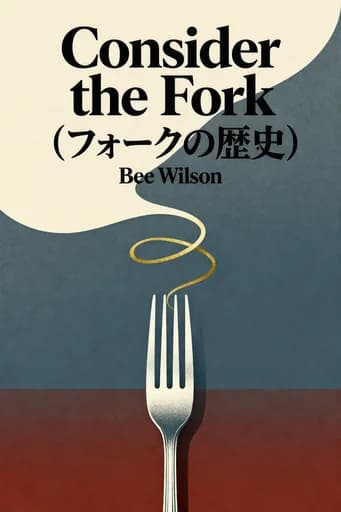
From wooden spoons to sous-vide machines, "Consider the Fork" reveals how kitchen tools shaped human civilization. The Washington Post praised Wilson's seamless journey "from Stone Age flints to modern kitchens" - a delicious exploration that forever changes how you'll view that humble fork.
Bee Wilson, acclaimed food historian and award-winning author of Consider the Fork: A History of Invention in the Kitchen, blends culinary scholarship with cultural analysis to explore how kitchen tools shaped human diets.
A Cambridge-trained PhD and fellow of the Royal Society of Literature, Wilson ties her expertise in food technology to broader themes of innovation and societal change. Her other works, including First Bite (a study of eating habits) and The Way We Eat Now (examining modern food systems), cement her authority in food anthropology.
A six-time Fortnum & Mason Award winner, Wilson contributes to The Wall Street Journal, The Guardian, and London Review of Books, and co-founded the charity TastEd to promote sensory food education. Consider the Fork has been translated into 12 languages, from Spanish to Japanese, and praised by The Los Angeles Times as “a pure joy to read.”
Consider the Fork explores how kitchen tools—from ancient fire pits to modern microwaves—have shaped global food cultures. Bee Wilson blends history, anthropology, and personal anecdotes to trace the evolution of cooking gadgets like knives, pots, and refrigeration, revealing how these innovations transformed diets, social norms, and daily life.
Food enthusiasts, history buffs, and cultural anthropology readers will enjoy this book. It appeals to those curious about the hidden stories behind everyday kitchen objects or seeking a fresh perspective on how technology intersects with culinary traditions.
Yes—it’s a witty, award-winning deep dive into culinary history. Wilson’s engaging storytelling and surprising insights (e.g., how boiling food revolutionized agriculture) make it a standout for readers who enjoy narrative nonfiction with scholarly depth.
Wilson contrasts the fork’s European adoption (linked to meat-centric diets) with chopsticks’ Asian origins, shaped by grain-based meals. She highlights how utensil design reflects broader societal values, like efficiency versus ritual.
Refrigeration democratized access to fresh food and reshaped global trade. Wilson notes how iceboxes eliminated reliance on seasonal eating and enabled new cuisines, calling it a “culinary revolution” comparable to the invention of cooking pots.
From geothermal springs to nonstick pans, Wilson shows how pots enabled boiling—a breakthrough that made toxic plants edible and turned grains into staples. Their design evolution also mirrors shifts in gender roles and labor.
Some reviewers wanted deeper analysis of non-Western culinary traditions and a stronger political lens. Others found the gadget-focused sections less substantive than historical chapters.
Wilson details hazards like open fires and sharpened flint knives, contrasting them with modern risks (e.g., mandoline slicers). She argues safety innovations, like tempered steel, reshaped cooking confidence and recipe complexity.
Fire’s mastery allowed protein-rich diets and communal meals, but Wilson also critiques its inefficiency: traditional open fires waste energy and cause health issues, prompting later shifts to stoves.
The book remains relevant by framing tools like sous-vide machines as part of a millennia-long innovation chain. Wilson’s analysis of gadget-driven dietary shifts (e.g., microwave meals) helps contextualize today’s food tech trends.
Unlike single-topic culinary histories, Wilson’s gadget-centric approach offers a unique lens. It complements works like Salt by Mark Kurlansky but focuses on tools rather than ingredients.
著者の声を通じて本を感じる
知識を魅力的で例が豊富な洞察に変換
キーアイデアを瞬時にキャプチャして素早く学習
楽しく魅力的な方法で本を楽しむ
Each tool has its own history, its own logic, its own way of shaping our experience of food.
The knife and fork are not just tools; they are also weapons.
Cooking was the decisive moment in human evolution.
Kitchens are places of violence.
The knife is our oldest culinary tool.
『Consider the Fork』の核心的なアイデアを分かりやすいポイントに分解し、革新的なチームがどのように創造、協力、成長するかを理解します。
『Consider the Fork』を素早い記憶のヒントに凝縮し、率直さ、チームワーク、創造的な回復力の主要原則を強調します。

鮮やかなストーリーテリングを通じて『Consider the Fork』を体験し、イノベーションのレッスンを記憶に残り、応用できる瞬間に変えます。
何でも質問し、声を選び、本当にあなたに響く洞察を一緒に作り出しましょう。

"Instead of endless scrolling, I just hit play on BeFreed. It saves me so much time."
"I never knew where to start with nonfiction—BeFreed’s book lists turned into podcasts gave me a clear path."
"Perfect balance between learning and entertainment. Finished ‘Thinking, Fast and Slow’ on my commute this week."
"Crazy how much I learned while walking the dog. BeFreed = small habits → big gains."
"Reading used to feel like a chore. Now it’s just part of my lifestyle."
"Feels effortless compared to reading. I’ve finished 6 books this month already."
"BeFreed turned my guilty doomscrolling into something that feels productive and inspiring."
"BeFreed turned my commute into learning time. 20-min podcasts are perfect for finishing books I never had time for."
"BeFreed replaced my podcast queue. Imagine Spotify for books — that’s it. 🙌"
"It is great for me to learn something from the book without reading it."
"The themed book list podcasts help me connect ideas across authors—like a guided audio journey."
"Makes me feel smarter every time before going to work"

Consider the Forkの要約をPDFまたはEPUBで無料でダウンロード。印刷やオフラインでいつでもお読みいただけます。
Think about the last time you reached for a wooden spoon. Did you pause to consider why this ancient implement - essentially a stick with a shallow bowl carved at one end - has survived every kitchen revolution from the Bronze Age to the microwave era? Its genius lies in what it doesn't do: it won't scratch your pans, won't react with acidic foods, won't conduct heat up the handle to burn your fingers. Yet we rarely celebrate the wooden spoon. We save our enthusiasm for gleaming espresso machines and sous-vide circulators, forgetting that every technological leap in the kitchen must ultimately answer to the same test: Does it feel right in human hands? This tension between innovation and tradition defines our relationship with food technology. The tools we use to cook haven't just shaped what we eat - they've literally reshaped our bodies, altered the structure of societies, and determined which civilizations thrived. From fire to refrigeration, each breakthrough didn't simply make cooking easier; it fundamentally changed what it meant to be human.