第1章
From South Side to White House: A Journey of Becoming
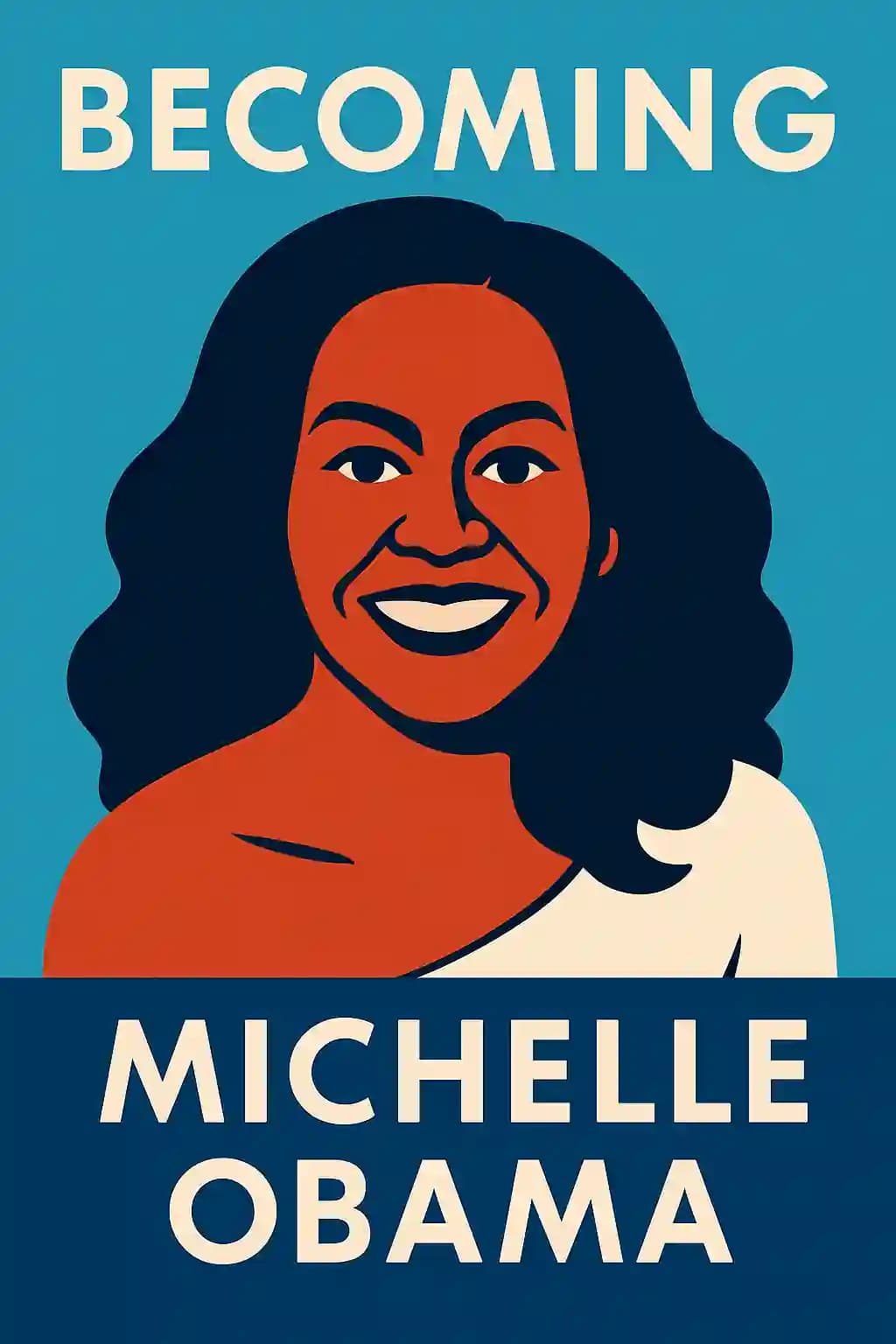
Michelle Obama's memoir opens a window into an extraordinary journey that began in a modest apartment on Chicago's South Side and culminated at 1600 Pennsylvania Avenue. But this isn't just a political story-it's a deeply personal narrative about finding one's voice and purpose while navigating life's unexpected turns. Since its 2018 publication, "Becoming" has sold over 15 million copies worldwide, becoming the best-selling memoir ever written by a former First Lady. Oprah Winfrey called it "vulnerable, powerful, and so authentically Michelle," while former President Barack Obama admitted it gave him "a whole new perspective on our marriage." The book resonated across political divides, with Laura Bush praising its "refreshing honesty" and even conservative commentators acknowledging its universal themes of family, education, and personal growth. Let's explore the remarkable journey of a woman who transformed herself while helping transform a nation.
第2章
Roots That Ground, Wings That Soar
Michelle Robinson's childhood was shaped by her parents' contrasting influences-her father Fraser's stoic resilience and her mother Marian's practical wisdom. Fraser Robinson worked at Chicago's water filtration plant despite advancing multiple sclerosis, never missing a day in 26 years. He taught Michelle the dignity of consistency and hard work, driving to work each morning with a limp that grew more pronounced over time but never diminished his determination. "My father taught me that showing up matters," Michelle writes, "not just when it's convenient or when you feel good, but every single day."
Her mother Marian provided the counterbalance-pragmatic, straightforward, and focused on raising adults rather than children. She gave guidance instead of strict rules, encouraging independence while maintaining high expectations. When Michelle struggled with an incompetent second-grade teacher, Marian quietly advocated for her daughter to be tested and moved to third grade. She was neither overly effusive with praise nor dramatic with punishment-she simply expected excellence and provided the tools to achieve it.
The family lived in a small apartment on Euclid Avenue, with Michelle and her brother Craig eventually getting their own rooms through a clever renovation that created a plywood divider in their shared bedroom. Though modest by middle-class standards, their home was filled with music, conversation, and love. Michelle's grandfather Southside, a passionate music lover who'd moved to their neighborhood, introduced her to jazz greats like Coltrane and Miles Davis, buying her first album-Stevie Wonder's "Talking Book"-which she kept on a special shelf at his house.
Piano lessons with the strict Robbie MacAllister became a formative experience, teaching Michelle both discipline and the courage to overcome mistakes. During her first recital at Roosevelt University, she froze upon discovering the piano's middle C wasn't chipped like her practice instrument. When Robbie quietly approached to place one finger on middle C before returning to her seat, Michelle learned a lesson about support that doesn't overwhelm-guidance that empowers rather than rescues.
As their neighborhood transitioned from predominantly white to predominantly Black, Michelle observed the subtle mechanics of white flight. The contrast became clear when visiting the Stewarts, former neighbors who had moved to the planned suburban community of Park Forest. While her brother Craig played happily with new friends, Michelle felt uncomfortable in this sterile environment. The family's visit ended with a disturbing discovery-someone had keyed a long scratch along her father's beloved Buick, a silent act of racial hostility that her father acknowledged with only a quiet "Well, I'll be damned" before having it repaired without complaint.
第3章
Education as Liberation
Education became Michelle's pathway forward, beginning at Bryn Mawr Elementary School. When a newspaper article criticized the school as a "run-down slum" with a "ghetto mentality," Principal Dr. Lavizzo defended it vigorously, understanding how "feelings of failure" could spread through a community facing white flight and predatory real estate practices. Michelle thrived in a special multigrade classroom for higher-performing students, benefiting from dedicated teachers who fueled her competitive nature with college visits and independent learning opportunities.
Her academic journey continued at Whitney Young, Chicago's first magnet high school designed as an "equal-opportunity nirvana" to draw high-performing students from all backgrounds. The ninety-minute commute on two city buses exposed Michelle to parts of Chicago she'd never seen, while the school introduced her to an unfamiliar social landscape that included wealthy white kids from the North Side and an African American elite whose parents were doctors and lawyers. For the first time, Michelle glimpsed "the apparatus of privilege and connection"-a network of advantages available to some but not all.
Despite feeling initially uncertain among 1,900 students who seemed universally confident, Michelle earned good grades and found her footing. When her French teacher announced a class trip to Paris, Michelle didn't mention it at home, understanding the financial strain her parents already faced with her brother Craig's Princeton expenses. But when her parents learned about it from a friend's mother, they insisted on sending her. "That's actually not for you to decide, Miche," her father said gently. "We were their investment," Michelle reflects, noting that her parents, then in their forties and married nearly twenty years, had never vacationed in Europe themselves.
Princeton University presented new challenges-navigating the shadow of affirmative action that followed minority students while holding her own academically. Though sometimes feeling scrutinized by peers and professors wondering "why I was there," Michelle gradually realized Princeton wasn't a pure meritocracy-athletes, legacy students, and wealthy families all received special consideration. Her roommate Suzanne ("Screwzy") provided another kind of education with her carefree approach to life, teaching Michelle that "not everyone needs to have their file folders labeled and alphabetized"-a lesson that would later help her coexist with a similarly messy future partner.
第4章
The Reluctant Lawyer Meets Her Match
After graduating from Harvard Law School, Michelle landed at Sidley & Austin in Chicago, making more money than her parents ever had, wearing Armani suits and driving a Saab. She'd "climbed the mountain" until a senior partner asked her to mentor an incoming summer associate-another Black Harvard student whose name she didn't yet know: Barack Obama.
Barack arrived late on Michelle's first day mentoring him, and she was immediately skeptical of the hype surrounding him-supposedly the most gifted Harvard Law student his professor had ever encountered. In her experience, "you put a suit on any half-intelligent black man and white people tended to go bonkers." But over lunch, she discovered Barack was nothing like she expected. Three years older at 28, he had an improvisational zigzag life path compared to her direct trajectory-the son of a Kenyan father and white Kansas mother, raised in Hawaii with four years in Indonesia, who'd worked as a community organizer in Chicago's South Side before law school.
Their relationship shifted during a firm outing to Les Miserables when they escaped the dreary musical together. Later, after a barbecue at a partner's lakefront home, Michelle watched Barack play basketball with "power I hadn't before noticed" and felt "a new ache, some freshly planted seed of longing." That evening, after sharing ice cream outside his Hyde Park apartment, he asked "Can I kiss you?" and everything became clear.
What Michelle valued most about Barack was his sense of limitless possibility. He didn't waste energy questioning whether opportunities would dry up or measure his progress against others. Unlike many thirtysomething lawyers, he wasn't chasing material success-no fancy car or suburban house. As Michelle contemplated her first major career change, this quality became even more precious. While others cautioned her about financial obligations and her mother advised to "make the money first and worry about happiness later," Barack simply encouraged her to pursue what would make her happy.
第5章
Finding Purpose Beyond Prestige
Michelle's father's declining health became a catalyst for reassessing her own path. Despite visibly worsening symptoms of his multiple sclerosis, Fraser Robinson insisted he was "fine" whenever asked, maintaining his jovial humor during family dinners. After twenty-six years without missing a shift at the filtration plant, his pride was wrapped in his reliability. When Michelle finally convinced him to see a doctor, she witnessed a heartbreaking moment through the peephole-her father sitting exhausted on the back steps, unable to continue. She didn't intervene, preserving his dignity, and somehow he eventually willed himself to his van and went to work anyway.
His death shortly afterward left Michelle questioning her own priorities. "If I died, I didn't want to be remembered for legal briefs or corporate trademarks," she realized. She began networking across Chicago, seeking meaningful work beyond law. A meeting with Valerie Jarrett, the deputy chief of staff to Chicago's mayor, led to an opportunity in public service at half her current salary. Despite growing up mistrusting politics, something about this opportunity intrigued her-the vibrant chaos of city hall, where the building truly belonged to the people, with an immediacy she never felt at Sidley.
This career shift led Michelle to Public Allies, where she became executive director of the Chicago chapter. The organization recruited talented young people for paid apprenticeships in community organizations, providing training to develop the next generation of community leaders. Negotiating her salary revealed sobering truths about nonprofit work-it paid dramatically less than her city job, which was already half what she'd earned as a lawyer. Many nonprofit workers, she realized, could afford the low pay because their virtue was "discreetly underwritten by privilege."
Michelle threw herself into building the organization from scratch-securing cheap office space with donated furniture, leveraging every connection for donors and placements, and recruiting Allies from diverse backgrounds. The Friday gatherings were her favorite-helping Allies navigate professional challenges while celebrating their progress. "It was the best job I ever had," she writes, "doing something immediately meaningful while staying connected to my city and culture."
第6章
The Political Journey Begins
While Michelle focused on Public Allies, Barack settled into teaching at the University of Chicago Law School, working on voting rights cases, and completing his memoir "Dreams from My Father." When he asked what she thought about him running for state senate, Michelle was skeptical but gave her approval. He was elected in November 1996, and to her surprise, she enjoyed participating in his campaign. Now with the legislature in session, Barack spent weekdays in Springfield while maintaining his teaching load to keep pace with their debts.
They spoke on the phone every night he was downstate and had a standing Friday date night at a restaurant called Zinfandel. Michelle would always arrive punctually and wait for Barack, her heart leaping when he finally walked through the door. They ordered the same meal every Friday-pot roast, Brussels sprouts, and mashed potatoes. This was a golden time for them, with him pursuing his legislative work despite partisan battles, and her transitioning to a new position at the University of Chicago.
During this period, they faced a personal challenge-trying to get pregnant without success. After a miscarriage, they consulted a fertility doctor who recommended in vitro fertilization. Michelle found herself alone administering daily shots while Barack was in Springfield, feeling the unequal burden of their shared dream. But her resentment vanished when she heard their baby's heartbeat on ultrasound. On July 4, 1998, Malia Ann Obama was born, followed by Natasha (Sasha) Marian Obama on June 10, 2001.
Motherhood became Michelle's motivator, but working part-time created a sanity-warping double bind. She battled guilt when taking work calls at home and different guilt when distracted at the office by worries about Malia. Meanwhile, Barack hardly missed a stride-reelected to the state senate with 89% of the vote and contemplating a congressional run against incumbent Bobby Rush. Though Michelle wasn't enthusiastic about this new campaign, she gave it her wan blessing, secretly hoping failure might push him toward something with better hours.
第7章
From Senate to Spotlight
After Barack's electrifying keynote speech at the 2004 Democratic National Convention, their lives underwent a seismic transformation. The speech, which emphasized America's unity beyond partisan divisions, catapulted Barack from relative obscurity to national prominence overnight. Everywhere they went-restaurants, airports, city streets-people recognized him, rushing over for autographs, photos, and eager to share their political views. His previously modest-selling memoir "Dreams from My Father" suddenly shot to the top of bestseller lists, and their Chicago home became a destination for media personalities, including Oprah Winfrey, who arrived with a full production crew for an intimate interview.
In November 2004, Barack won his Senate race with an overwhelming 70 percent of the vote, the largest margin in Illinois state history. While he adapted to a grueling schedule shuttling between Chicago and Washington D.C., Michelle shouldered the responsibility of maintaining stability at home. She coordinated school pickups, doctor appointments, and ballet lessons, all while continuing her own career at the University of Chicago Hospitals. Yet increasingly, she noticed a shift in how others perceived her-colleagues, friends, and even strangers began referring to her primarily as "Mrs. Obama" rather than acknowledging her individual accomplishments and identity.
The presidential campaign launched officially in February 2007 with a carefully orchestrated announcement in Springfield, Illinois, the same city where Abraham Lincoln had begun his political journey. As campaign strategists and advisers swirled around them with logistics and messaging plans, Michelle focused on the practical aspects she could control-like ensuring eight-year-old Malia and five-year-old Sasha had warm enough winter coats and appropriate hats for the freezing Illinois weather. On announcement day-February 10, a brutally cold twelve-degree morning-Michelle's maternal anxiety overshadowed the historical significance of the moment. Despite weeks of preparation and outreach, she worried the crowds wouldn't materialize.
After receiving a final briefing inside the historic Old State Capitol, Barack stepped out first to thunderous applause. When it was time for Michelle and the girls to join him, she concentrated entirely on guiding Sasha up the stairs, ensuring her youngest wouldn't stumble or appear overwhelmed by the moment. Only after reaching the platform did Michelle lift her eyes to take in the full scope of the scene-over fifteen thousand supporters had gathered, creating a vast sea of faces and signs that stretched beyond the capitol grounds.
"I'd never understood why people would spend hours standing at political rallies," Michelle later reflected, "but suddenly I realized: we were the band, the team taking the field. We owed something to each person who had braved the cold to be there. This was democracy's call-and-response, a contract forged person by person." With fifteen thousand more reasons to believe in Barack's vision, she found herself fully committed to the campaign, despite her initial reservations. Their whole family stood before the crowd and cameras, united in purpose, ready to embark on an unprecedented journey that would test their resilience, challenge their privacy, and ultimately change American history.
第8章
Becoming First Lady
There's no handbook for incoming First Ladies-it's not technically a job, has no salary, and comes with no spelled-out obligations. As the first African American First Lady, Michelle understood she'd be measured by a different yardstick. The grace automatically extended to her white predecessors would need to be earned. She faced intense scrutiny over everything from her facial expressions to her choice of sleeveless dresses, and encountered coded language about her appearance and demeanor that often carried racial undertones. She worried many Americans wouldn't see themselves reflected in her or relate to her journey, and she remained vulnerable to unfounded fears and racial stereotypes lurking beneath public consciousness.
During the transition period, Michelle prioritized creating stability for Malia and Sasha, meticulously researching Washington schools and arranging visits to ensure they'd find the right fit. Simultaneously, she began assembling her East Wing team, carefully selecting staff who shared her values and vision for the role. She witnessed the staggering complexity of presidential security arrangements - the advance teams, Secret Service protocols, and the elaborate choreography required for even simple family outings. She contemplated the reality of living in America's most public residence-the White House with its 132 rooms, 35 bathrooms, and 28 fireplaces spread across six floors, each space steeped in history and tradition.
Living in the White House feels like staying in an exclusive hotel with no other guests-just your family. Fresh flowers appear daily, replaced so discreetly you never see it happen. The building feels old and imposing with thick sound-absorbing walls and tall windows sealed with bomb-resistant glass. An invisible staff of ushers, chefs, housekeepers, florists, electricians, painters, and plumbers maintain everything immaculately, slipping in and out of rooms to refresh towels or place fresh gardenias by the bedside. The residence staff, many of whom have served multiple administrations, maintain centuries-old traditions while adapting to each new family's needs with remarkable discretion and professionalism.
This luxury sometimes gave Michelle vertigo, considering her South Side Chicago roots where she shared a bedroom with her brother Craig and learned the value of hard work from her parents. She worked deliberately to maintain normalcy by establishing clear rules: the girls would make their own beds, do their homework without special consideration, and handle their own laundry. She also focused on loosening White House formality-allowing them to throw balls in hallways, grab snacks from the pantry, and sled on the South Lawn using trays borrowed from kitchen staff. Michelle insisted on regular family dinners and created new traditions, like hosting sleepovers for the girls' friends in what became known as the "Kids' State Floor." Through it all, she strived to balance the extraordinary privilege of their position with maintaining authentic family values and keeping her children grounded in reality.
第9章
Let's Move: Finding Purpose as First Lady
Michelle's first meaningful initiative as First Lady began with planning a White House garden-a project that would evolve from a simple planting effort into a national conversation about health and nutrition. After extensive soil testing revealed adequate nutrients and safe lead levels, she partnered with Bancroft Elementary School, choosing this local DC school to help demonstrate the accessibility of gardening. Together with twenty-three excited fifth-graders, they planted an impressive variety of vegetables and herbs: multiple varieties of lettuce, spinach, Swiss chard, fennel, broccoli, carrots, collard greens, black kale, onions, snap peas, shell peas, berry bushes, and an herb garden featuring basil, oregano, and mint.
By late June, the garden had exceeded expectations. The returning Bancroft Elementary students were amazed by the transformation, harvesting basketfuls of fresh lettuce, peas, and herbs. In the White House kitchen, alongside professional chefs, they created fresh salads and learned about food preparation. The garden's success was remarkable - in just ten weeks, it had yielded over ninety pounds of organic produce from an initial investment of approximately $200 in seeds and mulch. The media coverage and public interest confirmed Michelle's ability to generate meaningful dialogue around important issues.
The garden project opened her eyes to a broader crisis: childhood obesity. The statistics were alarming - nearly one-third of American children were overweight or obese, with rates having tripled over three decades. Her research revealed a complex web of contributing factors: the prohibitive cost of fresh produce in many communities, systematic cuts to physical education and school sports programs, the growing dominance of screen-based entertainment, food deserts in both urban and rural communities where fresh produce was unavailable, and sophisticated marketing campaigns targeting children with processed foods.
After six months of intensive preparation, including over 30 meetings with business leaders, health advocacy organizations, and members of Congress, Michelle launched "Let's Move!" in February 2010. The comprehensive initiative aimed to eliminate childhood obesity within a generation through a multi-pronged approach. The program secured significant commitments from major stakeholders: the nation's largest school lunch suppliers agreed to reduce sodium content by 25%, cut sugar and fat significantly, and double the amount of fresh produce offered; the American Beverage Association committed to clearer calorie labeling on all products; the American Academy of Pediatrics pledged to make BMI measurements standard practice in pediatric visits; and major media companies agreed to donate $0 million in airtime for public service announcements promoting healthy habits.
The initiative also worked closely with mayors and local officials to create more opportunities for physical activity, including building new playgrounds, establishing safe walking routes to schools, and revitalizing community recreation centers. Through partnerships with chefs, athletes, and celebrities, "Let's Move!" made healthy living appealing and accessible to children across the country.
第10章
Legacy of Hope
As the Obama presidency concluded, Michelle reflected on what would endure from their presence. They'd commissioned official china, redecorated the Old Family Dining Room featuring the first artwork by a black woman in the permanent collection, and expanded the White House garden with pathways and benches made from historically significant wood. Their initiatives had produced tangible results: 45 million kids eating healthier meals, 1.5 million veterans and military spouses hired or trained, billions leveraged for girls' education globally, and 20 million more Americans with health insurance-all accomplished without scandal.
Perhaps most meaningful was witnessing cultural shifts, like Lin-Manuel Miranda's "Hamilton" cast performing beneath White House chandeliers, telling an inclusive American story. Michelle came to see America as a place of contradictions and resilience, where stories can be told different ways. Her story-growing up with a disabled dad in a small house yet surrounded by love in a diverse city-could be one of having nothing or having everything, depending on how you tell it.
At fifty-four, Michelle entered a new phase of life, unhooked from political obligations, with nearly grown daughters and a husband no longer carrying the nation's weight. For her, becoming isn't about arriving somewhere specific-it's forward motion, continuously evolving toward a better self. She draws strength from the dignity and decency she's witnessed throughout her life, reminding herself that we all play a role in democracy. Optimism remains her antidote to fear-the same optimism she saw in her father's refusal to be limited by his illness, in her mother's stubborn commitment to their neighborhood, in Barack's hopeful grin, and in countless Americans she met as First Lady.
"I'm an ordinary person who found herself on an extraordinary journey," Michelle concludes, "and by sharing my story, I hope to create space for others. Let's invite one another in, embrace our similarities, and find power in being known and heard. This is how we become."