第1章
The Novel That Shook the World: A Manifesto of Individualism
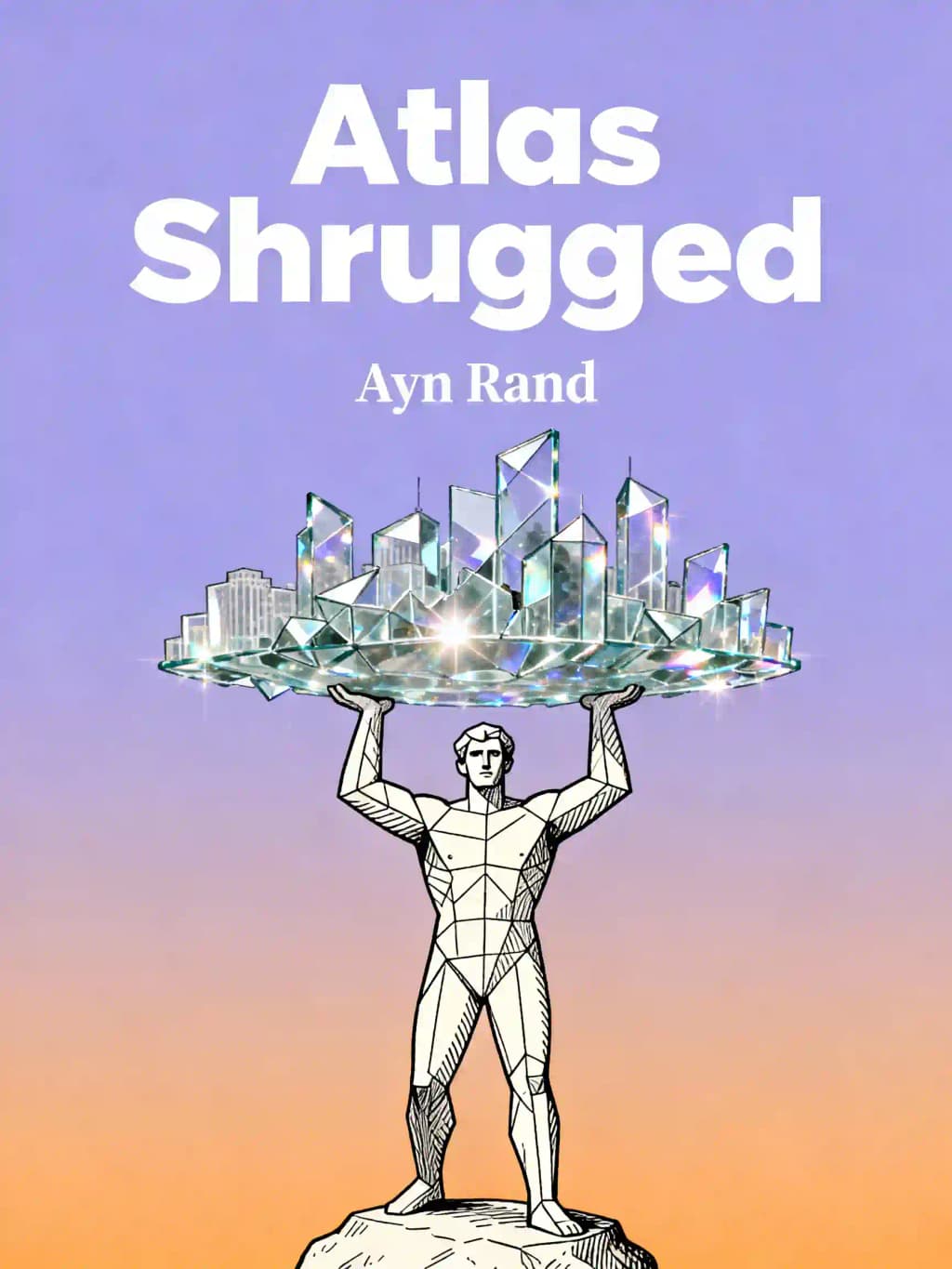
In 1957, a philosophical novel exploded onto the American literary scene that would forever change how we think about capitalism, individualism, and human potential. Ayn Rand's magnum opus became a cultural phenomenon that continues to sell hundreds of thousands of copies annually, with fans ranging from tech titans like Mark Cuban and Elon Musk to politicians across the spectrum. More than a mere story, it represents a comprehensive philosophical system that challenges conventional morality and celebrates human achievement as the highest virtue. Though controversial, its influence remains undeniable in shaping discussions about freedom, government, and the nature of human excellence.
第2章
A World Slowly Crumbling Under Its Own Contradictions
The novel opens in a world teetering on the edge of collapse. America has become unrecognizable - productivity is plummeting, businesses are failing, and innovation has ground to a halt. The government responds with increasingly restrictive regulations, while intellectuals preach the virtue of sacrifice and condemn profit-seeking as immoral. The once-proud railroad industry, symbolized by Taggart Transcontinental, struggles under the weight of bureaucracy and incompetence.
Dagny Taggart, the novel's protagonist and Operating Vice President of the railroad, represents everything the culture has come to despise: competence, ambition, and an unapologetic love of achievement. While her brother James, the company's president, maneuvers politically and avoids responsibility, Dagny fights to keep the trains running. She forms an alliance with Hank Rearden, a brilliant industrialist who has developed an extraordinary new metal stronger and lighter than steel.
Together, they battle against a system that seems designed to punish excellence. When the government issues the "Anti-dog-eat-dog Rule" to eliminate Taggart's only efficient competitor in Colorado, Dagny is appalled by the injustice. When Rearden is prosecuted for selling his metal to a customer of his choice, he proudly defends his right to the product of his mind. "I do not recognize anyone's right to one minute of my life," he declares in court. "Nor to any part of my energy, nor to any achievement of mine."
Meanwhile, the country's most productive citizens begin mysteriously disappearing. Ellis Wyatt, an innovative oil producer; Andrew Stockton, a skilled manufacturer; Lawrence Hammond, a gifted automobile designer - one by one, they vanish without explanation. The only clue is a question that has become a meaningless cultural catchphrase: "Who is John Galt?"
As economic conditions deteriorate, the government responds with increasingly desperate measures. The "Equalization of Opportunity Bill" prevents businessmen from owning more than one company. The "Directive 10-289" freezes all employment, production, and trade, essentially turning the country into an economic prison. Each measure aimed at "the public good" only accelerates the decline.
What makes this portrayal so compelling is how it systematically exposes contradictions in collectivist thinking. The very people who condemn profit-making are desperate for the products that profit-seekers create. Those who preach sacrifice never specify who should be sacrificed to whom, or by what standard. The government officials who claim to protect the public from "economic dictatorship" exercise increasingly dictatorial powers themselves.
第3章
The Mind on Strike: Rebellion Against Exploitation
The novel's central mystery gradually unfolds: the disappearing industrialists haven't been kidnapped or killed - they've gone on strike. Led by the enigmatic John Galt, they've withdrawn their minds from a world that demonizes their achievements while depending on their productivity. This disappearance creates rippling effects throughout the economy, as innovations cease, production falters, and the engines of industry gradually grind to a halt.
This concept - the "strike of the mind" - represents Rand's most original contribution to political philosophy. Throughout history, labor has struck against capital, demanding higher wages or better conditions. But what if capital - or more precisely, the creative minds that drive production - went on strike against a society that vilifies them while living off their efforts? This inversion of the traditional labor strike narrative forces readers to consider the role of intellectual capital in society's prosperity.
Galt articulates this when he finally reveals himself: "We have granted you everything you demanded of us, we who had always been the givers, but have received nothing in return... We have been damned for our virtues in a world where only the vicious have the right to virtue... We are on strike against martyrdom - and against the moral code that demands it." His words crystallize the strikers' fundamental grievance: they're rebelling not against exploitation of their labor, but against the exploitation of their minds and creative capacity.
The strikers retreat to "Galt's Gulch," a hidden valley where they've created a miniature society based on voluntary exchange and mutual respect. Here, former industrial titans work as farmers, cooks, and laborers - not because they must, but because they've chosen to withdraw their talents from a world that punishes production. They've taken the moral principle that "no man may obtain values from others by physical force" and created a community where trade is the only means of dealing with others. This sanctuary serves as a laboratory for Rand's ideals, demonstrating how productivity flourishes when freed from coercion and guilt.
What makes this vision so powerful is how it reframes the relationship between producers and society. Rather than seeing successful businesspeople as exploiters who owe society their wealth, Rand portrays them as the exploited - the victims of progressive taxation, arbitrary regulations, and moral condemnation for the very virtues that keep civilization functioning. Through characters like Hank Rearden and Dagny Taggart, Rand illustrates how innovators and entrepreneurs face not just economic obstacles, but moral persecution for their achievements.
In perhaps the novel's most famous speech, Francisco d'Anconia defends money as "the tool of exchange, which can't exist unless there are goods produced and men able to produce them." He challenges the biblical claim that money is the root of all evil: "Money is a tool that will take you wherever you wish, but it will not replace you as the driver... Money is the product of virtue, but it will not give you virtue and it will not redeem your vices." This defense of wealth creation extends beyond mere economics, positioning money as a symbol of human achievement and productive capacity. D'Anconia's speech serves as a philosophical defense of capitalism itself, arguing that the creation of wealth through voluntary exchange is not just practical but moral.
The strike becomes a metaphor for the moral right of producers to withhold their efforts from a system that treats their productivity as a collective resource rather than an individual achievement. Through this lens, Rand challenges readers to consider whether society has a legitimate claim on the fruits of individual genius and effort.
第4章
The Moral Revolution: Reclaiming Selfishness as a Virtue
The novel's most radical aspect is its moral philosophy. Rand systematically inverts traditional ethics, arguing that selfishness - properly understood - is a virtue, while self-sacrifice is destructive. This isn't the crude selfishness of exploiting others, but rather the principled pursuit of one's rational self-interest through productive work and voluntary exchange. She presents this philosophy through both dramatic conflicts and philosophical discussions, showing how conventional morality has corrupted the meaning of selfishness from rational self-interest to predatory exploitation.
This moral revolution plays out most powerfully in Hank Rearden's character arc. When we first meet him, he's created a revolutionary metal but feels no joy in his achievement, having internalized society's condemnation of pride. He supports his ungrateful family out of duty, remains in a loveless marriage out of obligation, and accepts unearned guilt for his desire for Dagny Taggart. His brother Philip constantly demands money while insulting him, his mother manipulates him with guilt, and his wife Lillian treats his work with contempt - yet he endures it all because he believes self-sacrifice is noble.
Rearden's transformation comes when he realizes that the moral code he's been following is designed to control him by exploiting his virtues. His willingness to bear burdens, his sense of responsibility, his commitment to his promises - all are used against him by people who produce nothing but expect everything. In a pivotal courtroom scene, he declares: "I am proud of my ability to serve men, but I don't propose to be a sacrificial animal... I don't propose to serve them at the price of my self-immolation." This moment marks his rejection of the duty-based morality that had enslaved him to others' demands.
The novel portrays conventional morality as a means by which the unproductive control the productive through an intricate system of guilt and obligation. By teaching people that selfishness is evil and sacrifice is good, society creates a moral framework where the competent feel obligated to support the incompetent. As Francisco d'Anconia explains in his famous "money speech," this inverted morality demands that ability be punished and inability rewarded. The novel demonstrates this through multiple examples, from industrialists being forced to support failing competitors to talented individuals being made to feel guilty for their success.
This moral inversion extends to sexuality as well, challenging traditional views of physical desire as base or shameful. Rand portrays it instead as the natural expression of spiritual values and intellectual admiration. Dagny's relationships with Francisco d'Anconia, Hank Rearden, and ultimately John Galt are presented not as compromises of her independence but as celebrations of shared values and achievements. Their passion is the physical manifestation of their admiration for each other's minds and capabilities, a theme most powerfully expressed in the contrast between Dagny's fulfilling relationships and the loveless unions of characters who accept conventional morality. Through these relationships, Rand illustrates her view that romantic love is not about sacrifice or duty, but about the selfish pleasure of recognizing and rewarding virtue in another person.
第5章
The Power of Reason and the Virtue of Production
Throughout the novel, Rand celebrates reason as humanity's defining attribute and productive achievement as its proper expression. Her heroes are engineers, inventors, and entrepreneurs who transform ideas into reality through disciplined thought and effort. They represent what she calls "the men of the mind" - those who use reason to understand reality and reshape it to human purposes. Dagny Taggart's railroad innovations, Hank Rearden's revolutionary metal alloy, and Ellis Wyatt's oil extraction methods exemplify this ideal of rational productivity.
This celebration of reason stands in stark contrast to the novel's villains, who rely on feelings, mysticism, or political pull. Dr. Simon Pritchett teaches that "logic is an old-fashioned superstition"; Balph Eubank writes novels celebrating "man's defeat by the hopelessness of life"; James Taggart makes decisions based on who he knows rather than what he knows. These characters represent different forms of anti-reason: academic skepticism, artistic nihilism, and crony capitalism respectively. Their actions consistently lead to destruction, whether through failed policies, collapsing industries, or devastating accidents.
The novel's climactic speech by John Galt serves as Rand's comprehensive statement of her philosophy. "Man's mind is his basic tool of survival," he declares. "Life is given to you, the knowledge to sustain it is not." He traces humanity's progress from caves to skyscrapers, from superstition to science, from starvation to abundance - all through the application of reason to reality. This progress is exemplified in the novel through technological achievements like the John Galt Line, Rearden Metal, and the revolutionary motor discovered in the abandoned factory.
This emphasis on production as a moral achievement represents a fundamental challenge to both religious ethics (which often treat worldly success with suspicion) and progressive politics (which often portrays wealth as exploitation). For Rand, the creator's relationship to his creation is sacred - not because it brings material comfort, but because it represents the proper function of consciousness in reshaping reality according to human values. This is illustrated through Francisco d'Anconia's speech about money as the product of virtue, and through the contrast between the productive Valley of John Galt and the decaying outside world.
The novel presents numerous examples of reason's practical power: Eddie Willers' methodical management, Ken Danagger's efficient coal mining operations, and Dr. Hendricks' scientific medical practice. Each demonstrates how rational thought translates into concrete achievements that benefit human life. Conversely, the collapse of the Taggart Bridge, the failure of Project X, and the destruction of the Wyatt oil fields show the catastrophic consequences of abandoning reason for force or feelings.
Rand's philosophy argues that reason and production are inseparable - that the mind's proper function is to understand reality and use that understanding to create value. This connection is symbolized in the sign of the dollar, which appears throughout the novel as an emblem of the mind's creative power. The novel's structure itself mirrors this principle, moving from the question "Who is John Galt?" - representing resignation and despair - to the triumphant answer embodied in Galt himself as the archetype of the rational producer.
第6章
The Danger of Compromise and the Power of Conviction
One of the novel's most striking aspects is its uncompromising stance. While most political philosophies seek middle ground between individual rights and collective needs, Rand rejects such compromises as logically and morally incoherent. "There are two sides to every issue," says one character, "and one of them is wrong." This stark perspective forms the philosophical backbone of the narrative, with Rand consistently demonstrating how attempted compromises between opposing moral principles inevitably lead to destruction.
Throughout the story, characters face pivotal moments where compromise appears to offer an easy solution. Hank Rearden is pressured to surrender his metal patents "for the public good," Dagny Taggart is urged to accept government controls to keep her railroad running, and Francisco d'Anconia is expected to maintain his inherited business while secretly opposing the system. Each instance illustrates Rand's conviction that partial surrender to what one considers wrong is itself wrong. The novel presents numerous examples where characters who attempt to find middle ground - like James Taggart or Dr. Robert Stadler - ultimately contribute to the very destruction they hoped to prevent.
This absolutism plays out dramatically in the story's structure. The strikers refuse half-measures; they withdraw completely from a system they consider immoral. When government officials finally locate John Galt and offer him power to implement his ideas gradually, he refuses: "You want me to be the one to save you from the consequences of your own actions... I will not help you to preserve an illusion." His rejection exemplifies the novel's central theme that compromise with evil enables its continuation.
The uncompromising quality extends beyond plot to permeate the novel's style and symbolism. Rand's characters are larger than life, her dialogue philosophical rather than naturalistic, her narrative structured to dramatize ideas rather than merely entertain. Even her descriptions of technology and industry take on an almost religious quality - the glowing furnaces of Rearden Steel become temples to human achievement, the triumphant progress of the John Galt Line's first run represents the victory of uncompromised vision, and the hidden valley powered by Galt's revolutionary motor stands as a testament to what humanity can achieve when freed from the demands of compromise.
For Rand's admirers, this absolutism represents moral clarity and philosophical consistency in a world too willing to blur ethical lines. The novel demonstrates through multiple storylines how compromise can corrode not just individual integrity but civilization itself. For her critics, it reflects a dangerous oversimplification of complex social realities and human relationships. The contrast between Galt's Gulch, where principles remain pure, and the collapsing outside world serves as Rand's ultimate argument against the practice of compromise. Either way, the novel's unwillingness to compromise gives it a unique power that more moderate works often lack, making it both deeply influential and deeply controversial.
第7章
The Individual Against the Collective
At its core, the novel presents a fundamental conflict between individualism and collectivism - not just as political systems, but as opposing views of human nature and morality. The collectivist worldview, represented by characters like Wesley Mouch and Dr. Floyd Ferris, sees individuals as interchangeable parts in a social machine, their value determined by their usefulness to others. This perspective manifests in policies like the "Anti-Dog-Eat-Dog Rule" and "Directive 10-289," which systematically subordinate individual rights to perceived collective needs. The individualist worldview, embodied by Galt and his followers, sees each person as an end in themselves, with the right to their own life and the pursuit of their own happiness. This is demonstrated through characters like Dagny Taggart and Hank Rearden, who create value through their individual vision and effort.
The philosophical battle plays out in numerous confrontations throughout the novel. When Rearden faces trial for violating government regulations, he refuses to defend himself, stating that he recognizes no right of others to dictate his productive activities. Similarly, Francisco d'Anconia deliberately destroys his own copper mines rather than let them be nationalized, demonstrating the principle that creators have a right to withhold their creation from those who would seize it by force.
This conflict reaches its climax when the government attempts to force Galt to become an economic dictator who will "make things work." When he refuses, they resort to torture - the ultimate expression of the principle that the individual must be sacrificed for the collective. Even in this extremity, Galt remains defiant: "You want me to be the one to save you from the consequences of your own actions... To assume responsibility for your lies, your evasions, your own laziness... I will not help you to preserve an illusion." His torture scene symbolically represents the fundamental choice between submission to collective authority and maintaining individual integrity.
The novel's resolution comes not through political revolution but through the complete collapse of the collectivist system. Without the minds that kept it functioning, the machinery of civilization grinds to a halt. The lights of New York going dark, trains stopping mid-journey, and factories falling silent serve as physical manifestations of what happens when individual achievement is stifled by collective control. Only then, with the old order in ruins, do Galt and his followers prepare to return and rebuild society on the principle of individual rights. Their return is marked by the promise of a new society based on the recognition of individual rights, voluntary exchange, and the moral right to the products of one's mind and effort.
The novel thus presents the triumph of individualism not merely as a political victory, but as a moral necessity for human survival and flourishing. Through the contrast between the declining outside world and the thriving Galt's Gulch, Rand demonstrates her thesis that only a society based on individual rights can sustain human life and progress.
第8章
The Enduring Legacy: Why Atlas Continues to Shrug
More than sixty years after its publication, Atlas Shrugged remains a cultural touchstone, with annual sales consistently exceeding 100,000 copies. Its influence extends far beyond literature into economics, politics, and popular culture. The Ayn Rand Institute distributes hundreds of thousands of copies to students annually, while business schools incorporate its themes into leadership courses. Politicians from Ronald Reagan to Paul Ryan have cited it as inspiration, while tech entrepreneurs from Peter Thiel to Jeff Bezos embrace its celebration of innovation and creative destruction.
The novel's impact on business culture has been particularly profound. Silicon Valley startups often echo Galt's Gulch in their pursuit of disruption free from government interference. Cryptocurrency advocates see their movement as a modern parallel to Rand's vision of financial independence. Even Wall Street firms have been known to distribute copies to new hires as a philosophical primer on free-market capitalism.
What explains this enduring appeal? Perhaps it's the novel's unapologetic celebration of human potential in an age of cynicism and lowered expectations. In a world increasingly focused on collective action and shared responsibility, Rand's emphasis on individual achievement resonates with those who feel their personal agency is under threat. The character of Dagny Taggart, in particular, continues to inspire women in business leadership, offering a model of uncompromising competence in a male-dominated world.
The novel's themes seem particularly relevant in today's political climate. Debates about regulation, taxation, and the role of government mirror the conflicts Rand depicted. The concept of "going Galt" - withdrawing productive capacity in protest - has entered the political lexicon, appearing in discussions of everything from tax policy to tech industry regulation. The book's warnings about the dangers of government overreach and economic intervention find new audiences during every financial crisis or regulatory expansion.
The novel's final image is both defiant and hopeful: John Galt tracing the sign of the dollar in the air, a symbol not just of money but of free minds and free markets. This gesture has become iconic, reproduced on everything from t-shirts to cryptocurrency logos, encapsulating the book's essential message: that human greatness is possible, that achievement deserves celebration rather than condemnation, and that a society that punishes its creators ultimately destroys itself.
Whatever one thinks of Rand's philosophy, her novel stands as one of the most ambitious and influential works of the 20th century - a passionate defense of individual rights, creative achievement, and the power of ideas to shape the world. Its influence can be seen in movements ranging from libertarianism to objectivism, from cryptocurrency to space exploration. In an era when collectivist thinking dominates much of our politics and culture, Atlas Shrugged continues to challenge readers to question received wisdom and consider the moral foundations of a truly free society, inspiring new generations of entrepreneurs, innovators, and independent thinkers.