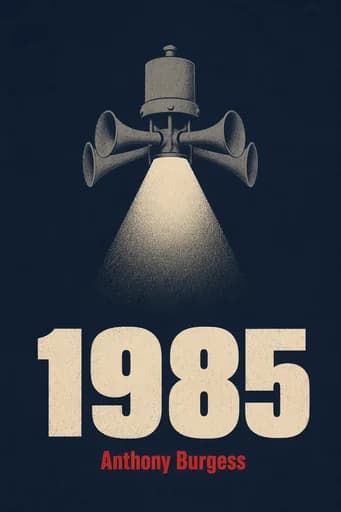
『1985年』の概要
バージェスの『1985年』は、オーウェルのディストピアを鮮やかに再構築し、鋭い批評と身の毛もよだつフィクションの二部構成に分かれています。このダークコメディの傑作は、『1984年』を喜劇として読むべきだと主張しています。これは、私たちが政治的予言や社会の衰退をどのように解釈するかを問い直す、刺激的な見解です。
1985年の要約をダウンロード
1985年の要約をPDFまたはEPUBで無料でダウンロード。印刷やオフラインでいつでもお読みいただけます。
バージェスの『1985年』は、オーウェルのディストピアを鮮やかに再構築し、鋭い批評と身の毛もよだつフィクションの二部構成に分かれています。このダークコメディの傑作は、『1984年』を喜劇として読むべきだと主張しています。これは、私たちが政治的予言や社会の衰退をどのように解釈するかを問い直す、刺激的な見解です。
1985年の要約をPDFまたはEPUBで無料でダウンロード。印刷やオフラインでいつでもお読みいただけます。
コロンビア大学卒業生がサンフランシスコで開発
"Instead of endless scrolling, I just hit play on BeFreed. It saves me so much time."


"I never knew where to start with nonfiction—BeFreed’s book lists turned into podcasts gave me a clear path."


"Perfect balance between learning and entertainment. Finished ‘Thinking, Fast and Slow’ on my commute this week."
"Crazy how much I learned while walking the dog. BeFreed = small habits → big gains."
"Reading used to feel like a chore. Now it’s just part of my lifestyle."

"Feels effortless compared to reading. I’ve finished 6 books this month already."
"BeFreed turned my guilty doomscrolling into something that feels productive and inspiring."

"BeFreed turned my commute into learning time. 20-min podcasts are perfect for finishing books I never had time for."
"BeFreed replaced my podcast queue. Imagine Spotify for books — that’s it. 🙌"

"It is great for me to learn something from the book without reading it."
"The themed book list podcasts help me connect ideas across authors—like a guided audio journey."
"Makes me feel smarter every time before going to work"
コロンビア大学卒業生がサンフランシスコで開発
"Instead of endless scrolling, I just hit play on BeFreed. It saves me so much time."
"I never knew where to start with nonfiction—BeFreed’s book lists turned into podcasts gave me a clear path."
"Perfect balance between learning and entertainment. Finished ‘Thinking, Fast and Slow’ on my commute this week."
"Crazy how much I learned while walking the dog. BeFreed = small habits → big gains."
"Reading used to feel like a chore. Now it’s just part of my lifestyle."
"Feels effortless compared to reading. I’ve finished 6 books this month already."
"BeFreed turned my guilty doomscrolling into something that feels productive and inspiring."
"BeFreed turned my commute into learning time. 20-min podcasts are perfect for finishing books I never had time for."
"BeFreed replaced my podcast queue. Imagine Spotify for books — that’s it. 🙌"
"It is great for me to learn something from the book without reading it."
"The themed book list podcasts help me connect ideas across authors—like a guided audio journey."
"Makes me feel smarter every time before going to work"
"Instead of endless scrolling, I just hit play on BeFreed. It saves me so much time."
"I never knew where to start with nonfiction—BeFreed’s book lists turned into podcasts gave me a clear path."
"Perfect balance between learning and entertainment. Finished ‘Thinking, Fast and Slow’ on my commute this week."
"Crazy how much I learned while walking the dog. BeFreed = small habits → big gains."
"Reading used to feel like a chore. Now it’s just part of my lifestyle."
"Feels effortless compared to reading. I’ve finished 6 books this month already."
"BeFreed turned my guilty doomscrolling into something that feels productive and inspiring."
"BeFreed turned my commute into learning time. 20-min podcasts are perfect for finishing books I never had time for."
"BeFreed replaced my podcast queue. Imagine Spotify for books — that’s it. 🙌"
"It is great for me to learn something from the book without reading it."
"The themed book list podcasts help me connect ideas across authors—like a guided audio journey."
"Makes me feel smarter every time before going to work"
"Instead of endless scrolling, I just hit play on BeFreed. It saves me so much time."
"I never knew where to start with nonfiction—BeFreed’s book lists turned into podcasts gave me a clear path."
"Perfect balance between learning and entertainment. Finished ‘Thinking, Fast and Slow’ on my commute this week."
"Crazy how much I learned while walking the dog. BeFreed = small habits → big gains."
"Reading used to feel like a chore. Now it’s just part of my lifestyle."
"Feels effortless compared to reading. I’ve finished 6 books this month already."
"BeFreed turned my guilty doomscrolling into something that feels productive and inspiring."
"BeFreed turned my commute into learning time. 20-min podcasts are perfect for finishing books I never had time for."
"BeFreed replaced my podcast queue. Imagine Spotify for books — that’s it. 🙌"
"It is great for me to learn something from the book without reading it."
"The themed book list podcasts help me connect ideas across authors—like a guided audio journey."
"Makes me feel smarter every time before going to work"


1985年の同じアイデアを、あなたに合う声・深さ・ペースで学べます。いつでも切り替えられます。
In an era where dystopian fiction has become mainstream entertainment, Anthony Burgess's "1985" remains curiously overlooked despite its prescient warnings about state control, union power, and religious fundamentalism. Written in 1978 as a direct response to George Orwell's "Nineteen Eighty-Four," this hybrid work combines literary criticism with a chilling novella that imagines an alternative path to totalitarianism. While Elon Musk has cited Orwell's masterpiece as a formative influence, and Margaret Atwood's "The Handmaid's Tale" enjoys renewed cultural relevance, Burgess's equally disturbing vision languishes in relative obscurity. Yet its warnings about the fragility of individual freedom against collective demands feel increasingly relevant in our polarized political landscape. What happens when the right to work conflicts with the demands of solidarity? How easily might our cherished liberties be sacrificed on the altar of security or collective welfare?
Burgess approaches Orwell's classic not as prophecy but as satire-a reflection of post-war Britain with "certain fanciful things grafted on." Both authors shared remarkable parallels: they abandoned their birth names (John Burgess Wilson and Eric Blair), worked in imperial service abroad, and developed profound concerns about totalitarianism, albeit from different angles. While Orwell's guilt about privilege drove him to identify with the working class, Burgess sought to escape his working-class origins through education and cosmopolitanism. For Burgess, Orwell's nightmare vision stems from his unique position as both a socialist and a critic of socialism. Orwell cherished distinctly English pleasures-wild flowers, church architecture, Oxford marmalade, and bitter beer-while simultaneously critiquing the society that produced them. This tension between idealism and pragmatism runs through Nineteen Eighty-Four, which Burgess reads as a warning about intellectual totalitarianism rather than merely state surveillance. "The appropriate response to dystopian fiction," Burgess suggests, "is a pleasurable shudder coupled with awareness of the warning." Dystopias aren't predictions but explorations of possibilities-what might happen if current trends continue unchecked. Orwell's genius lay in recognizing that totalitarianism "if not fought against, could triumph anywhere," including Britain with its proud democratic traditions. Burgess's analysis cuts deeper than mere literary criticism. He identifies the philosophical core of Orwell's nightmare: power exercised for its own sake. O'Brien's vision of "a boot stamping on a human face-forever" represents not sustainable governance but an unsustainable sadism. Real power requires choice, not just cruelty. The Party's collective solipsism ignores natural forces that would inevitably undermine it-disease, environmental collapse, even linguistic evolution would erode Newspeak's rigid structures. What makes Nineteen Eighty-Four truly disturbing isn't its surveillance technology but its philosophical consistency. The Party doesn't just want obedience; it wants to remake human nature itself. As Burgess observes, "Evil in its purest form shares with good a certain disinterestedness." While good promotes freedom, evil seeks to eliminate it entirely.
『1985年』の一語一語が音声に合わせてリアルタイムでハイライトされ、自然に読み進められます。
Burgess expands his analysis beyond Orwell to examine how anarchist philosophy shapes modern political movements. Mikhail Bakunin, the Russian revolutionary who adapted Hegel's dialectic to anarchist ends, provides a philosophical framework: history moves toward a better world, new things are better than old, therefore destroying old institutions necessarily creates better replacements. This interpretation of historical progress, while compelling to revolutionaries, overlooks the complex ways institutions evolve and adapt over time. The destructive impulse found powerful expression in the student rebellions of the 1960s and 1970s, particularly in events like the Paris uprising of 1968 and American campus protests. Burgess observes that youth movements define themselves through communal identity rather than coherent political action - creating shared symbols, language, and cultural markers that often supersede actual political strategy. While some intellectuals developed sophisticated rationales mixing Marx, Bakunin, and counterculture elements, most youth rebellion lacked the nineteenth-century anarchists' goal of providing a genuine alternative to the State. Instead, these movements often focused on immediate grievances and symbolic victories without developing sustainable models for social organization. The paradox of anarchism, Burgess suggests, is that rejecting all authority often leads to new forms of tyranny. Communes that reject state authority frequently develop their own oppressive structures through ignorance of social principles - from the Paris Commune's descent into factional violence to modern instances of commune leadership becoming autocratic. Without education in history and philosophy, rebels remain vulnerable to manipulation by "mature radical minds" who understand power's mechanisms. Historical examples like the Cultural Revolution in China demonstrate how anti-authority movements can be co-opted by those seeking to consolidate power. This analysis illuminates our current political moment, where social media amplifies anti-establishment sentiment while providing few constructive alternatives. Digital platforms create echo chambers that reinforce destructive impulses while limiting exposure to complex political theory or historical context. The impulse to tear down institutions without understanding their functions creates a vacuum that more organized forces - whether corporations, religious movements, or authoritarian leaders - can readily exploit. Recent examples include the way social media-driven protests have been channeled into various political movements, often serving interests far removed from their original anti-establishment goals. Burgess's insights prove particularly relevant in examining how modern movements often repeat historical patterns of anarchist thought without learning from their predecessors' experiences. The cycle of rebellion, destruction, and eventual co-optation continues, suggesting that genuine social change requires not just the energy of youth movements but also deep understanding of political theory and institutional dynamics.
For Burgess, true freedom requires maintaining certain areas of judgment - truth, beauty, and goodness - that remain separate yet echo religious attributes. These fundamental values serve as pillars supporting individual autonomy, much like a secular trinity that provides moral orientation. Education provides both knowledge and evaluative tools, enabling individuals to make informed judgments about their world and resist manipulation. Through rigorous study of history, literature, and philosophy, people develop the critical thinking skills necessary to recognize and resist authoritarian control. The greatest danger comes when young people reject tradition and education, leaving themselves vulnerable to tyranny disguised as liberation. This rejection often manifests as a dismissal of the past's wisdom in favor of seemingly progressive ideologies that actually restrict freedom. The individual remains eternally in conflict with collectives, a struggle that intensifies as society becomes more mechanized and standardized. Winston Smith in Nineteen Eighty-Four fights for truth but lacks metaphysical grounding to oppose the state effectively - his isolation from traditional knowledge and values leaves him without philosophical weapons against totalitarianism. Modern tyranny's goal isn't merely eliminating enemies but converting them - making them love Big Brother through psychological manipulation and the destruction of individual identity. The process involves breaking down personal beliefs, memories, and relationships until the person becomes an empty vessel ready to accept state doctrine. Winston's defeat culminates in a chess metaphor: he had freedom to maneuver but no hope against the stronger player, highlighting how individual resistance requires more than just the will to oppose - it needs intellectual and moral foundations. This chess analogy perfectly captures the nature of the State's game against citizens in both Orwell's and Burgess's dystopias. The state, like a masterful chess player, can anticipate and counter every move, while the citizen, though technically free to choose their actions, lacks the strategic depth to win. Unlike Huxley's Brave New World where humans are conditioned from birth through biological and psychological engineering, these nightmares depend on free will - citizens must be aware their freedom is being impaired for true totalitarianism to function. The state requires conscious submission rather than mere robotic compliance, making the victory over human spirit complete. This awareness of loss makes the oppression more psychologically devastating and serves as a warning about how freedom can be systematically dismantled while maintaining its outward appearance.
Burgess's novella "1985" opens with tragedy: Bev Jones returns home to find his mentally challenged daughter Bessie watching cartoons while his wife Ellen lies dying in a hospital fire. The fire occurred during both a firemen's strike and an army mutiny, leaving no emergency services available. Ellen's final words-"Don't let them get away with it"-set Bev on a collision course with Britain's union-dominated society. This Britain of 1985 has evolved into "Tucland" (named after the Trades Union Congress), where union membership has become mandatory for employment, voting rights, and social benefits. History education focuses primarily on trade union movements, while classical culture withers under utilitarian pressures. The Arabs own much of Britain, including oil rights, hotels, and breweries, with Islam gaining influence as the Great Mosque of London rises in Westminster. When Bev defies a Christmas Eve confectionery workers' strike by reporting to his chocolate factory job, he's promptly fired and denied unemployment benefits despite years of National Insurance contributions. His principled stand leaves him homeless and separated from his daughter, who's placed in a state institution. Burgess's dystopia differs fundamentally from Orwell's. Where Nineteen Eighty-Four presents a monolithic state with absolute control, Burgess envisions competing powers-unions, corporations, religious interests-creating a chaotic tyranny where individual rights vanish between collective demands. The state doesn't need telescreens when economic pressure achieves the same control.
Homeless and desperate, Bev encounters unexpected allies: "kumina boys," young gang members who combine violent crime with intellectual pursuits. Their leader Tuss explains their underground educational movement inspired by someone called Mizusako, who advocates "disinterestedness" and an "underground university" teaching forbidden subjects like Latin, Greek, and history. These youths reject the "lousy" Labour education system that "levels" and discourages intelligence. They seek out "antistate teachers" to learn what the State deems useless-classical languages, philosophy, and history. Their philosophy combines violent rebellion with intellectual pursuit, viewing both as necessarily "antistate" activities. Later, Bev finds shelter with a group of homeless men including Reynolds, a former literature teacher who resigned rather than teach the State's approved curriculum of pop lyrics and dumbed-down fiction. The group includes two professional musicians without union cards who play Mozart and Bach duets on violin and viola, lamenting how unions have destroyed classical performances by stopping operas mid-act when overtime is refused. Burgess presents culture itself as inherently subversive in a totalitarian context. When the state demands utility and conformity, beauty and intellectual complexity become forms of resistance. This insight feels particularly relevant today, when humanities education faces pressure to demonstrate immediate economic value, and complex ideas are reduced to simplistic political positions.
『1985年』の一語一語が音声に合わせてリアルタイムでハイライトされ、自然に読み進められます。
Caught stealing food to survive, Bev finds himself facing "rehabilitation" at Crawford Manor, a Trade Union Congress center designed to break the will of those who resist the system. The facility, with its sterile corridors and institutional efficiency, represents the regime's approach to ideological correction. Mr. Pettigrew, the center's calculating director, articulates the regime's fundamental philosophy through carefully rehearsed arguments: the inner world of dreams, visions, and spiritual beliefs must never infiltrate or influence the outer world of work and collective needs. He presents historical evidence of suffering caused by those who imposed their inner visions on society-from Moses leading his people into the wilderness, to medieval religious reformers inciting peasant revolts, to modern political ideologues spawning revolutions. When Bev challenges this collectivist philosophy, he strikes at its core contradiction-questioning what truly motivates its middle-class proponents who themselves enjoy privileges while preaching equality. Pettigrew responds by outlining the three pillars of rehabilitation: mandatory job selection within the union framework, issuance of a new union card marking the person as "reformed," and formal recantation of ideological "heresy." The process reveals how the system seeks not just behavioral compliance but complete psychological submission. After Bev physically attacks Pettigrew-a spontaneous act of defiance against this mechanical process-union officials drag him to a basement interrogation room. Here, the veneer of rehabilitation falls away to reveal crude coercion. They demand he sign a carefully worded statement acknowledging his "errors" and pledging unwavering future cooperation with union principles. Despite severe beatings that leave him bloodied and barely conscious, Bev maintains his resistance, refusing to surrender his inner convictions. This sequence brilliantly illustrates how totalitarian systems operate through forced confession and ideological conversion rather than mere physical control. The goal isn't simply outward compliance but genuine belief-the victim must come to love and embrace the system that oppresses them. The rehabilitation process mirrors historical examples from the Soviet show trials to China's Cultural Revolution, where public confession and ideological reformation were central to maintaining control. When Bev refuses this inner surrender, Pettigrew reveals the system's true face, condemning him as "a flaw in the system" and "a piece of stinking gangrenous flesh" that must be cut off from society's blood supply-metaphors that chillingly echo the dehumanizing language of totalitarian purges throughout history.
Expelled from rehabilitation for his continued resistance, Bev joins the "Free Britons," a paramilitary organization that emerges as a response to Britain's deteriorating social order. Led by the enigmatic Colonel Lawrence - a figure who cultivates a mystique of patriotic authority - the group positions itself as the last defense of essential services during widespread industrial action. They recruit primarily from former military personnel and disillusioned workers, promising to maintain order through direct action where government authority fails. However, Bev's initial attraction to their message of resistance quickly sours as he witnesses their methods firsthand. Lawrence's organization reveals itself to be as oppressive as the system it claims to fight - enforcing discipline through intimidation and violence. Workers attempting to leave the controversial mosque construction project simply disappear, their families too frightened to ask questions. The Free Britons' headquarters, a converted country estate, becomes a center for surveillance and coercion, complete with holding cells for "problematic elements." Islamic influence penetrates British society through sophisticated economic leverage rather than direct force. Sheikh Jamaluddin, the shrewd chairman of the Islamic Oil Union, exemplifies this approach. His "request" to take Bev's thirteen-year-old daughter Bessie for "probationary concubinage" - a euphemism for what amounts to purchased marriage rights - demonstrates how economic power translates into social control. The Sheikh's offer of financial security proves impossible for many struggling families to refuse. The cultural transformation accelerates through subtle market manipulation. Arab-owned breweries gradually alter traditional British beer, making it progressively weaker while maintaining the same price point. Pork products become prohibitively expensive through targeted market interventions - not through outright bans, but through economic pressure on suppliers and distributors. Halal options multiply in shops and cafeterias, while traditional British foods become luxury items. When Britain finally succumbs to a general strike, three distinct power centers emerge: militant union leaders controlling basic utilities and transport, Free Briton paramilitaries patrolling streets with unofficial authority, and Islamic business interests protected by private security forces. The formal government structure crumbles as Prime Minister Sheen resigns, unable to maintain even a pretense of control. The King's initial silence reveals the uncomfortable truth - Britain has long been effectively governed by Trade Union Congress demands rather than elected officials. This three-way power struggle creates a perfect storm of competing tyrannies. Union militants control access to essential services, Free Briton paramilitaries enforce their version of order through violence, and Islamic interests leverage their economic power to reshape society. Individual rights disappear in the chaos of competing authorities. The deadlock breaks only when King Charles III - in an unprecedented breach of constitutional convention - directly addresses the nation. His intervention, ordering armed forces to resume duty, disbanding the Free Britons, and mandating that mosque construction follow standard union regulations, temporarily stabilizes the situation but reveals how far Britain has strayed from democratic governance.
Burgess concludes with a comprehensive scholarly exposition on "Worker's English," the rationalized proletarian language made compulsory in State schools following the 1981 Democratization of Language Act. Created by government linguists through careful social engineering, it standardizes the natural speech patterns of urban industrial workers while systematically simplifying grammar and vocabulary - effectively creating a class-based linguistic system that reinforces social hierarchies. This linguistic engineering parallels Orwell's Newspeak but with more nuanced and subtle differences. Where Newspeak aims to make thoughtcrime impossible by eliminating words for forbidden concepts entirely, Worker's English operates through sophisticated class markers and calculated simplification. It strategically maintains certain irregular plural forms like "men," "women," and "mice" but standardizes verb forms across the board, implementing the invariable negative "ain't" and consistent past-tense formations. This selective preservation of irregularities serves to create an illusion of organic language evolution while actually controlling thought patterns. The verb "get" achieves special status in this system, expanding to possess remarkable versatility with the potential to replace most other verbs through carefully constructed phrases: "get angry" (become), "get going" (depart), "get done" (accomplish). Worker's English embraces what Burgess terms "economy of lexis," requiring precise trade and technical vocabulary for industrial work while simultaneously simplifying social and emotional vocabulary to mainly Germanic origins. Abstract concepts are systematically avoided or reduced, though a specific rhetorical sub-lexis of Latin and Greek polysyllables remains available to workers without precise definition - creating an illusion of intellectual access while maintaining class distinctions. The system's genius lies in its apparent naturalism. Unlike crude propaganda or obvious censorship, Worker's English appears to emerge from working-class speech patterns while actually reshaping them. It maintains enough complexity in technical areas to enable industrial productivity while limiting vocabulary and structures that might facilitate complex social or political thought. This detailed linguistic analysis demonstrates Burgess's brilliance as both novelist and linguist. He understood that controlling language shapes thought in ways far subtler and more effective than outright censorship. By privileging certain expressions and grammatical structures while subtly deprecating others, authorities can profoundly influence how citizens conceptualize their world without resorting to obvious repression. The system creates invisible boundaries of thought - limits that feel natural to those working within them while serving the state's purposes of social control.
Bev's story reaches a devastating conclusion that serves as a stark commentary on individual autonomy in the face of systemic control. Sentenced to indefinite detention "for as long as His Majesty's pleasure shall determine," he's transported to Purfleet Castle, now coldly redesignated as SI-5 - a facility that represents the state's power to remake even historic buildings into instruments of control. During his psychological assessment, he passionately defends his fundamental beliefs about what makes life meaningful: "beauty, truth, spiritual endeavour, ideals, eccentricity." The examining doctors, products of a system that prizes conformity above all, interpret these deeply human values not as wisdom but as clear evidence of mental instability. For years, Bev attempts to maintain his dignity and purpose by teaching history to fellow inmates, sharing his knowledge of a past that the authorities would rather forget. His persistent efforts to contact his daughter meet with silence - whether due to interference from authorities or her own choice remains painfully unclear. This separation from his only child becomes a symbol of how the system severs not just political but deeply personal connections. As hope gradually erodes, Bev's mental state deteriorates, though his core beliefs remain unshaken. His final reflection that "they all got away with it; they always would" speaks to the bitter recognition that power structures perpetuate themselves regardless of individual resistance. In his last act of defiance, he approaches the electrified perimeter fence - a literal barrier between imprisonment and freedom - and commits suicide, "puzzling an instant about why you had to resign from the union of the living in order to join the strike of the dead." This poetic yet devastating final thought frames his death as both a protest and a philosophical question about the nature of resistance. Unlike Winston Smith in Orwell's 1984, who ultimately surrenders his inner resistance by learning to love Big Brother, Bev maintains his principles until the very end. Yet this steadfast adherence to his values leads to an equally futile outcome. His death illustrates a cruel paradox: in a totalitarian system, maintaining one's integrity may require the ultimate sacrifice of self-destruction. The system wins either way - through compliance or elimination. Bev's tragic end serves as a powerful meditation on the limits of individual resistance against collective power, suggesting that while the human spirit may remain unbroken, its victory often comes at an unbearable cost.
『1985年』の一語一語が音声に合わせてリアルタイムでハイライトされ、自然に読み進められます。
In his epilogue, Burgess offers predictions for the year 2000 that prove remarkably accurate: multi-channel television dominating entertainment, heightened security measures everywhere due to terrorism, expensive fuel, growing Islamic influence alongside declining Christianity, and increasingly tasteless food despite material abundance. His most prescient warning concerns language: words for moral concepts losing precise meaning, technical terms proliferating, and governments restricting certain expressions deemed offensive. This linguistic shift undermines the capacity for moral reasoning and political resistance-when we lack words for complex ethical concepts, we struggle to articulate objections to power. Reading "1985" today reveals its continuing relevance. While unions no longer dominate Western economies, new collective pressures emerge from both corporate power and identity politics. The tension between individual liberty and group solidarity remains unresolved. Religious fundamentalism continues challenging secular governance, while technological surveillance surpasses anything Orwell imagined. Burgess's hybrid work-part criticism, part fiction-offers a unique perspective on liberty's fragility. Unlike many dystopian writers, he recognizes that tyranny doesn't require a monolithic state; it can emerge from competing powers that collectively eliminate individual autonomy. His warning resonates in our fractured political landscape, where freedom faces threats from multiple directions simultaneously. The greatest danger, Burgess suggests, comes not from obvious oppression but from gradual surrender-trading liberty for security, comfort, or group belonging. His final message remains cautiously optimistic: despite these threats, he believes in "the persistence of free mind and inquiry against those who would restrict freedom." The human spirit's resilience offers hope, even as institutional protections erode.
100万人以上の学習者に愛用されています
“23日間、毎日使い続けています。今では日課の一部です。”
jayallen
The Rogue's Progress to Modern Satire
This plan is essential for literature students and writers who want to master the art of social critique through the lens of the anti-hero. It provides a historical roadmap from Spanish picaresque origins to contemporary satire, making it ideal for those interested in character-driven cultural commentary.

Read high-concept sci-fi exploring extremes
High-concept science fiction pushes the boundaries of imagination, challenging readers to confront radical ideas about humanity's future and the nature of reality itself. This learning plan is ideal for readers seeking to move beyond conventional sci-fi narratives into more intellectually demanding works that explore consciousness, technological transcendence, and the outer limits of speculative thought.

Oxford Greats: The 19th-Century Novel
This learning plan offers a deep dive into the socio-political forces that shaped the Victorian era's most enduring literary works. It is ideal for literature students, history buffs, and readers looking to understand the intersection of industrial trauma and identity politics.

The Architecture of Defiance
This curriculum is essential for those seeking to understand how high-stakes philosophy translates into lived resistance and psychological resilience. It is ideal for students of literature, political activists, and anyone grappling with the burden of personal freedom in a post-truth world.
The Sociology of Morbid Curiosity
This learning plan provides a critical lens into the darker corners of digital social behavior and the collapse of traditional narratives. It is essential for sociologists, digital strategists, and cultural critics seeking to understand why modern audiences are drawn to transgression and chaos.

The Culture: AI Minds and Human Purpose
This plan explores the intersection of advanced technology and social philosophy through the lens of Iain M. Banks's universe. It is ideal for sci-fi enthusiasts, futurists, and ethicists interested in the long-term implications of AI governance.

Aron beauregard's playground
This plan is essential for aspiring writers and horror enthusiasts who want to master the delicate balance between visceral shock and psychological depth. It provides a structured approach to understanding the mechanics of extreme fiction while honoring its literary significance.

The Birth of Wisdom
This plan bridges the gap between ancient logic and modern existential critique, offering a powerful toolkit for independent thought. It is ideal for students of philosophy, debaters, or anyone seeking to liberate their mind from conventional biases.