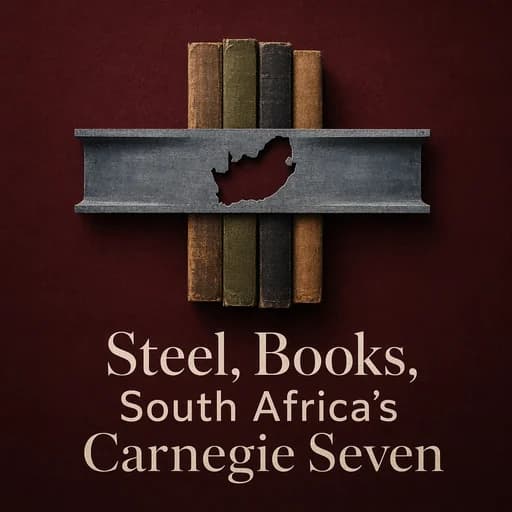
Steel, Books, and South Africa’s Carnegie Seven
Explore the architectural legacy and cultural impact of the twelve Carnegie libraries built in South Africa, from Edwardian designs to the surviving seven landmarks.
Miglior citazione da Steel, Books, and South Africa’s Carnegie Seven
The Carnegie libraries were more than just architecture; they were the physical manifestation of a belief that access to books is the ultimate ladder for self-improvement and an engine of development for the community.

Questa lezione audio è stata creata da un membro della comunità BeFreed
Teach me the history and architecture of the Carnegie Libraries built in South Africa by the Carnegie Corporation in New York



Domande frequenti
Carnegie’s philanthropy was rooted in his own history as a "self-made man" who attributed his success to having access to a private library as a young boy in Pittsburgh. In South Africa, the movement was sparked by local needs, such as in Vryheid, where the librarian petitioned Carnegie for a building to provide "enlightenment" and a productive alternative for young men who otherwise only had the local canteen for social gathering. Carnegie believed that providing the "hardware" of a library would help industrious individuals help themselves.
The Carnegie Formula was a set of strict conditions a municipality had to meet to receive a grant. The local government was required to provide the site for the building at no cost and pledge an annual budget for maintenance and operation equal to ten percent of the original construction cost. This ensured the community had "skin in the game" and that the library would become a permanent public institution rather than a short-lived gift.
Early libraries like Vryheid and Muizenberg featured Edwardian flourishes such as decorative cupolas and domes. However, after 1910, Carnegie’s secretary James Bertram implemented strict "general specifications" to prioritize efficiency over elegance. He viewed fancy embellishments as a waste of money that provided no functional space. Later buildings, such as those in Potchefstroom and Newcastle, reflect this minimalist influence, focusing on high windows for maximum shelf space and central desks for better supervision.
Out of the original twelve Carnegie library buildings in South Africa, five are considered lost because they were demolished or fell into extreme disrepair. For example, the Krugersdorp and Benoni libraries were demolished in the 1970s to make way for more modern facilities as populations grew. In some cases, like Barberton and Germiston, the buildings suffered severe deterioration or fire, leading to projects that preserved only the original façades while the rest of the structure was replaced or repurposed.
By 1917, the Corporation moved away from "bricks and mortar" grants to focus on the "software" of librarianship. They realized that beautiful buildings were ineffective without professional staff, so they began funding librarian training, correspondence courses, and the establishment of the South African Library Association. This shift aimed to transform libraries from mere book warehouses into professional educational hubs, eventually leading to the creation of the first library school at the University of Cape Town.
Scopri di più

Steel and Strategy
This plan provides a comprehensive bridge between classical military theory and modern global power dynamics. It is ideal for aspiring strategists, history enthusiasts, and professionals seeking to understand the structural forces that shape our world.

The Evolution of the Built Environment
This learning plan provides a comprehensive overview of how human design has shaped our world across centuries. It is ideal for aspiring architects, history enthusiasts, and urban planners looking to understand the structural and spiritual evolution of our cities.
American Mechanical Heritage Archive
This archive provides a comprehensive look at the mechanical milestones that built the modern world. It is essential for history buffs, aspiring engineers, and manufacturing professionals seeking to understand the roots of American industrial leadership.

The most important works of literature
This learning plan provides a comprehensive journey through the essential works that shaped Western literature, offering both historical context and deep textual analysis. It's ideal for serious readers seeking cultural literacy, students preparing for advanced literary study, educators building curriculum knowledge, or anyone wanting to understand the books that continue to influence modern storytelling and thought. By progressing chronologically through literary history, learners gain both breadth of knowledge and the critical tools to engage meaningfully with humanity's most celebrated narratives.

Stone, Steel, and Koine
This plan is essential for historians and linguists seeking to bridge the gap between classical studies and field archaeology. It provides the rare technical toolkit needed to read the literal foundations of the Hellenistic world, making it ideal for researchers and dedicated enthusiasts of ancient Mediterranean history.

Build a Massive Mental Library
This plan is designed for lifelong learners and aspiring polymaths who want to move beyond surface-level facts. It bridges the gap between historical context, scientific curiosity, and social intelligence to help you build a more sophisticated understanding of the world.

The Architecture of Power
Understanding the structural roots of authority is essential for navigating modern political and social landscapes. This plan is ideal for students of history, sociology, or leadership seeking to understand how power is built and sustained.

Classic literature
Classic literature forms the foundation of Western cultural literacy and continues to influence modern storytelling, philosophy, and social discourse. This learning plan is ideal for anyone wanting to move beyond surface-level reading to deeply understand the works that have shaped our literary heritage, whether you're a student, educator, lifelong learner, or simply someone who wants to engage meaningfully with the books everyone references but few truly comprehend.
Creato da alumni della Columbia University a San Francisco
"Instead of endless scrolling, I just hit play on BeFreed. It saves me so much time."


"I never knew where to start with nonfiction—BeFreed’s book lists turned into podcasts gave me a clear path."


"Perfect balance between learning and entertainment. Finished ‘Thinking, Fast and Slow’ on my commute this week."
"Crazy how much I learned while walking the dog. BeFreed = small habits → big gains."
"Reading used to feel like a chore. Now it’s just part of my lifestyle."

"Feels effortless compared to reading. I’ve finished 6 books this month already."
"BeFreed turned my guilty doomscrolling into something that feels productive and inspiring."

"BeFreed turned my commute into learning time. 20-min podcasts are perfect for finishing books I never had time for."
"BeFreed replaced my podcast queue. Imagine Spotify for books — that’s it. 🙌"

"It is great for me to learn something from the book without reading it."
"The themed book list podcasts help me connect ideas across authors—like a guided audio journey."
"Makes me feel smarter every time before going to work"
Creato da alumni della Columbia University a San Francisco
"Instead of endless scrolling, I just hit play on BeFreed. It saves me so much time."
"I never knew where to start with nonfiction—BeFreed’s book lists turned into podcasts gave me a clear path."
"Perfect balance between learning and entertainment. Finished ‘Thinking, Fast and Slow’ on my commute this week."
"Crazy how much I learned while walking the dog. BeFreed = small habits → big gains."
"Reading used to feel like a chore. Now it’s just part of my lifestyle."
"Feels effortless compared to reading. I’ve finished 6 books this month already."
"BeFreed turned my guilty doomscrolling into something that feels productive and inspiring."
"BeFreed turned my commute into learning time. 20-min podcasts are perfect for finishing books I never had time for."
"BeFreed replaced my podcast queue. Imagine Spotify for books — that’s it. 🙌"
"It is great for me to learn something from the book without reading it."
"The themed book list podcasts help me connect ideas across authors—like a guided audio journey."
"Makes me feel smarter every time before going to work"
"Instead of endless scrolling, I just hit play on BeFreed. It saves me so much time."
"I never knew where to start with nonfiction—BeFreed’s book lists turned into podcasts gave me a clear path."
"Perfect balance between learning and entertainment. Finished ‘Thinking, Fast and Slow’ on my commute this week."
"Crazy how much I learned while walking the dog. BeFreed = small habits → big gains."
"Reading used to feel like a chore. Now it’s just part of my lifestyle."
"Feels effortless compared to reading. I’ve finished 6 books this month already."
"BeFreed turned my guilty doomscrolling into something that feels productive and inspiring."
"BeFreed turned my commute into learning time. 20-min podcasts are perfect for finishing books I never had time for."
"BeFreed replaced my podcast queue. Imagine Spotify for books — that’s it. 🙌"
"It is great for me to learn something from the book without reading it."
"The themed book list podcasts help me connect ideas across authors—like a guided audio journey."
"Makes me feel smarter every time before going to work"
"Instead of endless scrolling, I just hit play on BeFreed. It saves me so much time."
"I never knew where to start with nonfiction—BeFreed’s book lists turned into podcasts gave me a clear path."
"Perfect balance between learning and entertainment. Finished ‘Thinking, Fast and Slow’ on my commute this week."
"Crazy how much I learned while walking the dog. BeFreed = small habits → big gains."
"Reading used to feel like a chore. Now it’s just part of my lifestyle."
"Feels effortless compared to reading. I’ve finished 6 books this month already."
"BeFreed turned my guilty doomscrolling into something that feels productive and inspiring."
"BeFreed turned my commute into learning time. 20-min podcasts are perfect for finishing books I never had time for."
"BeFreed replaced my podcast queue. Imagine Spotify for books — that’s it. 🙌"
"It is great for me to learn something from the book without reading it."
"The themed book list podcasts help me connect ideas across authors—like a guided audio journey."
"Makes me feel smarter every time before going to work"