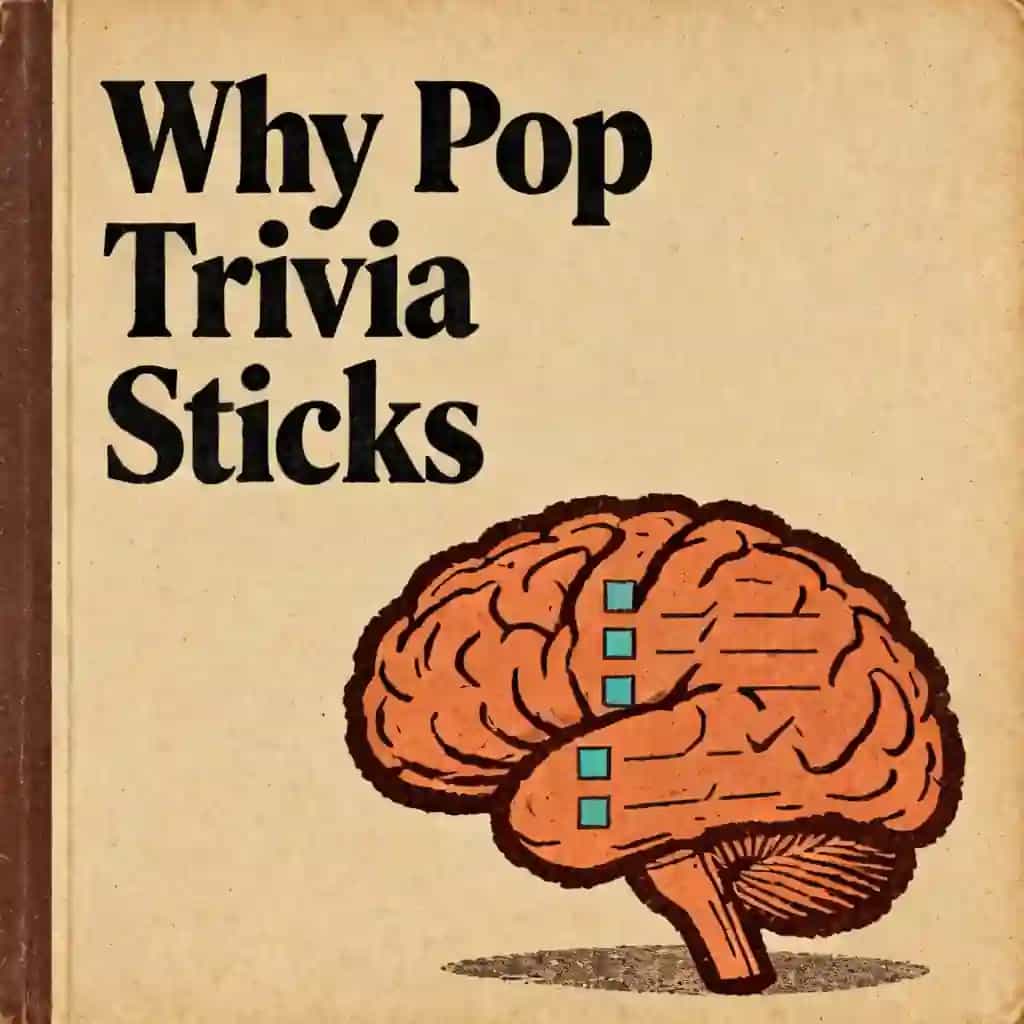
Miles: It’s a real risk, Lena. When we outsource our "knowing" to search engines, we stop building that "cognitive reserve." There is actually a term for it now—the "Google Effect." We’re becoming better at remembering where to find information than the information itself. We’re essentially turning our brains into bookmarks instead of libraries.
Lena: That is such a chilling thought! "Our brains as bookmarks." So, if the internet goes down, we’re all just... empty shelves?
Miles: Pretty much. Which is why being a "trivia legend" is actually a quiet act of rebellion. It’s about owning your knowledge. But to do that effectively—especially if you’re playing to win—you have to understand the anatomy of a great fact. Trivia champions don't just memorize everything; they look for facts with three specific qualities.
Lena: Okay, give me the secret sauce. What makes a fact "trivia gold"?
Miles: First, it has to sound unbelievable but be 100% true. Like the fact that a blue whale’s heart is so big a human could swim through its arteries.
Lena: I’ve heard that one! It sounds like a total "tall tale," but then you see the scale of the thing and you’re like, "Oh, okay, that checks out."
Miles: Exactly. It forces people to second-guess themselves. The second quality is diversity—it needs to span categories. You want facts that bridge history and science, or pop culture and medicine. Like the fact that ketchup was sold as a medicine in the 1830s. A doctor in Ohio claimed it could cure diarrhea and indigestion. It was even sold in pill form!
Lena: Ketchup pills... I’m not sure if that’s better or worse than the chainsaw thing.
Miles: (Laughs) Right? But see how that covers food, history, and medicine all at once? That is a high-utility fact. And the third quality is "vividness." It has to create a mental image. Like the "Dancing Plague" of 1518, where hundreds of people in Strasbourg just danced uncontrollably for days. Some literally danced themselves to death.
Lena: That is terrifying! But I can see it. It’s like a movie scene.
Miles: Exactly. Vividness makes it "sticky." Now, if you’re hosting a trivia night—and a lot of people are doing this now to build community or raise money—you have to balance these "heavy hitters" with "gimme" questions. If every question is about dancing plagues and pelvic saws, people get frustrated. You need that "climb" in difficulty.
Lena: Like the "Jeopardy!" board. You start with the $200 questions to get the gears turning, then you hit them with the $2000 deep-cuts.
Miles: Precisely. And you have to consider your audience. If you’re at a bar near a university, you go heavy on pop culture and "chronically online" trends. If it’s a neighborhood pub, you want more general knowledge—stuff that appeals to multiple generations. You want the Boomer who knows about the 1960s space race to feel just as valuable as the Gen Z-er who knows who won the latest reality show.
Lena: That "social" aspect seems so key. It’s not just about what you know; it’s about how your team’s collective knowledge fits together. I love the idea of "collaborative retrieval"—where one person remembers a snippet of a song, another remembers the year it came out, and together you piece it together.
Miles: It is a beautiful thing to watch. It actually lowers "test anxiety." When you’re on a team, the pressure is shared. You can laugh off a wrong answer. And that social bonding is a huge part of why trivia is so good for mental health. It fights loneliness in a low-pressure way. You don't have to "think of something to say"—the question gives you the prompt, and your personality fills in the gaps.
Lena: It’s like a "social lubricant" for nerds. But we have to talk about the "dark side" of trivia—the arguments. We’ve all been there where the host says one thing, and the "expert" at Table 4 insists they’re wrong. How do you handle that "editorial friction" in person?
Miles: (Laughs) Oh, man. The "disputed answer." That is the "edit war" of the real world. As a host, you have to be the final word, but you also have to be prepared. Fact-checking is everything. You can't just trust a random "fun facts" list from 2012. You have to verify. For example, a lot of people still think Napoleon was short.
Lena: He wasn't?
Miles: Nope. He was about 5'7", which was actually average or even slightly tall for a Frenchman at the time. The "short" thing was British propaganda and a misunderstanding of French versus English measurements. If a host uses that as a "fact," and an actual history buff is in the room, you’re going to have a riot on your hands.
Lena: So the host has to be as rigorous as a Wikipedia editor, but with more charisma.
Miles: Exactly. You need the receipts. And you need to set the rules upfront. "No phones" is the big one. Trivia is one of the few places left where we can actually "unplug" and trust our own brains. If someone pulls out a phone, it kills the magic. It turns a "mental workout" into a "data entry" task.
Lena: It’s cheating yourself of that dopamine hit! If you didn't retrieve it, you don't get the reward. It’s like using a motorized scooter to finish a marathon and then wondering why you don't feel "runner’s high."