The unexpected truth about why some companies leap ahead while others stay stuck
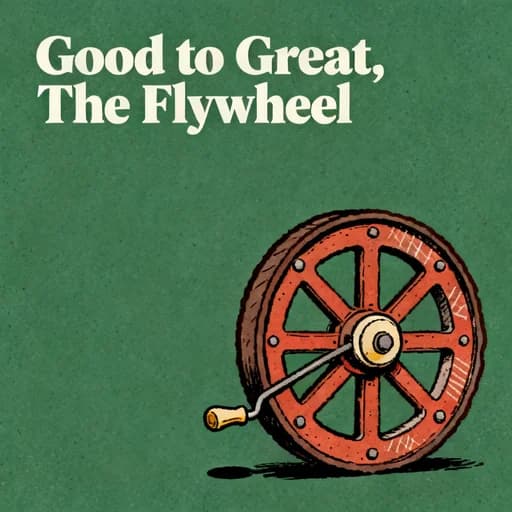
Most of us have been taught that greatness requires a massive, sudden transformation—a hero CEO, a revolutionary new product, or a stroke of luck that changes everything overnight. But if you look at the actual data of companies that made the leap from being merely good to truly great, you find something far more subtle and, frankly, far more useful. The reality is that greatness isn't a result of a single "eureka" moment or a charismatic leader sweeping in to save the day . It is a cumulative process, much like pushing a giant, heavy flywheel. At first, it takes every ounce of your strength just to get the thing to budge an inch. You push and push, and for a long time, it feels like you're getting nowhere. But then, almost imperceptibly, the wheel starts to move. It completes one rotation, then two. Suddenly, the momentum of the wheel itself starts to work in your favor, and before you know it, it's spinning with a force that seems unstoppable .
This isn't just a metaphor; it’s a rigorous finding from a study that spanned years of corporate history. The researchers looked for companies that showed a specific pattern: fifteen years of average performance followed by fifteen years of returns that were at least three times the general market. They found only eleven companies that truly fit this "good-to-great" profile, and none of them achieved their status through a flashy miracle . If you've ever felt like your career or your business is stuck in a cycle of "good enough," or if you're tired of the "fad of the month" management style that promises the world and delivers nothing, these insights are for you. We’re going to talk about why the most effective leaders are often the quietest people in the room, why you need to find your "Hedgehog Concept," and how to confront the most brutal facts of your reality without ever losing heart.
One of the most striking things the research revealed is that the "good-to-great" companies almost never looked to the outside for a savior. In fact, they promoted from within in nearly every single case, favoring leaders who had a deep, bone-deep understanding of the company's culture and operations . These weren't the celebrity CEOs you see on magazine covers. They were people who combined extreme personal humility with an intense, almost fanatical professional will. They didn't want the spotlight; they wanted the company to win. This is what the study calls Level 5 leadership, and it's the foundation upon which everything else is built. If you want to understand how to move from being a competent manager to someone who builds something that lasts, you have to start by looking at how these leaders actually behave—how they prioritize the "who" before the "what" and how they create a culture where the truth is heard, no matter how much it stings. So, let’s dive into what it actually takes to build that foundation.