Capitolo 1
Designing Products People Love: The Empathy-Driven Approach
Imagine a world where your thermostat understands your habits so well it feels like a thoughtful roommate rather than a piece of technology. This isn't science fiction-it's the reality created by companies like Nest, which transformed the humble thermostat from a forgettable utility into an object of desire and delight. What separates these exceptional products from the sea of mediocrity that fills our digital lives? The answer lies in empathy-a deep, genuine understanding of human needs that goes far beyond market research spreadsheets or feature checklists.
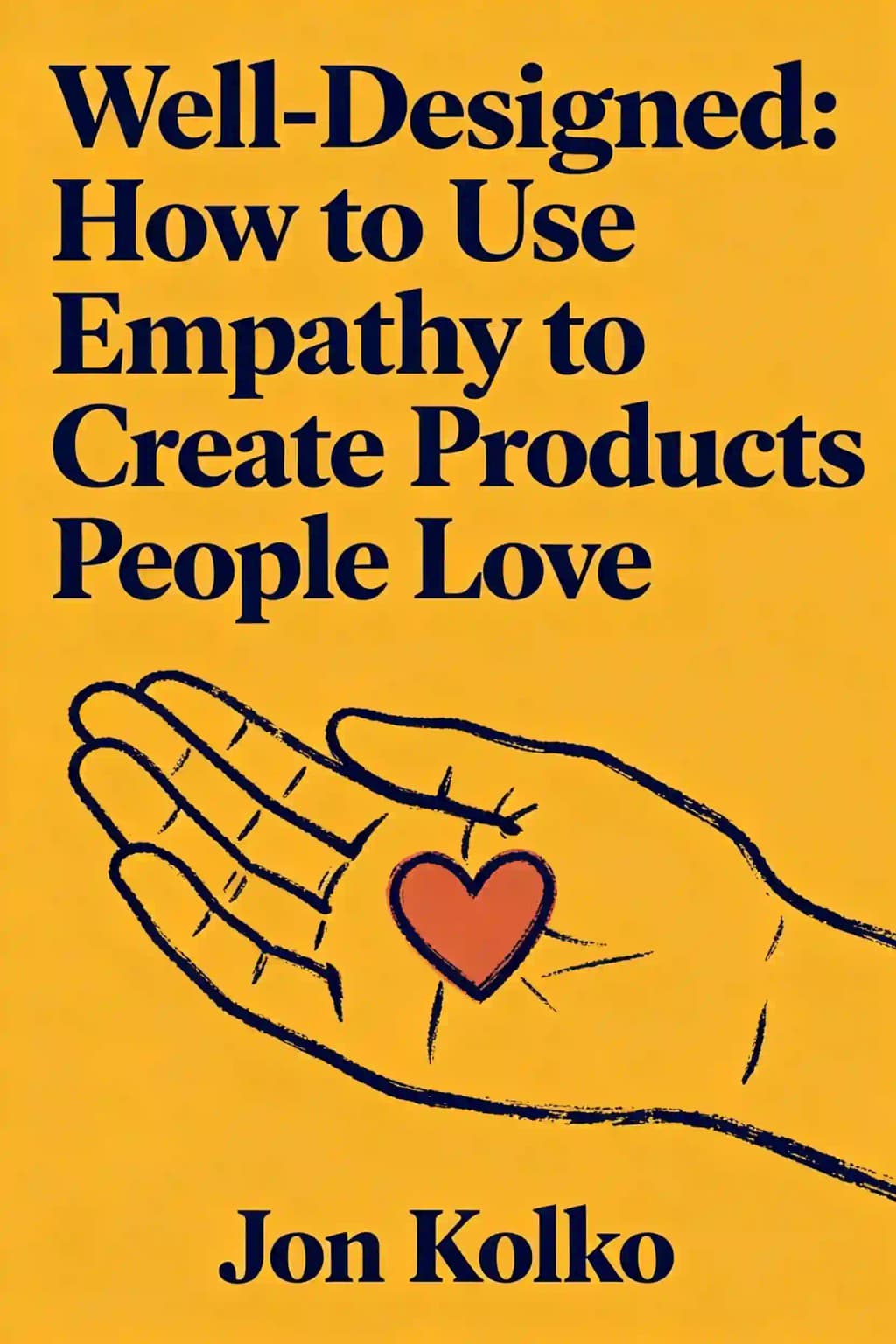
Jon Kolko's approach to product design has influenced countless successful products across industries. His methodology has been embraced by companies ranging from startups to Fortune 500 corporations, with his book becoming required reading in design programs at leading universities. What makes his work particularly compelling is how it bridges the traditionally separate worlds of business strategy and human-centered design, offering a framework that appeals to both executives focused on market success and designers committed to creating meaningful user experiences.
Capitolo 2
The Design-Driven Product Development Revolution
The gap between great products and mediocre ones isn't about technology-it's about approach. While traditional product development remains mired in outdated processes like requirements documents and feature checklists, design-driven companies create products that connect emotionally with users. These companies don't just build functional tools; they create experiences that feel like relationships.
Design isn't merely about making things pretty-it's a comprehensive approach to problem-solving that centers on human needs and emotions. This process embraces empathy through immersive research with real people in natural environments, generates meaningful insights into human behavior, uses structured exploration techniques, and celebrates creativity in everyone involved.
At the heart of this approach is emotional engagement-the deep feelings people form about products. We naturally personify products, especially digital ones, relating to them on a human level. Think about how you feel when your phone "dies" or when your favorite app gets a "facelift." This isn't accidental language; it reflects our tendency to form emotional connections with the objects we use.
Gaining genuine empathy requires spending time with people, seeing what they see and experiencing what they experience. This approach generates insights that drive innovation through a clear, flexible process with four key elements: determining product-market fit by seeking signals from user communities; identifying behavioral insights through ethnographic research; sketching product strategy by synthesizing complex research into simple insights; and polishing product details using visual representations.
What makes this approach powerful is that it can be learned. Empathy isn't an innate trait some people have and others don't-it's a skill that can be developed through practice. The design process teaches you to work through complexity to find simplicity, establish product personality, and communicate future visions effectively.
Capitolo 3
Understanding Products Through a Design Lens
What exactly constitutes a product? Products range from physical objects like lamps and airplane seats to digital goods like apps and software. While physical products provide utility or emotional value, digital products are increasingly valued for their data rather than their physical form. Digital products help users accomplish specific goals, whether emotional (connecting with friends) or practical, while sometimes serving hidden purposes like delivering targeted advertising.
The person responsible for guiding this process-the product manager-identifies goals, oversees development, and evaluates success. Unlike project managers who focus on schedules and budgets, product managers are content experts who articulate vision without necessarily building the product themselves. Their core responsibility is ensuring good fit between product, person, and market.
Product-market fit takes a macro view of consumer wants and market conditions, while product-person fit focuses on features, emotions, and helping users achieve both practical and aspirational goals. When you bring design thinking to product management, you're embracing a fundamentally different approach to problem-solving that values intuitive leaps and visual thinking over purely analytical processes.
Large corporations have adopted design as an innovation driver that helps avoid commoditization and manage complex services. Product managers with design backgrounds pursue user-centered strategies, prioritizing people's needs over business drivers or technological advancements. This approach often requires making organizationally difficult decisions, like breaking down silos between product teams to support users' cross-product goals.
Designers are typically optimistic about the future, skeptical of technology for its own sake, and use visual artifacts to communicate ideas while embracing integrative thinking that holds opposing ideas simultaneously. They work to make technology fit appropriately into human interactions rather than celebrating technology for its own merit.
When you bring design to product management, you'll take bigger risks guided by user empathy, resulting in potentially greater rewards despite occasional failures. This approach differs fundamentally from "lean" methodologies that focus on quickly creating minimum viable products to test and measure objectively. Design embraces a slower, more reflective process that's contemplative and methodical, encouraging exploration and dreaming.
Capitolo 4
Finding the Sweet Spot: Product-Market Fit
Product-market fit describes the complex relationship between a product and the market, going beyond sales to include competitive positioning, collaborative relationships, and technological adoption. Success metrics vary by context-a new product might achieve fit through early adopter visibility, while established products need substantial profits or market disruption.
Markets may not be ready for certain products despite their value. GPS and microwave technology took decades to gain cultural acceptance. Conversely, products like AT&T's U-verse faced "last mile" infrastructure challenges that prevented market adoption despite consumer interest.
The market itself is a complex ecosystem comprising customers, users, competitors, policies, laws, and trends. When launching a product like an iPhone app, you engage with: the community (both paying and non-paying users who influence your reputation); customers who exchange money for your product with high expectations; competitors who may ignore, copy, or try to eliminate you; trends that may converge to create larger market shifts; policies like Apple's App Store rules that can arbitrarily restrict your product; and laws that may limit or prevent your offering.
Achieving product-market fit requires harmonizing with all these facets. The ride-sharing app Heyride illustrates these dynamics-it launched in 2012 to disrupt the taxi industry but faced legal obstacles when the City of Austin issued a cease and desist letter. Despite the CEO's dismissive response, the company was acquired by SideCar just three months later, and service in Austin remained unavailable. As Brian Romanko, former CTO of Heyride explains, passionate user communities are key to changing legislation: "The more passionate users you have supporting your disruption... the greater your chances of changing the status quo."
To navigate this complex landscape, you need to gather and interpret market signals-small pieces of data that, when thoughtfully interpreted together, drive market strategy. However, not all signals are equally valuable. While competitive analysis seems useful, copying competitors' features is counterproductive because development is a zero-sum game-building what competitors do means not building what they aren't doing, leaving you constantly playing catch-up.
Instead, focus on how communities respond to competition and how competitors engage with technological advancement. Communities provide the richest market signals through shifts in attitudes, rules, and conventions that indicate changing values. When these shifts become patterns, they reveal valuable insights.
Capitolo 5
Translating Market Signals Into Product Strategy
As a product manager, you need thinking artifacts to help interpret market signals. These aren't presentation tools but working artifacts to establish strategy. Several frameworks can help synthesize market signals:
Value-Goal Statements shift from thinking about "products" to "value" by framing your offering in human terms (love, connection, respect) against market leaders. For example, "I help travelers build memories in foreign lands through comfortable flights" versus "I'm the product manager for an airline."
This approach forces honesty about your brand's actual value proposition. The United Airlines example (making people "physically and emotionally uncomfortable") demonstrates how difficult it is to hide behind marketing when focusing on real human value. These statements help identify emotional facets that drive meaningful differentiation-not through engineering features (which are table stakes) but through experiential qualities.
A 2x2 Matrix helps make sense of market signals by framing data from two perspectives. For example, in the health and wellness space, you might identify sixteen communities (from endurance athletes to gluten-free dieters) and list both factual attributes (cost, time commitment) and emotional attributes (social stigma, body image issues).
By selecting two attributes for the axes (like "quantity of population" and "accompanied by introspection"), communities can be positioned relative to each other. The resulting diagram reveals white spaces-potential market opportunities or areas to avoid. The goal isn't to exhaustively map all combinations but to develop intuition about how communities relate to each other.
"What If?" Scenarios generate multiple futures through provocative questions. For a startup disrupting taxi services, these might include: "What if Yellow Cab releases a similar app?" or "What if the city government introduces legal challenges?" These questions create fictional narratives that help you plan preemptively rather than reactively.
Imagining Losing helps you get ahead of competition by visualizing your product losing to a hypothetical new competitor. What factors drive their decision? Price? Features? Brand reputation? Create tangible artifacts of this hypothetical failure: sketch the competitor's pricing strategy, draw wireframes of their unique functionality, or write a fake press release announcing their product. This exercise reveals weaknesses in your strategy and provides the foundation for a defensive product approach.
Capitolo 6
Uncovering Behavioral Insights Through Empathy
While product-market fit concerns broad market trends, behavioral insights zoom in on individual interactions-examining how people interact with products to achieve goals. Gaining these insights requires spending time with potential users, both understanding and empathizing with them through observation of actual behavior.
The challenge in behavioral research isn't just finding people to observe but determining which behaviors to watch. Rather than demographic segmentation, the focus should be on observing real-time behavior. Build a profile of assumptions about existing behaviors (what people do, why, where, how frequently, and when) as a starting point-acknowledging these assumptions may be wrong but provide direction for research.
Behavioral research occurs in specific contexts (physical, geographic, or conceptual) with two distinct but related goals: understanding and empathy. Understanding involves gaining factual knowledge about how systems work, who uses them, and what tools are involved-identifying opportunities for design intervention. Empathy means approximating another person's feelings through immersive experiences.
The process for gathering behavioral signals is surprisingly simple: be present where behavior happens, watch it occur, and talk to people doing it. Despite potential social awkwardness, most people enjoy discussing their activities when someone shows genuine interest. Establish a clear focus before entering the context; prepare open-ended questions about actions and processes (not statistics or opinions); and ideally ask questions that provoke behavior rather than just discussion.
Conducting research in the actual environment where behavior naturally occurs is crucial. Avoid neutral settings like offices or coffee shops that only yield retrospective summaries. Instead, arrange to observe participants in their natural context-whether home, workplace, or elsewhere. Once there, capture everything: record audio, take photos, shoot video, and collect artifacts.
When participants mention any product, process, workflow, or software, immediately ask to see an example. This grounds the conversation in action rather than abstract discussion. Simply asking "Can I see an example?" transforms theoretical talk into practical demonstration, yielding far greater insight and clarity.
Capitolo 7
Transforming Observations Into Product Insights
Interpretation helps identify clear needs where people are underserved by current products. When observing subway users, for example, you might notice tourists spending excessive time at ticket kiosks, indicating the process is too difficult for first-time users. Or you might see people juggling coffee, phones, and wallets, suggesting the need for a surface to place items. These observations directly reveal both problems and solutions with minimal inference.
Insights, however, are provocative truths about people's lifestyles, aspirations, and desires that require deeper interpretation. For example, subway passengers using laptops or reading might be creating artificial boundaries in public space, or they might be embracing the focused productivity the confined space enables. Both interpretations make sense but lead to different design directions.
Creating a product synthesis wall helps externalize research data beyond your head and computer. Unlike digital storage that forces hierarchical organization, a physical wall enables you to discover hidden connections between data points and spot anomalies. It provides a common workspace for the team, signals the importance of the work to the organization, and enables forced comparison and dialogue essential for sensemaking.
After transcribing and exploding your research into a nonlinear form by placing individual utterances on the wall, begin finding patterns across participants. Highlight interesting quotes subjectively and physically group similar notes together. Name these emerging patterns on colorful Post-its, focusing on behavioral intent rather than functional descriptions.
As patterns emerge from your data, you'll begin to see structures related to workflow or lifestyle choices spanning various timeframes. Draw these patterns as simple diagrams showing the flow of data, emotions, and decisions across time. Use circles for stages and arrows for connections between them.
Using your utterance groupings and time-based visualizations, create succinct statements about what you've observed. These statements should make generalizations about the people you studied without qualifying them as biased-at this stage, bias is actually desired as it reflects interpretive depth.
Transform observational statements into insights by asking and answering "Why?" An insight is a provocative statement of truth about human behavior-presented as fact but actually an inference. While insights introduce risk because they may be factually wrong, they're the source of innovation. The innovation process requires these inferential leaps-the larger the leap, the riskier but potentially more differentiated the resulting product.
Capitolo 8
Crafting a Strong Product Personality
A strong product stance leverages two essential qualities: framing (applying an active perspective to situations) and play (exploring different possibilities out of curiosity). When combined in product development, they create opportunities to reframe situations from new perspectives.
If your product's personality has consistency and emotional credibility, users will experience rich interactions where the product's aspirational emotional traits actually transfer to them-a user will become more playful by using a playful product. While digital products may be subtler than physical ones like cars, their emotional impact can be amplified by digital reach and scale, as demonstrated by examples like Burger King's irreverent "Whopper Sacrifice" campaign and MailChimp's whimsical interface details.
Concept maps are powerful tools for both persuasion and education, helping stakeholders see your vision through a combination of emotion and narrative. The process involves four key steps: (1) listing the nouns and verbs that describe your product's stance and value proposition, (2) prioritizing these elements based on emotional value to users, (3) creating a main armature by connecting top nouns with verbs into a sentence that captures the product's essence, and (4) adding remaining elements to complete the map.
The real challenge with concept maps isn't creating them but introducing them effectively to others who haven't been part of your learning journey. Rather than overwhelming colleagues with a complex finished artifact, introduce your map gradually over weeks or months as a strategic tool for organizational change. Start with simplified versions that capture just the major elements, then progressively add complexity as understanding grows.
To solidify your still-incomplete product vision, sketch the main paths or "hero flows" through your system-the ideal ways users will move through the product. Start by creating a list of verb-noun activity pairs representing all possible user interactions throughout the product lifecycle, from purchase to discard.
Capitolo 9
From Vision to Reality: Shipping Great Products
A product road map is your visual tool for communicating capability and strategy changes. It helps manage complexity and shows how current tactics connect to broader goals, typically with a three to six-month horizon-anything beyond becomes less believable. Unlike a Gantt chart, it's not for daily tracking but provides a broad view of how the product evolves.
The road map consists of capability blocks (rectangles showing development efforts), swim lanes (horizontal sections showing organizational responsibility), and strategic connections between functionality and larger business goals. Build it in phases, starting with a comprehensive capability list derived from hero flows, including both user actions and system functions.
When your road map meets reality, you'll likely discover achieving your vision takes longer than expected. Rather than eliminating functionality or cutting corners, break capabilities into iterative phases spread over time. For example, "Send text messages" can become four smaller capabilities: sending texts to all users simultaneously, scheduling texts at various times, sending generic messages, and sending custom texts based on user activity.
Each capability on your road map needs to be translated into user stories that bridge between broad capabilities and specific features. These stories describe how functionality works from the user's perspective, zooming into the hero flow to detail each step.
Once your product is functioning, you'll have more good ideas than engineering capacity to implement them. Manage these in a product backlog-a living list that requires regular pruning and prioritization. The backlog serves a dual purpose: organizing future development and depoliticizing functionality suggestions. When someone offers a new idea that doesn't align with your vision, add it to the backlog but prioritize it lower.
A design-driven approach means caring about all details users encounter-aesthetics, usability, language, pricing, information hierarchy-because these small elements significantly impact user experience. As teams fatigue near launch, it's tempting to call things "good enough," but details matter tremendously. If you want others to care about details, you must demonstrate that care yourself.
Capitolo 10
The Human Side of Product Management
Product management requires taking initiative rather than waiting for things to happen. Whether you're seeking media coverage, user adoption of new features, or faster team performance, your role demands action. You don't control the market or other people, but you can significantly influence outcomes through deliberate, strategic actions that increase your chances of success.
When product discussions become circular arguments with people emotionally attached to their ideas, short-circuit endless debates by creating tangible artifacts. Diagrams, sketches, or design mockups transform abstract concepts into concrete representations that clarify intent and reduce ambiguity.
Actively socialize your product roadmap throughout the organization to ensure alignment. Understand each stakeholder's motivations and show how product decisions support their goals. Connect product decisions to strategic business goals by explaining how each change supports your emotional value proposition and helps users feel what you want them to feel.
Regular product launches-weekly or even daily-allow quick adjustments and create a sense that the product is responsive to feedback. This cadence helps your team feel forward momentum and emotional ownership of the product, empowering them to make improvements rather than waiting for major release cycles.
Keep engineers motivated by clearly explaining the rationale behind each roadmap item and how it provides value to users. Provide measurable indicators of success before development begins so your analytical team members understand what determines success and can track their impact.
With thousands of analytics data points available, focus your analysis on metrics directly tied to your emotional value proposition rather than measuring everything. Dedicate specific time for exploratory data analysis to discover unexpected patterns. When metrics change, recognize that causality might be hidden in tiny interface details-small design changes like smartly selected defaults can dramatically impact user behavior when amplified across your user base.
Building products requires deep emotional investment from the entire team. Take time to celebrate launches and usage milestones. Product design is challenging work, and acknowledging achievements helps maintain motivation and perspective when the process becomes all-consuming.
Capitolo 11
The Future of Product Development
The design process-focused on people, emotional value, and optimistic thinking through divergent approaches-has become essential for modern product development. You've learned to build empathy through field research, translate observations into insights for innovation, craft goal-oriented user stories, and create emotional value statements as guiding principles for your team. This human-centered approach has transformed how companies like Apple, Airbnb, and Netflix develop their products, leading to experiences that resonate deeply with users' lives.
When viewed strategically, design transcends surface aesthetics to become a way of thinking about problems and people, a method for navigating complexity and ambiguity. Companies like IDEO and Frog Design have demonstrated how design thinking can solve challenges in healthcare, education, and public services. In the future, more jobs will leverage this empathetic process for managing uncertainty and driving creativity, from urban planning to financial services.
Though presented in the context of digital products, these methods apply equally to services, policies, business models, strategies, and value delivery. For instance, governments are using design thinking to improve citizen services, healthcare providers are redesigning patient experiences, and educational institutions are reimagining learning environments. We are all becoming product managers, and our best process for success is design-a creative process built on empathy and iterative improvement.
The fundamental shift in technology over the past decade has been from focusing on technical capabilities to emphasizing human behavior change. While Google was the last major tech company to succeed primarily through computational innovation, newer companies like Facebook and Twitter succeeded by understanding human interaction patterns. Instagram's success came not from superior photo technology, but from understanding how people want to share and connect through visual stories. The priority has shifted from "how" technology works to "what" should be built to influence behavior, with the interface layer taking precedence over backend technology.
As we move forward, the most successful products will continue to be those that connect deeply with human needs and emotions-not just those with the most advanced technology. Companies like Peloton have shown how combining technology with emotional engagement creates powerful user experiences. The rise of AI and machine learning makes this human-centered approach even more critical, as these technologies must be shaped to serve genuine human needs rather than technical possibilities. By embracing design thinking and empathy-driven development, you position yourself to create products that people don't just use, but love and integrate into their daily lives. This approach will become increasingly vital as technology continues to evolve and user expectations grow more sophisticated.
The future of product development lies in the intersection of technological capability and human understanding, where success depends on creating solutions that not only work flawlessly but also resonate with users' deeper motivations and aspirations. Organizations that master this balance will lead the next wave of innovation across all sectors.