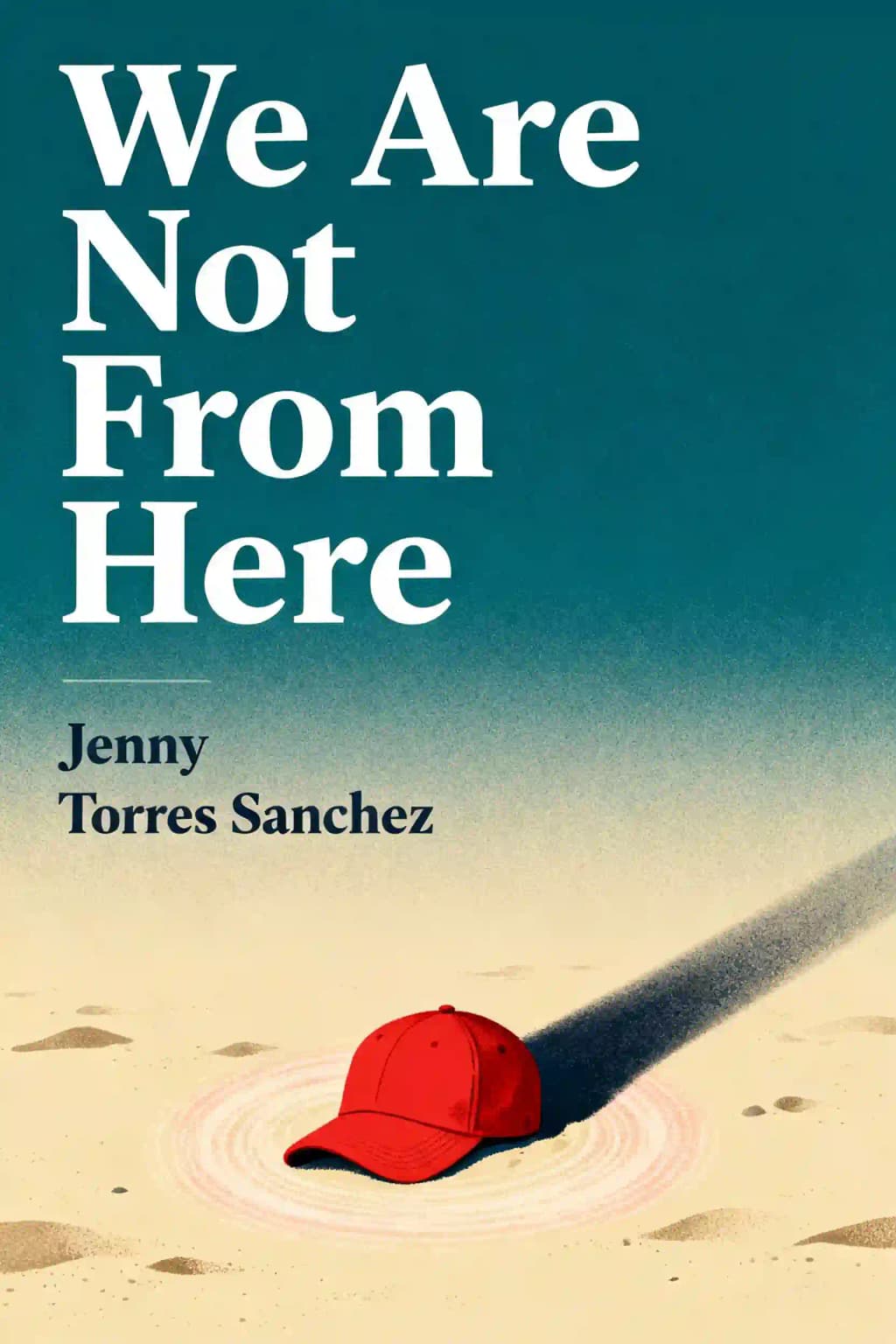
Three Guatemalan teens flee deadly gang violence on a harrowing journey north. This five-starred masterpiece earned the Pura Belpre Honor Award, capturing the migrant experience with Garcia Marquez-like intensity. What would you risk for survival when home becomes unlivable?
Jenny Torres Sanchez is the award-winning author of We Are Not from Here, a critically acclaimed young adult novel following three Guatemalan teens fleeing gang violence on a dangerous journey to the United States. Born in Brooklyn to immigrant parents from Guatemala and El Salvador, Sanchez brings authentic cultural perspective to her exploration of migration, survival, and the harsh realities facing Central American youth.
A former high school English teacher, she draws inspiration from her students' experiences to write about difficult topics including grief, family dysfunction, and displacement with empathy and nuance.
Her other notable young adult works include Death, Dickinson, and the Demented Life of Frenchie Garcia and The Fall of Innocence. Her debut picture book, With Lots of Love, was selected as Jumpstart's Read for the Record in 2023. We Are Not from Here earned a Pura Belpré Honor and was described by The New York Times as "a novel precisely for this moment," later becoming her first book translated into Spanish—allowing her Spanish-speaking parents to finally read her work.
We Are Not From Here follows three Guatemalan teenagers—Pulga, Chico, and Pequeña—who flee gang violence in Puerto Barrios and undertake the dangerous journey to the United States. The novel alternates between Pulga and Pequeña's perspectives as they travel through Mexico aboard La Bestia, facing exploitation, violence, and uncertainty. Jenny Torres Sanchez explores themes of survival, trauma, chosen family, and the heartbreaking realities faced by unaccompanied migrant youth.
Jenny Torres Sanchez is an American young adult author and former English teacher whose parents immigrated from Guatemala and El Salvador. Born in Brooklyn and raised in Florida, she writes about difficult topics affecting teens, drawing from her border-world experience. We Are Not From Here is her fifth YA novel and a Pura Belpré Honor book, recognized by the New York Times as "a novel precisely for this moment."
We Are Not From Here is ideal for readers seeking powerful, empathetic storytelling about the migrant experience, particularly young adults and educators. It suits those interested in social justice, immigration issues, and contemporary Latin American narratives. The book is valuable for anyone wanting to understand the human stories behind migration statistics, though content warnings apply for violence, sexual assault, and trauma.
Yes, We Are Not From Here is worth reading for its raw, humanizing portrayal of Central American migration. Jenny Torres Sanchez crafts a deeply emotional narrative that stays with readers, fostering empathy and understanding beyond headlines. As a Pura Belpré Honor book praised for its timeliness and literary depth, it offers both educational value and compelling storytelling that challenges perspectives on asylum seekers and survival.
We Are Not From Here explores survival against impossible odds, the meaning of chosen versus blood family, and the lasting impact of violence and trauma. Jenny Torres Sanchez examines gender-based violence, particularly through Pequeña's experiences, and the resilience required to endure unimaginable circumstances. The novel also addresses systemic corruption, poverty as a driver of migration, and the universal human desire for safety and dignity.
Pulga, Chico, and Pequeña escape Puerto Barrios together, but their journey ends tragically. Chico dies during the trek through Mexico, devastating his companions. At the U.S. border, Pulga collapses and enters detention before release to his aunt. Pequeña, now calling herself Flor, finds refuge with a kind woman named Marta and begins healing while initiating contact with her mother, though their futures remain uncertain.
Pequeña cuts her hair to disguise herself as a boy before the journey, knowing the extreme sexual violence women face while migrating. Having already endured assault in Guatemala, she understands that appearing male offers protection. Jenny Torres Sanchez uses this transformation to illustrate how women must arm themselves against patriarchal violence, with Pequeña imagining her body covered in razor blades to ward off attackers.
La Bestia (The Beast) is the nickname for the freight trains traveling through Mexico that Central American migrants ride to reach the U.S. border. In We Are Not From Here, Jenny Torres Sanchez depicts the train as extremely dangerous—one wrong move can be fatal. The characters travel from Guatemala through Mexican cities like Ixtepec and Guadalajara, facing exploitation by cartels, corrupt officials, and constant physical peril.
We Are Not From Here illustrates how gang violence, particularly from leaders like Rey, makes staying home deadlier than fleeing. Jenny Torres Sanchez shows gangs controlling communities through intimidation, forced recruitment, and brutal killings. The teenagers witness horrific violence against innocent people, understanding that refusing gang involvement or remaining in Puerto Barrios means certain death, making the dangerous migration journey their only survival option.
We Are Not From Here ends with separation and fragile hope—Pulga enters detention, while Pequeña (now Flor) begins recovery with Marta. The ending emphasizes that reaching the border isn't triumph but another phase of trauma and uncertainty. Pulga's final scream symbolizes his shattered heart yet reawakening of feeling, suggesting that while profoundly broken, the will to live persists, leaving their futures open to possible healing.
Chosen family becomes a survival mechanism in We Are Not From Here as Pulga, Chico, and Pequeña form bonds stronger than blood. Jenny Torres Sanchez shows how their commitment to one another provides hope and strength through extreme danger. When biological families cannot protect them from gang violence, these three teenagers create their own family unit, demonstrating that kinship formed through shared trauma and mutual protection can be equally powerful.
Jenny Torres Sanchez wrote We Are Not From Here after hearing heartbreaking news about unaccompanied children making the journey from Central America alone, beginning the project around 2015. With her parents from Guatemala and El Salvador, and as a mother herself, these stories deeply affected her. She wanted to humanize those often reduced to statistics, shedding light on the dangerous realities of La Bestia and the circumstances forcing children to flee.
Senti il libro attraverso la voce dell'autore
Trasforma la conoscenza in spunti coinvolgenti e ricchi di esempi
Cattura le idee chiave in un lampo per un apprendimento veloce
Goditi il libro in modo divertente e coinvolgente
'Que corran,' she warns-they must run.
'We are small people with small names, meant to live small lives.'
'This ring is your destiny,' he declares.
Their hometown has become a maze of invisible boundaries and deadly consequences.
The choice to leave is really no choice at all.
Scomponi le idee chiave di We Are Not from Here in punti facili da capire per comprendere come i team innovativi creano, collaborano e crescono.
Distilla We Are Not from Here in rapidi promemoria che evidenziano i principi chiave di franchezza, lavoro di squadra e resilienza creativa.

Vivi We Are Not from Here attraverso narrazioni vivide che trasformano le lezioni di innovazione in momenti che ricorderai e applicherai.
Chiedi qualsiasi cosa, scegli la voce e co-crea spunti che risuonino davvero con te.

Creato da alumni della Columbia University a San Francisco
"Instead of endless scrolling, I just hit play on BeFreed. It saves me so much time."
"I never knew where to start with nonfiction—BeFreed’s book lists turned into podcasts gave me a clear path."
"Perfect balance between learning and entertainment. Finished ‘Thinking, Fast and Slow’ on my commute this week."
"Crazy how much I learned while walking the dog. BeFreed = small habits → big gains."
"Reading used to feel like a chore. Now it’s just part of my lifestyle."
"Feels effortless compared to reading. I’ve finished 6 books this month already."
"BeFreed turned my guilty doomscrolling into something that feels productive and inspiring."
"BeFreed turned my commute into learning time. 20-min podcasts are perfect for finishing books I never had time for."
"BeFreed replaced my podcast queue. Imagine Spotify for books — that’s it. 🙌"
"It is great for me to learn something from the book without reading it."
"The themed book list podcasts help me connect ideas across authors—like a guided audio journey."
"Makes me feel smarter every time before going to work"
Creato da alumni della Columbia University a San Francisco

Ottieni il riassunto di We Are Not from Here in formato PDF o EPUB gratuito. Stampalo o leggilo offline quando vuoi.
In Puerto Barrios, Guatemala, life for teenagers Pulga, Chico, and Pequena unfolds in a world where beauty and brutality exist side by side. The cold Coca-Colas from Don Felicio's corner store and the uniquely blue sky overhead stand in stark contrast to the blood turning brown on concrete and people disappearing only to reappear in fragments. Pulga dreams of becoming an artist while caring for his gentle cousin Chico, who wears his too-small "American Eagle" shirt with innocent pride. Meanwhile, Pequena has just given birth to a baby she refuses to acknowledge-the result of sexual assault by a local gang leader named Rey. Everything changes when Pulga and Chico witness Don Felicio's murder, his throat slashed by Rey and his brother Nestor. At the wake, the murdered man's wife shares a disturbing vision: Pequena riding away on a bloody mattress, and the boys running scared. "Que corran," she warns-they must run. When Rey discovers the boys witnessed his crime, he gives them an impossible choice: join his "army" or die. In this moment, escape becomes their only option. Why does this matter? Because in places where violence becomes as common as breathing, escape isn't just a dream-it's a survival strategy. These teenagers aren't chasing the American Dream; they're fleeing a Guatemalan nightmare.