In Samuel Beckett's masterpiece where "nothing happens, yet keeps audiences glued," two tramps wait endlessly for someone who never arrives. Voted "most significant English play of the 20th century," this absurdist revolution asks: what meaning exists in our own perpetual waiting?
Samuel Barclay Beckett (1906–1989), the Nobel Laureate and visionary playwright behind Waiting for Godot, redefined 20th-century theatre with his existential themes and avant-garde style.
Born in Dublin and later settling in Paris, Beckett’s work in the Theatre of the Absurd genre—marked by bleak humor and minimalist settings—reflects his philosophical exploration of human futility, isolation, and the search for meaning.
A protégé of James Joyce, Beckett wrote in both French and English, producing seminal works like his novel trilogy Molloy, Malone Dies, and The Unnamable, as well as plays such as Endgame and Krapp’s Last Tape. His experiences during World War II, including involvement in the French Resistance, deeply influenced his stark yet poignant narratives.
Awarded the 1969 Nobel Prize in Literature for elevating modernist literature through “new forms for the novel and drama,” Beckett’s Waiting for Godot remains a cornerstone of existential drama, translated into over 30 languages and performed globally since its 1953 debut.
Waiting for Godot follows two men, Vladimir and Estragon, as they wait endlessly for a mysterious figure named Godot, who never arrives. Through minimalist dialogue and repetitive actions, Beckett explores existential themes like the absurdity of life, the search for purpose, and the human struggle to find meaning in a meaningless world. The play’s lack of plot progression underscores the futility of their wait.
This play appeals to readers interested in existential philosophy, absurdist theater, or modernist literature. It’s ideal for those grappling with questions about life’s purpose or seeking to understand post-World War II existential disillusionment. Students of drama and avant-garde art will also find its innovative structure and symbolism compelling.
Yes—it’s a cornerstone of 20th-century literature and a defining work of the Theatre of the Absurd. Beckett’s exploration of existential crisis and human resilience remains culturally significant, offering profound insights into the human condition. Its sparse dialogue and haunting themes provoke lasting reflection.
Key themes include the absurdity of existence, the purposelessness of life, and the illusion of time. Characters engage in futile routines, highlighting humanity’s struggle to create meaning in a universe devoid of inherent purpose. The play also critiques reliance on external saviors (e.g., Godot) for direction.
Godot represents humanity’s futile search for external meaning—whether religious, philosophical, or societal. His absence underscores the impossibility of finding answers outside oneself, suggesting that hope for salvation is an illusion. Beckett leaves his identity intentionally ambiguous to amplify existential uncertainty.
Their repetitive conversations and reliance on routines mirror humanity’s attempts to distract itself from existential dread. Their bond—marked by bickering and loyalty—reflects the duality of human relationships as both comforting and fraught. Their inability to act decisively symbolizes paralysis in the face of life’s absurdity.
Pozzo (a domineering master) and Lucky (his enslaved companion) embody power dynamics and codependency. Their physical and emotional decay across the play critiques exploitative systems and the emptiness of material pursuits. Lucky’s silent suffering contrasts with Pozzo’s hollow authority.
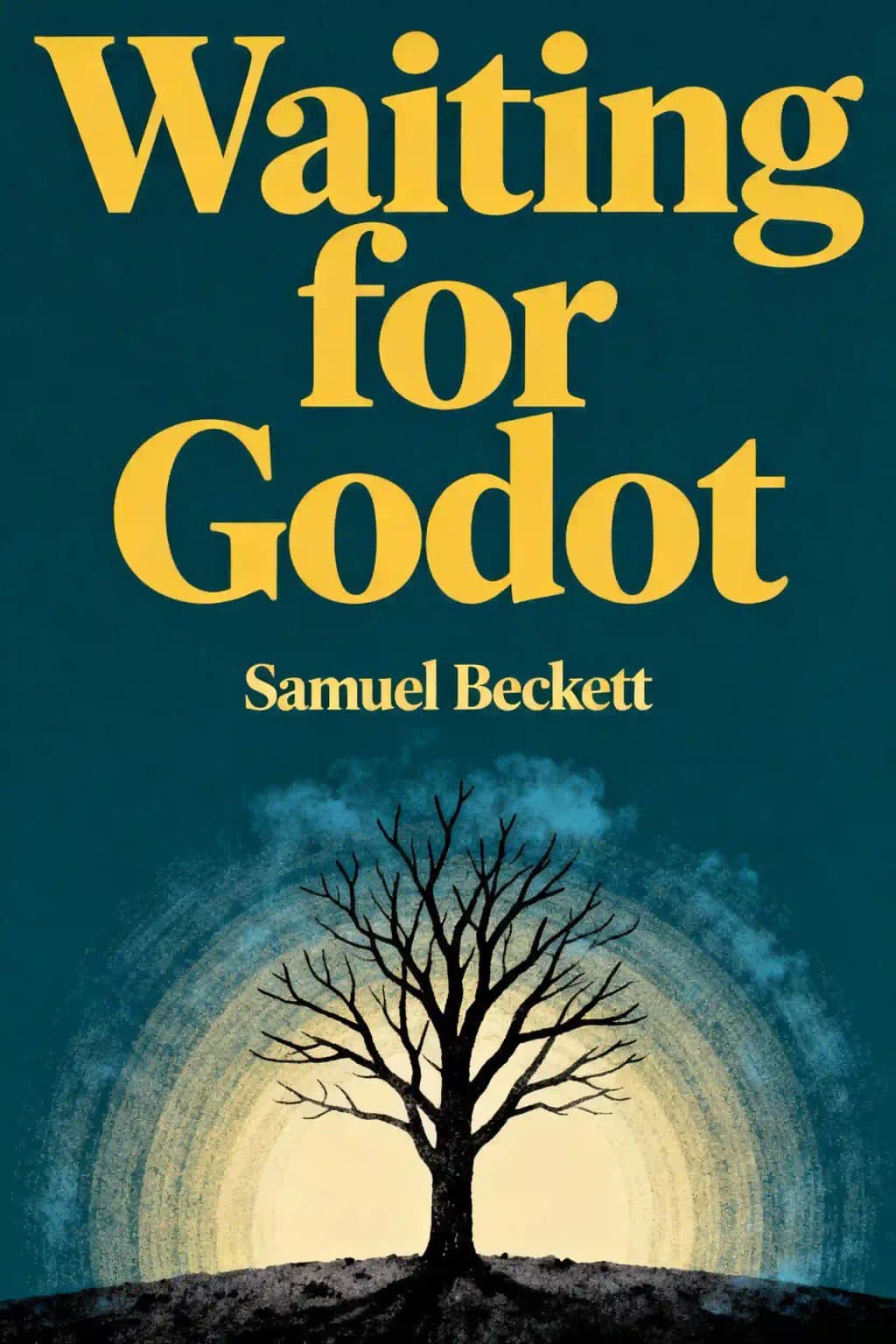
Time is circular and meaningless—each day repeats without progress, and the barren setting (a single tree and empty road) mirrors existential desolation. This minimalism forces audiences to confront the void at the heart of human existence.
The lack of plot and repetitive dialogue mirror life’s monotony and the absence of grand narratives. Act II nearly replicates Act I, emphasizing stagnation and the illusion of change. This structure invites audiences to question traditional storytelling.
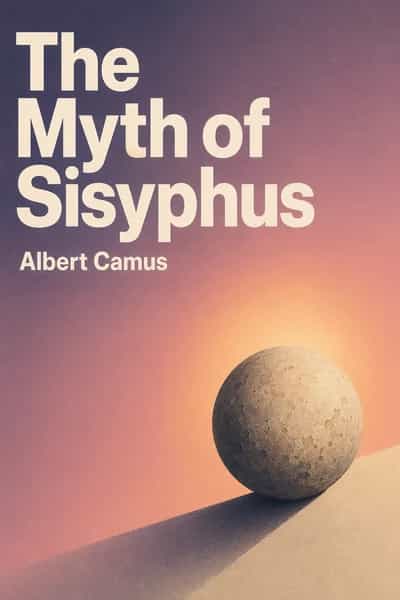
Like Camus’ The Myth of Sisyphus, it frames life as inherently absurd. However, Beckett’s focus on dialogue and inaction contrasts with more narrative-driven works. It pioneered the Theatre of the Absurd, influencing later playwrights like Ionesco.
Its themes resonate in modern contexts like AI-driven alienation and global uncertainty. The play’s critique of waiting for external solutions parallels contemporary struggles with climate inaction or political stagnation. Its timeless questions about purpose continue to challenge readers.
Senti il libro attraverso la voce dell'autore
Trasforma la conoscenza in spunti coinvolgenti e ricchi di esempi
Cattura le idee chiave in un lampo per un apprendimento veloce
Goditi il libro in modo divertente e coinvolgente
Nothing to be done.
We are waiting for Godot.
Let us do something, while we have the chance!
People are bloody ignorant apes.
They give birth astride of a grave, the light gleams an instant, then it's night once more.
Scomponi le idee chiave di Waiting for Godot (Acting Edition) in punti facili da capire per comprendere come i team innovativi creano, collaborano e crescono.
Distilla Waiting for Godot (Acting Edition) in rapidi promemoria che evidenziano i principi chiave di franchezza, lavoro di squadra e resilienza creativa.

Vivi Waiting for Godot (Acting Edition) attraverso narrazioni vivide che trasformano le lezioni di innovazione in momenti che ricorderai e applicherai.
Chiedi qualsiasi cosa, scegli la voce e co-crea spunti che risuonino davvero con te.

Creato da alumni della Columbia University a San Francisco
"Instead of endless scrolling, I just hit play on BeFreed. It saves me so much time."
"I never knew where to start with nonfiction—BeFreed’s book lists turned into podcasts gave me a clear path."
"Perfect balance between learning and entertainment. Finished ‘Thinking, Fast and Slow’ on my commute this week."
"Crazy how much I learned while walking the dog. BeFreed = small habits → big gains."
"Reading used to feel like a chore. Now it’s just part of my lifestyle."
"Feels effortless compared to reading. I’ve finished 6 books this month already."
"BeFreed turned my guilty doomscrolling into something that feels productive and inspiring."
"BeFreed turned my commute into learning time. 20-min podcasts are perfect for finishing books I never had time for."
"BeFreed replaced my podcast queue. Imagine Spotify for books — that’s it. 🙌"
"It is great for me to learn something from the book without reading it."
"The themed book list podcasts help me connect ideas across authors—like a guided audio journey."
"Makes me feel smarter every time before going to work"
Creato da alumni della Columbia University a San Francisco

Ottieni il riassunto di Waiting for Godot (Acting Edition) in formato PDF o EPUB gratuito. Stampalo o leggilo offline quando vuoi.
A bare stage. A single tree. Two men in worn clothes, waiting. One struggles with his boot while the other watches. "Nothing to be done," comes the opening line - a phrase that will echo through every moment of what follows. This is where we meet Vladimir and Estragon, two souls bound together by habit, hope, and the simple fact that they're waiting for someone named Godot. But here's the thing: Godot never shows up. Not in Act I. Not in Act II. And if there were an Act III, he wouldn't appear then either. What sounds like theatrical suicide - a play where nothing happens, twice - became the most influential drama of the twentieth century. Why? Because in their endless waiting, these two tramps stumbled onto something we all recognize: the strange, stubborn persistence of hope in a universe that offers no guarantees.