Capitolo 4
The Coming Demographic Tsunami
The coming retirement of 76 million baby boomers threatens to overwhelm America's fiscal future while crowding out all other national priorities. Our government has transformed into an "ATM state" where 70% of federal spending now goes to mandatory entitlement programs rather than discretionary investments. This shift has already caused public investment in infrastructure, education and research to decline from 2.6% of GDP two decades ago to just 1.7% today.
The demographic facts are stark: Worker-to-retiree ratios are plummeting from 5:1 in 1960 to nearly 2:1 by 2040. Between 2010-2030, the workforce will grow by just 13 million while Social Security recipients will increase by 31 million. Health and pension costs will soar by 3.7% of GDP between 2000-2020 (equivalent to adding $400 billion annually to today's budget), then rise another 2.5% in the decade after.
By 2018, Social Security will begin paying out more than it collects, and by 2030, five entitlement programs will consume all available revenue. The nation faces $25 trillion in unfunded liabilities, effectively promising massive tax increases on future generations.
Complicating matters is seniors' outsized political power through the AARP (growing from 35 to 50 million members) and their high voter turnout (68% in presidential elections versus 30% for young voters). The ultimate irony, especially for liberals, is that Medicare - not conservatives - will soon become the greatest obstacle to funding unmet social needs. Every unnecessary dollar spent on Medicare will be one that can't help a poor child.
While experts acknowledge the burden the boomers' retirement will place on younger generations, most agree economic growth will still leave incomes higher than today. America can afford the baby boom's retirement, but the real question is whether we'll be wise enough to do so while leaving room for government to address other priorities.
Capitolo 5
Taking Luck Seriously: A Foundation for Reform
To move beyond our current political stalemate, we must organize around first principles, particularly the phenomenon of luck. "Luck" here refers specifically to the pre-birth lottery - those aspects of existence outside our control: inherited genes, race, wealth, looks, brains, talents, family values, and educational opportunities.
Milton Friedman struggled with the concept of luck in economic outcomes. While acknowledging that "inequalities resulting from deliberate decisions clearly raise very different normative issues than do inequalities imposed from outside," he danced around luck's implications. Friedman's blind spot stemmed from his fear that acknowledging luck's role would justify freedom-limiting redistribution. Having fought against communism and 70-90% tax rates, he presented a false choice between incentive-killing equality and unfettered capitalism, missing middle-ground solutions.
John Rawls offered a "Third Way" between Marxism and classical liberalism. His landmark 1971 work "A Theory of Justice" proposed that a just society should be designed as if from behind a "veil of ignorance" where no one knows what traits or circumstances they'll be born into. From this perspective, Rawls argued people would agree on two principles: equality in basic rights and duties, and social inequalities arranged to benefit the least advantaged while ensuring positions remain open to all.
A more serious regard for luck's dominion can be integrated into modern capitalism and command broad consensus, leading to an agenda built around equal opportunity and a minimally decent life, achieved through market-friendly mechanisms.
Capitolo 6
Universal Coverage, American Style
What would a bipartisan approach to universal healthcare look like? The author arranged a meeting between two congressmen from opposite sides of the political spectrum - Jim McDermott (D-Seattle) and Jim McCrery (R-Louisiana) - to explore what he calls "The Bradley-Bush Sr. Health plan," which offers tax subsidies to help people buy insurance from competing private plans.
The meeting proved productive, with both congressmen acknowledging the need for compromise. McDermott, typically an advocate for single-payer healthcare, admitted: "I'm so frustrated by having spent thirty years watching it get worse that I'm willing to try practically anything to get us moving." McCrery, a conservative, conceded: "I'm willing to accept a lot more government intervention in the market than I normally would to create a system that will have some vestige of the market left in it."
Their discussion focused on defining the basic benefits package that would be available to all Americans. McCrery advocated for a system where government provides basic coverage while allowing market-driven premium services for those who can afford them. He suggested using the federal employee health plan as a model, which defines general areas of coverage rather than specifying every test and procedure.
Both congressmen tackled how to protect people with predictably high medical costs. McCrery surprisingly advocated for community rating - where everyone pays the same premium regardless of age, sex, or medical history. "I looked at it nine ways to Sunday," McCrery explains, "and I don't think there's any other way to do it." He argues insurers should compete on service and efficiency rather than "getting lucky" by cherry-picking healthier customers.
McCrery also explained the inequity in the current healthcare system, where taxpayers subsidize coverage for the well-off while offering nothing to those who need help most. He proposed dismantling the current $125 billion tax subsidy that disproportionately benefits wealthy executives, instead creating a sliding scale system helping those who truly need assistance.
The congressmen believe universal coverage is achievable through a bipartisan approach that would function like a healthcare voucher system. People would receive tax credits based on income, applied directly to insurance premiums through certified private insurers. This approach could satisfy both liberal goals of universal coverage and conservative preference for market solutions at a cost of approximately $80 billion annually.
Capitolo 7
Millionaire Teachers: Transforming Education for the Disadvantaged
Urban America faces an education crisis, with students in poor neighborhoods three grade levels behind those in higher-income areas. While schools need many reforms, teacher quality stands as the single most critical issue. Research shows that half the achievement gap facing poor and minority students stems not from poverty but from systematic differences in teacher quality.
The problems begin with education schools, widely viewed as third-tier campus backwaters. Most elementary teachers major only in education rather than subject matter, leading to widespread "out-of-field" teaching that disproportionately affects poor children. Eighteen million children are taught core subjects by teachers lacking even a minor in those fields.
When Roy Romer became L.A. superintendent, he discovered only 40-50% of math teachers in grades 3-5 were adequately prepared. "How can the most technically advanced nation have this situation?" he asked in frustration. Meanwhile, the neediest children routinely face brand new, untrained rookies each year as experienced teachers flee troubled schools.
The market reality is stark: in 1970, a starting lawyer and teacher in New York had only a $2,000 salary gap; today, that lawyer makes $145,000 while teachers earn roughly $40,000. As Harold Levy puts it, "Why would we think the laws of supply and demand have been repealed with respect to public education?" Urban districts face a particularly cruel disadvantage - suburban schools typically offer higher pay, better conditions, and easier-to-teach students.
A truly serious approach would make teaching poor children the career of choice for talented Americans. The author proposes "Title I for Teachers" - raising salaries for every teacher in poor schools by 50 percent, conditioned on two reforms: allowing the top half of performers to earn another 50 percent on average, and streamlining dismissal of poor performers to a fair 4-6 month process.
In practice, this means starting teachers earning $60,000 instead of $40,000, with the best eventually earning close to $150,000. The goal: make America's best teachers of poor children millionaires over their careers. This would transform teaching from an embarrassing profession to one held in awe.
The plan would cost roughly $30 billion annually - a 7 percent increase in K-12 spending that would create a 1000 percent revolution in how teaching is viewed. This serious proposal dwarfs current political offerings - Bush's symbolic tax breaks and Democrats' underfunded plans of $3 billion rather than $30 billion.
Education leaders across the spectrum find this approach compelling. Sandra Feldman of the AFT acknowledged that everyone knows who the best teachers are in any school, and agreed it was unfair they weren't rewarded accordingly. Conservative reformer Chester Finn worried about "a 50 percent boost for just showing up" without performance measures, suggesting teachers surrender tenure in exchange for higher pay.
A federal challenge approach could transform education politics by putting billions on the table for communities willing to meet conditions. This would reverse typical dynamics where unions and district managers negotiate privately, instead creating public pressure from parents, media, business leaders, and rank-and-file teachers who'd stand to gain $20,000-$50,000 annually.
Capitolo 8
Vouchers Even Liberals Can Love
The voucher debate represents one of America's most politically polarized education issues, yet affects only a tiny fraction of students. While Milwaukee and Cleveland offer public vouchers to about 17,500 students combined, and private voucher programs serve 60,000 nationwide, these represent just one-tenth of one percent of America's schoolchildren.
The voucher movement has progressive roots often overlooked in today's polarized debate. In 1962, law professor Jack Coons began studying why suburban schools outperformed urban ones, discovering the fundamental inequity in property-tax school financing. This system creates dramatic disparities: a poor district taxing itself at twice the rate of a wealthy district might still generate far less funding per student.
Coons eloquently denounced this "socialism for the rich," noting that while other public services like highways and libraries are accessible to all, admission to good public schools "comes only with the price of the house." His work led to California's landmark Serrano case in 1971, where he proposed vouchers as a remedy for inequitable school funding.
Milton Friedman, meanwhile, had advocated vouchers since 1955 from a market-based perspective, arguing that government could finance education without administering schools directly - similar to the G.I. Bill for higher education. Where Coons focused on equity for disadvantaged students, Friedman emphasized liberty and competition.
Both sides perpetuate misleading arguments. Unions claim vouchers lack evidence (despite opposing larger trials), drain money from public schools (despite insisting on additional funding), are unconstitutional (despite the Supreme Court's 2002 ruling), lack capacity (ignoring market responses), and introduce harmful profit motives (though education is already big business). Meanwhile, conservatives falsely claim vouchers save money (ignoring costs of special education and infrastructure) and naively believe unregulated markets will serve disadvantaged students (when markets naturally favor the advantaged).
Fresh perspectives are emerging that could break the voucher stalemate. Arthur Levine, president of Teachers College and lifelong voucher opponent, now advocates a "rescue operation" giving vouchers to 2-3 million poor children in the worst schools, calling it his "Schindler's list." Republican Lisa Graham Keegan criticizes property-tax school funding as "pernicious" and "wholly unfair," noting that poor districts often bear twice the tax burden of wealthy ones while receiving less funding.
The proposed voucher bargain would increase urban per-pupil spending by 20-30% but implement it through universal vouchers giving every child choice. In cities spending $6000 per pupil, each child would receive a $7500 voucher, with federal funding guaranteed for 10-15 years. Schools accepting vouchers would need to reserve about 15% of seats where the voucher covers full tuition.
This compromise attracted support from diverse voices, from Jack Coons to Clint Bolick to Senator Lamar Alexander. Even NAACP President Kweisi Mfume expressed openness if his concerns about inclusivity, accountability, and transportation costs were addressed. Only teachers' union leaders remained adamantly opposed, even when asked about doubling or tripling urban school funding through vouchers.
Progress on vouchers requires progressive oversight to ensure benefits reach the poor without harm. Democrats should be the natural champions of this approach, but teachers unions' political influence blocks reform. Republicans alone can't carry this issue without minority leaders' trust.
Capitolo 9
Uncle Sam Guarantees a Living Wage
Pat Williams' story illustrates America's working poor crisis. Despite working two jobs, this single mother earned just $12,367 in 2000, leaving her vulnerable when an unexpected $477 gas bill arrived. Millions like her face declining wages despite full-time work, creating urban wastelands where work no longer provides dignity or adequate living.
The usual remedies-improved education, labor law reform, immigration changes-could take decades to help, while the living wage debate remains stuck between right-wing free market absolutism and left-wing mandates that price the unskilled out of jobs.
Enter Edmund Phelps, a Columbia economist whose thinking was influenced by philosopher John Rawls. Phelps developed a non-ideological approach that challenges both liberal dependency-creating welfare and conservative laissez-faire indifference. His solution: guarantee $9-10/hour for full-time work through sliding-scale employer tax credits.
Under Phelps' plan, employers might pay $6/hour while government adds $3, creating a $9 effective minimum wage. As wages rise, the subsidy tapers off, reaching zero around $14/hour. Unlike the Earned Income Tax Credit, Phelps' plan covers all workers including childless singles, applies only to private sector jobs, and requires full-time work. This approach recognizes that the social benefits of employment exceed the productivity of less-skilled workers, making government subsidization logical.
This "grand bargain" requires liberals to stop burdening employers with the full living wage while conservatives accept government's role in supplementing low wages. The $85 billion annual cost (partly offset by repurposing the $35 billion EITC) would create millions of entry-level jobs while ensuring work pays decently.
Capitolo 10
Patriot Dollars: Democratizing Campaign Finance
Bruce Ackerman, Yale's Sterling Professor of Law, conceived "patriot dollars" as a market-based campaign finance reform. His solution: give every registered voter a $50 voucher (via special ATM card) to support federal candidates or political organizations. This injects $5 billion in grassroots money-outweighing the $3 billion raised from special interests in 2000-while avoiding bureaucratic allocation of public funds.
The system would amplify ordinary voters' voices, potentially shifting campaign focus to issues affecting millions without financial clout, like healthcare for the uninsured. It increases political speech rather than limiting it, and lets individuals, not bureaucrats, direct public campaign funds.
An alternative to Patriot dollars is the "clean elections" approach adopted in states like Arizona and Maine, where candidates receive public funding after demonstrating viability through small-dollar contributions. Jonathan Rauch proposed a framework combining public financing for candidates who reject private money with unlimited private contributions requiring immediate disclosure for those who don't.
This "grand bargain" would provide public financing (through either Patriot dollars or clean elections) while deregulating private spending with instant disclosure requirements. This would make campaign financing itself an election issue, putting focus back on ethics rather than legality.
Capitolo 11
Finding Two Cents: Paying for Transformation
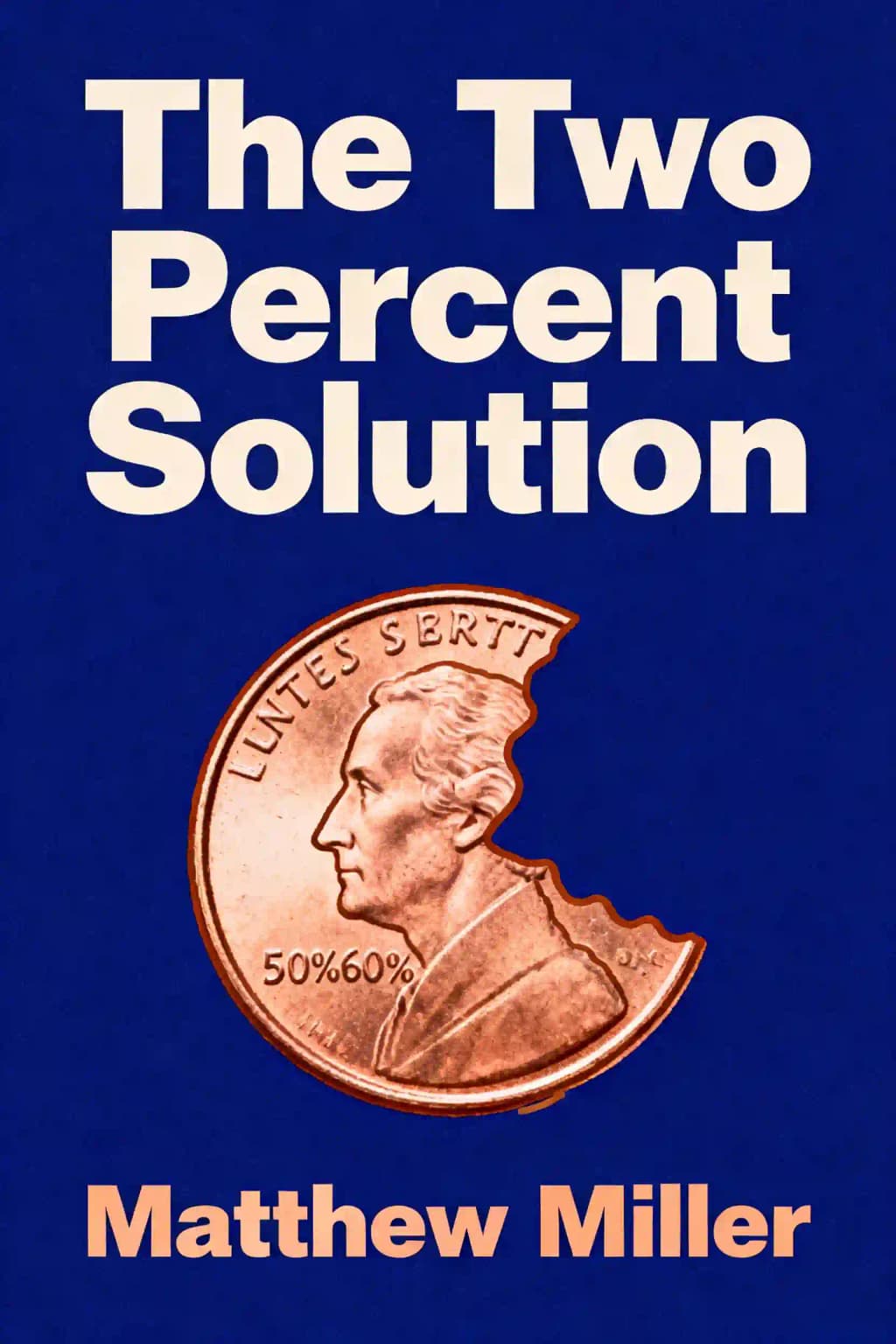
Having outlined ideologically balanced solutions for universal healthcare ($80 billion), improving teaching in poor schools ($30 billion), establishing a living wage ($85 billion), funding school voucher trials ($2 billion), and campaign finance reform ($3 billion), we've allocated $200 billion of our $220 billion "Two Percent Solution" budget. The remaining $20 billion is allocated to universal preschool ($10 billion) and addressing the $100 billion school construction and repair backlog ($10 billion).
How do we find these resources? The author proposes several approaches:
1. Stop giving unjustified subsidies to big corporations. Analysts from across the political spectrum estimate $90-125 billion annually goes to "corporate welfare." Rather than eliminating all corporate welfare, this proposal suggests ending just one-quarter of it, saving $25 billion annually.
2. Stop subsidizing extra health coverage for Americans who already have good coverage. Americans don't pay taxes on employer-paid health insurance, a $120 billion annual subsidy with 70% going to the highest-earning third of Americans. Including as taxable income employer health contributions exceeding the average would save $35 billion annually.
3. Shift one of every six dollars going to bureaucratic programs serving the poor. In 2004, governments at all levels will spend about $175 billion on means-tested benefits for low-income Americans. This proposal would shift $30 billion to the Two Percent agenda.
4. Shift half of current federal aid to poor schools to the Two Percent teacher initiative. Title I sends about $12 billion yearly to poorer districts, but much is spent ineffectively. Redirecting $5 billion from Title I makes sense.
5. Shift $25 billion now given as 'backstop compensation' to health care providers for serving the uninsured. With universal coverage, these subsidies become unnecessary.
6. Implement a Middle Eastern oil liberation tax. Phasing in a 60-cent-per-gallon gas tax would generate $60 billion annually while still keeping prices below 1981 highs and half what Europeans pay.
7. Cancel a portion of President Bush's tax relief for America's highest earners. Scrapping about one-third of Bush's tax cuts-primarily those benefiting the highest earners-would generate roughly $70 billion annually.
8. Consider defense spending reductions. By 2004, defense spending will reach nearly $400 billion-more than the next twenty nations combined and 15% higher than our Cold War average. An "Eisenhower-style 8-7-23 defense plan" could save $50 billion annually while still spending 8 times more than China, 7 times more than Russia, and 23 times more than Iran, North Korea, and Syria combined.
Capitolo 12
Building a Two Percent America
In Orange County, California, focus groups of swing voters revealed encouraging receptivity to the Two Percent agenda. When asked whether they had a stake in solving problems like the uninsured, failing schools, and working poverty, participants readily connected these issues to the nation's future prosperity and their own well-being.
Polling showed substantial support for increased federal action: 74% believed government should do more about the uninsured, 68% about poor schools, and 65% about the working poor. When asked about willingness to pay higher taxes for these issues, 55% supported taxes for the uninsured, 59% for poor schools, but only 38% for helping the working poor.
The strongest supporters of the Two Percent agenda were women, young adults (18-34), Black Americans, and those earning under $30,000 annually - groups that generally believe poverty stems from bad luck rather than personal choices. Suburban women, highly coveted by both parties, showed encouraging support for all three proposals after hearing arguments.
Testing revealed two particularly effective arguments for the Two Percent package. The first framed it as "a smart investment in our nation's future" that would prevent long-term costs of neglecting education and opportunity. The second positioned the agenda not as "big spending" but as a shift in priorities, emphasizing that it would leave government smaller than during Reagan's presidency.
Creating a Two Percent Society requires changing the cynical habits of mind prevalent in America's public culture. While conventional wisdom views problems like healthcare and education as intractable, the Two Percent mindset recognizes these problems have answers requiring only modest changes in resource allocation.
The author paints a vivid picture of America transformed by the Two Percent Solution. In this vision, no American would consider emergency rooms their primary care provider or fear bankruptcy from illness. The teaching profession would attract top talent, with the best teachers gravitating toward the neediest students. Low-wage workers would still face challenges, but would feel their country values work through guaranteed health coverage, good schools for their children, and living wages.
This America would face the aging population challenge while meeting other public goals. Its social progress would enhance its global standing and inspire fresh appreciation for the American model of "civilized freedom" - producing both growth and justice while maintaining lower tax rates and higher job creation than other advanced nations.