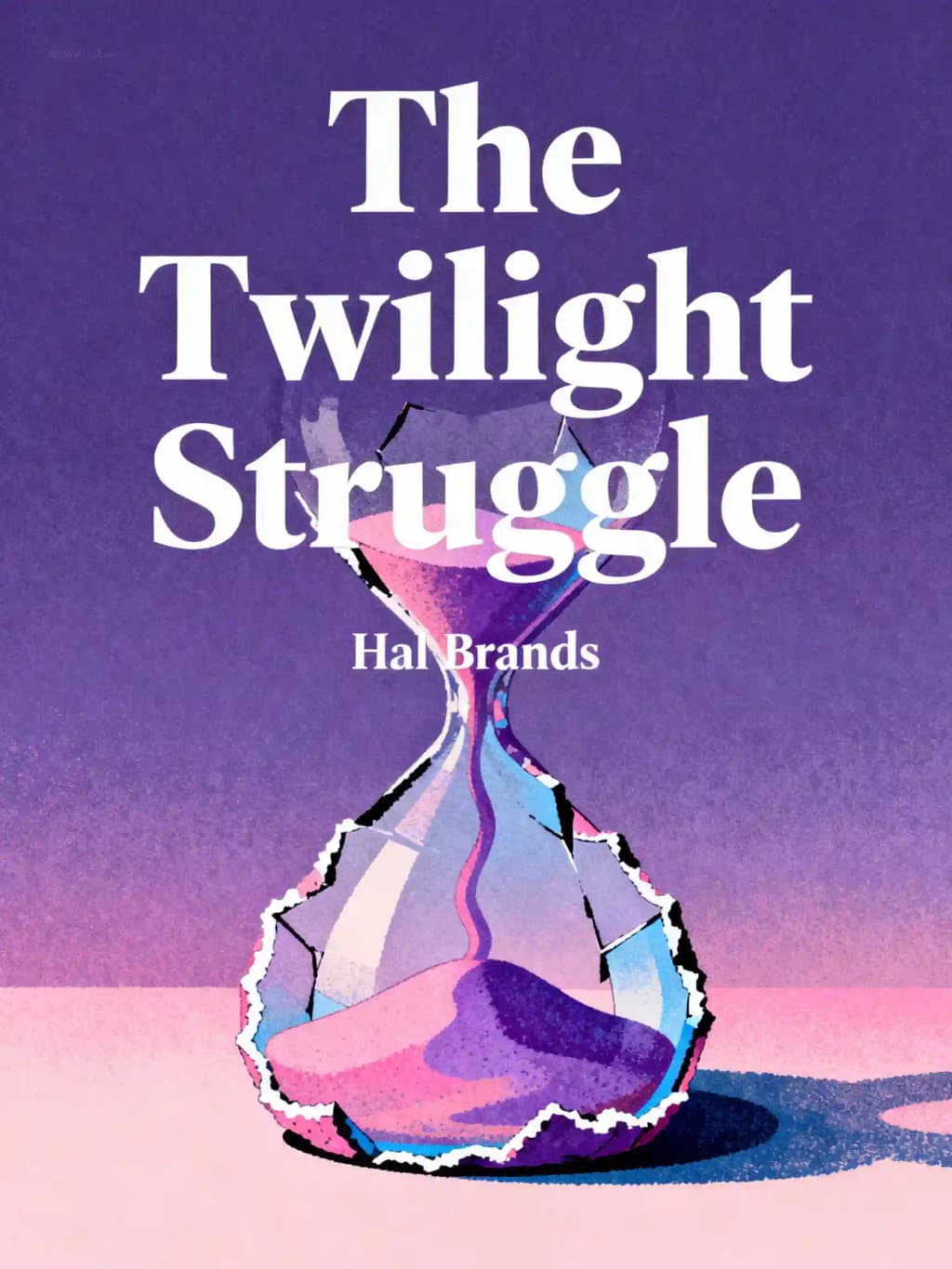
Twilight Struggle: What the Cold War Teaches Us about Great-Power Rivalry Today book cover

Twilight Struggle

What the Cold War Teaches Us about Great-Power Rivalry Today

Hal Brands
3.98 (233 Reviews)

Panoramica di Twilight Struggle

Hal Brands' "The Twilight Struggle" decodes Cold War lessons for today's great-power rivalries. Praised by Harvard's elite policy circles yet sparking debate: can we really repurpose Cold War strategies against China without repeating costly moral compromises?

Temi chiave in Twilight Struggle

  • great power competition
  • containment strategy
  • ideological rivalry
  • milieu strategy
  • asymmetric advantage

Citazioni da Twilight Struggle

  • Containment wasn't just about stalemate but exploiting Soviet internal weaknesses.

  • Wars between major capitalist powers became unthinkable.

  • The Soviet threat made internal disputes seem trivial by comparison.

  • America created an environment where democratic practices flourished.

  • The Marshall Plan wasn't simply economic recovery but defense of weak democracies.

Personaggi di Twilight Struggle

  • George KennanDiplomat who provided the strategy of containment
  • Franklin D. RooseveltPresident who sought post-WWII global cooperation
  • Harry S. TrumanPresident who transitioned U.S. to Cold War policy
  • Joseph StalinSoviet leader whose actions prompted containment
  • Dean AchesonSecretary of State who built situations of strength

Sull'autore

Sull'autore di Twilight Struggle

Hal Brands, author of The Twilight Struggle: What the Cold War Teaches Us about Great-Power Rivalry Today, is a renowned historian and foreign policy strategist specializing in global security and grand strategy. A Henry A. Kissinger Distinguished Professor at Johns Hopkins SAIS and senior fellow at the American Enterprise Institute, Brands draws on his academic expertise and government experience to analyze historical power rivalries and their modern implications.

Brands' experience includes roles as a Pentagon advisor and contributor to U.S. defense strategy. His Bloomberg Opinion columns and frequent media commentary reinforce his authority on geopolitical trends.

Other notable works by Brands include Danger Zone: The Coming Conflict with China (co-authored with Michael Beckley) and The Lessons of Tragedy: Statecraft and World Order, both of which explore themes of international conflict and strategic statecraft. A trusted advisor to policymakers, Brands’ research is widely cited in academic and national security circles, with his books serving as critical resources for understanding 21st-century geopolitics.

The Twilight Struggle has been integrated into graduate-level curricula at leading institutions for its incisive Cold War parallels to contemporary U.S.-China tensions.

Scarica il riassunto di Twilight Struggle

Ottieni il riassunto di Twilight Struggle in formato PDF o EPUB gratuito. Stampalo o leggilo offline quando vuoi.

FAQ su questo libro

The Twilight Struggle analyzes Cold War strategies to offer lessons for modern great-power rivalries, particularly between the U.S., China, and Russia. Hal Brands identifies ten themes—like balancing idealism with realism and managing military escalation—to argue that historical Cold War tactics, such as containment and deterrence, remain relevant today. The book emphasizes strategic discipline and coalition-building to navigate 21st-century geopolitical tensions.

This book is ideal for policymakers, historians, and readers interested in U.S. foreign policy or modern geopolitics. It provides actionable insights for strategists addressing China’s rise and Russia’s aggression, while also appealing to students of Cold War history seeking parallels to contemporary conflicts. Brands’ clear prose makes complex statecraft accessible to general audiences.

Yes, for its concise synthesis of Cold War history and practical applications to current rivalries. Brands’ expertise in grand strategy and his ability to link past policies to modern challenges—like countering authoritarian expansion—make it a valuable resource. However, critics argue its focus on historical analogies may oversimplify today’s multipolar world.

  • Prioritize core interests over peripheral conflicts to avoid overextension.
  • Build alliances to amplify diplomatic and economic leverage.
  • Use deterrence to prevent aggression while avoiding direct war.
  • Maintain strategic adaptability to respond to asymmetric threats.

Brands stresses that enduring rivalries require patience, consistency, and a blend of military and non-military tools.

The book advocates Cold War-style strategies, like containing China’s territorial ambitions through regional partnerships (e.g., NATO-style alliances in Asia) and countering economic coercion. Brands warns against underestimating ideological competition, urging the U.S. to champion democratic values while avoiding outright confrontation. Critics caution that China’s global economic integration complicates direct comparisons to Soviet rivalry.

Some argue Brands overstates the applicability of Cold War tactics, particularly in an era of interconnected economies and cyber warfare. Critics note the book downplays risks of military escalation and lacks concrete solutions for hybrid threats like disinformation. Others contend its focus on U.S. primacy ignores the rise of non-aligned nations.

Grand strategy involves aligning a nation’s military, economic, and diplomatic resources toward long-term goals. Brands highlights the Cold War’s “strategic synthesis”—combining containment, deterrence, and ideological mobilization—as a model for managing modern rivalries. He warns that fragmented policies risk incoherence in facing systemic adversaries.

  • The Cuban Missile Crisis to illustrate crisis management.
  • NATO’s formation as a template for modern alliance-building.
  • Reagan’s arms control diplomacy to show how engagement can complement pressure.
  • The Vietnam War as a cautionary tale of mission creep.

Unlike Danger Zone (co-authored with Michael Beckley), which focuses specifically on China, this book offers broader strategic principles. It expands on themes from The Lessons of Tragedy, applying historical insights to contemporary statecraft. Fans of Brands’ Bloomberg Opinion columns will recognize his emphasis on pragmatic realism.

Brands argues ideological competition is unavoidable in great-power rivalries, citing the Cold War’s clash between democracy and communism. He advises the U.S. to leverage alliances with democracies while avoiding overly moralistic policies that provoke backlash. However, he acknowledges modern authoritarian regimes exploit economic interdependence more effectively than the Soviets.

The book emphasizes deterrence and arms control as dual pillars for managing nuclear risks, drawing from Cold War precedents like the Intermediate-Range Nuclear Forces Treaty. Brands warns that emerging technologies (e.g., hypersonic missiles) and multipolar nuclear rivalry (e.g., North Korea) require updated frameworks.

Economic tools—like sanctions and trade agreements—are framed as critical for pressuring adversaries and rewarding allies. Brands highlights the Marshall Plan’s success in rebuilding post-WWII Europe and urges similar investments in green technology or infrastructure to counter China’s Belt and Road Initiative.

Esplora il Tuo Modo di Imparare

Twilight Struggle non è solo un libro — è una masterclass in History. Per aiutarti ad assorbire le sue lezioni nel modo che funziona meglio per te, offriamo cinque modalità di apprendimento uniche. Che tu sia un pensatore profondo, un apprendista veloce o un amante delle storie, c'è una modalità progettata per il tuo stile.

Modalità Riassunto Rapido

Leggi o ascolta il riassunto di Twilight Struggle in 9 minuti

Scomponi le idee chiave di Twilight Struggle in punti facili da capire per comprendere come i team innovativi creano, collaborano e crescono.

play
00:00
00:00

Modalità Divertente

Lezioni da Twilight Struggle Raccontate in Storie di 21 Min

Vivi Twilight Struggle attraverso narrazioni vivide che trasformano le lezioni di innovazione in momenti che ricorderai e applicherai.

play
00:00
00:00

Modalità Personalizza

Vivi Twilight Struggle nel tuo stile di apprendimento

Chiedi qualsiasi cosa, scegli il tuo stile di apprendimento e co-crea intuizioni che risuonano davvero con te.

Personalize Mode

Creato da alumni della Columbia University a San Francisco

BeFreed Riunisce Una Community Globale Di 1,000,000 Menti Curiose

"Instead of endless scrolling, I just hit play on BeFreed. It saves me so much time."

@Moemenn
platform
star
star
star
star
star

"I never knew where to start with nonfiction—BeFreed’s book lists turned into podcasts gave me a clear path."

@Chloe, Solo founder, LA
platform
comments
12
likes
117

"Perfect balance between learning and entertainment. Finished ‘Thinking, Fast and Slow’ on my commute this week."

@Raaaaaachelw
platform
star
star
star
star
star

"Crazy how much I learned while walking the dog. BeFreed = small habits → big gains."

@Matt, YC alum
platform
comments
12
likes
108

"Reading used to feel like a chore. Now it’s just part of my lifestyle."

@Erin, Investment Banking Associate , NYC
platform
comments
254
likes
17

"Feels effortless compared to reading. I’ve finished 6 books this month already."

@djmikemoore
platform
star
star
star
star
star

"BeFreed turned my guilty doomscrolling into something that feels productive and inspiring."

@Pitiful
platform
comments
96
likes
4.5K

"BeFreed turned my commute into learning time. 20-min podcasts are perfect for finishing books I never had time for."

@SofiaP
platform
star
star
star
star
star

"BeFreed replaced my podcast queue. Imagine Spotify for books — that’s it. 🙌"

@Jaded_Falcon
platform
comments
201
thumbsUp
16

"It is great for me to learn something from the book without reading it."

@OojasSalunke
platform
star
star
star
star
star

"The themed book list podcasts help me connect ideas across authors—like a guided audio journey."

@Leo, Law Student, UPenn
platform
comments
37
likes
483

"Makes me feel smarter every time before going to work"

@Cashflowbubu
platform
star
star
star
star
star

"Instead of endless scrolling, I just hit play on BeFreed. It saves me so much time."

@Moemenn
platform
star
star
star
star
star

"I never knew where to start with nonfiction—BeFreed’s book lists turned into podcasts gave me a clear path."

@Chloe, Solo founder, LA
platform
comments
12
likes
117

"Perfect balance between learning and entertainment. Finished ‘Thinking, Fast and Slow’ on my commute this week."

@Raaaaaachelw
platform
star
star
star
star
star

"Crazy how much I learned while walking the dog. BeFreed = small habits → big gains."

@Matt, YC alum
platform
comments
12
likes
108

"Reading used to feel like a chore. Now it’s just part of my lifestyle."

@Erin, Investment Banking Associate , NYC
platform
comments
254
likes
17

"Feels effortless compared to reading. I’ve finished 6 books this month already."

@djmikemoore
platform
star
star
star
star
star

"BeFreed turned my guilty doomscrolling into something that feels productive and inspiring."

@Pitiful
platform
comments
96
likes
4.5K

"BeFreed turned my commute into learning time. 20-min podcasts are perfect for finishing books I never had time for."

@SofiaP
platform
star
star
star
star
star

"BeFreed replaced my podcast queue. Imagine Spotify for books — that’s it. 🙌"

@Jaded_Falcon
platform
comments
201
thumbsUp
16

"It is great for me to learn something from the book without reading it."

@OojasSalunke
platform
star
star
star
star
star

"The themed book list podcasts help me connect ideas across authors—like a guided audio journey."

@Leo, Law Student, UPenn
platform
comments
37
likes
483

"Makes me feel smarter every time before going to work"

@Cashflowbubu
platform
star
star
star
star
star

"Instead of endless scrolling, I just hit play on BeFreed. It saves me so much time."

@Moemenn
platform
star
star
star
star
star

"I never knew where to start with nonfiction—BeFreed’s book lists turned into podcasts gave me a clear path."

@Chloe, Solo founder, LA
platform
comments
12
likes
117

"Perfect balance between learning and entertainment. Finished ‘Thinking, Fast and Slow’ on my commute this week."

@Raaaaaachelw
platform
star
star
star
star
star

"Crazy how much I learned while walking the dog. BeFreed = small habits → big gains."

@Matt, YC alum
platform
comments
12
likes
108

"Reading used to feel like a chore. Now it’s just part of my lifestyle."

@Erin, Investment Banking Associate , NYC
platform
comments
254
likes
17

"Feels effortless compared to reading. I’ve finished 6 books this month already."

@djmikemoore
platform
star
star
star
star
star

"BeFreed turned my guilty doomscrolling into something that feels productive and inspiring."

@Pitiful
platform
comments
96
likes
4.5K

"BeFreed turned my commute into learning time. 20-min podcasts are perfect for finishing books I never had time for."

@SofiaP
platform
star
star
star
star
star

"BeFreed replaced my podcast queue. Imagine Spotify for books — that’s it. 🙌"

@Jaded_Falcon
platform
comments
201
thumbsUp
16

"It is great for me to learn something from the book without reading it."

@OojasSalunke
platform
star
star
star
star
star

"The themed book list podcasts help me connect ideas across authors—like a guided audio journey."

@Leo, Law Student, UPenn
platform
comments
37
likes
483

"Makes me feel smarter every time before going to work"

@Cashflowbubu
platform
star
star
star
star
star

Vuoi vedere altre storie?

Come le persone parlano di BeFreed in giro per il web
1.5K Ratings4.7
Inizia il tuo percorso di apprendimento, ora