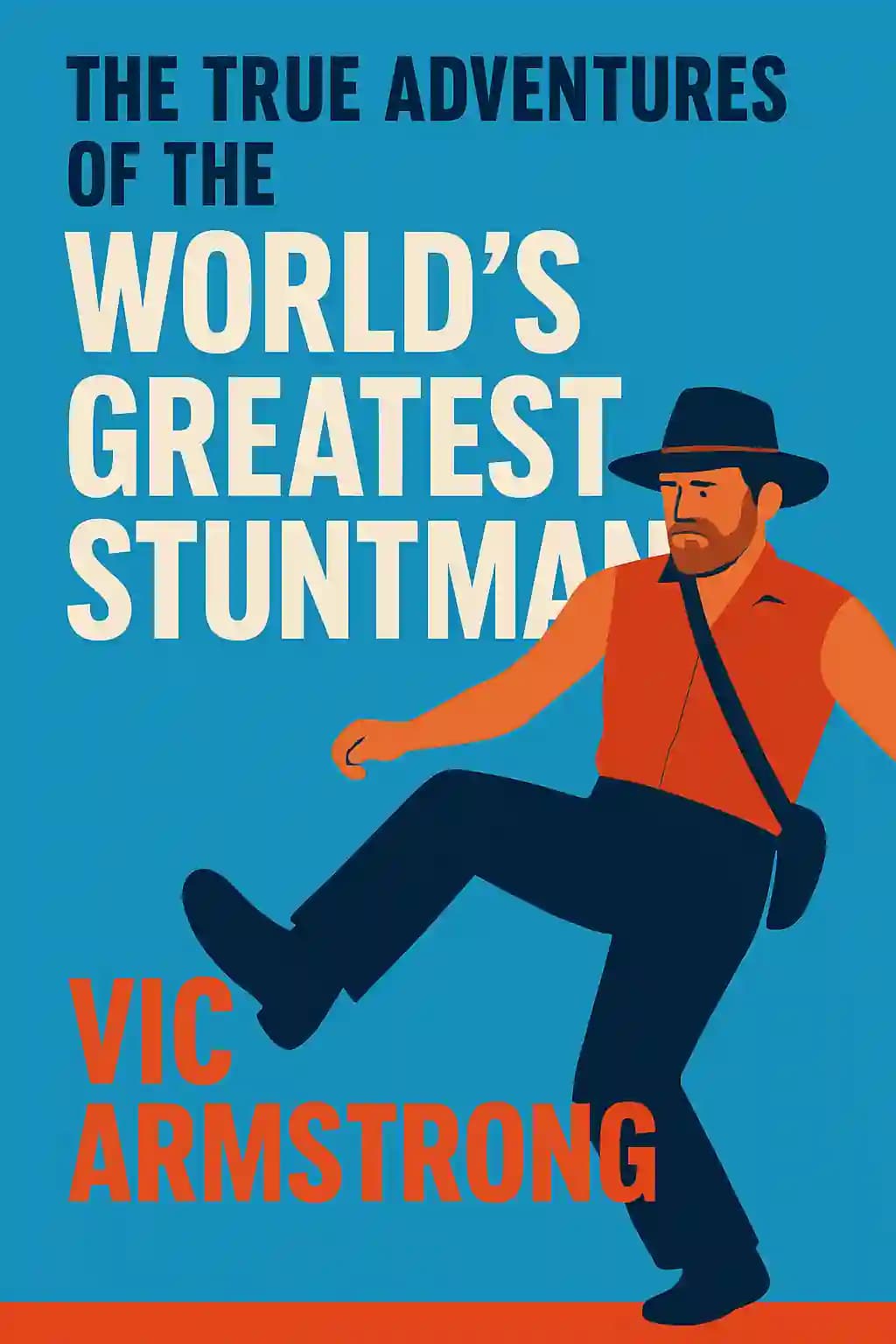
Before CGI ruled Hollywood, Vic Armstrong risked everything as Harrison Ford's double in Indiana Jones and Superman's stunt performer. Steven Spielberg insists "No CGI can match what Vic can accomplish" in this legendary memoir Martin Scorsese calls "the work of a true legend."
Vic Armstrong, author of The True Adventures of the World’s Greatest Stuntman, is a legendary British stuntman, stunt coordinator, and film director whose five-decade career redefined action cinema. Born in Farnham Common, England, Armstrong transitioned from aspiring jockey to Hollywood icon, doubling for stars like Harrison Ford (Indiana Jones, Han Solo) and Christopher Reeve (Superman).
His memoir blends adrenaline-fueled anecdotes with insights into blockbusters such as James Bond, Indiana Jones, and Superman, reflecting his unparalleled expertise in crafting cinematic danger.
A Guinness World Record holder as the “most prolific stuntman,” Armstrong later directed action sequences for films like Terminator 2: Judgment Day and Thor, earning an Academy Technical Achievement Award and BAFTA. His work bridges practical stunts and modern特效, showcasing innovation across eras.
The True Adventures offers a rare glimpse into Hollywood’s stunt evolution, informed by his roles as performer, coordinator, and director. The book has become a staple for film enthusiasts and industry professionals, cementing Armstrong’s legacy as a pioneer whose real-life daring mirrors the adventures he brought to screen.
The True Adventures of the World's Greatest Stuntman is Vic Armstrong’s memoir chronicling his 50+ years in Hollywood as a stuntman, stunt coordinator, and director. The book details his work on iconic films like Indiana Jones, James Bond, and Superman, including daring stunts like Harrison Ford’s tank jump in Indiana Jones and the Last Crusade and Sean Connery’s horseback dive in Never Say Never Again. It blends career highlights with behind-the-scenes anecdotes and insights into stunt innovation.
Film enthusiasts, aspiring stunt performers, and fans of classic action cinema will find this book invaluable. It offers a rare glimpse into Hollywood’s stunt industry, with practical wisdom for filmmakers and adrenaline-fueled stories for casual readers. Those interested in Harrison Ford’s stunt work or James Bond filming techniques will gain unique perspectives.
Yes, for its firsthand accounts of Hollywood’s most dangerous stunts and its historical insights. Armstrong’s stories—like dislocating his ankle during a Bond stunt or improvising Superman’s flying sequences—are gripping. The book also addresses ethical advancements, such as training horses humanely instead of using cruel methods common in early cinema.
Armstrong doubled for Harrison Ford in all three original Indiana Jones movies, performing stunts like the tank roof slide in The Last Crusade. He recounts Ford’s hands-on approach, Spielberg’s trust in his expertise, and how he seamlessly filled in when Ford needed surgery during Temple of Doom.
Armstrong discusses transitioning from stunts to directing action units for films like Terminator 2: Judgment Day and Mission: Impossible III. He highlights collaborations with George Lucas on Young Indiana Jones and overcoming challenges on lower-budget projects like Left Behind.
Some reviewers note the memoir prioritizes professional anecdotes over personal life details. While packed with stunt stories, it offers limited introspection into Armstrong’s relationships or struggles beyond his career.
Unlike actor-centric autobiographies, this focuses on technical filmmaking and stunt coordination. It shares similarities with No Time to Die: The Making of the Film but emphasizes physical artistry over celebrity gossip.
Armstrong underscores his Guinness World Record as the “most prolific stuntman” and his Academy Technical Achievement Award. He also details mentoring modern stunt performers and advocating for safer industry practices.
It traces his roots as a teenage jockey in England, his initial film work on Arabesque (1966), and mentorship under stuntman Jimmy Lodge. His equestrian background proved pivotal for early horse-riding stunts in Westerns and Bond films.
Senti il libro attraverso la voce dell'autore
Trasforma la conoscenza in spunti coinvolgenti e ricchi di esempi
Cattura le idee chiave in un lampo per un apprendimento veloce
Goditi il libro in modo divertente e coinvolgente
I can do that ten times better.
Being young was my greatest asset.
Employ the best people because you're only as good as those who work for you.
Scomponi le idee chiave di The True Adventures of the World's Greatest Stuntman in punti facili da capire per comprendere come i team innovativi creano, collaborano e crescono.
Vivi The True Adventures of the World's Greatest Stuntman attraverso narrazioni vivide che trasformano le lezioni di innovazione in momenti che ricorderai e applicherai.
Chiedi qualsiasi cosa, scegli il tuo stile di apprendimento e co-crea intuizioni che risuonano davvero con te.

Creato da alumni della Columbia University a San Francisco
"Instead of endless scrolling, I just hit play on BeFreed. It saves me so much time."
"I never knew where to start with nonfiction—BeFreed’s book lists turned into podcasts gave me a clear path."
"Perfect balance between learning and entertainment. Finished ‘Thinking, Fast and Slow’ on my commute this week."
"Crazy how much I learned while walking the dog. BeFreed = small habits → big gains."
"Reading used to feel like a chore. Now it’s just part of my lifestyle."
"Feels effortless compared to reading. I’ve finished 6 books this month already."
"BeFreed turned my guilty doomscrolling into something that feels productive and inspiring."
"BeFreed turned my commute into learning time. 20-min podcasts are perfect for finishing books I never had time for."
"BeFreed replaced my podcast queue. Imagine Spotify for books — that’s it. 🙌"
"It is great for me to learn something from the book without reading it."
"The themed book list podcasts help me connect ideas across authors—like a guided audio journey."
"Makes me feel smarter every time before going to work"
Creato da alumni della Columbia University a San Francisco

Ottieni il riassunto di The True Adventures of the World's Greatest Stuntman in formato PDF o EPUB gratuito. Stampalo o leggilo offline quando vuoi.
What does it take to make the impossible look effortless? Vic Armstrong knows the answer-he's lived it. When Indiana Jones leaps from a galloping horse onto a Nazi tank, when Superman soars between skyscrapers, when James Bond defies death in ways that make audiences gasp, Armstrong is the unseen force making magic real. Holding the Guinness World Record as cinema's most prolific stunt performer, he didn't just risk his life for entertainment-he revolutionized how action films are made. His invention of the fan descender transformed dangerous falls from potential death sentences into controlled artistry. This isn't a story about recklessness; it's about precision, innovation, and the relentless pursuit of perfection behind Hollywood's most breathtaking moments.
Armstrong's father Robert, a legendary farrier who shod horses for the Queen, once worked through a nail ripping through his hand tendons-setting an impossible standard for toughness. Growing up amid constant relocations, including Kenya during the Mau Mau uprising, young Vic developed adaptability and fearlessness. By nine, he was riding racehorses, dreaming of becoming a steeplechase jockey despite weighing 210 pounds. He'd starve himself down to 140 just to race, learning discipline that would define his career. His film entry came through Johnny Rock, Britain's biggest horse supplier to studios. Watching nervous stuntmen struggle with horses, Armstrong thought, "I can do that ten times better." At 20 pounds daily-ten times his jockey wages-the financial incentive was irresistible. His break came doubling for a lead actor in *Arabesque*. When he quipped to Sophia Loren, "If you were riding me bareback, I'd be bucking too," she laughed-and a career was born. His first Bond film, *You Only Live Twice*, had him sliding 125 feet down ropes into SPECTRE's volcano headquarters while firing a gun. *On Her Majesty's Secret Service* followed-hanging over cliff edges with questionable safety cables, learning that trust in equipment could mean life or death.
Years later, doubling Roger Moore in *Live and Let Die*, Armstrong performed a flip-and-swing stunt when the platform's weld gave way mid-somersault. He crashed down, crushing the pads under his heels-an injury that still haunts him decades later. Between Bond films, he doubled Jon Voight being pushed under a subway train in *The Odessa File*, learning painful lessons about impact absorption when improperly cushioned landing zones felt like hitting an oak table. *A Bridge Too Far* elevated everything. This $25 million production featured Connery, Hopkins, Olivier, and Redford, with director Richard Attenborough specifically requesting young stuntmen to authentically portray teenage soldiers. Armstrong coordinated massive sequences including the Rhine crossing using original canvas boats in treacherous currents. Meeting actual Arnhem veterans who wept watching their experiences recreated brought profound weight to the work. During one parachute landing stunt, his hooks popped off 80 feet up-he landed backwards, 200 feet off target, hitting his head. The film established him as Hollywood's go-to coordinator for large-scale productions.
*Superman* and *Superman II* consumed nearly a year of Armstrong's life, redefining practical effects. As Christopher Reeve's primary flying double, he spent countless hours in specialized harnesses, lying on body molds mounted on blue-painted pole arms. The most dangerous moment came diving headfirst through Lex Luthor's breakaway ceiling-arms extended, body rigid, cape flowing-with just three feet between entry point and crash pad. Technical mishaps were constant. Piano wires snapped during a spinning descent, sending him into an uncontrolled 15-foot fall. When supervisors proposed attaching him to a glider's nose for outdoor scenes, he refused-his suspicions confirmed when the supervisor admitted his own vertigo. One cameraman asked if Armstrong could "fall any slower"-capturing the disconnect between filmmaking ambitions and physical reality. Filming in New York during a massive blackout turned nighttime flying sequences into public spectacles as crowds gathered at 3 AM to watch "Superman" soar between buildings. The productions established Armstrong as the industry's premier high-stakes performer.
Tunisia's 120-degree heat halted *Raiders of the Lost Ark* filming at 2 PM daily. Spielberg consumed only personally unsealed food after discovering hotel staff refilled Evian bottles from the water truck. The director constantly reminded everyone this was "just a B movie," desperate to prove he could deliver on schedule after *1941*. When time constraints threatened an elaborate sword fight, Dave Tomblin sarcastically suggested "just shoot the guy" - and Spielberg realized that was perfect. Armstrong's resemblance to Harrison Ford was so uncanny he doubled him across multiple films. Nobody realized during production they were making a classic - only at the cast screening, watching children stand on seats shouting "Go on Indy!" did the magic become apparent. *Temple of Doom* brought darker adventures, with Armstrong and wife Wendy (doubling Kate Capshaw) rehearsing tumbles through canopies using fan descenders. When Ford's back seized up, Armstrong saved the film by doubling him for weeks - releasing children, mine car sequences, gantry jumps, rock-crusher conveyor belt fights. His proudest moment came in *The Last Crusade*: leaping from a galloping horse onto a moving tank. Using specialized flexible steel straps with elevated stirrup pegs, he perfectly timed his leap with the horse's upward stride, propelling across to land on the tank - a stunt that made movie history.
While filming *Green Ice* in Mexico, Armstrong made stunt history with the first-ever fan descender machine. After a terrifying 340-foot test leap off a Mexico City skyscraper, he performed the stunt ten times before 11 AM, earning $9,500. The final shot combined jumping off the building, helicopter pursuit, landing on a window ledge, then jumping onto a moving truck-all in one take. The fan descender revolutionized the industry, eventually earning Armstrong a Technical Achievement Academy Award and enabling digital wire removal that saved countless lives. On *An American Werewolf in London*, facing limited filming permission in Piccadilly Circus, Armstrong built a full-scale replica at Brooklands Aerodrome for rehearsals. The centerpiece-a London double-decker bus performing a 180-degree spin-seemed impossible until Dave Bickers modified it with forklift wheels that could drop on cue. Armstrong drove the bus at speed into Piccadilly Circus, nearly crashed into a Wimpy restaurant, but executed perfectly, triggering 20 vehicles crashing in two and a half minutes. Armstrong's directing break came through George Lucas's *Young Indiana Jones Chronicles*. While prepping *Universal Soldier*, Lucas invited him to shoot action sequences in Spain. After shooting 72 set-ups in one day, Lucas offered him an episode originally intended for Spielberg. His directing career expanded to *F/X2*, *Joshua Tree*, and significant uncredited work on *Double Impact*. On *Starship Troopers*, Paul Verhoeven wrote on Armstrong's poster: "You weren't my second unit director, you were my co-director."
After four decades, Armstrong witnessed cinema's transformation from practical magic to digital effects. He cherishes the era when filmmakers built entire towns without computer assistance, constructing everything from scratch on remote films like *The Mission* and *Rambo III*. Working with cinema's greatest stars revealed unique approaches. Harrison Ford did everything himself. Sean Connery preferred stuntmen. Arnold Schwarzenegger impressed with intelligence and work ethic, later calling stunt performers "the guys that put me on the map." Tom Cruise proved fearless on *Mission: Impossible III*, jumping off 80-foot buildings and lying under jackknifing semi-trucks. CGI enables impossible sequences and improves safety, but something's lost when audiences sense computer-generated imagery rather than real achievement. Armstrong's approach emphasized safety through preparation - repeatedly practicing leaps from galloping horses, training his horse Huracan for perfect timing. For *Die Another Day*'s ice chase, he insisted on converting Aston Martins and Jaguars to four-wheel drive - a million-pound modification that was absolutely necessary. Armstrong's legacy reminds us that the most powerful movie moments come from real human courage and artistry. The next time you watch a hero defy gravity, remember - someone actually did that. That's not just filmmaking - that's the purest form of storytelling, written in adrenaline and performed at the edge of human capability.