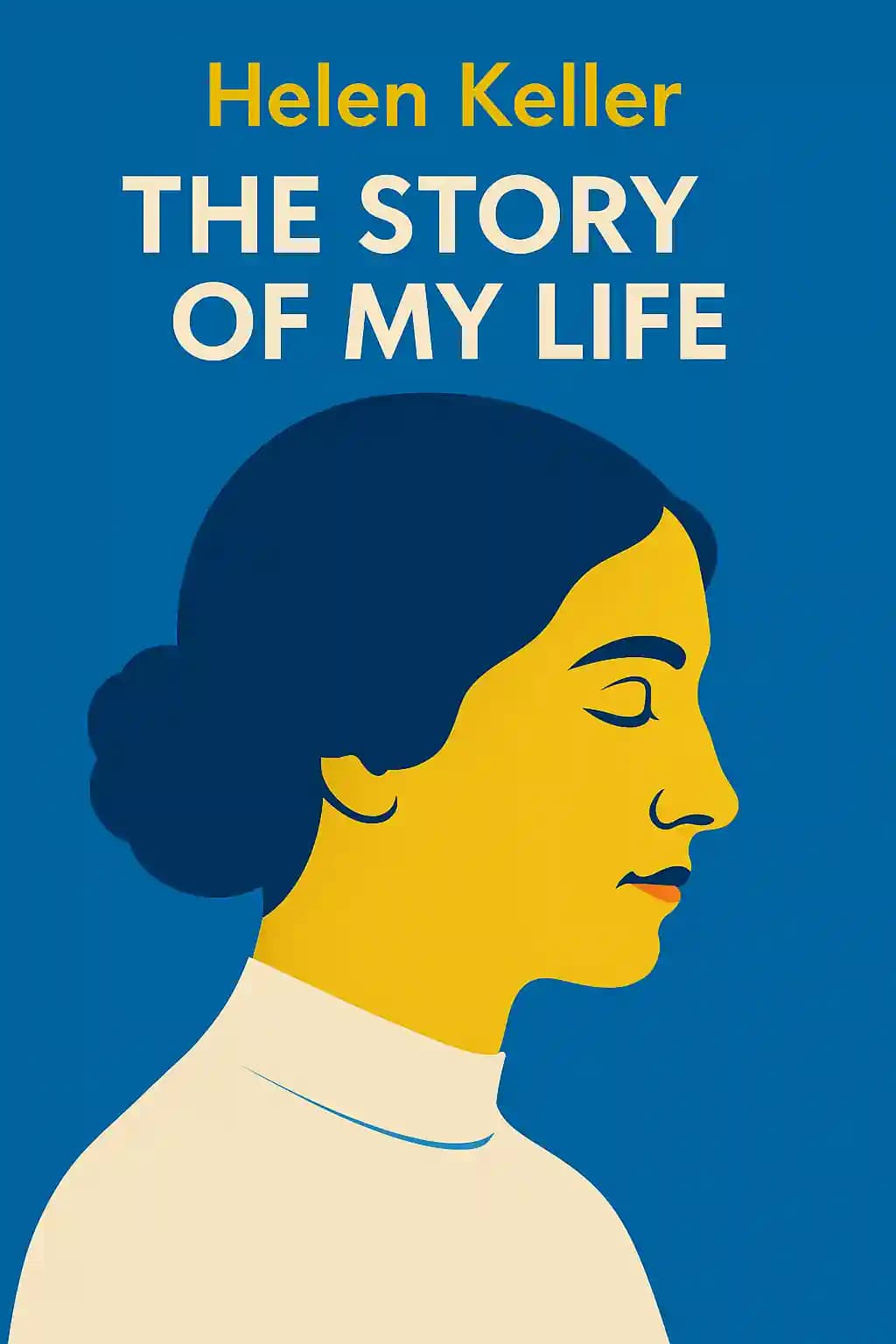
Blinded at 19 months, Helen Keller's autobiography transcends disability, inspiring millions worldwide. Mark Twain called her "one of the 19th century's most interesting characters" - a testament to how one teacher's dedication unlocked a brilliant mind trapped in darkness and silence.
Helen Adams Keller (1880–1968), author of the groundbreaking autobiography The Story of My Life, was a pioneering American disability rights advocate and literary figure who became globally renowned for overcoming dual blindness and deafness. This memoir chronicles her transformative early education with teacher Anne Sullivan, blending themes of perseverance, sensory perception, and human potential. Keller’s lived experience as the first deafblind person to earn a Bachelor of Arts degree (Radcliffe College, 1904) informs her vivid explorations of communication and resilience.
A prolific writer, Keller authored 12 books including philosophical works like The World I Live In and Optimism, along with numerous articles advocating for social justice. Her activism extended to co-founding the American Civil Liberties Union and decades of international lecturing on behalf of the visually impaired.
Recognized with the Presidential Medal of Freedom in 1964, The Story of My Life remains a seminal work in disability literature, translated into 50+ languages and continuously in print since 1903. Its enduring legacy includes multiple film adaptations and inclusion in academic curricula worldwide.
The Story of My Life chronicles Helen Keller’s journey from isolation as a deafblind child to becoming the first deafblind person to earn a Bachelor of Arts degree. The autobiography highlights her early struggles, transformative education under Anne Sullivan, and perseverance through challenges like learning to communicate via sign language and Braille. It also reflects her love of language, advocacy for disability rights, and academic achievements at Radcliffe College.
This book is ideal for readers interested in autobiographies, disability rights history, or stories of resilience. Educators, students, and advocates will appreciate Keller’s insights into overcoming adversity and her groundbreaking educational journey. It’s also a powerful read for those seeking inspiration from a pioneering figure in accessibility and human potential.
Yes, Keller’s lyrical prose and candid reflections offer a timeless perspective on perseverance, education, and human connection. The book’s blend of personal triumph and historical significance makes it a cornerstone of disability literature. Critics praise its emotional depth, though some note its collaborative authorship with Anne Sullivan and John Macy.
After losing her sight and hearing at 19 months, Keller learned tactile sign language through Anne Sullivan’s innovative teaching. Sullivan spelled words into Keller’s palm, beginning with “water” at a pump, which became a pivotal breakthrough. Keller later mastered Braille, lip-reading, and speech with Sarah Fuller’s guidance.
Anne Sullivan, Keller’s lifelong teacher, transformed her life by teaching her language and fostering intellectual curiosity. Sullivan’s patient, tactile methods—like finger-spelling—enabled Keller to connect with the world. Their partnership, spanning nearly 50 years, is central to Keller’s academic and personal achievements.
Key themes include resilience against adversity, the transformative power of education, and the importance of human connection. Keller also explores sensory perception, language as liberation, and advocacy for marginalized communities.
The water pump moment—where Sullivan spells “w-a-t-e-r” into Keller’s hand—marks her breakthrough understanding of language. This scene symbolizes Keller’s transition from isolation to intellectual awakening and is a defining moment in the book.
Keller saw her disabilities as challenges to overcome, not limitations. She emphasized adaptability, writing, “The only thing worse than being blind is having sight but no vision”. Her advocacy redefined societal perceptions of deafblind individuals.
Some critics note Keller’s reliance on others’ perspectives, as her early memories were shaped by Sullivan and family accounts. Others highlight the book’s optimistic tone, which occasionally glosses over deeper emotional struggles.
Keller’s story underscores the power of education and persistence in overcoming systemic barriers. Her advocacy laid groundwork for disability rights movements, making the book relevant to discussions on inclusivity and accessibility today.
Notable quotes include:
These lines encapsulate Keller’s philosophical outlook and literary voice.
The book subtly introduces themes Keller later championed: disability rights, women’s suffrage, and labor reform. Her academic success at Radcliffe, detailed in the memoir, became a symbol of possibility for marginalized communities.
Senti il libro attraverso la voce dell'autore
Trasforma la conoscenza in spunti coinvolgenti e ricchi di esempi
Cattura le idee chiave in un lampo per un apprendimento veloce
Goditi il libro in modo divertente e coinvolgente
That living word awakened my soul.
Knowledge is love and light and vision.
Scomponi le idee chiave di The story of my life in punti facili da capire per comprendere come i team innovativi creano, collaborano e crescono.
Distilla The story of my life in rapidi promemoria che evidenziano i principi chiave di franchezza, lavoro di squadra e resilienza creativa.

Vivi The story of my life attraverso narrazioni vivide che trasformano le lezioni di innovazione in momenti che ricorderai e applicherai.
Chiedi qualsiasi cosa, scegli la voce e co-crea spunti che risuonino davvero con te.

Creato da alumni della Columbia University a San Francisco
"Instead of endless scrolling, I just hit play on BeFreed. It saves me so much time."
"I never knew where to start with nonfiction—BeFreed’s book lists turned into podcasts gave me a clear path."
"Perfect balance between learning and entertainment. Finished ‘Thinking, Fast and Slow’ on my commute this week."
"Crazy how much I learned while walking the dog. BeFreed = small habits → big gains."
"Reading used to feel like a chore. Now it’s just part of my lifestyle."
"Feels effortless compared to reading. I’ve finished 6 books this month already."
"BeFreed turned my guilty doomscrolling into something that feels productive and inspiring."
"BeFreed turned my commute into learning time. 20-min podcasts are perfect for finishing books I never had time for."
"BeFreed replaced my podcast queue. Imagine Spotify for books — that’s it. 🙌"
"It is great for me to learn something from the book without reading it."
"The themed book list podcasts help me connect ideas across authors—like a guided audio journey."
"Makes me feel smarter every time before going to work"
Creato da alumni della Columbia University a San Francisco

Ottieni il riassunto di The story of my life in formato PDF o EPUB gratuito. Stampalo o leggilo offline quando vuoi.
Imagine having your world plunged into complete darkness and silence before you even understand what those senses mean. At nineteen months old, Helen Keller lost both sight and hearing to illness, leaving her trapped in a sensory void few can comprehend. Those early years were marked by rage and frustration-a brilliant mind imprisoned without language or structure. Helen existed as a wild, undisciplined child, communicating through primitive signs and often violent tantrums. Everything changed on March 3, 1887, when twenty-year-old Anne Sullivan arrived at the Keller home in Alabama. Their first month together was a battle of wills, culminating in the now-legendary breakthrough at the water pump. As cool water flowed over one hand, Anne spelled "w-a-t-e-r" into Helen's other palm. In that electric moment, the connection between physical sensation and abstract language ignited understanding. "That living word awakened my soul," Helen writes. Within hours, she learned thirty words. Within days, she formed simple sentences. The thirst for knowledge that would define her life had been unleashed. This wasn't just an educational technique but a profound philosophical transformation-proof that the human mind can find pathways to understanding even when conventional routes are blocked. Helen moved from isolation to engagement not through sight or sound, but through touch, forever changing our understanding of how consciousness develops.