Capitolo 1
The Shadows Before the Storm: Europe's Path to Catastrophe
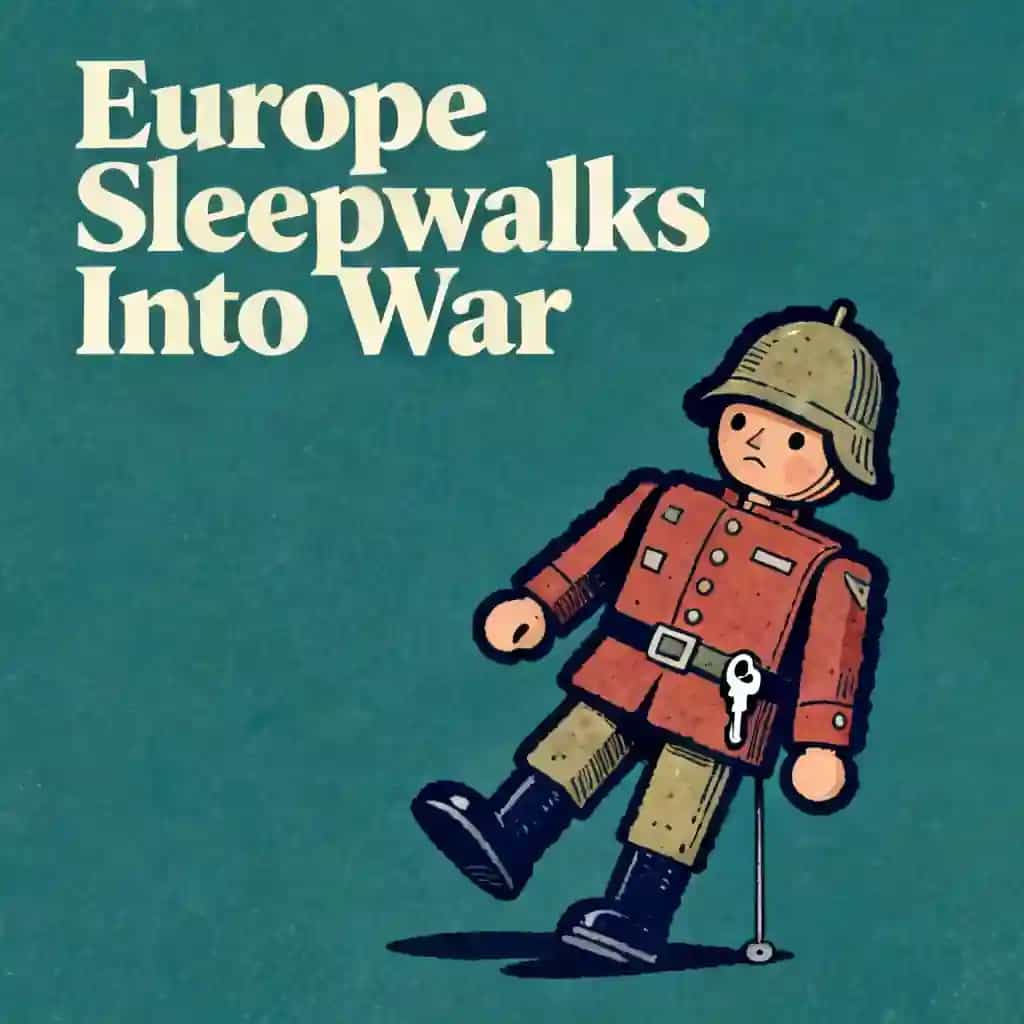
In 2012, historian Christopher Clark's "The Sleepwalkers" revolutionized our understanding of World War I's origins. Unlike previous accounts that assigned singular blame to Germany, Clark's narrative reveals a complex web of decisions across European capitals that culminated in catastrophe. The book became an international sensation, praised by figures from Angela Merkel to Barack Obama for its balanced perspective on how Europe "sleepwalked" into war. What makes Clark's work particularly relevant today is how it illuminates the dangers of alliance systems, misperceptions between nations, and the way crises can spiral beyond control-lessons that resonate powerfully in our current era of global tensions and shifting power dynamics.
Capitolo 2
A Continent Divided: The Polarization of Europe
By 1914, Europe had transformed from a fluid multi-polar system into two rigid alliance blocs poised for conflict. This polarization began with the Franco-Russian Alliance of 1894, a partnership that fundamentally altered European power dynamics. France, still smarting from its humiliating defeat in the Franco-Prussian War, sought security against German power, while Russia needed allies to pursue its ambitions in the Balkans and resist British imperial pressure in Asia. Though these powers had divergent interests, their alliance created a counterweight to the Triple Alliance of Germany, Austria-Hungary, and Italy.
Britain's gradual abandonment of "splendid isolation" further solidified this division. After decades of imperial rivalry with Russia, Britain surprisingly aligned with its former adversary through the 1907 Anglo-Russian Convention. This agreement, coupled with the earlier Entente Cordiale with France, effectively positioned Britain within the Franco-Russian camp, though without formal alliance commitments.
Meanwhile, Germany pursued its own "world policy" (Weltpolitik), seeking colonial possessions and naval power commensurate with its growing industrial might. Admiral Tirpitz's naval construction program directly challenged British maritime supremacy, though it ultimately failed to achieve its strategic objectives. By 1912, Germany had effectively lost the naval race, yet the damage to Anglo-German relations proved lasting.
What made this polarization particularly dangerous was how it transformed local disputes into potential triggers for continental war. The Franco-Russian Alliance contained a dangerous ambiguity: while France focused primarily on containing Germany, Russia was increasingly preoccupied with Austria-Hungary's activities in the Balkans. This asymmetry meant that a Balkan crisis involving Austria could automatically trigger Russian mobilization, potentially dragging France and Germany into conflict despite neither having direct interests in the original dispute.
By 1914, Europe's alliance system had created a precarious situation where, as British Foreign Secretary Edward Grey observed, "a spark might set the whole Balkans alight and involve all the Powers of Europe."
Capitolo 3
The Ghosts of Serbia: Nationalism and Assassination
The assassination of Archduke Franz Ferdinand in Sarajevo on June 28, 1914, was not a bolt from the blue but the culmination of decades of Serbian nationalist agitation. Following the violent overthrow of the Obrenovic dynasty in 1903, Serbia had transformed from an Austrian client state into a fiercely independent nation with expansionist ambitions. The new Karaorevic regime embraced a vision of "Greater Serbia" that directly challenged both Ottoman and Habsburg territories.
Serbian nationalism was fueled by a potent historical mythology centered on the medieval empire of Tsar Dusan and the 1389 Battle of Kosovo. This nationalist vision compressed historical time, equating a sprawling medieval empire with a modern nation-state and claiming territories where Serbs constituted minorities. The gap between nationalist ambitions and demographic realities made violence inevitable.
The 1908 Austrian annexation of Bosnia-Herzegovina-provinces under Habsburg occupation since 1878 but formally Ottoman-triggered unprecedented outrage in Serbia. This crisis strengthened ties between Serbia and Russia while radicalizing nationalist groups. In 1911, military officers formed "Ujedinjenje ili smrt!" (Union or Death!), popularly known as the "Black Hand," a secret society dedicated to Serbian unification by any means necessary. Led by Colonel Dragutin Dimitrijevic (codenamed "Apis"), the organization operated under a macabre insignia featuring a skull, crossbones, knife, bomb, and poison.
The Balkan Wars of 1912-13 dramatically expanded Serbian territory and confidence. After defeating Ottoman forces and then turning against former ally Bulgaria, Serbia nearly doubled its size. However, these victories brought new problems-Serbia's brutal treatment of conquered territories included systematic intimidation, arbitrary detentions, and massacres against Muslims, Bulgars, and other minorities.
By 1914, Serbian Prime Minister Nikola Pasic faced a dangerous power struggle with the military faction led by Apis. When the Black Hand supplied weapons and training to Bosnian Serb youths plotting to assassinate Franz Ferdinand, Pasic likely learned of the conspiracy but took only minimal steps to warn Austrian authorities. His oblique warning to Finance Minister Leon Bilinski that Franz Ferdinand's visit might provoke violence was deliberately vague and never reached those responsible for the Archduke's security.
The assassination itself was carried out by young Bosnian Serbs who had been radicalized by nationalist ideology. Gavrilo Princip, the 19-year-old who fired the fatal shots, had absorbed revolutionary literature and venerated Serbian nationalist martyrs. After a failed bombing attempt by another conspirator, Princip seized his opportunity when the Archduke's car took a wrong turn, firing two shots that killed both Franz Ferdinand and his wife Sophie. The assassins' connections to Serbian military intelligence would soon become the focus of Austrian investigations and ultimatums.
Capitolo 4
The Empire Without Qualities: Austria-Hungary's Predicament
Austria-Hungary entered the July Crisis as a multinational empire struggling with internal contradictions. The 1867 Compromise had created a unique "dual monarchy" giving both Germans and Hungarians dominance in their respective territories, while the empire's other nationalities-Czechs, Poles, Ruthenians, Romanians, Slovaks, Slovenes, Croats, Serbs, and Italians-chafed under this arrangement.
By 1914, parliamentary crises had effectively paralyzed the monarchy. The Bohemian Diet was dissolved in 1913, Czech protests had crippled the Cisleithanian parliament, and Hungary had suspended Croatia's Diet and constitution. When war broke out in July 1914, both halves of the empire were operating under administrative absolutism.
Yet despite appearances of dysfunction, Austria-Hungary was not a moribund polity doomed to disappear. The empire's political turbulence masked considerable economic vitality-the period 1887-1913 witnessed an "industrial revolution" with pig-iron consumption quadrupling, railroad coverage expanding fourfold, and infant mortality decreasing. By war's eve, Austria-Hungary ranked among Europe's fastest-growing economies, with Hungary achieving an impressive 4.8% annual growth.
Most citizens associated the Habsburg state with the benefits of orderly government: public education, welfare, sanitation, rule of law, and sophisticated infrastructure. As writer Robert Musil later recalled, the empire in its final peaceful year featured "white, broad, prosperous streets... like rivers of order, like ribbons of bright military serge, embracing the lands with the paper-white arm of administration."
Emperor Franz Joseph personified the monarchy's permanence. Despite a life rich in personal tragedy-his son Rudolf's suicide, his wife Elisabeth's assassination, his brother Maximilian's execution in Mexico-he maintained a glacial stoicism. Having reigned longer than most subjects had been alive, he seemed, in Joseph Roth's words, "coffered up in an icy and everlasting old age, like armour of an awe-inspiring crystal."
Austria-Hungary's foreign policy challenges centered on the Balkans, particularly Serbia. The 1903 Serbian regicide had marked a decisive break in relations, as the new Karaorevic regime aligned with Russia and adopted an openly anti-Austrian stance. The annexation crisis of 1908 poisoned relations further, while the Balkan Wars of 1912-13 created urgent challenges as the Ottoman Empire's collapse upended regional power balances.
By 1914, Austria's position in the Balkans had deteriorated dramatically. Serbian defiance-including repeated violations of Albanian borders that required Austrian ultimatums to resolve-gradually eroded Vienna's confidence in standard diplomatic procedures. Foreign Minister Leopold Berchtold and Chief of General Staff Franz Conrad von Hotzendorf increasingly viewed military action as the only solution to the Serbian threat, though Hungarian Prime Minister Istvan Tisza remained a voice of caution.
Capitolo 5
The Many Voices of European Foreign Policy
Early twentieth-century European governance was far more complex than the simplified image of sovereign individuals directing unified states. Policy-making involved competing power centers within each government, creating a chaotic landscape that would prove crucial in understanding why the July Crisis became "the most complex and opaque political crisis of modern times."
In Russia, the foreign minister occupied private apartments within the ministry building itself, integrating his family's social life with the work of the ministry. After the 1905 Revolution, reformers attempted to establish more concentrated decision-making structures, but the compromise created a Council of Ministers whose chairman could dismiss ministers while ministers retained their "right of individual report" to the Tsar.
This arrangement meant everything depended on the balance between chairmen, ministers, and the Tsar. Foreign Minister Sergei Sazonov often operated independently, particularly regarding Balkan policy, where he encouraged Serbian ambitions while attempting to maintain plausible deniability. By 1914, power in the Russian system constantly shifted between monarch, foreign minister, prime minister, and ambassadors in what one historian called a "hydraulics of power."
In France, the foreign ministry (Quai d'Orsay) enjoyed formidable autonomy as a socially cohesive organization with strong family networks. Under forceful ministers like Theophile Delcasse, senior ambassadors developed extraordinary influence. Paul Cambon, ambassador to London from 1898-1920, once told a foreign minister he considered himself the minister's equal. By 1911, two factions had emerged: the old ambassadors favoring detente with Germany, and the "Young Turks" of the Centrale (senior civil servants) who pursued more aggressive policies.
In Germany, foreign policy was shaped by interactions between the imperial chancellor, who usually also served as Prussia's minister-president and foreign minister, and the imperial state secretary for foreign affairs, his direct subordinate. Kaiser Wilhelm II's erratic interventions complicated this arrangement, as did military leaders' growing influence. By 1909, Chancellor Theobald von Bethmann Hollweg had established relative stability, though the Kaiser's unpredictability remained a factor.
Britain's Foreign Secretary Sir Edward Grey enjoyed remarkable continuity, serving from December 1905 to December 1916 while France cycled through fifteen foreign ministers. Grey projected disinterest in politics-an Oxford idler who graduated with a third-class degree, preferring tennis to studies, and later becoming known for birdwatching and fly-fishing rather than statecraft. Yet beneath this gentlemanly diffidence lay political cunning. He shielded policy-making from scrutiny, marking documents "For Limited Circulation Only" and excluding the cabinet from critical decisions-including Anglo-French military planning discussions in 1905-06.
Military-civilian relations varied across Europe but grew increasingly tense everywhere. In Russia, War Minister Vladimir Sukhomlinov wielded extraordinary influence through direct access to the Tsar. In France, Chief of Staff Joseph Joffre gained greater power than his German counterpart Helmuth von Moltke. Even in parliamentary Britain, Henry Wilson (who called cabinet ministers "dirty, ignorant curs") actively intrigued against the Liberal government while deepening military planning with France.
The European press played a crucial role in shaping public opinion while serving as an instrument of foreign policy. Governments planted articles in newspapers to provoke responses from rivals, subsidized publications in contested regions, and carefully monitored foreign press for signs of official thinking. Press feuds could poison international relations, whether government-directed or spontaneous.
By 1914, a "defensive patriotism" permeated European society, accepting war's possibility without necessarily welcoming it. This mentality was reinforced by arguments ranging from social Darwinism to claims about war's therapeutic benefits. A "sacrificial ideology" spread through boys' literature and organizations like the Scouting movement, while Russia experienced a "military renaissance" after its defeat in the Russo-Japanese War.
Capitolo 6
Balkan Entanglements: The Powder Keg Ignites
The First World War began as the Third Balkan War before engulfing the continent. While conflicts on Europe's southeastern Ottoman frontier weren't new, the European system had previously contained them without endangering continental peace. This changed fundamentally in the years before 1914.
Italy's unprovoked 1911 war against Ottoman Libya "broke the ice" for the Balkan states. Despite technological superiority, including history's first aerial bombardments, Italy struggled to break into Libya's interior. When Italy attempted to break the stalemate by taking the sea war into Ottoman home waters-bombarding forts guarding the Turkish Straits and seizing the Dodecanese Islands-the Turks finally signed the Treaty of Lausanne in October 1912.
This now-forgotten war disturbed the European system significantly. It exposed the weakness of the Triple Alliance, as Austrian and German warnings about Balkan destabilization were ignored. More fundamentally, it revealed how completely the pro-Ottoman European coalition had dissolved.
The First Balkan War erupted in October 1912 when Serbia, Bulgaria, Montenegro, and Greece attacked Ottoman territories. Bulgaria mobilized nearly 300,000 men-approximately 15 percent of its total male population-and advanced to within twenty miles of Constantinople. Serbia crushed Ottoman forces in northern Macedonia, while Greece secured Salonika. By December, the allies had conquered nearly half of European Turkey in just six weeks.
However, this victory contained seeds of conflict, as Serbia soon violated its treaty with Bulgaria. By June 1913, Bulgarian forces attacked Serbian positions without declaration of war, triggering the Second Balkan War where Serbia, Greece, Turkey, and Romania joined forces against Bulgaria. The Peace of Bucharest on August 10, 1913, saw Bulgaria lose most territories it had gained in the first war.
Russia's policy toward the Balkans evolved in the shadow of the 1908-9 Bosnian annexation crisis. Foreign Minister Sazonov sponsored the Serbo-Bulgarian alliance treaty of March 1912 with both anti-Austrian and anti-Turkish motives, believing Russia needed to control any resulting conflict. However, the alliance soon slipped from Russian control as Serbia and Bulgaria recruited Montenegro and Greece without consulting St. Petersburg.
When war broke out in October 1912, Sazonov made halfhearted efforts to restrain the Balkan states while privately acknowledging Russia's role in encouraging the alliance. His policy became increasingly erratic-supporting Austrian status quo policies one day, demanding Serbian access to the Adriatic the next, then reversing himself again.
The Balkan winter crisis of 1912-13 reached a critical point in late November when War Minister Sukhomlinov nearly persuaded the Tsar to order partial mobilization against Austria-Hungary. Though this was averted, Russia continued supporting confrontation with Austria. The resulting armed stalemate strained both empires financially and politically before Austria eventually took the first step backward in late January.
By 1914, Russia had decisively shifted toward Serbia. When Bulgaria faced financial crisis after the devastating Second Balkan War, St. Petersburg withheld assistance and pressured France to do likewise. This financial weaponization pushed Bulgaria toward German financing, while Serbia remained firmly in the Entente camp.
Austria-Hungary's position in the Balkans had deteriorated dramatically by 1914. The Serbian leadership, emboldened by Russian support, increasingly followed St. Petersburg's guidance. Relations deteriorated further when Serbian forces pushed toward the Albanian coast, with diplomatic incidents involving Austrian consuls. The "Prochaska affair," where Vienna briefly allowed false rumors about a consul's castration by Serbs to circulate, backfired as propaganda.
Despite the London conference establishing Albanian independence, Serbia repeatedly violated the agreed borders, occupying Albanian territory and ignoring diplomatic protests. This pattern of Serbian defiance and diplomatic evasion gradually eroded Vienna's confidence in standard diplomatic procedures.
Capitolo 7
The Road to War: Last Chances and Fatal Decisions
In early May 1914, British diplomat Arthur Nicolson remarked that he had "not seen such calm waters" since joining the Foreign Office. This observation highlights a curious feature of the last two pre-war years: even as arms stockpiling accelerated and some leaders grew more militant, the European international system demonstrated surprising capacity for crisis management and detente.
The Anglo-German Balkan detente continued despite the failure to achieve a naval agreement. Together, Britain and Germany sponsored the Ambassadors' Conference in London (December 1912-July 1913) that brokered solutions to problems arising from the First Balkan War, with both powers urging restraint on their respective allies.
Yet ulterior motives shaped this cooperation. German Foreign Secretary Gottlieb von Jagow hoped continued collaboration would weaken British dependence on the Entente by exposing Russian aggressiveness. Grey hoped Germany would continue restraining Austria. Neither side was prepared to substantially alter their bloc strategies.
For Germany, international developments in the last two pre-war years presented a deeply ambivalent picture. On one hand, the post-Agadir period showed reduced tensions, especially with Britain. On the other hand, the Agadir and Balkan crises triggered dramatic military preparations and increasingly aggressive Russian Balkan policy backed by Paris.
From the German military's perspective, particularly Chief of General Staff Helmuth von Moltke, the geopolitical situation was rapidly shifting against Germany. Moltke believed Russia's expanding economy and vast manpower would eventually create an unbeatable military advantage, allowing Germany's enemies to choose the moment for conflict on their own terms.
This led Moltke to become an eloquent advocate for "preventive war" before Germany's strategic position deteriorated irreversibly. Such thinking spread throughout the military command, with dozens of occasions where senior commanders pressed for war "sooner rather than later." Even Britain's Major-General Henry Wilson recognized Germany's predicament, noting in March 1914 that it was "easy to understand now why Germany is cautious about the future and why she may think that it is a case of 'now or never'."
Yet preventive war arguments never became German policy before 1914. Unlike in Russia or France, Germany's divided civilian and military command structures made it harder for militarists to build political support. Chancellor Bethmann consistently pursued cautious diplomacy focused on collaboration with Britain and Russia after the 1911 Agadir crisis.
Meanwhile, Russia's strategic thinking increasingly viewed the Balkans as the hinterland to the Straits, the key to ultimately controlling the Ottoman chokepoint. In February 1914, Sazonov acknowledged that seizing the Straits would likely trigger a "general European war," prompting discussion of priorities. Chief of Staff Zhilinsky argued that in a European war, Russia couldn't spare troops for seizing the Straits-these would be needed on the western front. However, if Russia prevailed there, the Straits question would "solve itself."
By May 1913, Sazonov was writing to Ambassador Hartwig (who shared the letter with Pasic) that Serbia had completed only "the first stage of its historical path." He declared that "Serbia's promised land lies in the territory of today's Austria-Hungary" and that Serbia must prepare itself "through determined and patient work" for the "inescapable future struggle."
This rhetoric framed Habsburg decline as historically inevitable. Such narratives of Austrian obsolescence, common among Entente statesmen, served multiple purposes: they legitimized Serbian armed struggle as the herald of a pre-ordained modernity destined to sweep away outdated imperial structures; they obscured evidence that Austria-Hungary was actually a center of European cultural and industrial modernity; and most importantly, they allowed decision-makers to evade responsibility by suggesting they were merely aligning with History's impersonal momentum rather than making consequential choices.
Capitolo 8
The July Crisis: Europe's Sleepwalk into Catastrophe
On Sunday morning, June 28, 1914, Archduke Franz Ferdinand and his wife Sophie traveled in a motorcade through Sarajevo. As the procession moved along the Appel Quay, the first assassin, Muhamed Mehmedbasic, froze with terror. The second, Nedeljko Cabrinovic, broke his bomb's detonator against a lamppost and threw it at the archduke's car. The driver accelerated, and the bomb bounced off the back of the vehicle, exploding beneath the car behind and wounding several officers.
Despite the attack, the archduke insisted they continue to the Town Hall, even planning to visit the wounded in hospital afterward. As the motorcade continued, the remaining assassins failed to act. Gavrilo Princip repositioned himself on Franz Joseph Street, anticipating the return journey.
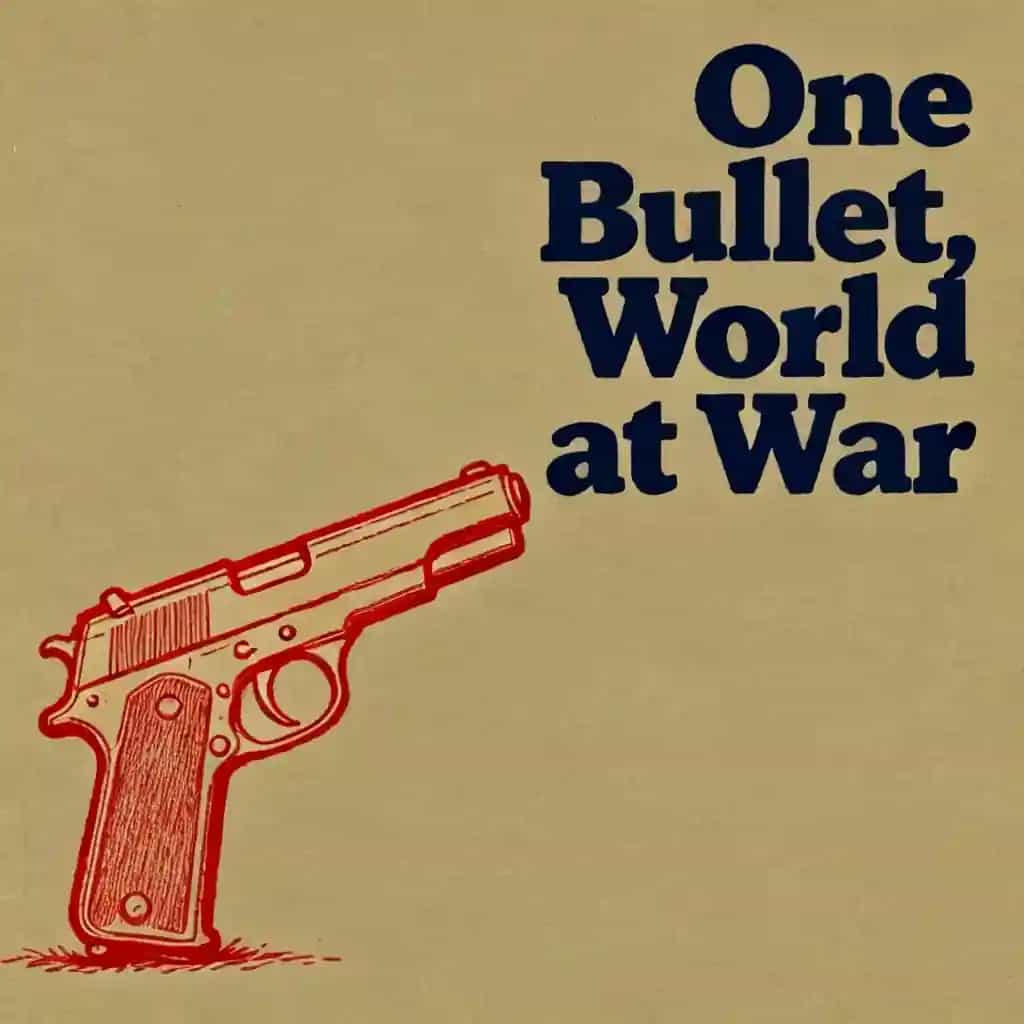
The fatal mistake came when the drivers, uninformed about a route change, turned into Franz Joseph Street. As the car slowed to correct course, Princip seized his opportunity. Drawing his revolver, he fired twice from point-blank range. One bullet pierced Sophie's abdomen, severing an artery; the other struck the archduke's neck, tearing his jugular vein. Both died within minutes.
The assassination quickly entered literary imagination, from Jaroslav Hasek's "The Good Soldier Svejk" to works by Karl Kraus and Joseph Roth. As Kraus noted, "what had remained silent in Franz Ferdinand's life became eloquent in his death."
Austrian officials paid close attention to Serbian reactions, noting a stark discrepancy between official condolences and widespread jubilation. While Belgrade officially declared eight days of mourning, Austrian observers reported streets and coffee-houses full of Serbs celebrating the Habsburg blow. The Serbian nationalist press further inflamed tensions with inflammatory articles blaming Austria for the murders and praising the assassins as "good, honourable youths."
Most damaging was Serbia's refusal to seriously investigate the conspiracy. When asked what Serbian police were doing to follow up leads, a foreign ministry official naively replied they had done nothing. Though Interior Minister Protic eventually ordered an investigation, Belgrade's police chief closed it after just one week, declaring the assassination had no connection whatsoever with Serbia.
The assassinations profoundly impacted Austria-Hungary's decision-making elite, but immediate military action proved impossible. Hungarian Premier Tisza insisted on diplomatic options first, while most others favored demands harsh enough to ensure Serbian rejection. Foreign Minister Berchtold orchestrated a diplomatic mission to Berlin, sending his hawkish chef de cabinet Count Alek Hoyos with a personal letter from Franz Joseph to Kaiser Wilhelm II and a revised policy memorandum.
Wilhelm II received Ambassador Szogyeny at the Neues Palais in Potsdam, quickly reading through both documents. Though initially cautious about "serious European complications," the Kaiser ultimately assured Szogyeny that Austria-Hungary could count on Germany's "full support," adding that action against Serbia "should not be delayed" as Russia was unprepared for war.
On July 6, Bethmann Hollweg formally delivered what became known as the "blank cheque"-Germany's unconditional support for whatever action Austria deemed necessary against Serbia. The German leadership genuinely believed Russia would not intervene, partly because they assumed the Tsar would not side "with regicides" and because Russia's military preparations remained incomplete.
The Austrian ultimatum, delivered on July 23, gave Serbia just 48 hours to respond to ten stringent demands, including suppressing anti-Austrian publications, dismissing implicated officials, allowing Austrian officials to participate in investigations on Serbian soil, and arresting Major Vojislav Tankosic and Milan Ciganovic.
The Serbian government, upon receiving the ultimatum, immediately sought guidance from Russia. Despite the harsh terms, Serbia crafted a conciliatory response, accepting most demands while carefully preserving its sovereignty. They rejected only points requiring Austrian officials to operate on Serbian soil and participate in judicial proceedings-conditions no independent state could accept.
When Pasic delivered the response five minutes before the deadline, Baron Giesl immediately recognized its inadequacy. By 6:30 p.m., Giesl, his wife, and the legation staff were on the train out of Belgrade, crossing the Austrian border ten minutes later.
On July 28, 1914, Emperor Franz Joseph signed the declaration of war on Serbia. That night, Serbian troops blew up the bridge over the Save River between Semlin and Belgrade, and Austrian gunboats opened fire. The news filled Sigmund Freud with unexpected patriotic elation: "For the first time in thirty years, I feel myself to be an Austrian."
Capitolo 9
The Final Days: From Local Conflict to World War
When news of the Austrian ultimatum reached St. Petersburg on July 24, it triggered immediate alarm. Foreign Minister Sazonov declared it "meant war" and summoned an emergency council. Ambassador Paleologue assured Sazonov of France's "complete readiness to fulfill her obligations as an ally," while Britain's Buchanan urged restraint.
By July 25, Russia's military preparations had accelerated dramatically. Despite public denials, the Council of Ministers approved the "Period Preparatory to War," a significant pre-mobilization measure that included recalling officers from leave, securing border fortresses, and preparing horses and equipment.
On July 30, Russia moved from partial to general mobilization, a decision that effectively made war inevitable. This dramatic escalation followed intense internal debates among Russian leadership. The Russian high command insisted that partial mobilization against Austria alone was technically impossible under their mobilization plans. When Tsar Nicholas II initially hesitated, War Minister Sukhomlinov and Chief of General Staff Yanushkevich convinced him that Germany was already mobilizing (which was false).
Throughout mid-July 1914, German decision-makers remained committed to their policy of "localization," initially believing the crisis would resolve quickly. To avoid triggering escalation, Chancellor Bethmann encouraged the Kaiser to proceed with his scheduled Baltic cruise and senior military commanders to remain on holiday.
The Germans repeatedly urged Austria to act swiftly to produce a fait accompli, but Vienna's cumbersome bureaucracy moved slowly, undermining the localization strategy. Despite this, Berlin persisted with the approach, believing Russia's incomplete armaments program would prevent intervention.
When Kaiser Wilhelm finally read Serbia's conciliatory response on July 28, he unexpectedly declared "This does away with any need for war" and attempted to halt the momentum toward conflict. However, his intervention came too late-Bethmann had already committed to the localization strategy and didn't fully convey the Kaiser's changed position to Vienna, which declared war on Serbia that same day.
As Grey proposed his four-power mediation, French President Raymond Poincare and Prime Minister Rene Viviani were crossing the Gulf of Finland on the France. Throughout their journey back to Paris, Poincare grew increasingly convinced war was unavoidable, though Germany had shown no military counter-measures. He was pleased to find ministers in a resolute mood and military preparations well underway-soldiers recalled from leave, prefects on alert, and supplies secured. When asked if a political settlement remained possible, Poincare replied: "No, there can be no settlement. There can be no arrangement."
For French Ambassador Paul Cambon in London, these were the worst days of his life. France was being called to support Russia's intervention in a Balkan conflict-an obligation about which he himself had expressed earlier concerns. When Grey informed him on August 1st that cabinet opposed intervention, a desperate Cambon reminded him that France had left its northern coast defenseless based on British naval assurances. Staggering from Grey's office "white as a sheet and close to tears," he muttered to Nicolson, "They are going to drop us. They are going to drop us."
Grey's masterful speech to Parliament on August 3rd cemented the pro-war consensus by emphasizing Britain's moral obligation to France, whose fleet concentration in the Mediterranean had left its northern coasts undefended based on trust in British friendship. The speech satisfied nearly the entire House, with only three or four exceptions, and the nation united behind the decision with remarkable speed.
Germany's military planning created a fatal diplomatic trap. Since 1905, German strategy required striking through neutral Luxembourg and Belgium to bypass French fortifications, enabling a swift victory in the west before turning east against Russia. The General Staff viewed this as military necessity, developing no alternatives that might have given civilian leaders diplomatic options.
As diplomacy gave way to military action, emotional reactions varied dramatically among leaders. German Ambassador Pourtales burst into tears when leaving Sazonov, stammering "So this is the result of my mission!" British Prime Minister Asquith was found "quite broken" with tears coursing down his cheeks. Meanwhile, military leaders celebrated-Bavarian officers in Berlin exchanged handshakes with "beaming faces," French officers showed "unconcealed joy" at the strategic opportunity, and Churchill wrote to his wife that he felt "interested, geared-up and happy."
The mobilization experience differed across Europe. In St. Petersburg, Reverend Mansell Merry watched reservists trudging in "sullen silence" while weeping women struggled to keep pace with their loved ones. In Paris, the Boulevard du Palais filled with marching men in the small hours, moving northward without music or cheering, just the scraping of boots and crunching of wheels on cobbles.
The complex chain of events that sparked the conflagration quickly vanished from view, with an American diplomat noting on August 2nd: "Nobody seems to remember that a few days ago Serbia was playing a star role in this affair."
Capitolo 10
The Tragedy of the Sleepwalkers
The 1914 crisis wasn't a simple "whodunit" mystery with a smoking gun, but rather a tragedy where every major power held some responsibility. The crisis emerged from a shared political culture but was genuinely interactive and multipolar-making it the most complex event of modern times.
None of the prizes politicians sought justified the cataclysm that followed. While some statesmen recognized the potential for a devastating conflict-German generals warning of "tedious and bloody crawling forward," Asquith writing of approaching "Armageddon," and French and Russian generals speaking of "war of extermination"-they failed to truly internalize these risks.
The protagonists were "sleepwalkers"-watchful but unseeing, haunted by dreams yet blind to the horror they would unleash. This blindness was evident in the glib way Europeans discussed new weapons technology, simultaneously celebrating both the "horrific force" of their arms and their "marvellous" medical organizations to treat the resulting wounds.
What makes Clark's analysis particularly valuable is his rejection of simplistic blame narratives. Rather than focusing on German guilt or inevitable structural forces, he illuminates the complex interactions between sovereign decision-makers, military planners, diplomats, and public opinion across all European powers. The July Crisis emerges not as a conspiracy or accident, but as a tragedy of miscalculation where leaders made decisions based on imperfect information, constrained by domestic pressures and alliance obligations.
The parallels to our contemporary world are striking. Today's international system features rising powers challenging established orders, complex alliance structures, nationalism resurgent in many regions, and leaders who sometimes prioritize domestic political considerations over international stability. Clark's "The Sleepwalkers" serves as both historical analysis and warning-reminding us that even sophisticated, interconnected societies can stumble into conflicts that no one truly wanted and that transform the world in ways no one could have predicted.