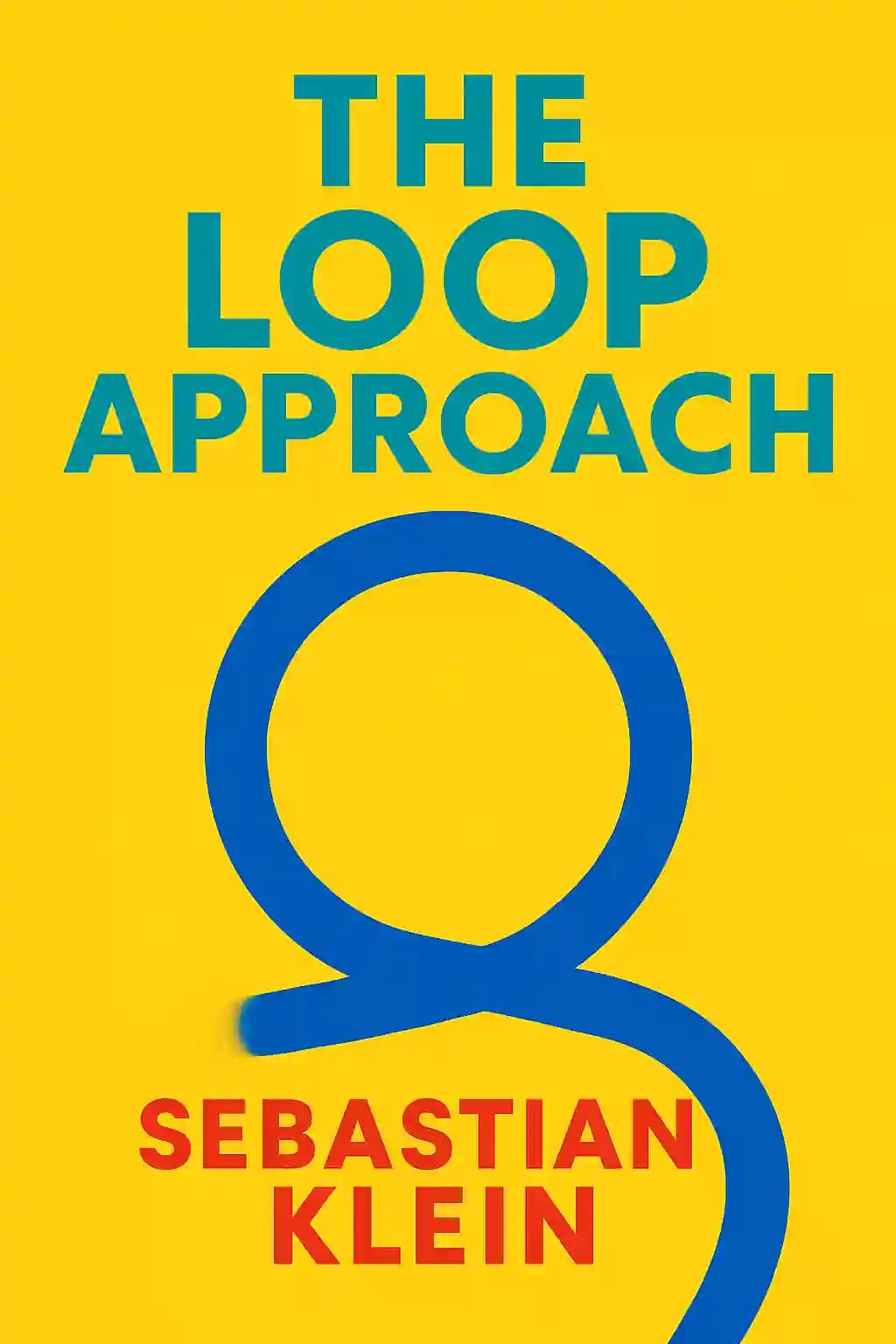
Forget rigid hierarchies. "The Loop Approach" revolutionizes organizations from within, offering practical tools that transformed giants like Audi and Deutsche Bahn. What if the secret to thriving amid rapid change isn't top-down control, but an adaptive system built on clarity, results, and evolution?
Sebastian Klein and Ben Hughes, authors of The Loop Approach: How to Transform Your Organization from the Inside Out, are recognized experts in organizational agility and innovation. Klein, co-founder and Editor-in-Chief of Blinkist, brings experience from his tenure at Boston Consulting Group and entrepreneurial ventures. Hughes, former Head of Content at Blinkist, combines management consulting expertise with psychology-driven strategies.
Their book, rooted in business transformation and adaptive leadership, offers a systematic toolkit for fostering iterative change, self-organization, and systemic resilience in organizations.
Klein co-authored the pioneering Blinkracy (2015), detailing Blinkist’s radical shift to manager-free operations, while Hughes frequently speaks on hybrid leadership and regenerative transformation. Klein’s TEDx Talk on organizational design and Hughes’s focus on behavioral change underscore their authority in modern workplace dynamics.
The Loop Approach has been widely adopted by startups and enterprises for its actionable frameworks, with case studies like SIEVERS-GROUP highlighting its scalable impact. Translated into multiple languages, the book merges academic rigor with real-world application, cementing its status as a go-to guide for sustainable organizational evolution.
The Loop Approach provides a systematic method for transforming rigid organizations into agile, adaptive entities. It combines tools like iterative development (IDM), 360-degree feedback, and role adaptation to help companies like Audi and Deutsche Bahn stay competitive. The book emphasizes continuous learning, decentralized decision-making, and practical checklists for implementation.
This book targets corporate leaders, change managers, and agile coaches in large organizations seeking to dismantle bureaucratic hierarchies. It’s particularly relevant for industries like tech, manufacturing, or consulting where rapid market shifts demand flexibility.
Yes—it offers actionable strategies like inbox prioritization frameworks and feedback loops, backed by real-world success stories. While some critics note it consolidates existing methods, its structured approach makes it valuable for teams aiming to balance stability with innovation.
Unlike top-down models, it rejects hierarchical pyramids (compared to the Roman Empire’s structure in the book) in favor of decentralized loops. It integrates agile principles with corporate scalability, contrasting with rigid frameworks like PDCA cycles.
Audi, Deutsche Bahn, and Telekom have implemented its methods to streamline operations. Case studies highlight reduced email overload and faster decision-making through classified actionable items (e.g., “delegate if >60 minutes”).
Yes. Its emphasis on autonomy and digital feedback tools (e.g., Asana, Google Docs) aligns with remote workflows. The authors advocate “location-fluid” workstyles to boost creativity.
Some reviewers argue it repackages known agile tactics rather than introducing novel ideas. Others note its primary examples are European corporates, requiring adaptation for startups or non-profits.
Klein’s psychology training, Blinkist startup experience, and consultancy work at TheDive inform the book’s focus on learning efficiency and employee empowerment.
It critiques traditional hierarchies (CEO as “emperor”) and advocates fluid, loop-based structures where feedback drives decisions—a contrast to rigid, top-down mandates.
As AI and market volatility accelerate, its iterative methods help organizations pivot quickly. The rise of hybrid work further validates its tools for distributed teams.
While Atomic Habits focuses on individual behavior, The Loop Approach scales these principles to organizations, linking small iterative changes (e.g., daily feedback) to systemic transformation.
Senti il libro attraverso la voce dell'autore
Trasforma la conoscenza in spunti coinvolgenti e ricchi di esempi
Cattura le idee chiave in un lampo per un apprendimento veloce
Goditi il libro in modo divertente e coinvolgente
YOU are the transformation.
Shipped is better than perfect.
Ignore the signs and perish, or boldly transform.
Purpose grants basic stability beyond what short-term goals can provide.
Autonomy and self-organization are hard-coded into the DNA of future organizations.
Scomponi le idee chiave di The Loop Approach in punti facili da capire per comprendere come i team innovativi creano, collaborano e crescono.
Distilla The Loop Approach in rapidi promemoria che evidenziano i principi chiave di franchezza, lavoro di squadra e resilienza creativa.

Vivi The Loop Approach attraverso narrazioni vivide che trasformano le lezioni di innovazione in momenti che ricorderai e applicherai.
Chiedi qualsiasi cosa, scegli la voce e co-crea spunti che risuonino davvero con te.

Creato da alumni della Columbia University a San Francisco
"Instead of endless scrolling, I just hit play on BeFreed. It saves me so much time."
"I never knew where to start with nonfiction—BeFreed’s book lists turned into podcasts gave me a clear path."
"Perfect balance between learning and entertainment. Finished ‘Thinking, Fast and Slow’ on my commute this week."
"Crazy how much I learned while walking the dog. BeFreed = small habits → big gains."
"Reading used to feel like a chore. Now it’s just part of my lifestyle."
"Feels effortless compared to reading. I’ve finished 6 books this month already."
"BeFreed turned my guilty doomscrolling into something that feels productive and inspiring."
"BeFreed turned my commute into learning time. 20-min podcasts are perfect for finishing books I never had time for."
"BeFreed replaced my podcast queue. Imagine Spotify for books — that’s it. 🙌"
"It is great for me to learn something from the book without reading it."
"The themed book list podcasts help me connect ideas across authors—like a guided audio journey."
"Makes me feel smarter every time before going to work"
Creato da alumni della Columbia University a San Francisco

Ottieni il riassunto di The Loop Approach in formato PDF o EPUB gratuito. Stampalo o leggilo offline quando vuoi.
In 2013, when Zappos CEO Tony Hsieh introduced Holacracy to eliminate hierarchy throughout his 1,500-person company, the business world watched intently. Five years later, the transformation remained incomplete, with significant employee resistance and turnover. Was this a failure? Not according to The Loop Approach creators. This apparent setback simply demonstrates that meaningful organizational change is complex, non-linear, and requires patience. We're witnessing the greatest organizational upheaval since the Industrial Revolution-rigid hierarchies giving way to flexible, network-like structures. This shift is happening because today's professionals demand meaning and autonomy, hierarchical pyramids respond too slowly in competitive markets, and our world desperately needs purpose-driven organizations to address humanity's greatest challenges. Think about how information flows in traditional companies: frontline employees notice market changes first, but information crawls up the chain of command before decisions trickle back down. By then, opportunities have vanished. This isn't just inefficient-it's existentially threatening in today's fast-paced environment. The pyramid thrived when business models could remain unchanged for decades, but that world no longer exists.