Capitolo 1
When Time Becomes Your Most Precious Currency
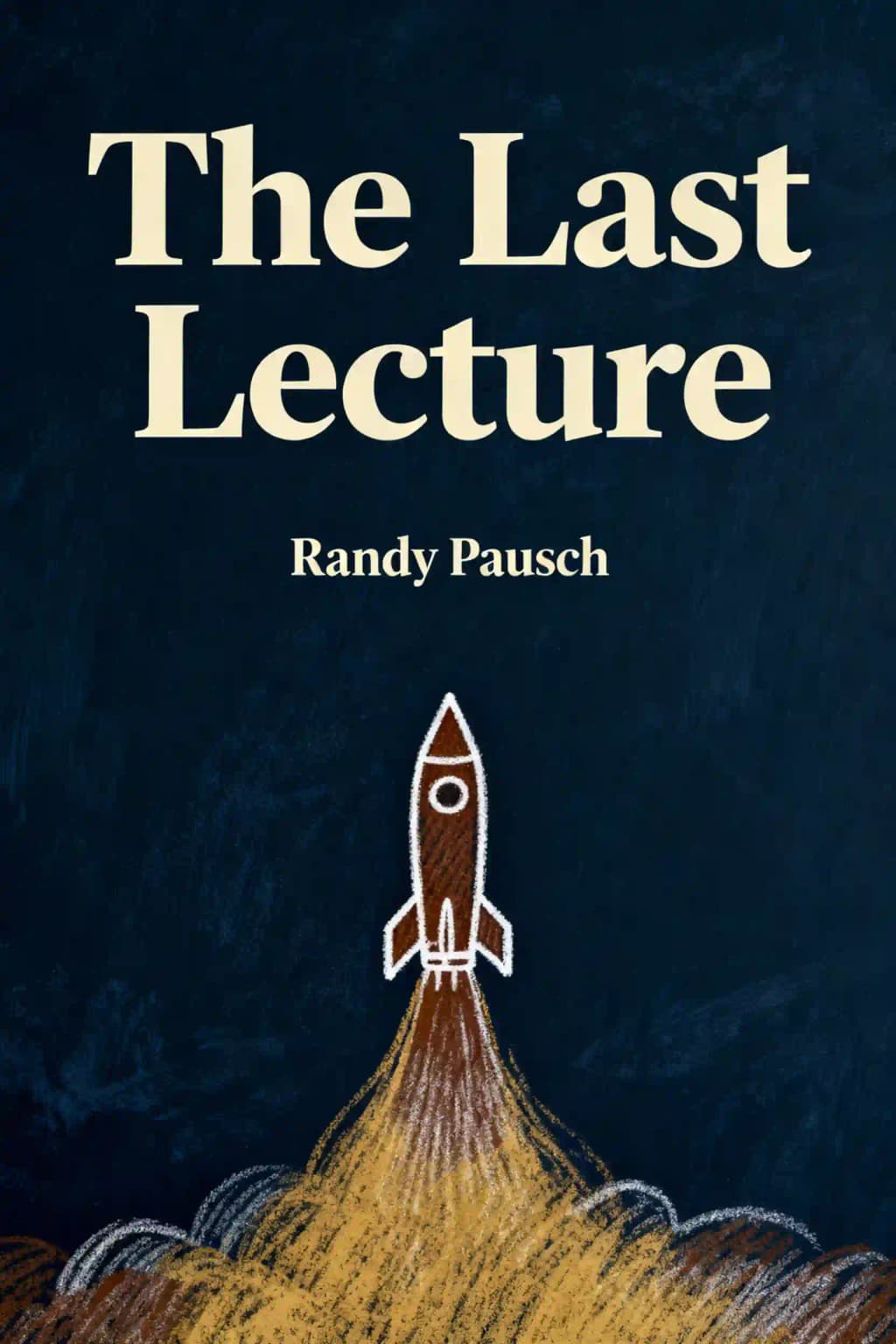
Randy Pausch's "The Last Lecture" arrived at a pivotal cultural moment when we were just beginning to understand how digital legacies could extend beyond our physical lives. This 2008 memoir, based on Pausch's actual "last lecture" at Carnegie Mellon University after receiving a terminal pancreatic cancer diagnosis, became an instant phenomenon-garnering over 18 million YouTube views and landing on The New York Times bestseller list for 112 weeks. Celebrities from Oprah Winfrey to Bill Gates praised its wisdom, with Gates noting it changed how he approached long-term planning. What makes this book extraordinary isn't just Pausch's situation, but his remarkable perspective: facing death with humor, wisdom, and an engineer's practical approach to leaving behind something meaningful for his young children who would grow up without him.
Capitolo 2
Facing the Elephant in the Room
"I have an engineering problem," Randy begins, framing his terminal diagnosis not as a tragedy but as a challenge to solve. With three young children and a wife he adores, his dilemma is how to teach his children what he would have taught them over twenty years when they're too young for those conversations now. This engineering mindset-approaching the unthinkable with pragmatism-becomes his north star.
When Carnegie Mellon invited Randy to give a "last lecture" (part of a series where professors share wisdom as if it were their final chance), the timing was brutally literal. His wife Jai initially resisted, seeing it as time stolen from their precious remaining months together. But she ultimately recognized its potential as a legacy for their children.
The lecture hall was packed with 400 people when Randy took the stage wearing his Disney Imagineer polo shirt-a nod to one of his fulfilled childhood dreams. He addressed his cancer immediately: "When there's an elephant in the room, introduce it." Showing CT scans with arrows pointing to ten liver tumors, he explained doctors had given him three to six months of good health-a month ago.
"We cannot change the cards we are dealt," he told the audience, "just how we play the hand."
To break the tension and demonstrate his current strength, he dropped to the floor and did push-ups. The audience's laughter and applause released their anxiety. It wasn't just some dying man on stage. It was just Randy-ready to share the lessons of his life.
What makes this moment so powerful isn't just Randy's courage, but his refusal to let cancer define him. By acknowledging his diagnosis directly and then moving beyond it, he creates space for something more meaningful: a conversation about living well, not just dying gracefully.
Capitolo 3
Childhood Dreams as Life's Compass
Randy structured his lecture around his childhood dreams-not as nostalgic reminiscence, but as a framework for understanding how he'd lived a meaningful life. He believed our earliest aspirations reveal something essential about who we are and what truly matters to us.
His parents created the foundation that made pursuing these dreams possible. Their dinner table required a dictionary within six steps-they were "the family that needed reference books to get through meals." They taught him intellectual curiosity and frugality, rarely spending money on restaurants or movies: "Watch TV," they'd say, "it's free. Or better yet, go to the library."
This upbringing fostered creativity. When teenage Randy asked permission to paint his bedroom walls with his thoughts and dreams, his father immediately encouraged this self-expression while his mother reluctantly agreed. The resulting room featured a quadratic formula, a silver elevator, a rocket ship, chess pieces, and even "Hope" inside Pandora's box (which his friend changed to "Bob Hope"). Though initially skeptical, his mother never repainted the room, and it eventually became the highlight of her house tours.
Randy's childhood dreams ranged from experiencing zero gravity to becoming a Disney Imagineer. The zero-gravity dream was fulfilled when his university team's virtual reality project was selected for NASA's "Vomit Comet." When told faculty advisors couldn't fly with students, Randy found a loophole: NASA allowed hometown journalists to accompany students. He called NASA, requesting their fax number to send his resignation as faculty advisor and his application as a journalist. Though transparent, his promise to generate publicity for NASA won him a spot.
His Disney dream began at age eight during a family visit to Disneyland. Standing in line, all he could think was, "I can't wait to make stuff like this!" Two decades later, despite rejection letters saying Disney had no positions requiring his "particular qualifications," he persisted. When he learned Disney was working on a secret virtual reality Aladdin attraction, he called repeatedly until reaching Jon Snoddy, the Imagineer running the project. After extensive preparation and navigating university bureaucracy, he secured a sabbatical with Disney's team.
"On my first night in California," Randy recalls, "I drove to Imagineering headquarters with The Lion King soundtrack blasting, tears streaming down my face. The eight-year-old inside me had finally arrived."
These stories illustrate Randy's core philosophy: "Brick walls aren't there to keep us out-they're there to show how badly we want something." His persistence wasn't just stubbornness; it was a deep commitment to honoring the dreams that defined him.
Capitolo 4
The Art of Enabling Others' Dreams
While achieving personal dreams brought Randy fulfillment, he found even greater joy in helping others achieve theirs. As a professor at Carnegie Mellon, he developed innovative approaches to education that transformed how students learned computer science and virtual reality.
His breakthrough came with "Building Virtual Worlds" (BVW), a course that brought together fifty undergraduates from diverse departments-actors, English majors, sculptors, engineers, mathematicians, and computer scientists-to collaborate on virtual reality projects. Their first assignments completely blew him away, exceeding what he thought possible in two weeks. When he called his mentor Andy van Dam for advice, Andy told him: "Go back into class tomorrow, look them in the eyes and say, 'Guys, that was pretty good, but I know you can do better.'" This challenge pushed them to even greater heights.
The class became so popular that presentation days moved to large auditoriums with over 400 attendees-students, roommates, friends, and parents. The university president said it felt like "an Ohio State pep rally, but for academics." The central lesson was clear: "In this course, you can't do it alone."
Randy expanded this collaborative approach by co-founding "The Entertainment Technology Center" (ETC), a master's program where artists and technologists worked together on amusement rides, computer games, and animatronics. Despite his different approach from co-founder Don Marinelli (whom Randy described as "right brain/left brain, drama guy/computer guy"), they created an environment of freedom and teamwork that companies eagerly supported.
Perhaps his most far-reaching contribution was developing Alice, Carnegie Mellon's free software teaching tool that uses 3D graphics and drag-and-drop techniques to make programming accessible and engaging. It employs what Randy called a "head fake"-students think they're making movies or games, but they're actually learning programming fundamentals. With over a million downloads already when the book was written, Alice had the potential to reach tens of millions of kids.
One of Randy's former students, Tommy Burnett, exemplifies how this approach to enabling dreams created ripple effects. Tommy joined Randy's research team with an unlikely childhood dream: to work on the next Star Wars film-even though none had been made since 1983 with no plans for more. Randy pushed him hard but also created a supportive environment. When Tommy eventually worked on all three of George Lucas's new Star Wars films, becoming a lead technical director, he credited Randy: "Getting to work with Randy and learn from him, that's some kind of luck right there. I wouldn't be here if not for Randy."
This moment was doubly meaningful to Randy-not just because Tommy credited him with helping enable his dreams, but because Tommy was now passing it on, enabling the dreams of Randy's current students. The cycle of mentorship and dream-enabling had come full circle.
Capitolo 5
Life Lessons from an Unlikely Teacher
Randy's approach to teaching extended far beyond technical skills. His lectures and interactions were filled with unconventional wisdom about how to navigate life's challenges:
On feedback: "When you're screwing up and nobody says anything anymore, that means they've given up on you." This insight came from his football coach, who rode him hard because he saw potential. Randy carried this lesson into his teaching, believing that honest criticism is an act of caring.
On brick walls: "Brick walls are there for a reason. They're not there to keep us out. They're there to give us a chance to show how badly we want something." When Randy was rejected by Carnegie Mellon's PhD program, his mentor made a call that got him a meeting. During that pivotal conversation, Randy mentioned winning a prestigious naval research fellowship. After careful consideration, he was accepted.
On time management: "Time must be explicitly managed, like money." Randy advised breaking tasks into small steps with to-do lists and constantly asking if you're spending time on the right things. He recommended developing a good filing system, rethinking telephone usage (always using speakerphone to keep hands free), and delegating tasks-even to his 18-month-old daughter.
On complaining: "Too many people go through life complaining about their problems. If you took one-tenth the energy you put into complaining and applied it to solving the problem, you'd be surprised by how well things can work out." He admired people like Jackie Robinson, who endured unimaginable racism but chose action over complaint.
On apologies: "A bad apology is worse than no apology." Randy taught that proper apologies have three parts: 1) What I did was wrong. 2) I feel badly that I hurt you. 3) How do I make this better?
On honesty: "If I could only give three words of advice, they would be 'tell the truth.' If I got three more words, I'd add: 'All the time.'" Randy believed honesty wasn't just morally right but efficient-in a culture where everyone tells the truth, you save time double-checking.
On entitlement: "You ought to be thrilled you got a job in the mailroom. And when you get there, be really great at sorting mail." Randy pushed back against the growing sense of entitlement among young people, believing no job should be beneath us.
On optimism: "I'm not in denial about my situation; I maintain a clear-eyed sense of the inevitable. I'm living like I'm dying, but also very much living like I'm still living." After his diagnosis, Randy bought a new convertible and got a vasectomy-actions that reflected both acceptance of his situation and hope for the future.
These lessons resonate because they come from someone facing the ultimate test. When Randy talks about choosing optimism or not wasting time on complaints, it's not theoretical-it's how he's choosing to spend his final months.
Capitolo 6
Love Stories: The Heart of a Life Well-Lived
Beneath Randy's academic achievements and childhood dreams runs a deeper current-the relationships that gave his life meaning. His marriage to Jai represents perhaps his greatest adventure and most formidable challenge.
Randy met Jai in 1998 when she hosted his lecture at UNC Chapel Hill. "From the moment I saw her," he writes, "I couldn't stop staring at her beauty, warmth and impishness." After flirting aggressively and changing his flight to spend more time with her, he began a long-distance relationship that faced its own brick wall when Jai suddenly told him: "I don't love you the way you want me to love you."
Heartbroken, Randy called his parents. His father wisely said she was probably scared, and if she truly loved him, love would win out. A few days later, Jai called: "I'm sitting here missing you... That means something, doesn't it?" She realized she was in love after all and moved to Pittsburgh.
Their wedding day exemplified their relationship-joyful but not without challenges. They departed their ceremony in a hot air balloon, with Jai beaming: "It's like a fairy tale ending to a Disney movie." Then reality intervened as the balloon crashed through tree branches, drifted over urban Pittsburgh, and eventually crash-landed in a field, narrowly missing a speeding train. "It was only dusk on our first day of marriage," Randy reflects, "but we'd made it so far."
This blend of romance and reality characterized their relationship. When Jai accidentally hit one of their cars with the other in their driveway, she spent an entire day orchestrating the perfect setting to break the news-soft music, his favorite meal, extraordinary sweetness. To her surprise, Randy barely reacted and decided they didn't need repairs. The cars still functioned-they'd just live with the dents. These dented cars became a statement in their marriage: Not everything needs to be fixed.
Cancer transformed their relationship in unexpected ways. "We still interact as if our marriage has decades to go," Randy writes, "discussing, getting frustrated, making up." Their counselor advised finding a "new normal," so instead of arguing about Randy's messiness, Jai would kick his clothes into a corner and move on. She kept a journal for venting frustrations without starting arguments.
During Randy's last lecture, he arranged to have Jai's birthday cake brought onstage and had 400 people sing to her. As she joined him onstage and they embraced, she whispered, "Please don't die." It was a raw moment that captured the heartbreak beneath their brave faces.
"We've had tough times," Randy acknowledges, "crying together in bed, falling asleep, waking to cry more." But they kept going because someone had to give the kids breakfast in the morning. Their love story wasn't perfect, but it was real-a testament to choosing love even when life doesn't follow the fairy tale script.
Capitolo 7
Leaving a Legacy: Messages for the Next Generation
As Randy's condition worsened, his focus shifted to what he could leave behind for his children-Dylan (6), Logan (3), and Chloe (18 months). The pain of separation was almost unbearable: "What pains me most isn't what I'll miss, but what they'll lose. 'They won't...they won't...they won't'-that's what chews me up inside."
Since his children's memories of him might be fuzzy, Randy created unforgettable experiences with them. He took Dylan swimming with dolphins and planned to take Logan to Disney World to meet Mickey Mouse. For Chloe, he wanted her to grow up knowing he was the first man to fall in love with her. Though she was too young to remember him, that father-daughter connection was real-"sometimes she looks at me and I just become a puddle."
Randy spoke with people who lost parents young to understand what helped them. They found comfort in knowing how much their parents loved them and reasons to be proud of their parents' accomplishments. They also found reassurance knowing their parents died with great memories of them.
So Randy built separate lists of memories for each child, made videos, and wrote letters. His book and last lecture video became pieces of himself he could leave behind. As for dreams for his children, Randy had a direct answer: "I don't want specific dreams for them. I've seen too many unhappy college freshmen pursuing majors wrong for them because of parental expectations. A parent's job is to encourage kids to develop joy for life and passion to follow their own dreams."
His message was clear: "Kids, don't try to figure out what I wanted you to become. I want you to become what you want to become."
As Randy concluded his lecture, he revealed the "head fake"-the hidden lesson beneath his talk: "Today's talk was about achieving childhood dreams. But did you figure out the head fake? It's not about how to achieve your dreams. It's about how to lead your life. If you lead your life the right way, the karma will take care of itself. The dreams will come to you."
Then came the second head fake: "The talk wasn't just for those in the room. It was for my kids." His final slide showed him with his children-holding Logan and Chloe in his arms, with Dylan sitting happily on his shoulders.
Capitolo 8
The Gift of Time: Finding Meaning in Mortality
Unlike many cancer patients, Randy wasn't grateful for his disease, though he was grateful for the advance notice of his death. It allowed him to prepare his family and give his last lecture-to "leave the field under my own power."
This perspective-finding opportunity even in tragedy-characterized Randy's approach to his final months. He continued teaching, consulting, and most importantly, creating memories with his family. He maintained what his surgeon called "the healthy balance between optimism and realism," embracing cancer as another life experience rather than surrendering to it.
Randy's story resonates because it addresses our deepest fear-mortality-with uncommon grace and practicality. He doesn't deny the pain or injustice of dying young but refuses to be defined by it. Instead, he shows us how to use the time we have, whether it's decades or months, with intention and joy.
His legacy extends far beyond his technological innovations or even his viral last lecture. Randy Pausch showed us how to face the unthinkable with humor, how to transform limitation into opportunity, and how to say goodbye with love rather than bitterness. In doing so, he provided a template for living well that transcends his own tragically shortened life.
As Randy puts it in one of the book's most powerful passages: "We cannot change the cards we are dealt, just how we play the hand." His life-and his approach to leaving it-demonstrates that even with the worst possible hand, we can play with dignity, purpose, and even joy.
Capitolo 9
The Ripple Effect of a Life Well-Lived
After Randy's last lecture spread on the Internet, he heard from countless people-childhood neighbors, long-ago acquaintances, former students, and strangers touched by his story. One coworker recalled his advice to pay attention to department chairs' suggestions. A former student created a personal-development website inspired by his philosophy. Even an unrequited high school crush gently reminded him why she found him "too nerdy" back then.
Thousands of strangers shared advice on coping with death and dying. A woman who lost her husband to pancreatic cancer emphasized the importance of counseling. Another widow assured him Jai would find strength through their children, who would be her best reason to wake up and smile each morning.
Public figures offered meaningful guidance too. Diane Sawyer advised Randy to tell his kids the specific, idiosyncratic ways he related to them-like "I love the way you tilted back your head when you laughed." These connections reminded Randy that even as his physical presence was fading, the impact of his life was expanding.
This ripple effect continues today, years after Randy's death in 2008. His lecture has been viewed millions of times, his book translated into dozens of languages, and his approach to computer science education through Alice continues to introduce programming to new generations of students.
Randy understood something profound about legacy-it's not just what we leave behind in material form, but how we change the people whose lives we touch. By sharing his journey so openly, he created a template for facing mortality with grace that continues to inspire people facing their own brick walls, whether terminal illness or other seemingly insurmountable challenges.
In his final days, Randy reflected: "I finally understood what artists meant when they talked about things inside them that 'needed to come out.' I didn't give the lecture just because I wanted to-I gave it because I had to." This compulsion to share what he had learned-to transform personal experience into universal wisdom-is perhaps his greatest gift to us all.
Capitolo 10
The Last Word: Dreams as Life's Navigation System
Randy's childhood dreams served as his life's navigation system-guiding him through academia, marriage, parenthood, and ultimately, his final days. These weren't just youthful fantasies but expressions of his essential self-what brought him joy, what challenged him, and what gave his life meaning. From wanting to experience zero gravity to creating virtual worlds, each dream reflected a deeper aspect of his character: curiosity, creativity, and a desire to push boundaries.
His journey through these dreams was methodical yet passionate. He approached each one with the mindset of an engineer and the heart of a dreamer. When he wanted to be a Disney Imagineer, he didn't just wish for it-he studied computer science, developed relevant skills, and eventually contributed to Disney's Virtual Reality Studio. Even his "failed" dreams proved valuable; his childhood desire to play in the NFL taught him about dedication, teamwork, and the importance of having coaches and mentors in life.
His approach invites us to reconsider our own childhood dreams. Not as naive wishes to be discarded, but as clues to what might bring us fulfillment. Randy demonstrated that dreams aren't about the specific achievement but about the qualities and values they represent. When he couldn't become an astronaut, he found another way to experience weightlessness through NASA's "Vomit Comet" program. This flexibility in pursuing dreams while maintaining their essence became a cornerstone of his philosophy.
Perhaps the most powerful aspect of Randy's story is how it reframes success. In a culture obsessed with achievement and longevity, Randy shows that a life cut short can still be complete. His measure wasn't years lived but dreams pursued, relationships nurtured, and wisdom shared. He transformed his terminal diagnosis into an opportunity to leave a lasting legacy, showing that true success lies in how we impact others rather than in personal achievements alone.
As he concluded in his lecture: "If you lead your life the right way, the karma will take care of itself. The dreams will come to you." This isn't magical thinking but a profound truth about authenticity-when we live aligned with our deepest values, opportunities naturally emerge that resonate with who we truly are. He demonstrated this through his own life, where seemingly unrelated pursuits often connected in unexpected ways, creating opportunities he couldn't have planned for.
Randy Pausch died on July 25, 2008, but his approach to life continues to inspire millions. In facing death with such openness, he taught us how to live-with purpose, humor, and an unwavering commitment to what matters most. His legacy lives on not just in his famous lecture, but in the countless lives he touched and the example he set of living authentically and purposefully, regardless of circumstances. His story reminds us that our dreams are not just endpoints but compasses that guide us toward our truest selves.